Heads up: some links on this page earn us a commission at no extra cost to you. It does not change what we recommend or the order. How we are funded.
The short answer
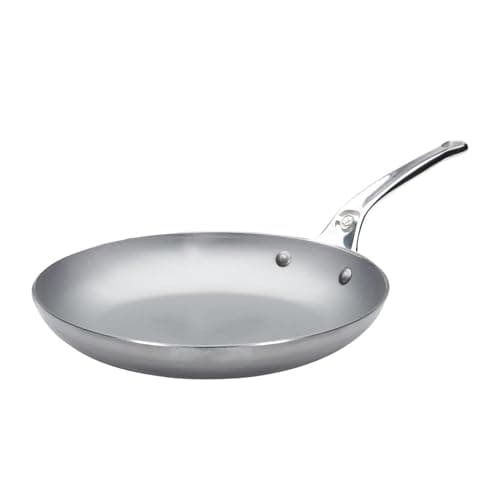
Always works: cast iron, enameled cast iron, carbon steel, and any clad stainless with a magnetic stainless exterior.
Never works: bare aluminum, copper, glass, and most coated aluminum pans without a bonded magnetic base.
Sometimes works: stainless that does not specify a magnetic exterior. 18/10 alone is not magnetic.
The test: hold a fridge magnet against the base. Firm grip means it works. Sliding off means it does not.
Quick picks
The whole answer, on one screen. Tap a row to jump to the full write-up. Every pick below carries a stated trade-off further down — including the one at the top.
#
Product
Best for
Price
1
Tramontina Signature Tri-Ply Clad 12-Piece Set
Magnetic stainless exterior over an aluminum core, so it works on induction without paying an induction premium.
Lodge Seasoned Cast Iron Skillet, 10.25 in (L8SK3)
Bare iron is ferrous all the way through, so induction couples to it perfectly - and induction's fast, even base heating fixes cast iron's biggest weakness.
Prices last checked October 19, 2026. Prices move constantly — the number on Amazon when you click is the real one.
How induction works, in one paragraph
An induction hob is an electromagnet. It generates a rapidly alternating magnetic field, and when a ferrous pan sits in that field the field induces electrical currents in the pan itself. Those currents meet the metal's resistance and the pan heats up. The hob surface stays comparatively cool; the heat is generated inside the pan, not transferred to it.
Two consequences follow, and they are the whole story. First, the pan must be ferrous — a magnetic field cannot induce useful currents in aluminum or copper. Second, only the part of the pan actually sitting on the element gets heated directly, which is why induction is unusually punishing about pans with warped or undersized bases.
The magnet test, which settles it
Take a fridge magnet to the shop, or to your own cupboard. Hold it against the flat base of the pan.
Grips firmly, needs a tug to remove: the pan will work well on induction.
Sticks weakly, falls off if you tilt it: it may work, poorly, or may not couple at all. Do not buy it for induction.
No attraction at all: it will not work. No adapter disc makes this genuinely fine — those work, badly, by heating a steel plate and conducting heat upward, which throws away most of induction's advantages.
One trap: "18/10 stainless steel" on a listing does not mean induction compatible. 18/10 is austenitic and essentially non-magnetic. An induction-ready clad pan specifies a magnetic stainless exterior — usually a 400-series grade — bonded as the outer layer, with the 18/10 on the inside where it touches food. If a stainless listing does not mention the magnetic exterior, assume it is not induction compatible until you have held a magnet to it.
Free, instant, and more reliable than any listing. Do this before you buy.
Material by material
Material
Works on induction?
How well
Cast iron
Yes, always
Excellently. Induction fixes cast iron's uneven-base problem
Enameled cast iron
Yes
The enamel is a surface; the iron under it is ferrous
Carbon steel
Yes, always
Very well, and it responds faster than cast iron
Clad stainless with magnetic exterior
Yes
Very well, and it is the most versatile option
18/10 stainless, single-layer
Usually no
Austenitic stainless is not magnetic
Bare aluminum
No
Not ferrous. No field coupling at all
Coated aluminum nonstick
Only with a bonded magnetic base
Check the base for a visible steel plate, or test it
Copper
No
Not ferrous, unless it has a bonded steel base
Glass and ceramic bakeware
No
For the oven, not the hob
Compiled from manufacturer specifications and the physical requirement that induction needs a ferrous base.
Flatness matters more here than on any other cooktop
On gas, a slightly warped pan still gets heat from flames wrapping around it. On induction, heat is only generated where the pan is in the field, so a base that bows away from the glass gets a cold ring. A warped pan on induction is not just less efficient; it can trip some hobs' pan-detection entirely.
This is a specific argument for thicker pans on induction. A 3 mm carbon steel pan holds its shape where a 1.5 mm one warps; a clad set with a proper bonded base stays flat where a thin stamped pan does not. It is also an argument against heating any pan empty on high, which is the fastest way to warp one.
Pan diameter versus element diameter
Most induction elements only heat the area directly above the coil, and many hobs will not switch on at all if the pan base is smaller than a minimum diameter — often around 4.5 inches. A pan much larger than the element has an unheated rim, which on stainless is annoying and on cast iron is worse, because iron spreads heat so poorly that the cold rim stays cold.
Match pan base diameter to element diameter where you can. If your hob has one large element and three small ones, buy your big skillet for the large element and accept that it will not work well on the others.
What induction is genuinely better at
It is worth saying, because most induction coverage is a list of restrictions. Induction puts more of its energy into the pan than gas does, comes to a boil noticeably faster, holds a low simmer more precisely than gas ever manages, and does not heat the kitchen. On a hob that responds instantly, a cast iron pan becomes far more usable than it is over a small gas burner.
The restriction is real but narrow: buy magnetic pans, keep them flat, match the element. Everything on this site's stainless, cast iron and carbon steel hubs works on induction. Only the coated aluminum pans need checking.
Every pick, in full
Each write-up below gives the published specs, what the pan is genuinely good at, what it costs you, and who should skip it. The trade-off line is there on the top pick too — a recommendation with no downside is an advertisement.
Top pick · Best induction setSpecs read September 3, 2026
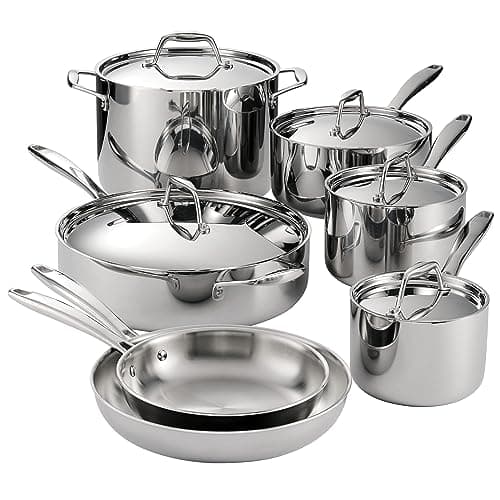
Tramontina Signature Tri-Ply Clad 12-Piece Set
Magnetic stainless exterior over an aluminum core, so it works on induction without paying an induction premium.
Best for: A first kitchen that should not need replacing
Published specifications for the Tramontina Signature Tri-Ply Clad 12-Piece Set
Construction
Tri-ply: 18/10 stainless, aluminum core, magnetic stainless exterior
Pieces
8 in and 10 in fry pans; 1.5, 2 and 3 qt covered saucepans; 5 qt covered deep saute; 8 qt covered stockpot
Oven maximum
500F on the 80116-249DS listing; other SKUs in the line are listed at 350F
Induction
Yes - magnetic stainless exterior
Dishwasher
Listed dishwasher safe
Handles
Precision cast, riveted
Certification
NSF-certified on the 80116-249DS line
Country of origin
Not asserted - retail listings disagree across SKUs (Brazil and China both appear)
Good
Fully clad, not disc-bottom: the aluminum runs up the sidewalls, so sauces do not scorch in a ring at the base
NSF certification on the flagship SKU is a real, checkable third-party mark rather than a marketing badge
Induction-ready without paying an induction premium
Not good
Retail listings disagree on the oven maximum across SKUs in the same line, which is a documentation problem, not a cooking one
Handles run hot on gas
The 12-piece count includes lids; the useful-item count is seven
The trade-off. Handles are the weak point. They are riveted and sturdy, but they get hot on a gas ring in a way the more expensive clad brands' do not.
Skip this if. You want a set you can leave in the oven above 500F, or you cook mostly eggs and pancakes and would rather spend the money on one good nonstick pan.
#2 · Best induction skilletSpecs read September 3, 2026
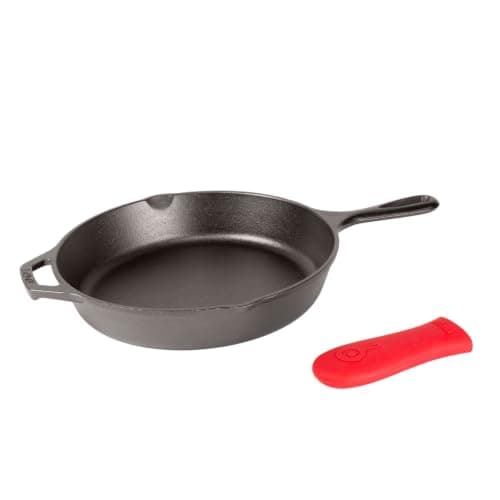
Lodge Seasoned Cast Iron Skillet, 10.25 in (L8SK3)
Bare iron is ferrous all the way through, so induction couples to it perfectly - and induction's fast, even base heating fixes cast iron's biggest weakness.
Best for: Searing, cornbread, and anyone who wants one pan that cannot be worn out
Published specifications for the Lodge Seasoned Cast Iron Skillet, 10.25 in (L8SK3)
Diameter
10.25 in
Weight
5.66 lb
Oven maximum
550F
Induction
Yes - bare iron is ferrous
Seasoning
Pre-seasoned with soy-based vegetable oil, no synthetic chemicals
Warranty
Lifetime
Made in
USA
Care
Hand wash. Lodge's own instructions permit warm soapy water
Good
Effectively unbreakable and fully restorable - a rusted one can be stripped and re-seasoned
Holds heat better than anything else at the price, which is what a sear needs
Lodge publishes its seasoning method openly, so the maintenance is not a mystery
Not good
Heavy
Heats unevenly on a small burner: cast iron conducts at roughly 50 W/m-K, so it is slow to spread and slow to react
Bare iron is reactive; long tomato braises will taste of it
The trade-off. It weighs 5.66 lb empty. You will feel that every time you move it full, and it is the single most common reason a cast iron skillet ends up in a cupboard.
Skip this if. You have wrist or shoulder trouble, or you cook mostly acidic braises. Carbon steel does most of the same jobs at roughly half the weight.
Anything ferrous: cast iron, enameled cast iron, carbon steel, and clad stainless with a magnetic stainless exterior. Bare aluminum, copper and most single-layer 18/10 stainless do not work, because they are not magnetic.
›How do I test if a pan is induction compatible?
Hold a fridge magnet against the flat base. A firm grip that needs a tug to release means it will work. A weak hold or none at all means it will not couple properly with the field.
›Is 18/10 stainless steel induction compatible?
Not on its own. 18/10 is austenitic and essentially non-magnetic. Induction-ready clad pans bond a magnetic stainless outer layer, usually a 400-series grade, with 18/10 on the food side.
›Do induction adapter discs work?
They work badly. The disc heats and then conducts heat upward into the pan, which reintroduces the slow, uneven transfer that induction exists to avoid. If you need one regularly, replace the pan instead.
›Why does my induction hob not detect my pan?
Usually the base is smaller than the hob's minimum detection diameter, often around 4.5 inches, or the base is warped enough to sit off the glass. Both are more common with thin stamped pans.
Sources
Every figure on this page came from one of these. Follow them and check our arithmetic — that is the point.