Heads up: some links on this page earn us a commission at no extra cost to you. It does not change what we recommend or the order. How we are funded.
The short answer
Material
Best at
Worst at
Conduction
Clad stainless
Everything adequately; acid and sauces well
Release without fat
15-16 W/m-K, cored with aluminum at 237
Cast iron
Searing and holding heat
Weight, acid, responsiveness
~50 W/m-K
Carbon steel
Searing at half the weight
Rust, acid, needs seasoning
~45 W/m-K
PTFE nonstick
Eggs and delicate fish
Browning, heat, lifespan
Aluminum body, ~237 W/m-K
Ceramic nonstick
Eggs, without PTFE
Keeping its release
Aluminum body, ~237 W/m-K
Bare aluminum
Sheet pans, even browning
Acid, staining, induction
237 W/m-K
Almost everything follows from two numbers
Cookware writing is full of adjectives — responsive, forgiving, versatile — that are all downstream of measurable properties. Two of them do most of the work.
The first is thermal conductivity: how fast a material moves heat sideways. Copper is 401 W/m-K, aluminum 237, cast iron around 50, carbon steel around 45, and type 304 stainless 15 to 16. A material that conducts badly develops a hot spot exactly where the flame is. A material that conducts well spreads the heat out across the whole base.
The second is mass. Heat is energy, and a heavy pan stores more of it. Two pans at the same temperature behave completely differently when you drop cold food in: the heavy one barely changes temperature, the light one plummets. That is why a 5.66 lb cast iron skillet sears better than a 3 lb clad pan even though the clad pan conducts better.
Every recommendation on this site is one of those two facts wearing different clothes. Conduction gives you evenness and responsiveness. Mass gives you searing power and stability. You cannot have both maximized in the same pan, which is why a kitchen has more than one.
Material
Conduction (W/m-K)
Typical mass
What the combination gives you
Copper
401
Moderate
The fastest response available. Reactive, so it must be lined. Expensive
Aluminum
237
Low
Even and fast, but soft and reactive. Used as a core or for bakeware
Cast iron
~50
Very high
Poor spread, enormous storage. Hot ring in the middle, superb sear
Carbon steel
~45
Moderate
Cast iron behavior at roughly half the weight, plus faster response
Stainless 304
15-16
Moderate
Almost unusable alone. Non-reactive and durable, so it wraps the aluminum
Conduction figures from Engineers Edge and Thermtest, 2026-09-03.
Clad stainless: the default, and why
A clad pan is stainless on both faces with aluminum in between. That layering exists purely to work around stainless's conduction problem while keeping its advantages, which are considerable: it does not react with acid, it does not care about metal utensils, it survives dishwashers, and it has no coating to wear out.
Get this material right and it is genuinely permanent. All-Clad's D3 is rated oven and broiler safe to 600F and carries a limited lifetime warranty; the failure mode on a clad pan is rivets, not the pan. Its one real weakness is release: bare steel is chemically sticky to protein, which is why food sticks to stainless and why the preheat matters so much.
Buy it if you want one material to build a kitchen around. Do not expect it to cook an egg without fat, or to sear as hard as iron.
Cast iron: a heat battery, not a general-purpose pan
Cast iron conducts poorly and weighs a great deal, and both of those are the point. It takes five to eight minutes to heat evenly and then holds that heat through anything you put in it. Nothing at the price sears better.
The costs are honest and worth stating. A 10.25-inch Lodge skillet is 5.66 lb empty. Bare iron is reactive, so long acidic cooking tastes metallic and strips seasoning. And it is slow to respond, so it is a bad choice for anything where you want to pull the heat back quickly.
Seasoning is not a coating in the nonstick sense. It is oil polymerized onto the metal, and it is repairable forever — a rusted skillet can be stripped and brought back, which is not true of any coated pan. Lodge publishes the method openly. See the cast iron hub.
Carbon steel: the same metal, formed differently
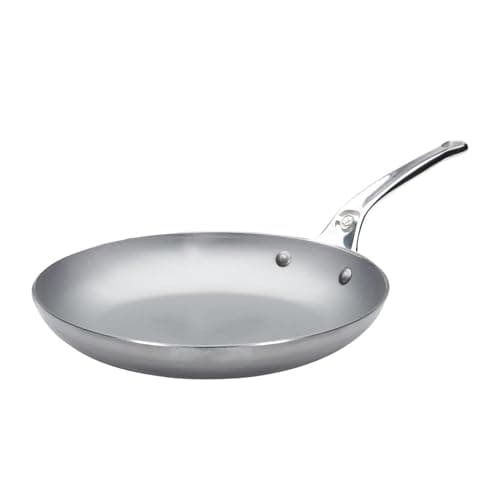
de Buyer publishes its MINERAL B PRO body as "Iron 99%, Carbon 1%", which is chemically close to cast iron. The difference is entirely in forming: cast iron is poured and must be thick; carbon steel is rolled to 2 to 3 mm and is strong at that thickness.
The result is a pan that conducts about the same and weighs about half. de Buyer's 11-inch at 3 mm is 4.6 lb against a comparable cast iron skillet nearer 7 to 8. It also has sloped sides, so you can toss food, which straight-sided iron resists.
What you pay for that is maintenance. Carbon steel rusts overnight if left wet, has a thinner seasoning layer than a decade-old iron pan, and is at least as reactive. Full comparison in cast iron versus carbon steel.
The coated pans: PTFE and ceramic
Both are aluminum pans with something sprayed on. The aluminum does the conducting — that is why coated pans heat quickly and evenly — and the coating does the release.
PTFE is a fluoropolymer, authorized for food contact under 21 CFR 177.1550, and the FDA states that "studies show negligible amounts of PFAS in this coating can migrate to food." It releases better and lasts longer than ceramic. It is also a PFAS, which some buyers rule out on environmental rather than direct-exposure grounds, and that is a coherent position.
Ceramic is a sol-gel silica coating. GreenPan publishes that its Thermolon is made "from sand-derived raw materials, Silicon Dioxide (SiO2)" and is PFAS-free, PFOA-free and free of lead and cadmium, with the coating rated to 850F. It releases beautifully when new and, in general use, declines faster than PTFE.
Neither publishes a lifespan. Not one manufacturer, in either technology. Treat both as consumables — the full argument is in the nonstick and ceramic hub.
Bare aluminum: wrong for pans, right for bakeware
Aluminum conducts at 237 W/m-K, second only to copper among practical cookware metals, and it is cheap and light. It is also soft, reactive with acid, and not magnetic, so it does not work on induction at all.
That combination rules it out as a bare cooking surface and makes it ideal for bakeware, where you want even browning, do not usually cook acid directly on the metal, and never put the pan on a hob. A bare aluminum half sheet with a steel rim is the professional standard for exactly these reasons. See sheet pan materials compared.
What this adds up to
A kitchen built on this reasoning has clad stainless as its spine, one heavy pan for searing, one coated pan for release, and aluminum for the oven. Four materials, each doing the thing it is physically good at, none asked to do a job it is bad at.
These are the products this page's reasoning actually points at. Same rules as everywhere else on the site: published specs, a stated trade-off, and a live price only where one exists.
Top pick · Clad stainlessSpecs read September 3, 2026
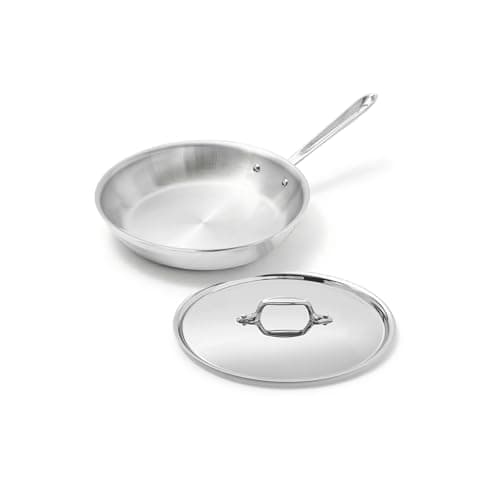
All-Clad D3 Stainless 10 in Fry Pan
Non-reactive, oven to 600F and maintenance-free - the material that asks nothing of you.
Best for: One good open-stock stainless pan bought instead of a cheap full set
Published specifications for the All-Clad D3 Stainless 10 in Fry Pan
Construction
Fully bonded tri-ply, aluminum core
Oven maximum
600F, oven and broiler safe
Induction
Yes - compatible with any stovetop
Dishwasher
Handwash only (All-Clad published)
Handle
Double-riveted stainless
Weight
3.0 lb (model 4110)
Warranty
Limited lifetime
Made in
Bonded, engineered and assembled in Canonsburg, PA
Good
600F is the highest oven ceiling of any stainless pan on this site
The one pan here whose manufacturing location is published down to the town
Genuinely repairable-adjacent: rivets are the only failure point and the warranty covers them
Not good
Hand wash only
The flared rim makes it a poor pan for anything with liquid
Costs several times what a Tramontina or Cuisinart pan of the same construction costs
The trade-off. Hand wash only. All-Clad publishes that plainly, and it is a real daily cost on a pan you will use every day.
Skip this if. You want a dishwasher-safe pan, or you are buying a whole kitchen on a fixed budget - one D3 skillet costs what a full clad set can cost.
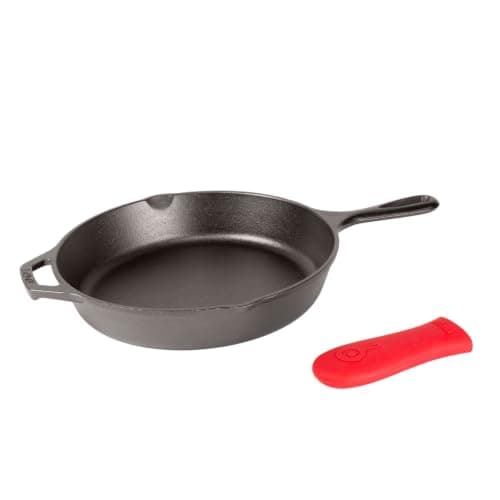
Published specifications for the Lodge Seasoned Cast Iron Skillet, 10.25 in (L8SK3)
Diameter
10.25 in
Weight
5.66 lb
Oven maximum
550F
Induction
Yes - bare iron is ferrous
Seasoning
Pre-seasoned with soy-based vegetable oil, no synthetic chemicals
Warranty
Lifetime
Made in
USA
Care
Hand wash. Lodge's own instructions permit warm soapy water
Good
Effectively unbreakable and fully restorable - a rusted one can be stripped and re-seasoned
Holds heat better than anything else at the price, which is what a sear needs
Lodge publishes its seasoning method openly, so the maintenance is not a mystery
Not good
Heavy
Heats unevenly on a small burner: cast iron conducts at roughly 50 W/m-K, so it is slow to spread and slow to react
Bare iron is reactive; long tomato braises will taste of it
The trade-off. It weighs 5.66 lb empty. You will feel that every time you move it full, and it is the single most common reason a cast iron skillet ends up in a cupboard.
Skip this if. You have wrist or shoulder trouble, or you cook mostly acidic braises. Carbon steel does most of the same jobs at roughly half the weight.
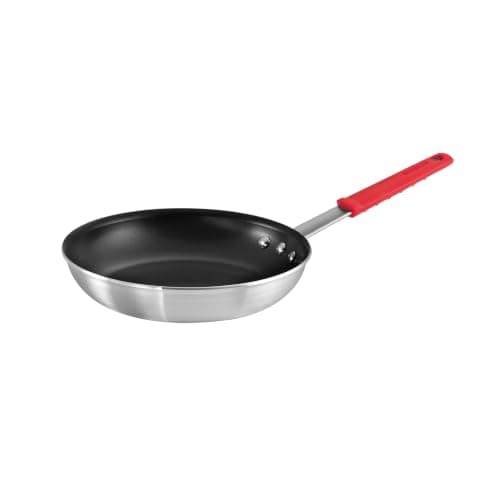
Published specifications for the Tramontina Professional Restaurant Fry Pan, 10 in
Body
Heavy-gauge aluminum
Coating
PTFE nonstick
Induction
No - aluminum body is not ferrous
Coating lifespan
Not published, by this or any nonstick maker
Good
Cheap enough that replacing it every couple of years is a real plan rather than a failure
Heavy gauge for a nonstick pan, so it does not warp on the first hot burner
Silicone handle sleeve that actually stays cool
Not good
Not induction compatible
PTFE, which some buyers will rule out on principle
No published coating lifespan, so the value case is unverifiable by design
The trade-off. It is PTFE. That is fine at normal cooking temperatures, and it is not a pan to preheat empty on high.
Skip this if. You want to avoid PTFE entirely. Buy ceramic instead and accept the shorter release life rather than pretending either one lasts forever.
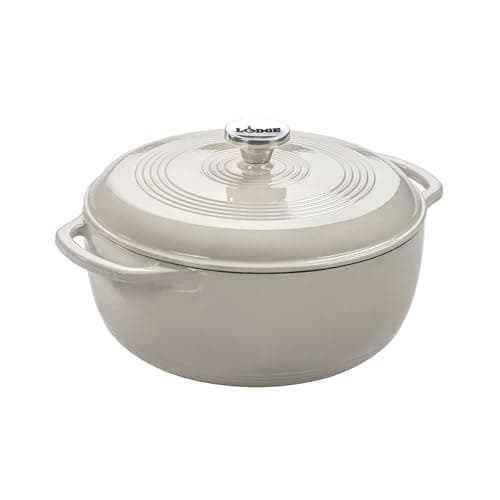
Published specifications for the Lodge Enameled Cast Iron Dutch Oven, 6 qt
Material
Cast iron with porcelain enamel, inside and out
Capacity
6 qt
Induction
Yes - the iron under the enamel is ferrous
Seasoning
None required - enamel is not a seasoning surface
Acid
Safe for tomato and wine, unlike bare iron
Oven maximum
Set by the knob material - check the specific SKU; Lodge publishes a lower ceiling than for bare iron
Good
Non-reactive, so it handles the acidic cooking bare iron cannot
No seasoning to maintain
Considerably cheaper than the French enameled pots it copies
Not good
Chipped enamel is not repairable, unlike bare iron's seasoning
Oven ceiling is lower than bare cast iron because of the knob
Heavy, and the enamel makes it heavier than bare iron of the same capacity
The trade-off. The enamel is a glass layer. Chip it and the pot is not restorable the way bare iron is, and Lodge's enamel chips more readily than the premium brands'.
Skip this if. You already own a large stainless stockpot and rarely braise. This duplicates it for most weeknight cooking.
There is no single best one, because the two properties that matter pull against each other. High conduction gives evenness and responsiveness; high mass gives searing power. Clad stainless is the best default, with cast iron or carbon steel added for searing and one coated pan for release.
›Why is stainless steel cookware layered with aluminum?
Because type 304 stainless conducts heat at only 15 to 16 W/m-K against aluminum's 237. A solid stainless pan would have a hot spot over the burner and cold walls, so the aluminum core does the spreading and the stainless does the durable, non-reactive food contact.
›Is carbon steel the same as cast iron?
Chemically almost, but they are formed differently. de Buyer publishes its carbon steel as 99 percent iron and 1 percent carbon. Cast iron is poured and must be thick; carbon steel is rolled to 2 to 3 mm, so it weighs roughly half as much for the same diameter.
›Which cookware material is the healthiest?
Stainless, cast iron and carbon steel involve no coating at all, which is why they sidestep the question entirely. Among coated pans, regulators treat PTFE as safe at normal cooking temperatures, and ceramic sol-gel coatings contain no PFAS. The genuine caution for both is never heating an empty coated pan.
Sources
Every figure on this page came from one of these. Follow them and check our arithmetic — that is the point.