Heads up: some links on this page earn us a commission at no extra cost to you. It does not change what we recommend or the order. How we are funded.
The short answer
There are three honest budgets: a minimum that genuinely works, a middle that most people should aim at, and a buy-once level. What separates them is construction and documentation, not performance you can feel. The number to compare on is cost per useful piece — vessels you will actually reach for — because that is what defeats padded piece counts.
Why there are no dollar figures on this page
Because they would be wrong by the time you read it. Cookware prices move constantly, sets go in and out of promotion, and a number typed into a page in September is a lie by November. Every buy button on this site shows a live price when we have one and says "Check price on Amazon" when we do not — which is the honest state right now.
What does not change is the structure of the decision: what each tier buys you, what the arithmetic looks like, and where the money is well spent. That is what this page is for. Read it, then check current prices on the products themselves.
The arithmetic that actually matters
Take any set and do this before anything else.
Count the vessels. Not pieces. A pan is a vessel; a lid is not. A twelve-piece set is usually six or seven vessels.
Cross out the ones you will not use. Be honest. The 1-quart saucepan. The 8-inch skillet if you already have a 10. The steamer insert.
Divide the price by what is left. That is your cost per useful piece.
Compare against buying those same pieces open-stock. If the set does not win by a clear margin, buy the pieces.
A twelve-piece set that gives you five pieces you will use at a good per-piece figure beats a twenty-one-piece set that gives you six at a worse one. This is the single calculation that stops piece counts from working on you.
Set
Pieces claimed
Vessels
Typically used
Tramontina Signature Tri-Ply Clad 12-pc
12
7
5 (both fry pans, 2 saucepans, stockpot)
Cuisinart MultiClad Pro MCP-12N
12
6 + steamer insert
5 (both skillets, both saucepans, stockpot)
A typical 21-piece bundled set
21
7-8
5-6, plus utensils that get replaced
Piece lists from each manufacturer's published specification. The last column is a judgment, and it is stated as one.
Tier one: the minimum that genuinely works
One small fully clad stainless set — skillet, 3-quart saucepan, 6-quart stockpot — one cheap coated pan, and one aluminum half sheet.
The non-negotiable at this tier is cladding. A disc-bottom set costs less and is the economy you actually notice: aluminum stops at the base, sidewalls stay cool, and sauces scorch in a ring. If clad is out of reach for a full set, buy fewer clad pieces rather than more disc-bottom ones.
What you give up: oven ceilings tend to be lower, handles run hotter, warranty terms are thinner, and the piece list is short enough that you will be washing up mid-cook. All survivable. None of it affects how the food tastes.
Tier two: where most people should land
A full twelve-piece fully clad set — Tramontina's Signature Tri-Ply Clad or Cuisinart's MultiClad Pro are the two obvious candidates — plus a cast iron skillet, a coated egg pan, and two half sheet pans.
This tier is where the value curve flattens. You get NSF certification on the Tramontina flagship SKU, a lifetime warranty on the Cuisinart, genuine dishwasher tolerance, and induction compatibility. Adding cast iron for searing costs very little and covers the one thing clad stainless does adequately rather than well.
Read the manuals at this tier, because it is where the documentation starts to matter and where it starts to contradict itself. Cuisinart's listing says the MultiClad Pro is oven safe to 550F and its own use-and-care guide says 500F, with Cuisinart confirming the manual. Tramontina's retail listings give 350F on some SKUs in the line and 500F on others. Neither is a scandal; both are reasons to read past the listing.
Tier three: buy once
Open-stock premium clad — All-Clad D3 or equivalent — bought piece by piece, plus cast iron, plus a 3 mm French carbon steel pan, plus proper bakeware.
What the money buys here is specific and worth naming, because it is not performance you can taste. It is a 600F oven and broiler ceiling instead of 500F. It is bonding, engineering and assembly in a named Pennsylvania town rather than an unspecified factory. It is a limited lifetime warranty from a company that has honored them for decades. And it is documentation: All-Clad publishes what its pans are and what they are not, including "Handwash Only", which is an inconvenience they could have quietly omitted.
What it does not buy is a better weeknight dinner. A Tramontina tri-ply pan and an All-Clad D3 pan are the same idea at different price points and the gap on a Tuesday is smaller than the price gap suggests. If that trade reads as obviously worth it to you, buy it. If it does not, tier two is not a compromise.
Where the money is genuinely wasted
Expensive coated cookware. No maker publishes a coating lifespan. Buying a premium coated set is buying a consumable at a keepsake price.
Ply counts above five. More layers means more thickness, which means slower. That is sometimes desirable and is never worth a large premium.
Piece counts above about fourteen. Everything past that is duplicates and utensils.
Bakeware sets. The pieces are cheap individually, so the bundle saves little and pads heavily. Buy two half sheets and add from there.
Grill pans, egg poachers, specialist inserts. Bought aspirationally, used twice.
If you are buying over time
Buy the clad set first, because that is where bundling is a genuine discount rather than a framing device. Add the sheet pans next, because they are cheap and change how you cook on weeknights. Add cast iron when you want to sear properly. Buy the coated pan last, because its clock starts the day you open it.
These are the products this page's reasoning actually points at. Same rules as everywhere else on the site: published specs, a stated trade-off, and a live price only where one exists.
Top pick · Best cost per useful pieceSpecs read September 3, 2026
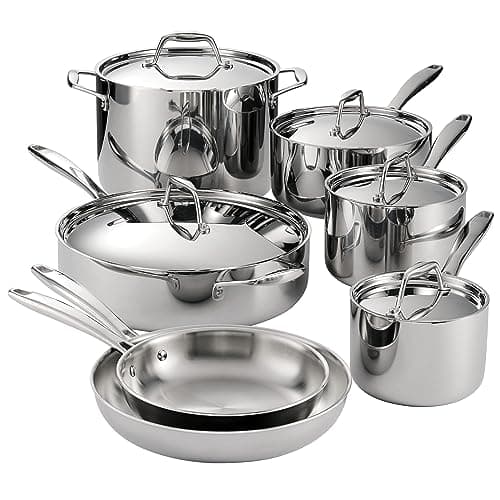
Tramontina Signature Tri-Ply Clad 12-Piece Set
Seven vessels, five of which most people use weekly, in fully clad construction. This is the set the middle tier is built around.
Best for: A first kitchen that should not need replacing
Published specifications for the Tramontina Signature Tri-Ply Clad 12-Piece Set
Construction
Tri-ply: 18/10 stainless, aluminum core, magnetic stainless exterior
Pieces
8 in and 10 in fry pans; 1.5, 2 and 3 qt covered saucepans; 5 qt covered deep saute; 8 qt covered stockpot
Oven maximum
500F on the 80116-249DS listing; other SKUs in the line are listed at 350F
Induction
Yes - magnetic stainless exterior
Dishwasher
Listed dishwasher safe
Handles
Precision cast, riveted
Certification
NSF-certified on the 80116-249DS line
Country of origin
Not asserted - retail listings disagree across SKUs (Brazil and China both appear)
Good
Fully clad, not disc-bottom: the aluminum runs up the sidewalls, so sauces do not scorch in a ring at the base
NSF certification on the flagship SKU is a real, checkable third-party mark rather than a marketing badge
Induction-ready without paying an induction premium
Not good
Retail listings disagree on the oven maximum across SKUs in the same line, which is a documentation problem, not a cooking one
Handles run hot on gas
The 12-piece count includes lids; the useful-item count is seven
The trade-off. Handles are the weak point. They are riveted and sturdy, but they get hot on a gas ring in a way the more expensive clad brands' do not.
Skip this if. You want a set you can leave in the oven above 500F, or you cook mostly eggs and pancakes and would rather spend the money on one good nonstick pan.
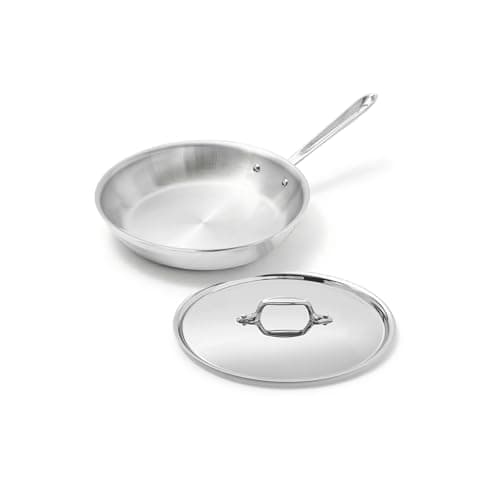
Published specifications for the All-Clad D3 Stainless 10 in Fry Pan
Construction
Fully bonded tri-ply, aluminum core
Oven maximum
600F, oven and broiler safe
Induction
Yes - compatible with any stovetop
Dishwasher
Handwash only (All-Clad published)
Handle
Double-riveted stainless
Weight
3.0 lb (model 4110)
Warranty
Limited lifetime
Made in
Bonded, engineered and assembled in Canonsburg, PA
Good
600F is the highest oven ceiling of any stainless pan on this site
The one pan here whose manufacturing location is published down to the town
Genuinely repairable-adjacent: rivets are the only failure point and the warranty covers them
Not good
Hand wash only
The flared rim makes it a poor pan for anything with liquid
Costs several times what a Tramontina or Cuisinart pan of the same construction costs
The trade-off. Hand wash only. All-Clad publishes that plainly, and it is a real daily cost on a pan you will use every day.
Skip this if. You want a dishwasher-safe pan, or you are buying a whole kitchen on a fixed budget - one D3 skillet costs what a full clad set can cost.
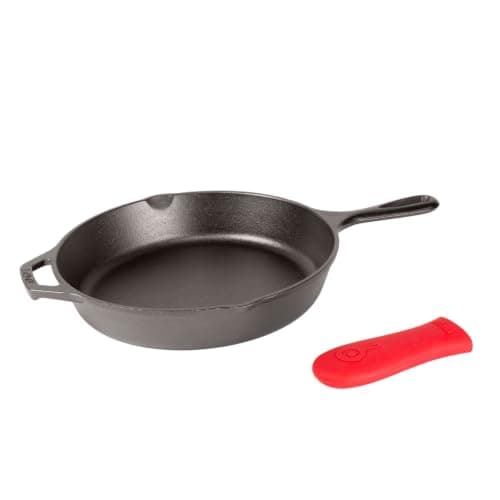
Published specifications for the Lodge Seasoned Cast Iron Skillet, 10.25 in (L8SK3)
Diameter
10.25 in
Weight
5.66 lb
Oven maximum
550F
Induction
Yes - bare iron is ferrous
Seasoning
Pre-seasoned with soy-based vegetable oil, no synthetic chemicals
Warranty
Lifetime
Made in
USA
Care
Hand wash. Lodge's own instructions permit warm soapy water
Good
Effectively unbreakable and fully restorable - a rusted one can be stripped and re-seasoned
Holds heat better than anything else at the price, which is what a sear needs
Lodge publishes its seasoning method openly, so the maintenance is not a mystery
Not good
Heavy
Heats unevenly on a small burner: cast iron conducts at roughly 50 W/m-K, so it is slow to spread and slow to react
Bare iron is reactive; long tomato braises will taste of it
The trade-off. It weighs 5.66 lb empty. You will feel that every time you move it full, and it is the single most common reason a cast iron skillet ends up in a cupboard.
Skip this if. You have wrist or shoulder trouble, or you cook mostly acidic braises. Carbon steel does most of the same jobs at roughly half the weight.
›How much should I spend on cookware for a new kitchen?
Enough for fully clad construction rather than disc-bottom, which is the one economy you notice every time you make a sauce. Beyond that, extra spending buys oven ceilings, warranty terms and documentation rather than performance you can taste.
›How do I tell whether a cookware set is good value?
Count the vessels, not the pieces. Cross out the ones you honestly will not use. Divide the price by what is left. That cost-per-useful-piece figure is what makes padded piece counts stop working.
›Is All-Clad worth the money over Tramontina?
It buys a 600F oven and broiler ceiling instead of 500F, bonding and assembly in a named Pennsylvania town, and a limited lifetime warranty. It does not buy a noticeably better weeknight dinner, because both are the same tri-ply idea.
›Where is cookware money most often wasted?
Expensive coated pans, since no maker publishes a coating lifespan; ply counts above five, which only add thickness; large piece counts, which are duplicates; and bakeware sets, where the pieces are cheap individually anyway.
Sources
Every figure on this page came from one of these. Follow them and check our arithmetic — that is the point.