Heads up: some links on this page earn us a commission at no extra cost to you. It does not change what we recommend or the order. How we are funded.
The short answer
Three pans cover most of what most people cook: a skillet, a saucepan and a stockpot.
Five covers almost everything: add a coated pan for eggs and a second skillet or a saute pan.
Seven is a generous, complete kitchen with room for simultaneous dishes.
Beyond seven, you are storing duplicates in slightly different sizes.
Why this question has a bad answer everywhere else
Search this and you get lists. Fourteen essential pans. The nine pots every kitchen needs. They are written by people selling pans, and they are all answering "what could you conceivably use" rather than "what will you reach for".
The better question is simultaneity. You do not need a pan per dish; you need enough pans that you are never waiting for one to be free. Count how many things are on your hob at the same time on your busiest cooking evening. That number, plus one, is your pan count. For most people it is three. For someone cooking a full dinner from scratch several nights a week it is five.
The three that do most of the work
The skillet
Everything that browns. If you own one pan, it is this one, at 10 or 12 inches depending on how many people you feed. It is on the hob more than the other two combined.
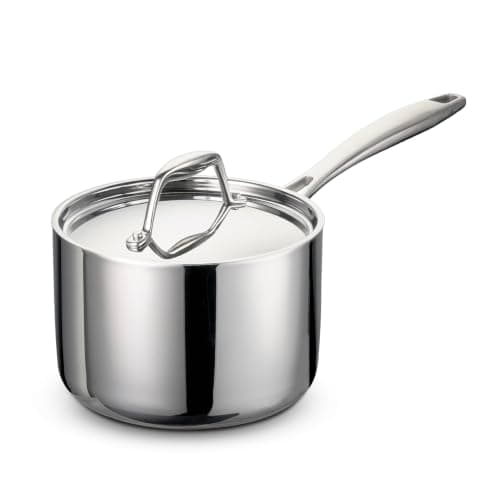
The 3-quart saucepan
Grains, sauces, reheating, small-batch boiling, blanching. Three quarts because two is too small for rice for four and four is unwieldy for one portion.
The stockpot
Pasta, soup, stock, anything in quantity. Six quarts minimum. It gets used less often than the other two and it is unsubstitutable when it is needed.
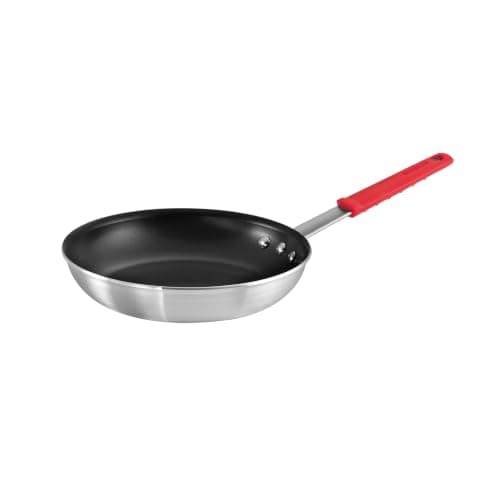
Fourth: a coated pan. Not because eggs are hard, but because cooking eggs in stainless every morning is a small daily irritation that compounds. Eight or ten inches, cheap, replaced when it stops releasing.
Fifth: a second skillet, or a saute pan. This is the one that depends on how you cook. If you often have two things browning at once, a second skillet. If you make a lot of braises and one-pan dishes, a 3 to 5-quart saute pan with straight sides and a lid is more useful.
Household
Pans
The list
One person, cooks sometimes
3
10-inch skillet, 3 qt saucepan, 6 qt stockpot
One or two, cooks most nights
4-5
Add a coated 8-inch pan, then a saute pan
Family of three or four
5-6
12-inch skillet instead of 10, plus a second saucepan
Cooks large meals, entertains
6-7
Add a Dutch oven and a second large skillet
Anyone
Never more than 7
Past this point the extras are duplicates in near-identical sizes
Counted by simultaneity - how many vessels are on the hob at once - not by cuisine.
Why sets go past this number
A 12-piece set is typically six or seven vessels plus five lids. That is roughly the right number of vessels, but the count is presented as twelve because twelve sounds like more value than seven.
The problem comes with the larger sets. A 17 or 21-piece set gets to its number by adding a 1-quart saucepan, an 8-inch skillet you already have a 10-inch version of, a steamer insert, and often utensils. None of these are useless; all of them are things you would not have bought individually. Full breakdown in what "12-piece" actually means.
The storage argument, which is not a small one
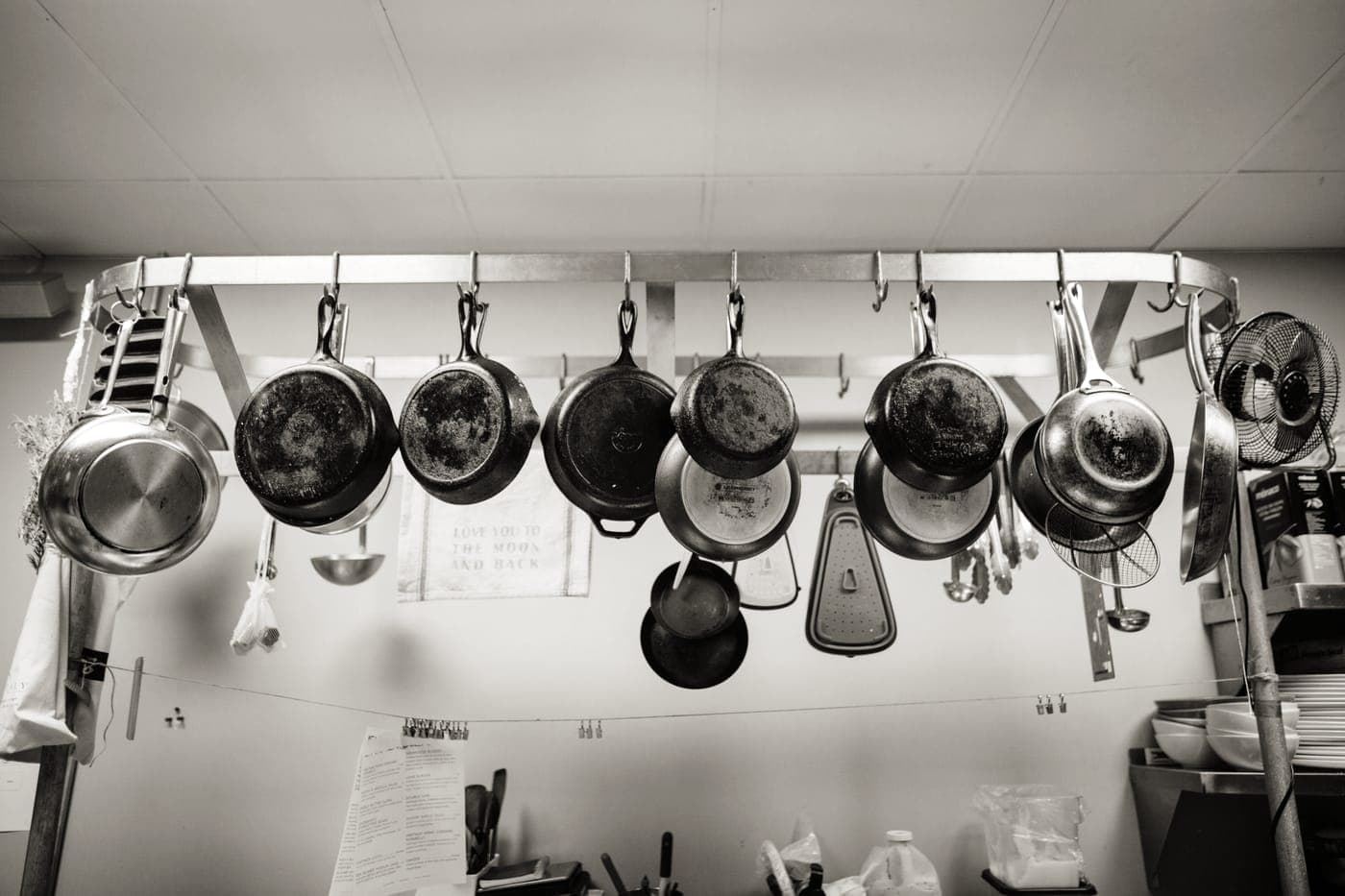
Pans nest badly. A cupboard of seven pans is a cupboard where the one you want is under three others, and that friction changes what you cook. This is a real reason to buy fewer, better pans rather than more adequate ones.
It also argues against buying the largest set on offer just because it is better value per piece. Value per piece is meaningless for a piece that lives at the back of a cupboard for a decade. See cookware set or open stock for how to think about that.
What to add later, if you find you want it
A Dutch oven, if you braise. Genuinely different from a stockpot in that it goes in the oven and holds heat.
A second sheet pan. Not a pan exactly, and the cheapest useful thing you can add.
Cast iron, if you sear more than occasionally.
A small saucepan, only once you have caught yourself wanting one more than twice.
The rule that works: buy the next pan when you have specifically wanted it three times. Not when it is on sale, and not because a list said you needed it.
What to buy, if you are buying
These are the products this page's reasoning actually points at. Same rules as everywhere else on the site: published specs, a stated trade-off, and a live price only where one exists.
Top pick · Pan oneSpecs read September 3, 2026
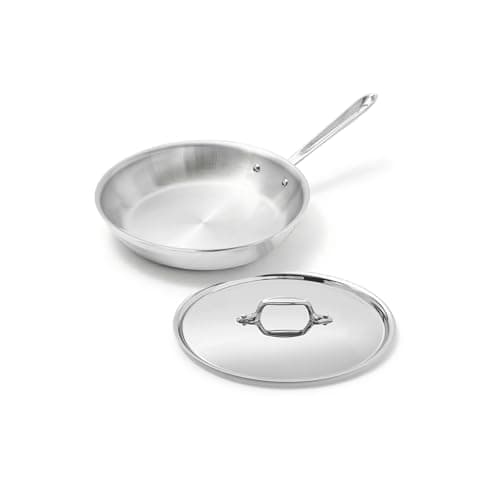
All-Clad D3 Stainless 10 in Fry Pan
The general-purpose skillet. If a kitchen owns one pan, this shape is it.
Best for: One good open-stock stainless pan bought instead of a cheap full set
Published specifications for the All-Clad D3 Stainless 10 in Fry Pan
Construction
Fully bonded tri-ply, aluminum core
Oven maximum
600F, oven and broiler safe
Induction
Yes - compatible with any stovetop
Dishwasher
Handwash only (All-Clad published)
Handle
Double-riveted stainless
Weight
3.0 lb (model 4110)
Warranty
Limited lifetime
Made in
Bonded, engineered and assembled in Canonsburg, PA
Good
600F is the highest oven ceiling of any stainless pan on this site
The one pan here whose manufacturing location is published down to the town
Genuinely repairable-adjacent: rivets are the only failure point and the warranty covers them
Not good
Hand wash only
The flared rim makes it a poor pan for anything with liquid
Costs several times what a Tramontina or Cuisinart pan of the same construction costs
The trade-off. Hand wash only. All-Clad publishes that plainly, and it is a real daily cost on a pan you will use every day.
Skip this if. You want a dishwasher-safe pan, or you are buying a whole kitchen on a fixed budget - one D3 skillet costs what a full clad set can cost.
Published specifications for the Tramontina Professional Restaurant Fry Pan, 10 in
Body
Heavy-gauge aluminum
Coating
PTFE nonstick
Induction
No - aluminum body is not ferrous
Coating lifespan
Not published, by this or any nonstick maker
Good
Cheap enough that replacing it every couple of years is a real plan rather than a failure
Heavy gauge for a nonstick pan, so it does not warp on the first hot burner
Silicone handle sleeve that actually stays cool
Not good
Not induction compatible
PTFE, which some buyers will rule out on principle
No published coating lifespan, so the value case is unverifiable by design
The trade-off. It is PTFE. That is fine at normal cooking temperatures, and it is not a pan to preheat empty on high.
Skip this if. You want to avoid PTFE entirely. Buy ceramic instead and accept the shorter release life rather than pretending either one lasts forever.
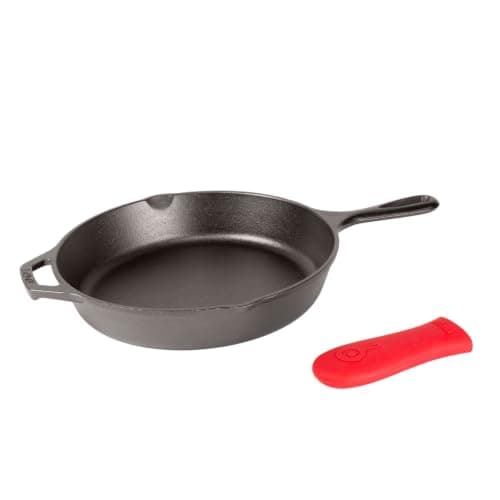
Published specifications for the Lodge Seasoned Cast Iron Skillet, 10.25 in (L8SK3)
Diameter
10.25 in
Weight
5.66 lb
Oven maximum
550F
Induction
Yes - bare iron is ferrous
Seasoning
Pre-seasoned with soy-based vegetable oil, no synthetic chemicals
Warranty
Lifetime
Made in
USA
Care
Hand wash. Lodge's own instructions permit warm soapy water
Good
Effectively unbreakable and fully restorable - a rusted one can be stripped and re-seasoned
Holds heat better than anything else at the price, which is what a sear needs
Lodge publishes its seasoning method openly, so the maintenance is not a mystery
Not good
Heavy
Heats unevenly on a small burner: cast iron conducts at roughly 50 W/m-K, so it is slow to spread and slow to react
Bare iron is reactive; long tomato braises will taste of it
The trade-off. It weighs 5.66 lb empty. You will feel that every time you move it full, and it is the single most common reason a cast iron skillet ends up in a cupboard.
Skip this if. You have wrist or shoulder trouble, or you cook mostly acidic braises. Carbon steel does most of the same jobs at roughly half the weight.
Three cover most cooking: a skillet, a 3-quart saucepan and a 6-quart stockpot. Five covers almost everything, adding a coated pan and a second skillet or saute pan. Past seven you are storing duplicates in near-identical sizes.
›How many frying pans should I have?
One good skillet plus one coated pan for eggs. A second skillet only helps if you regularly have two things browning at once, which is less often than most people expect.
›Is a 21-piece cookware set worth buying?
Rarely. Large sets reach their number with a 1-quart saucepan, a duplicate small skillet, a steamer insert and often utensils. Value per piece is meaningless for a piece that stays at the back of a cupboard.
›When should I buy another pan?
When you have specifically wanted it three times. Not because it is on sale and not because a list said so. That rule filters out almost every purchase people later regret.
Sources
Every figure on this page came from one of these. Follow them and check our arithmetic — that is the point.