Heads up: some links on this page earn us a commission at no extra cost to you. It does not change what we recommend or the order. How we are funded.
The short answer
Buy a set
Buy open stock
Empty kitchen
Yes - the bundle is a real discount
Only if budget is unlimited
Replacing one worn pan
No
Yes, always
You know exactly what you cook
No
Yes
You want matching lids
Yes
Lids sold separately get expensive
Coated pans
No - they wear on a different clock
Yes, always separately
The question underneath the question
"Is a set worth it" is really two questions wearing one coat. The first is whether bundling is a genuine discount. The second is whether you know yet what you cook. Sets win the first comfortably and lose the second badly, and which one decides your purchase depends on where you are.
If you are furnishing an empty kitchen, you do not yet know which pans you will reach for, so buying a coherent spread cheaply is the right move. If you have cooked in the same kitchen for five years, you know precisely which three pans you use and buying four more to get them is nonsense.
Where the set discount is real
It is real, and it is largest on clad stainless. Fully clad construction is expensive to manufacture — the layers have to be bonded and formed as one piece — and manufacturers price sets to move volume. A clad set typically costs substantially less than the same pans bought one at a time from the same brand.
The second, quieter saving is lids. Buying a lid open-stock is startlingly expensive relative to the pan, and mismatched lids that nearly fit are a genuine daily annoyance. A set arrives with lids that fit, in sizes the manufacturer will keep making.
Where the set discount is a framing device
Piece counts. A set is priced against its piece count, and the piece count includes lids, inserts, and sometimes utensils. Two sets with the same number on the box can differ by three actual pans.
The arithmetic that defeats this takes thirty seconds:
Count the vessels. A lid is not a vessel.
Cross out the ones you honestly will not use — the 1-quart saucepan, the second small skillet, the steamer insert.
Divide the price by what is left.
Compare that against buying those specific pieces open stock.
A twelve-piece set giving you five pieces you will use often beats a twenty-one- piece set giving you six. Full breakdown of what is in the common sets is in what "12-piece" actually means.
Scenario
What to buy
Why
Empty first kitchen
A 10 or 12-piece clad set
Bundling is a genuine discount and you do not yet know your habits
Replacing one worn skillet
One open-stock pan
Buying six pans to replace one is how cupboards fill up
You cook a narrow range well
Open stock
You already know the three pans you use; buy those, properly
Adding a coated egg pan
Always open stock
It wears out on a different clock from everything else
Adding cast iron or carbon steel
Always open stock
Different material, different maintenance, no set needed
Wedding registry or gift
A set
The recipient may not know their habits either, and lids matter
The hybrid, which is what most good kitchens actually are
The strongest answer for most people is not either one. It is a modest clad set — skillet, two saucepans, a stockpot — plus open-stock additions in different materials as you find you want them.
That gets you the bundling discount where it is real (clad stainless, matched lids) and avoids paying for it where it is not (coated pans, cast iron, specialist vessels). It also spreads the cost, and it means each addition is a decision you made rather than something that arrived in a box.
Practically: buy the set, cook for a month, then add. The pan you find yourself wanting three times is the pan to buy. Everything else was a hypothetical.
What should never come in a set
Coated pans. They are consumables with an unpublished lifespan. Putting them in a set you expect to keep for twenty years guarantees the set looks tired long before it is worn.
Cast iron or carbon steel. Different maintenance entirely, and the bundling saves nothing because the pans are individually cheap.
Utensils. Consistently the worst items in any cookware box.
Anything you have never used before. A grill pan, a poacher, a wok you got "for free". Free items you do not use still occupy the cupboard.
So which should you buy
Empty kitchen: a fully clad set, and buy the coated pan separately. Everything else: open stock. The set recommendations are in the best cookware sets, and the list of what a kitchen actually needs is in what cookware you actually need.
One thing sets genuinely cannot give you: the right pan for a job they did not anticipate. Every set on the market is a compromise designed for an average kitchen, and nobody cooks average.
What to buy, if you are buying
These are the products this page's reasoning actually points at. Same rules as everywhere else on the site: published specs, a stated trade-off, and a live price only where one exists.
Top pick · If the set winsSpecs read September 3, 2026
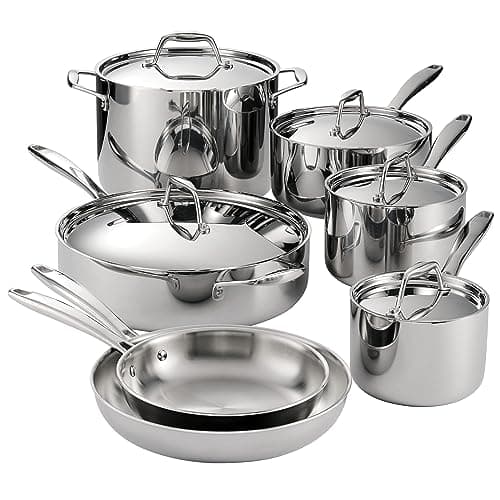
Tramontina Signature Tri-Ply Clad 12-Piece Set
Seven fully clad vessels, NSF certified on the flagship SKU, at the best cost-per-useful-piece figure on this site.
Best for: A first kitchen that should not need replacing
Published specifications for the Tramontina Signature Tri-Ply Clad 12-Piece Set
Construction
Tri-ply: 18/10 stainless, aluminum core, magnetic stainless exterior
Pieces
8 in and 10 in fry pans; 1.5, 2 and 3 qt covered saucepans; 5 qt covered deep saute; 8 qt covered stockpot
Oven maximum
500F on the 80116-249DS listing; other SKUs in the line are listed at 350F
Induction
Yes - magnetic stainless exterior
Dishwasher
Listed dishwasher safe
Handles
Precision cast, riveted
Certification
NSF-certified on the 80116-249DS line
Country of origin
Not asserted - retail listings disagree across SKUs (Brazil and China both appear)
Good
Fully clad, not disc-bottom: the aluminum runs up the sidewalls, so sauces do not scorch in a ring at the base
NSF certification on the flagship SKU is a real, checkable third-party mark rather than a marketing badge
Induction-ready without paying an induction premium
Not good
Retail listings disagree on the oven maximum across SKUs in the same line, which is a documentation problem, not a cooking one
Handles run hot on gas
The 12-piece count includes lids; the useful-item count is seven
The trade-off. Handles are the weak point. They are riveted and sturdy, but they get hot on a gas ring in a way the more expensive clad brands' do not.
Skip this if. You want a set you can leave in the oven above 500F, or you cook mostly eggs and pancakes and would rather spend the money on one good nonstick pan.
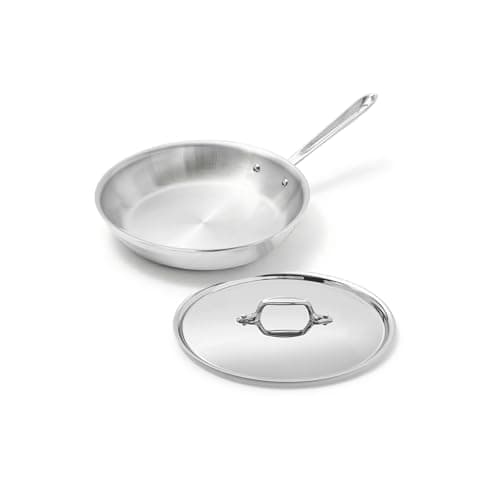
Published specifications for the All-Clad D3 Stainless 10 in Fry Pan
Construction
Fully bonded tri-ply, aluminum core
Oven maximum
600F, oven and broiler safe
Induction
Yes - compatible with any stovetop
Dishwasher
Handwash only (All-Clad published)
Handle
Double-riveted stainless
Weight
3.0 lb (model 4110)
Warranty
Limited lifetime
Made in
Bonded, engineered and assembled in Canonsburg, PA
Good
600F is the highest oven ceiling of any stainless pan on this site
The one pan here whose manufacturing location is published down to the town
Genuinely repairable-adjacent: rivets are the only failure point and the warranty covers them
Not good
Hand wash only
The flared rim makes it a poor pan for anything with liquid
Costs several times what a Tramontina or Cuisinart pan of the same construction costs
The trade-off. Hand wash only. All-Clad publishes that plainly, and it is a real daily cost on a pan you will use every day.
Skip this if. You want a dishwasher-safe pan, or you are buying a whole kitchen on a fixed budget - one D3 skillet costs what a full clad set can cost.
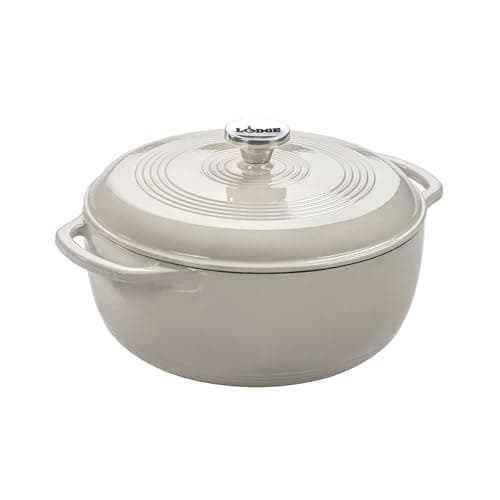
Published specifications for the Lodge Enameled Cast Iron Dutch Oven, 6 qt
Material
Cast iron with porcelain enamel, inside and out
Capacity
6 qt
Induction
Yes - the iron under the enamel is ferrous
Seasoning
None required - enamel is not a seasoning surface
Acid
Safe for tomato and wine, unlike bare iron
Oven maximum
Set by the knob material - check the specific SKU; Lodge publishes a lower ceiling than for bare iron
Good
Non-reactive, so it handles the acidic cooking bare iron cannot
No seasoning to maintain
Considerably cheaper than the French enameled pots it copies
Not good
Chipped enamel is not repairable, unlike bare iron's seasoning
Oven ceiling is lower than bare cast iron because of the knob
Heavy, and the enamel makes it heavier than bare iron of the same capacity
The trade-off. The enamel is a glass layer. Chip it and the pot is not restorable the way bare iron is, and Lodge's enamel chips more readily than the premium brands'.
Skip this if. You already own a large stainless stockpot and rarely braise. This duplicates it for most weeknight cooking.
›Is it better to buy a cookware set or individual pans?
A set for an empty kitchen, because clad pans bought together genuinely cost less and matched lids are worth more than they look. Individual pans once you know what you cook, because you are then paying only for pieces you will use.
›Are cookware sets actually cheaper?
Per piece, yes, and the discount is real on clad stainless. Per piece you actually use, often not, because the piece count includes lids, inserts and duplicate sizes. Count vessels, cross out the ones you will not use, and divide.
›Should a nonstick pan be part of a cookware set?
No. Coated pans are consumables with no published lifespan, so putting one in a set you expect to keep for decades means the set looks worn long before it is. Buy the coated pan separately and replace it on its own schedule.
›What is open stock cookware?
Pans sold individually rather than as a bundle. It costs more per piece and less per piece you use, and it is the right way to buy anything that is a wear item or a different material from the rest of your kitchen.
Sources
Every figure on this page came from one of these. Follow them and check our arithmetic — that is the point.