Heads up: some links on this page earn us a commission at no extra cost to you. It does not change what we recommend or the order. How we are funded.
The short answer
A "piece" is anything in the box. Lids count. Inserts count. Utensils sometimes count.
A 12-piece set is typically 6-7 vessels and 5 lids. That is a reasonable kitchen, described misleadingly.
Above about 14 pieces, the additions are duplicates. A second small saucepan, a second small skillet, a steamer.
Count vessels, cross out what you will not use, then divide. That figure is the only one worth comparing.
The unit problem
There is no standard for what a "piece" is. A manufacturer can count a lid as a piece, and every manufacturer does, because it is free volume in the headline number. A steamer insert is a piece. A pair of tongs, in some sets, is a piece.
This is not fraud and nobody is hiding it — the piece list is usually printed on the box. But the number is what gets compared, and comparing on it produces consistently bad decisions: a 21-piece set with more lids and utensils looks like nearly twice the cookware of a 12-piece set with more vessels.
What is actually in the common sets
Two of the most-bought clad sets, from their published piece lists:
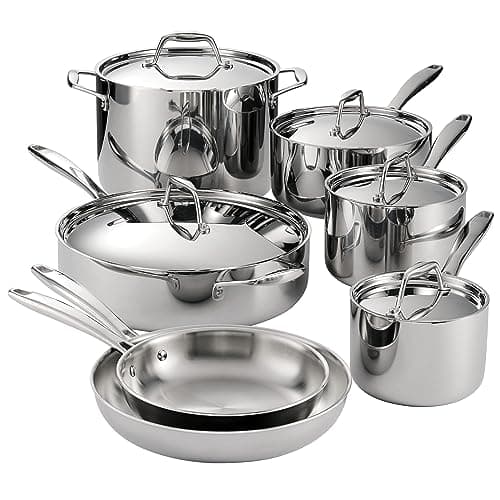
Tramontina Signature Tri-Ply Clad, 12-piece
8-inch fry pan
10-inch fry pan
1.5-quart covered saucepan
2-quart covered saucepan
3-quart covered saucepan
5-quart covered deep saute
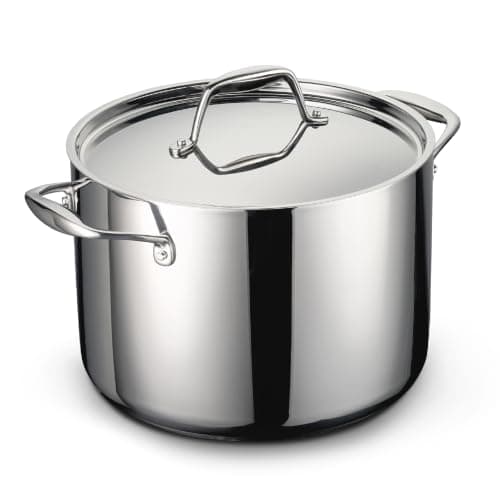
8-quart covered stockpot
Seven vessels, five lids. Twelve pieces. A genuinely useful spread, and the missing item is a 12-inch skillet.
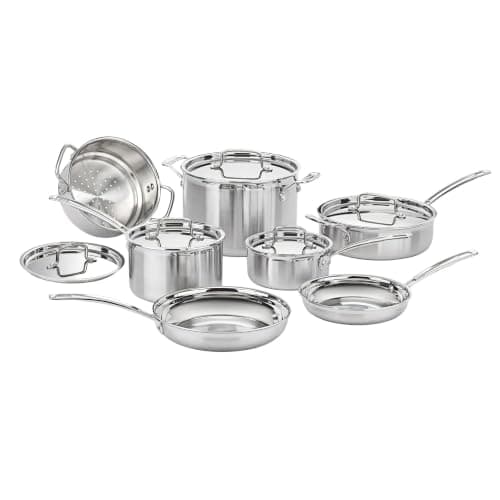
Cuisinart MultiClad Pro MCP-12N, 12-piece
8-inch skillet
10-inch skillet
1.5-quart covered saucepan
3-quart covered saucepan
3.5-quart covered saute
8-quart covered stockpot
Steamer insert
Six vessels, five lids, one insert. Also twelve pieces. Note that the two sets differ by a whole saucepan while carrying the same number on the box.
Advertised
Typical vessels
Typical lids
Typical padding
7-piece
4-5
2-3
None - these are usually honest
10-piece
5-6
4-5
A small saucepan you may not need
12-piece
6-7
5
Sometimes a steamer insert
15-piece
7-8
5-6
A duplicate small skillet, sometimes utensils
21-piece
7-9
6-7
Utensils, a second steamer, occasionally storage lids
Vessel counts are from published piece lists where available and are ranges elsewhere. The pattern holds across brands.
Are the lids a con?
No, and this is worth being fair about. Lids are genuinely useful and genuinely expensive to buy separately. A lid that fits properly is the difference between rice that steams and rice that dries out, and open-stock lids are startlingly costly relative to the pan.
The problem is not that lids are included. It is that including them in the headline count makes two dissimilar sets look identical. Count them separately and the lids stop being a distortion and start being a feature.
One thing to check: glass or stainless? Glass lids look better in listing photos and cap your oven ceiling at whatever the lid assembly tolerates. They also break first and are frequently unavailable as spares five years on.
The gap almost every set has
A 12-inch skillet. Neither of the sets above includes one, and it is the pan most people reach for second — the moment you cook for three or more, a 10-inch pan means crowding, and crowded food steams instead of browning.
The instinct is to buy a larger set to get it. That is usually the wrong move, because the larger set adds the 12-inch plus four things you did not want. Budget for one open-stock 12-inch pan instead, in whatever material suits you — clad stainless, or cast iron if you sear.
How to read any piece count in thirty seconds
Find the piece list, not the number. It is on the listing, near the bottom.
Count vessels only. Lids, inserts and utensils go in a separate column.
Cross out duplicates and sizes you will not use. Be honest about the 1-quart saucepan.
Divide the price by what is left. That is your comparable number.
Check the lid material while you are there, because it sets your real oven ceiling.
Do this on two sets side by side once and you will never look at a piece count the same way again. The set comparisons are in the best cookware sets, and the strategy question is in set or open stock.
What to buy, if you are buying
These are the products this page's reasoning actually points at. Same rules as everywhere else on the site: published specs, a stated trade-off, and a live price only where one exists.
Top pick · Twelve pieces, seven vesselsSpecs read September 3, 2026
Cuisinart MultiClad Pro MCP-12N 12-Piece Set
The clearest worked example of the arithmetic on this page - and dishwasher safe, which matters more than the count.
Best for: A cook who wants a dishwasher-safe clad set and a lifetime warranty
Published specifications for the Cuisinart MultiClad Pro MCP-12N 12-Piece Set
Construction
Tri-ply: 18/10 stainless interior, pure aluminum core, brushed stainless exterior
Pieces
1.5 and 3 qt covered saucepans; 8 in and 10 in skillets; 3.5 qt covered saute; 8 qt covered stockpot; steamer insert
Oven maximum
500F per the Cuisinart use-and-care manual, which the Amazon listing we cite now matches. Major retail listings still advertise 550F; Cuisinart has confirmed the manual figure
Induction
Yes
Dishwasher
Dishwasher safe
Handles
Riveted solid stainless, cool-grip profile
Warranty
Lifetime
Good
Heat runs up the sidewalls, not just across the base
Genuinely dishwasher safe, which the pricier clad brands often are not
Lifetime warranty on a set at this price
Not good
Published oven maximum contradicts the retail listing for the same product
Handle spine is divisive
No 12-inch skillet in the box, which is the pan most people reach for second
The trade-off. The cool-grip handles have a sharp spine that some people find uncomfortable on a full 8-quart stockpot.
Skip this if. You want the higher oven ceiling that major retail listings advertise. The manual says 500F and Cuisinart has confirmed the manual is correct.
Published specifications for the Tramontina Signature Tri-Ply Clad 12-Piece Set
Construction
Tri-ply: 18/10 stainless, aluminum core, magnetic stainless exterior
Pieces
8 in and 10 in fry pans; 1.5, 2 and 3 qt covered saucepans; 5 qt covered deep saute; 8 qt covered stockpot
Oven maximum
500F on the 80116-249DS listing; other SKUs in the line are listed at 350F
Induction
Yes - magnetic stainless exterior
Dishwasher
Listed dishwasher safe
Handles
Precision cast, riveted
Certification
NSF-certified on the 80116-249DS line
Country of origin
Not asserted - retail listings disagree across SKUs (Brazil and China both appear)
Good
Fully clad, not disc-bottom: the aluminum runs up the sidewalls, so sauces do not scorch in a ring at the base
NSF certification on the flagship SKU is a real, checkable third-party mark rather than a marketing badge
Induction-ready without paying an induction premium
Not good
Retail listings disagree on the oven maximum across SKUs in the same line, which is a documentation problem, not a cooking one
Handles run hot on gas
The 12-piece count includes lids; the useful-item count is seven
The trade-off. Handles are the weak point. They are riveted and sturdy, but they get hot on a gas ring in a way the more expensive clad brands' do not.
Skip this if. You want a set you can leave in the oven above 500F, or you cook mostly eggs and pancakes and would rather spend the money on one good nonstick pan.
Anything in the box. Lids count, steamer inserts count, and in larger sets utensils count. There is no standard, which is why two sets advertising twelve pieces can differ by a whole saucepan.
›How many vessels are in a 12-piece cookware set?
Usually six or seven, plus five lids. Tramontina's Signature Tri-Ply Clad 12-piece has seven vessels; Cuisinart's MultiClad Pro MCP-12N has six vessels and a steamer insert.
›Is a 21-piece set better than a 12-piece set?
Almost never. The extra nine pieces are typically utensils, a duplicate small skillet, extra lids and a second insert. Vessel count barely moves, and the additions fill the cupboard you need for something else.
›Why do cookware sets not include a 12-inch skillet?
Because it is the most expensive pan to include and the piece count does not reward it. It is also the pan most people want second, so budget for one open stock rather than buying a larger set to get it.
Sources
Every figure on this page came from one of these. Follow them and check our arithmetic — that is the point.