Heads up: some links on this page earn us a commission at no extra cost to you. It does not change what we recommend or the order. How we are funded.
The short answer
Glass lids let you watch and are usually rated lowest for the oven, often 350F to 400F.
Metal lids match the pan's ceiling and survive a broiler, but hide the food.
The knob material sets the rating, not the lid - a stainless knob beats phenolic.
A vent hole stops boil-overs and stops a lid sealing itself onto a cooling pan.
Lids are sold separately by most quality brands, and by diameter rather than by pan.
What a lid is actually for
Three things, and they conflict.
It traps heat, so water boils faster and a simmer holds with less energy.
It traps moisture, which is what you want for braising and steaming and exactly what you do not want when reducing a sauce or crisping anything.
It contains spitting, which is why people reach for one when frying, and why a vented or mesh lid exists.
Most cooking mistakes involving lids are really about the second one - a lid on when you wanted evaporation, or off when you wanted moisture.
Glass or metal
Tempered glass
Stainless or metal
See the food
Yes - the main reason to buy one
No
Typical oven rating
350F to 400F, knob dependent
Matches the pan, often 500F to 600F
Broiler safe
No
Usually yes
Weight
Heavier
Lighter
Can shatter
Yes, with thermal shock or a drop
No
Stacks and nests
Poorly - the knob gets in the way
Better
Self-basting effect
Little
Better, especially heavy cast iron lids
Shows hard-water marks
Very much so
Less
Glass is the default in home-retail sets because being able to see in is a genuine convenience and it photographs well. Metal is what professional kitchens use, because it survives a broiler, weighs less, stacks and cannot break.
This is the part almost nobody checks, and it is the number that governs what you can do. A lid is rated by its lowest-rated component, which is the knob, not the glass or the steel.
Le Creuset publishes a stainless knob rated to 500F on its Signature line, which is high enough for essentially every no-knead bread recipe. A phenolic knob is rated considerably lower and will scorch, craze or fail at bread temperatures. The important practical point: metal replacement knobs are sold for most models, so a pot you already own can be upgraded cheaply - baking bread in a Dutch oven and best enameled Dutch ovens.
Knobs vary by SKU within a brand, so check the specific product rather than trusting the range. This is one of the few places where a single small part decides whether a pot can do a whole category of cooking.
Vents, and why they matter
A small hole or notch in the lid does two useful things. It lets a little steam escape so a pot of pasta or rice is far less likely to boil over, and it prevents the lid sealing itself onto the pan as it cools.
That second one is the one people meet unexpectedly. A tight lid on a cooling pan creates a partial vacuum as the trapped air contracts, and the lid can become genuinely difficult to remove. Briefly reheating the pan breaks the seal. It is most common on well-fitting metal lids and on cast iron.
Vented lids: good for starches, pasta, rice, anything that foams.
Unvented lids: better for braising and steaming, where you want every bit of moisture held.
Mesh splatter guards: not lids - they stop spitting while letting steam out, so food still crisps. The right tool for frying.
Self-basting lids: ridges or spikes underneath that encourage condensation to drip back onto the food rather than run to the sides. Staub's textured underside is the well-known example.
Fit, and the cupboard problem
Lids are sized by the pan's rim diameter, and rim diameter is not the same as the nominal pan size - a pan sold as 10 inches is measured across the rim, which is where the lid sits, but a 3 quart saucepan and a 10 inch skillet from the same line may share a diameter and a lid without either being labeled that way - how to read a cookware listing.
Two practical consequences:
Buy into a line with consistent diameters. Fewer distinct lids means fewer lids to store and fewer to lose.
Measure the rim, not the pan, when replacing. Measure the inside of the rim in inches and match that.
Lid storage is genuinely the hardest part of storing cookware, because a lid nests with nothing - a rack, a rail or a drawer divider solves it better than stacking - how to store pots and pans and cookware storage and organizers.
Count the lids before you count the pieces. A twelve-piece set is frequently seven pans and five lids.
Lids in piece counts
Worth naming because it inflates every set on the market: lids are counted as pieces. A twelve-piece set is often seven vessels and five lids, and a fifteen-piece set may include utensils. Count the pans - cookware set buying mistakes treats this as mistake number one, and what piece count you need works out what you actually want.
Replacing a lost or broken lid
Entirely doable, and cheaper than replacing the pan.
Check the maker first. Quality brands sell lids as open stock, and this is one of the strongest reasons to buy into a line that does - replacing a piece of your cookware set.
Measure the rim inside diameter in inches and buy a universal lid to match. Universal glass lids with a stepped edge fit a range of diameters.
A slightly oversized flat lid resting on the rim works perfectly well for simmering, if not for a tight braise.
Replace a phenolic knob with a metal one rather than replacing the whole lid, if the knob is what failed.
A sheet pan or a plate covers a pot in an emergency. Not elegant, and entirely functional.
Care
Do not put a hot glass lid into water. Thermal shock breaks tempered glass, and it breaks into a great many pieces.
Check the rim seal on glass lids - the metal band around the edge can loosen over years, and a loose band means a lid to retire.
Hand wash if the pan is hand wash. Repeated dishwasher cycles loosen knobs and bands - dishwasher-safe cookware.
Tighten the knob screw occasionally. It is the one piece of cookware maintenance nobody does, and it takes seconds.
Store lids upright or on a rack, not face-down on a coated surface.
Lids that publish a rating, and lines whose lids interchange
The knob material is the specification to check - it sets the oven ceiling for the whole pan, and it varies by SKU.
Le Creuset Signature Round Dutch Oven, 5.5 qt
A braising pot bought once, kept for decades and handed on
These are the products this page's reasoning actually points at. Same rules as everywhere else on the site: published specs, a stated trade-off, and a live price only where one exists.
Top pick · Best lid rating publishedSpecs read September 3, 2026
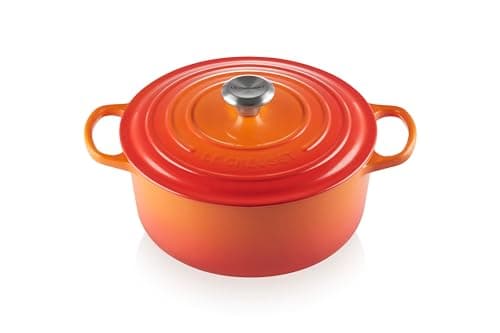
Le Creuset Signature Round Dutch Oven, 5.5 qt
A stainless knob published at 500F, which is high enough for bread baking without swapping parts - and the figure most brands will not print.
Best for: A braising pot bought once, kept for decades and handed on
Published specifications for the Le Creuset Signature Round Dutch Oven, 5.5 qt
Material
Cast iron with porcelain enamel inside and out
Capacity
5.5 qt
Interior enamel
Sand-colored, so browning and fond stay visible
Knob
Stainless steel, rated to 500F
Induction
Yes - the iron under the enamel is ferrous
Dishwasher
Dishwasher safe; Le Creuset recommends hand washing
Warranty
Limited lifetime
Made in
France
Good
The pale interior is a genuine cooking advantage: you can see whether the fond is browning or burning
Wide, low-profile handles that a hand in an oven mitt actually fits
The one enameled pot with a real secondhand market, which changes the true cost of ownership
Not good
Costs several times a Lodge enameled pot of the same capacity
The pale interior stains permanently, and Le Creuset says so
Chipped enamel is not repairable on any enameled pot, this one included
The trade-off. You are paying a large multiple of what a Lodge enameled pot costs for a difference in enamel quality, finish and resale value rather than in cooking.
Skip this if. You braise a few times a year. The cooking difference over a Lodge enameled pot is small; the price difference is not.
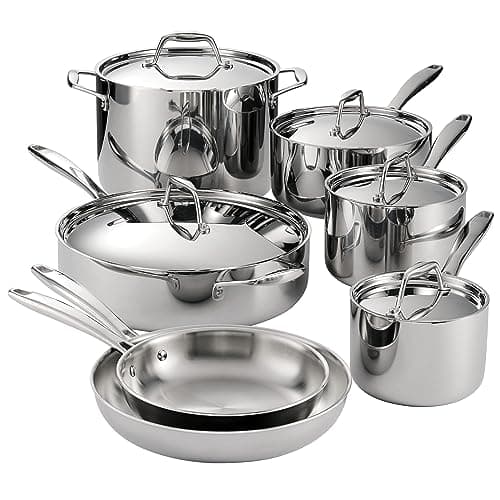
Published specifications for the Tramontina Signature Tri-Ply Clad 12-Piece Set
Construction
Tri-ply: 18/10 stainless, aluminum core, magnetic stainless exterior
Pieces
8 in and 10 in fry pans; 1.5, 2 and 3 qt covered saucepans; 5 qt covered deep saute; 8 qt covered stockpot
Oven maximum
500F on the 80116-249DS listing; other SKUs in the line are listed at 350F
Induction
Yes - magnetic stainless exterior
Dishwasher
Listed dishwasher safe
Handles
Precision cast, riveted
Certification
NSF-certified on the 80116-249DS line
Country of origin
Not asserted - retail listings disagree across SKUs (Brazil and China both appear)
Good
Fully clad, not disc-bottom: the aluminum runs up the sidewalls, so sauces do not scorch in a ring at the base
NSF certification on the flagship SKU is a real, checkable third-party mark rather than a marketing badge
Induction-ready without paying an induction premium
Not good
Retail listings disagree on the oven maximum across SKUs in the same line, which is a documentation problem, not a cooking one
Handles run hot on gas
The 12-piece count includes lids; the useful-item count is seven
The trade-off. Handles are the weak point. They are riveted and sturdy, but they get hot on a gas ring in a way the more expensive clad brands' do not.
Skip this if. You want a set you can leave in the oven above 500F, or you cook mostly eggs and pancakes and would rather spend the money on one good nonstick pan.
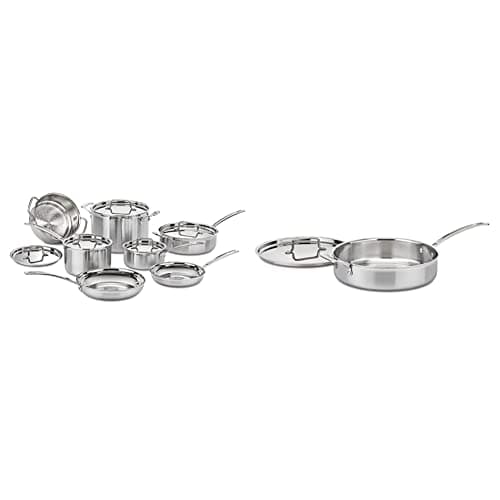
Published specifications for the Cuisinart MultiClad Pro MCP-12N 12-Piece Set
Construction
Tri-ply: 18/10 stainless interior, pure aluminum core, brushed stainless exterior
Pieces
1.5 and 3 qt covered saucepans; 8 in and 10 in skillets; 3.5 qt covered saute; 8 qt covered stockpot; steamer insert
Oven maximum
500F per the Cuisinart use-and-care manual. Amazon listings say 550F; Cuisinart has confirmed the manual figure
Induction
Yes
Dishwasher
Dishwasher safe
Handles
Riveted solid stainless, cool-grip profile
Warranty
Lifetime
Good
Heat runs up the sidewalls, not just across the base
Genuinely dishwasher safe, which the pricier clad brands often are not
Lifetime warranty on a set at this price
Not good
Published oven maximum contradicts the retail listing for the same product
Handle spine is divisive
No 12-inch skillet in the box, which is the pan most people reach for second
The trade-off. The cool-grip handles have a sharp spine that some people find uncomfortable on a full 8-quart stockpot.
Skip this if. You want the higher oven ceiling that the Amazon listing advertises. The manual says 500F and Cuisinart has confirmed the manual is correct.
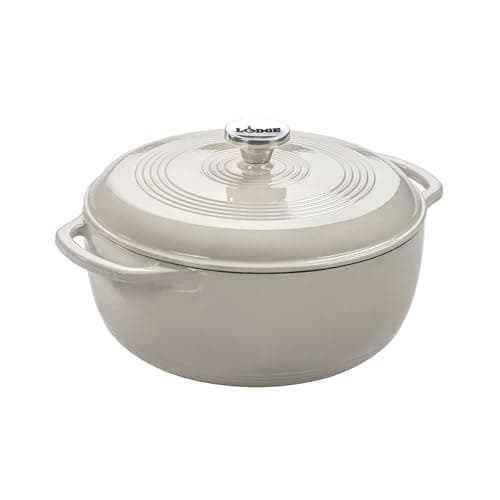
Published specifications for the Lodge Enameled Cast Iron Dutch Oven, 6 qt
Material
Cast iron with porcelain enamel, inside and out
Capacity
6 qt
Induction
Yes - the iron under the enamel is ferrous
Seasoning
None required - enamel is not a seasoning surface
Acid
Safe for tomato and wine, unlike bare iron
Oven maximum
Set by the knob material - check the specific SKU; Lodge publishes a lower ceiling than for bare iron
Good
Non-reactive, so it handles the acidic cooking bare iron cannot
No seasoning to maintain
Considerably cheaper than the French enameled pots it copies
Not good
Chipped enamel is not repairable, unlike bare iron's seasoning
Oven ceiling is lower than bare cast iron because of the knob
Heavy, and the enamel makes it heavier than bare iron of the same capacity
The trade-off. The enamel is a glass layer. Chip it and the pot is not restorable the way bare iron is, and Lodge's enamel chips more readily than the premium brands'.
Skip this if. You already own a large stainless stockpot and rarely braise. This duplicates it for most weeknight cooking.
Glass lets you see the food, which is a real convenience. Metal matches the pan's oven rating, survives a broiler, weighs less, stacks better and cannot shatter. If you finish food in the oven often, metal is the better choice; otherwise glass is a reasonable default.
›What temperature are glass lids oven safe to?
Typically 350F to 400F, and the limiting part is the knob rather than the glass. That is frequently far lower than the pan itself, so a pan rated 500F with a glass lid effectively has a much lower ceiling for covered cooking. Check the lid separately from the pan.
›Why does my pot lid get stuck?
As the pan cools, the trapped air contracts and creates a partial vacuum that holds the lid down. Briefly reheating the pan breaks the seal. Lids with a vent hole or notch avoid the problem, which is one of the practical arguments for a vented lid.
›Can you buy replacement cookware lids?
Yes. Quality brands sell lids as open stock, and universal glass lids with a stepped edge fit a range of diameters. Measure the inside of the pan's rim in inches rather than going by the nominal pan size. If only the knob failed, a metal replacement knob is cheaper than a new lid.
›Do lids count as pieces in a cookware set?
Yes, and that is how piece counts get inflated. A twelve-piece set is frequently seven vessels and five lids, and larger sets sometimes count utensils too. Count the pans rather than the pieces when comparing sets.
Sources
Every figure on this page came from one of these. Follow them and check our arithmetic — that is the point.