Heads up: some links on this page earn us a commission at no extra cost to you. It does not change what we recommend or the order. How we are funded.
The short answer
Never stack a coated pan directly on another pan. Use a felt protector or a rack. This is the most common avoidable cause of coating damage.
Store cast iron and carbon steel bone dry and uncovered. A warm pan in a closed cupboard condenses and rusts.
Nest clad stainless freely. It is the only common material with nothing to protect.
Store lids separately, on edge. A lid on a pan wastes the pan and traps moisture inside it.
Storage is a wear mechanism
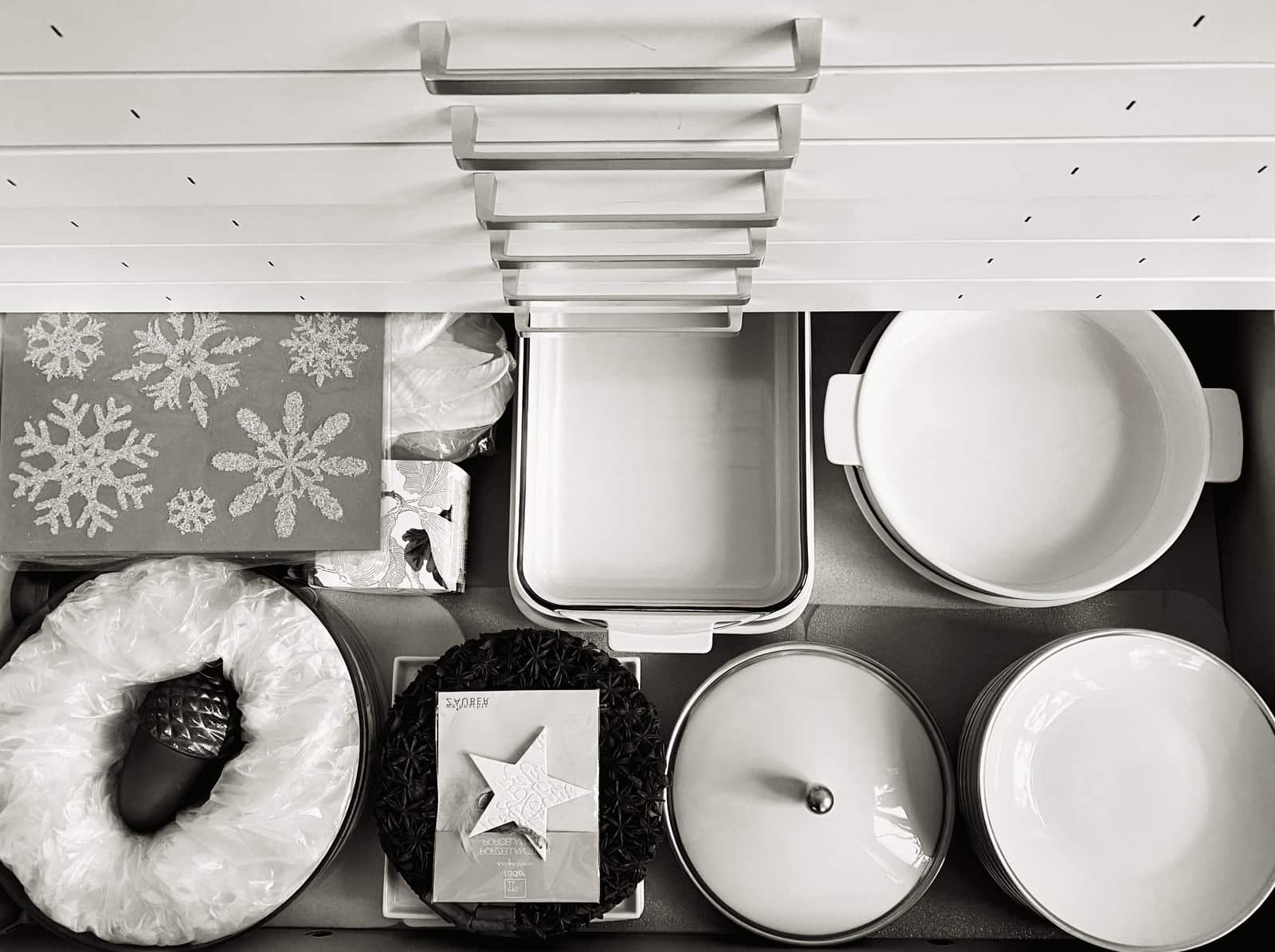
Cookware damage gets blamed almost entirely on cooking, and a surprising share of it happens in a cupboard. Coatings get scuffed by the base of the pan stacked on top. Seasoned iron rusts because it went away slightly damp. Enamel chips on a knock. None of that is dramatic enough to notice on the day, which is why it accumulates.
Nothing here needs a product purchase. Two paper towels and a habit fix most of it, and where a purchase genuinely helps we say what it is rather than padding the page with racks nobody needs.
What can stack and what cannot
Material
Stack directly?
What to do instead
Clad stainless
Yes
Nest freely. Nothing on the surface can be damaged by another pan
Bare cast iron
Yes, if bone dry
Paper towel between pans - it absorbs condensation and stops metal-on-metal scraping
Carbon steel
Yes, if bone dry
Same as iron, and it matters more because the steel is thinner
Enameled cast iron
Not really
Store alone or with a cloth. Enamel chips on impact and cannot be repaired
PTFE nonstick
No
Felt protector, pan rack, or hang it
Ceramic nonstick
No
Same, and ceramic is the more fragile of the two coatings
Hard-anodized
No
The anodized body resists dents; the coating on top does not resist scuffs
Bare aluminum bakeware
Yes
Sheet pans stack happily. They will scratch each other and it does not matter
The rule is simple: if the surface is a coating or an enamel, do not let another pan rest on it.
The coated-pan rule, specifically
The base of a pan is metal and it has a rim. Set that rim on a coated surface, add the weight of the pan, and slide it half an inch pulling it out of the cupboard, and you have made a scratch that no amount of careful cooking will undo. Every nonstick pan that dies early has some of this in its history.
The fixes, in order of how well they work:
Hang it. Nothing touches the surface at all. This is the only perfect answer.
Store it flat, alone, in a drawer. Deep drawers make this easy and it needs no accessory.
Use felt or fabric pan protectors between stacked pans. Pan protectors cost very little and solve the problem completely.
A paper towel or a folded dish cloth does the same job for nothing, if you will actually keep doing it.
A seasoned pan that goes into a cupboard slightly warm and slightly damp will condense inside a confined space. The result is the light orange bloom people describe as "it rusted for no reason". The reason is trapped moisture.
Dry the pan on a warm burner for a minute before it goes away. This takes less time than drying it with a towel and works better.
Leave a paper towel inside it, which absorbs whatever remains.
Do not put the lid on a Dutch oven in storage. Rest it ajar or store it separately.
Avoid the cupboard directly beside a dishwasher vent, which is the dampest cabinet in most kitchens.
If a pan has already bloomed, it is entirely recoverable - restoring rusty cast iron covers surface rust through to a full strip, and it applies to carbon steel almost unchanged.
Lids are the actual space problem
A twelve-piece set contains five lids, and a lid stored on its pan is the reason the stack will not nest. Lids stored flat in a pile are the reason you take four out to reach the fifth.
Store them on edge, in a rack or a divider, the way plates go in a dish rack. A lid organizer in a base cabinet or an over-door rack is the standard answer, and a tension rod across a deep drawer does the same job for less. Once the lids are out, a set that previously filled a cupboard collapses into one stack of pans.
Storing in a kitchen that does not have room
The order of operations in a small kitchen is to buy less rather than store better, which is the argument in cookware for small kitchens and what piece count you need. A seven-useful-piece set stores easily; a fourteen-piece set does not, and no rack fixes the difference.
Where storage genuinely drives the buying decision, prefer pans with flat helper handles over long ones, matched-diameter pieces that nest, and glass lids that fit more than one pan. Hanging is the highest-density option per cubic foot and it is also the only one that protects coated surfaces perfectly.
One caution on hanging: check what the rail is anchored into. A cast iron skillet and an enameled Dutch oven together are a serious load for a rail screwed into plasterboard.
These are the products this page's reasoning actually points at. Same rules as everywhere else on the site: published specs, a stated trade-off, and a live price only where one exists.
Top pick · Nests without a thoughtSpecs read September 3, 2026
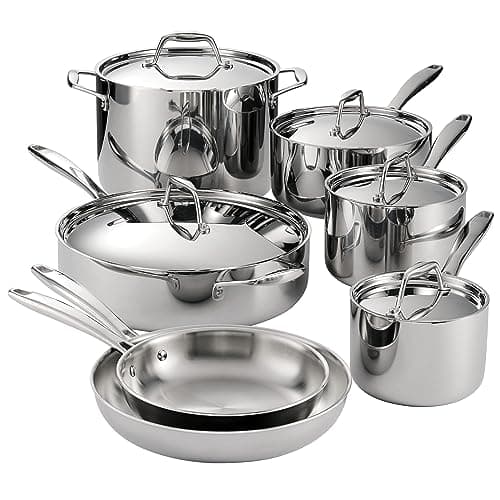
Tramontina Signature Tri-Ply Clad 12-Piece Set
Clad stainless has no coating and no seasoning, so a twelve-piece set genuinely collapses into one stack.
Best for: A first kitchen that should not need replacing
Published specifications for the Tramontina Signature Tri-Ply Clad 12-Piece Set
Construction
Tri-ply: 18/10 stainless, aluminum core, magnetic stainless exterior
Pieces
8 in and 10 in fry pans; 1.5, 2 and 3 qt covered saucepans; 5 qt covered deep saute; 8 qt covered stockpot
Oven maximum
500F on the 80116-249DS listing; other SKUs in the line are listed at 350F
Induction
Yes - magnetic stainless exterior
Dishwasher
Listed dishwasher safe
Handles
Precision cast, riveted
Certification
NSF-certified on the 80116-249DS line
Country of origin
Not asserted - retail listings disagree across SKUs (Brazil and China both appear)
Good
Fully clad, not disc-bottom: the aluminum runs up the sidewalls, so sauces do not scorch in a ring at the base
NSF certification on the flagship SKU is a real, checkable third-party mark rather than a marketing badge
Induction-ready without paying an induction premium
Not good
Retail listings disagree on the oven maximum across SKUs in the same line, which is a documentation problem, not a cooking one
Handles run hot on gas
The 12-piece count includes lids; the useful-item count is seven
The trade-off. Handles are the weak point. They are riveted and sturdy, but they get hot on a gas ring in a way the more expensive clad brands' do not.
Skip this if. You want a set you can leave in the oven above 500F, or you cook mostly eggs and pancakes and would rather spend the money on one good nonstick pan.
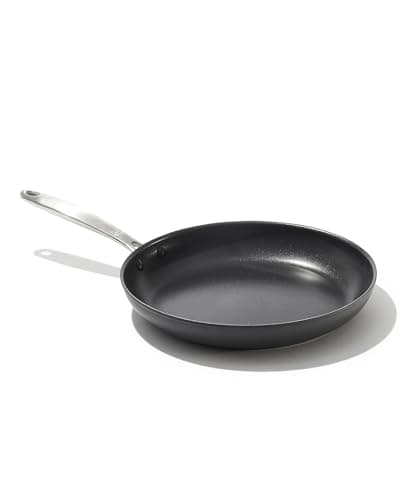
Published specifications for the OXO Good Grips Pro Hard-Anodized Nonstick Fry Pan, 10 in
Body
Hard-anodized aluminum
Coating
Three-layer PTFE nonstick, published PFOA-free
Oven maximum
430F published for the line
Induction
No on the standard hard-anodized line
Dishwasher
Dishwasher safe
Edge
Rolled, for pouring without dripping down the side
Coating lifespan
Not published
Good
The rolled pour edge is a small thing you notice every single time you use it
The hard-anodized body resists the denting that ruins cheap aluminum pans
Handle stays cool and does not rotate the way riveted plastic ones eventually do
Not good
Not induction compatible
Oven ceiling capped by the handle, not the pan
Still a coating, still a consumable, still no published lifespan
The trade-off. The handle that makes it comfortable is a stainless-and-silicone assembly, and that is what caps the oven rating below the body's own limit.
Skip this if. You need induction. The standard hard-anodized body is not ferrous.
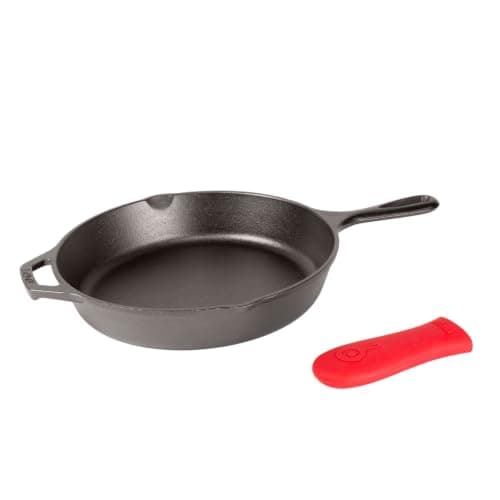
Published specifications for the Lodge Seasoned Cast Iron Skillet, 10.25 in (L8SK3)
Diameter
10.25 in
Weight
5.66 lb
Oven maximum
550F
Induction
Yes - bare iron is ferrous
Seasoning
Pre-seasoned with soy-based vegetable oil, no synthetic chemicals
Warranty
Lifetime
Made in
USA
Care
Hand wash. Lodge's own instructions permit warm soapy water
Good
Effectively unbreakable and fully restorable - a rusted one can be stripped and re-seasoned
Holds heat better than anything else at the price, which is what a sear needs
Lodge publishes its seasoning method openly, so the maintenance is not a mystery
Not good
Heavy
Heats unevenly on a small burner: cast iron conducts at roughly 50 W/m-K, so it is slow to spread and slow to react
Bare iron is reactive; long tomato braises will taste of it
The trade-off. It weighs 5.66 lb empty. You will feel that every time you move it full, and it is the single most common reason a cast iron skillet ends up in a cupboard.
Skip this if. You have wrist or shoulder trouble, or you cook mostly acidic braises. Carbon steel does most of the same jobs at roughly half the weight.
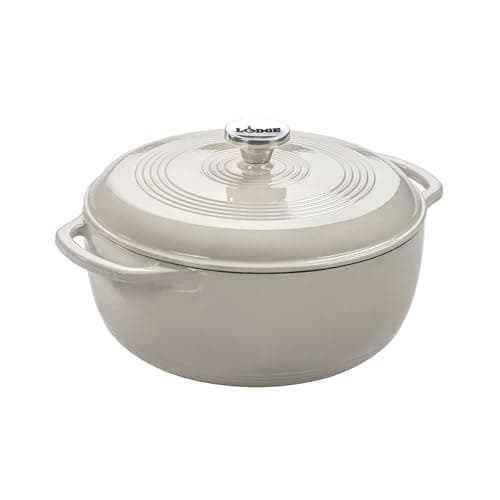
Published specifications for the Lodge Enameled Cast Iron Dutch Oven, 6 qt
Material
Cast iron with porcelain enamel, inside and out
Capacity
6 qt
Induction
Yes - the iron under the enamel is ferrous
Seasoning
None required - enamel is not a seasoning surface
Acid
Safe for tomato and wine, unlike bare iron
Oven maximum
Set by the knob material - check the specific SKU; Lodge publishes a lower ceiling than for bare iron
Good
Non-reactive, so it handles the acidic cooking bare iron cannot
No seasoning to maintain
Considerably cheaper than the French enameled pots it copies
Not good
Chipped enamel is not repairable, unlike bare iron's seasoning
Oven ceiling is lower than bare cast iron because of the knob
Heavy, and the enamel makes it heavier than bare iron of the same capacity
The trade-off. The enamel is a glass layer. Chip it and the pot is not restorable the way bare iron is, and Lodge's enamel chips more readily than the premium brands'.
Skip this if. You already own a large stainless stockpot and rarely braise. This duplicates it for most weeknight cooking.
Hung, laid flat alone in a drawer, or stacked with a felt protector or cloth between them. Never stack a bare pan directly on a coated surface - the rim of the pan above scratches the coating below, and that damage is permanent.
›Can you stack cast iron pans?
Yes, provided they are completely dry. Put a paper towel between them, which absorbs condensation and prevents metal-on-metal scraping. The usual cause of rust in stored cast iron is a warm, slightly damp pan going into a closed cupboard.
›Where should you store pot lids?
On edge in a rack or divider, separately from the pans. A lid stored on its pan is what stops a set from nesting, and it also traps moisture inside the pan.
›Is hanging pots and pans a good idea?
It is the best option for coated pans because nothing touches the cooking surface, and the highest-density option in a small kitchen. Check what the rail is anchored into first - cast iron and enameled cast iron are a serious load.
›Should you store a Dutch oven with the lid on?
No. Rest the lid ajar or store it separately. A sealed enameled pot traps moisture, and on bare cast iron that is how rust starts.
Sources
Every figure on this page came from one of these. Follow them and check our arithmetic — that is the point.