Heads up: some links on this page earn us a commission at no extra cost to you. It does not change what we recommend or the order. How we are funded.
The short answer
Replace a pan when the fault is structural or when the surface cannot be restored: a warped base that rocks, a loose or cracked handle, flaking nonstick, chipped enamel with iron showing, or pitting through a stainless interior. Do not replace a pan for discoloration, rainbow staining, burnt-on residue, or rust on bare iron and carbon steel - all four are cosmetic or recoverable, and rust in particular looks far worse than it is.
One question sorts almost every case
Is the fault in the structure of the pan, or on its surface? Structural faults end a pan: it no longer sits flat, the handle is no longer safely attached, the metal is cracked or holed. Surface faults are usually recoverable, and the exception - a coating - is recoverable only by replacement, because a coating cannot be reapplied at home.
What you are seeing
Verdict
Why
Base rocks or spins on a flat cooktop
Replace
A warped base cannot be flattened and it will never heat evenly again
Nonstick flaking or peeling in sheets
Replace
A coating cannot be reapplied. Food is now cooking on bare aluminum
Nonstick just not releasing any more
Replace when it annoys you
Worn release is the coating's normal end of life, not a defect
Handle loose, wobbling, or rivets weeping
Replace
This is the fault most likely to cause an actual injury
Enamel chipped with dark iron showing inside
Replace
Enamel cannot be repaired and bare iron under enamel rusts and can shed chips
Enamel stained or crazed but intact
Keep
Cosmetic. Le Creuset publishes that pale interiors stain permanently
Stainless interior pitted with small dark craters
Replace
Usually salt added to cold water. The passive layer is breached locally
Stainless discolored, rainbow or cloudy
Keep
Purely cosmetic and reversible with an acid wash
Burnt-on residue, however bad
Keep
Recoverable. Four methods, none of which need replacement
Cast iron rusted, even heavily
Keep
Fully recoverable. Rust is the least serious fault on this list
Cast iron cracked, or a chunk missing
Replace
The only genuine end of a cast iron pan
Warped thin nonstick that spins on the hob
Replace
Common on thin aluminum. It will not flatten
Structural faults sit in the top rows. Everything cosmetic is recoverable, and most people replace far too early on those.
Nonstick: the pan you are supposed to replace
No manufacturer publishes a coating lifespan - not one, across any of the ledger's coated pans - and that silence is the single most important fact about buying nonstick. It is examined at length in how long nonstick lasts.
The practical consequence is that nonstick should be bought as a consumable. A cheap pan replaced every couple of years costs less over a decade than an expensive one replaced every four years, and neither is a failure. What matters is the state of the coating, not its age:
Replace now if the coating is flaking, blistering or peeling in visible pieces.
Replace soon if eggs stick to a properly preheated, properly oiled pan.
Do not replace for light surface scratches with no lifting. Release is what matters, not appearance.
A worn coating is not a safety event. What ends the pan is that it has stopped doing the one job you bought it for. The evidence on the safety question, including scratched pans, is set out in is nonstick cookware safe.
Stainless: almost never, and two exceptions
Clad stainless is the material most likely to outlive its owner and most likely to be thrown away for no reason. Discoloration, blue-gold rainbow staining and white chalky spots are all cosmetic and all reversible - the methods are in cleaning burnt stainless. Food sticking is a technique problem covered in why food sticks to stainless steel, not a worn-out pan.
The two real exceptions are pitting and delamination. Pitting - small dark craters, usually from salt dropped into cold water - is localized corrosion through the passive chromium oxide layer, and it does not heal. Delamination, where a disc-bottom pan's base separates from its body, is terminal and is one more argument for fully clad construction.
Cast iron and carbon steel: the rules are different
These are the two materials where almost nothing is fatal. A pan found rusted solid in a garage is restorable to better-than-new, and the process is in restoring rusty cast iron. A stripped, blotchy or sticky seasoning is re-done rather than replaced - seasoning carbon steel and cast iron seasoning and care both cover it.
What genuinely ends one: a crack, a hole, or a warp severe enough that the pan spins on a flat cooktop. Carbon steel warps far more readily than cast iron because it is thin, and a mild warp on a gas ring is livable while the same warp on induction or a smooth top is not. That distinction is covered in carbon steel problems and fixes.
Enameled cast iron: the chip decides it
Enamel is glass fused to iron, and once it chips there is no home repair and no manufacturer repair. The question is where the chip is:
Inside the cooking area, with dark iron visible: retire it from cooking. The exposed iron rusts and the chip edge can shed.
On the outside or the rim: cosmetic. Keep using it. Rim chips are the most common complaint on every budget enameled pot.
Crazed - a fine crack network in an otherwise intact glaze: normal aging, not a failure.
Stained pale interior: normal, and Le Creuset publishes that it is permanent.
Before you replace, check the warranty
Several faults on this page are warranty claims rather than purchases. Cuisinart and Tramontina carry lifetime warranties on their clad lines, All-Clad a limited lifetime, Lodge a lifetime warranty, and Le Creuset and Staub limited lifetime terms. Coating wear is excluded almost everywhere - Calphalon publishes a lifetime warranty that explicitly excludes it - but a loose handle or a delaminating base is exactly what these terms exist for. What the words mean and what they exclude is unpacked in cookware warranties explained.
Replacing well
Replace like for like only if it worked. If a coated set died in three years, the replacement should probably not be another coated set.
Replace one pan, not the kitchen. Sets fail piece by piece and open stock exists for this.
Keep the survivors. A dead nonstick pan does not mean the stockpot beside it is finished.
If it is only the coating that has gone, a single replacement skillet is a smaller purchase than a set and usually the right one.
What to buy, if you are buying
These are the products this page's reasoning actually points at. Same rules as everywhere else on the site: published specs, a stated trade-off, and a live price only where one exists.
Top pick · The one you are meant to replaceSpecs read September 3, 2026
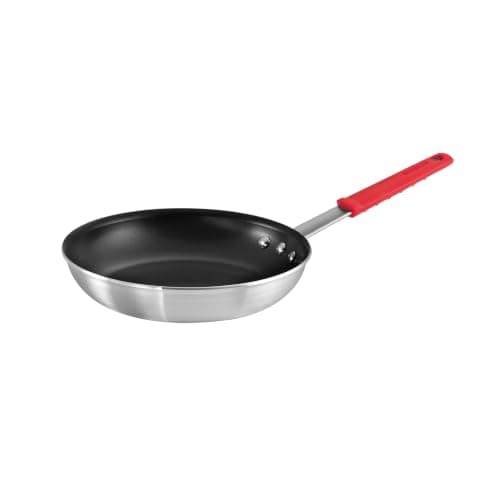
Tramontina Professional Restaurant Fry Pan, 10 in
Cheap enough that replacing it every couple of years is a plan rather than a failure, which is the only honest way to own nonstick.
Best for: Eggs, pancakes and fish, in a kitchen that also owns a stainless or iron pan
Published specifications for the Tramontina Professional Restaurant Fry Pan, 10 in
Body
Heavy-gauge aluminum
Coating
PTFE nonstick
Induction
No - aluminum body is not ferrous
Coating lifespan
Not published, by this or any nonstick maker
Good
Cheap enough that replacing it every couple of years is a real plan rather than a failure
Heavy gauge for a nonstick pan, so it does not warp on the first hot burner
Silicone handle sleeve that actually stays cool
Not good
Not induction compatible
PTFE, which some buyers will rule out on principle
No published coating lifespan, so the value case is unverifiable by design
The trade-off. It is PTFE. That is fine at normal cooking temperatures, and it is not a pan to preheat empty on high.
Skip this if. You want to avoid PTFE entirely. Buy ceramic instead and accept the shorter release life rather than pretending either one lasts forever.
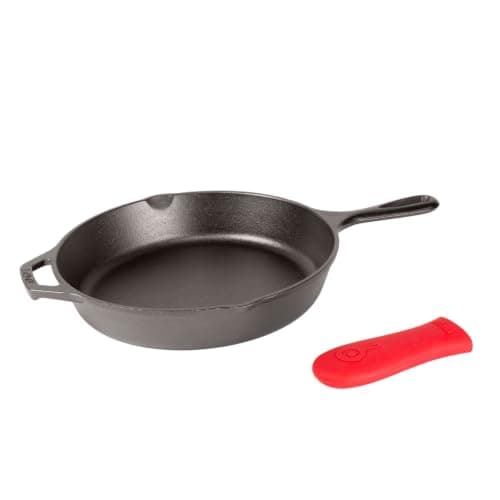
Published specifications for the Lodge Seasoned Cast Iron Skillet, 10.25 in (L8SK3)
Diameter
10.25 in
Weight
5.66 lb
Oven maximum
550F
Induction
Yes - bare iron is ferrous
Seasoning
Pre-seasoned with soy-based vegetable oil, no synthetic chemicals
Warranty
Lifetime
Made in
USA
Care
Hand wash. Lodge's own instructions permit warm soapy water
Good
Effectively unbreakable and fully restorable - a rusted one can be stripped and re-seasoned
Holds heat better than anything else at the price, which is what a sear needs
Lodge publishes its seasoning method openly, so the maintenance is not a mystery
Not good
Heavy
Heats unevenly on a small burner: cast iron conducts at roughly 50 W/m-K, so it is slow to spread and slow to react
Bare iron is reactive; long tomato braises will taste of it
The trade-off. It weighs 5.66 lb empty. You will feel that every time you move it full, and it is the single most common reason a cast iron skillet ends up in a cupboard.
Skip this if. You have wrist or shoulder trouble, or you cook mostly acidic braises. Carbon steel does most of the same jobs at roughly half the weight.
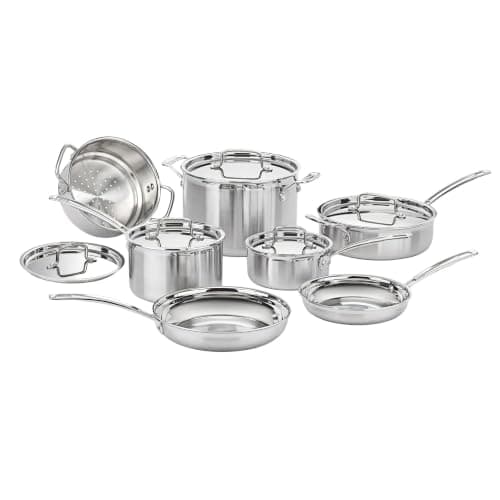
Published specifications for the Cuisinart MultiClad Pro MCP-12N 12-Piece Set
Construction
Tri-ply: 18/10 stainless interior, pure aluminum core, brushed stainless exterior
Pieces
1.5 and 3 qt covered saucepans; 8 in and 10 in skillets; 3.5 qt covered saute; 8 qt covered stockpot; steamer insert
Oven maximum
500F per the Cuisinart use-and-care manual, which the Amazon listing we cite now matches. Major retail listings still advertise 550F; Cuisinart has confirmed the manual figure
Induction
Yes
Dishwasher
Dishwasher safe
Handles
Riveted solid stainless, cool-grip profile
Warranty
Lifetime
Good
Heat runs up the sidewalls, not just across the base
Genuinely dishwasher safe, which the pricier clad brands often are not
Lifetime warranty on a set at this price
Not good
Published oven maximum contradicts the retail listing for the same product
Handle spine is divisive
No 12-inch skillet in the box, which is the pan most people reach for second
The trade-off. The cool-grip handles have a sharp spine that some people find uncomfortable on a full 8-quart stockpot.
Skip this if. You want the higher oven ceiling that major retail listings advertise. The manual says 500F and Cuisinart has confirmed the manual is correct.
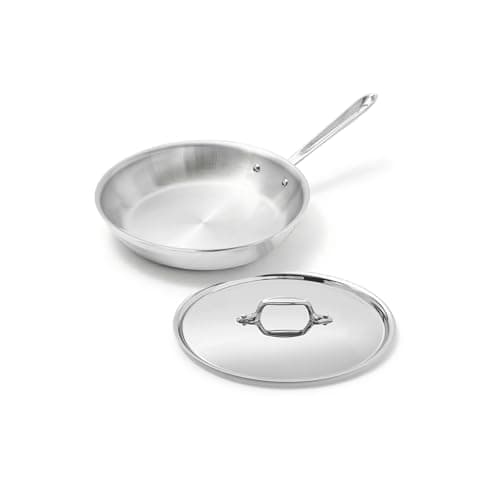
Published specifications for the All-Clad D3 Stainless 10 in Fry Pan
Construction
Fully bonded tri-ply, aluminum core
Oven maximum
600F, oven and broiler safe
Induction
Yes - compatible with any stovetop
Dishwasher
Handwash only (All-Clad published)
Handle
Double-riveted stainless
Weight
3.0 lb (model 4110)
Warranty
Limited lifetime
Made in
Bonded, engineered and assembled in Canonsburg, PA
Good
600F is the highest oven ceiling of any stainless pan on this site
The one pan here whose manufacturing location is published down to the town
Genuinely repairable-adjacent: rivets are the only failure point and the warranty covers them
Not good
Hand wash only
The flared rim makes it a poor pan for anything with liquid
Costs several times what a Tramontina or Cuisinart pan of the same construction costs
The trade-off. Hand wash only. All-Clad publishes that plainly, and it is a real daily cost on a pan you will use every day.
Skip this if. You want a dishwasher-safe pan, or you are buying a whole kitchen on a fixed budget - one D3 skillet costs what a full clad set can cost.
When the coating is flaking, blistering or peeling, or when food sticks in a properly preheated and oiled pan. Light surface scratches with no lifting are not a reason to replace it. No manufacturer publishes a coating lifespan, so the pan's condition is the only guide.
›Can a warped pan be fixed?
No, not reliably. A base that rocks or spins on a flat cooktop will not sit flat again, and it will never heat evenly. Thin aluminum nonstick pans warp most readily; thick cast iron almost never does.
›Is rusty cast iron ruined?
No. Rust is the least serious fault a pan can have. Surface rust scrubs off and a full re-season restores even a pan that has been left outside. Only a crack or a missing chunk genuinely ends a cast iron pan.
›Should you replace a stainless pan that has turned rainbow colored?
No. Rainbow staining and cloudy white spots on stainless are cosmetic and reversible with an acid wash. The two faults that do end a stainless pan are pitting - small dark craters - and a disc bottom separating from the body.
›Is chipped enamel on a Dutch oven dangerous?
A chip inside the cooking area exposing dark iron means retiring the pot from cooking, because the exposed iron rusts and the chip edge can shed. Chips on the outside or the rim are cosmetic. Enamel cannot be repaired at home or by the manufacturer.
Sources
Every figure on this page came from one of these. Follow them and check our arithmetic — that is the point.