Heads up: some links on this page earn us a commission at no extra cost to you. It does not change what we recommend or the order. How we are funded.
The short answer
At normal cooking temperatures, yes. PTFE is authorized for food contact under 21 CFR 177.1550 and the FDA states that "studies show negligible amounts of PFAS in this coating can migrate to food." The genuine caution is never heating an empty coated pan, because an overheated coating degrades and can produce fumes - which are dangerous to pet birds long before they affect people.
Four terms that get used interchangeably and should not be
Most of the confusion in this subject is vocabulary. Sorting it out settles most of the question.
Term
What it means
Status
PFAS
A class of thousands of per- and polyfluoroalkyl substances
A serious environmental concern; the class spans everything from firefighting foam to pan coatings
PTFE
Polytetrafluoroethylene - the specific fluoropolymer used in nonstick pans
A PFAS. FDA-authorized for food contact under 21 CFR 177.1550
PFOA
A processing aid formerly used to make PTFE
Phased out of US manufacturing. Not present in pans made today
Teflon
A brand name for PTFE, owned by Chemours
A trademark, not a material
A headline about PFAS in drinking water is not a headline about your frying pan, even though PTFE is technically in the class.
What the FDA says
The FDA has authorized specific PFAS for food-contact applications since the 1960s, across four categories: nonstick coatings, sealing gaskets, manufacturing aids, and grease-proofing agents for paper packaging.
On nonstick cookware coatings specifically, the FDA states: "Studies show negligible amounts of PFAS in this coating can migrate to food."
On the manufacturing process, the agency explains that polymerization at very high temperature "removes virtually all the smaller (i.e., migratable) PFAS molecules, resulting in negligible amounts of PFAS capable of migrating to food." The molecules that could migrate are driven off during manufacture; what remains is a large, stable polymer that stays where it is.
The January 2025 action, and what it was actually about
The FDA announced that 35 food contact notifications for PFAS-containing substances were "no longer effective based on the abandonment of these uses", noting that these presented migration concerns because "there is potential for PFAS to migrate to food at levels that may result in a potential safety concern."
Those notifications were for grease-proofing agents applied to paper and paperboard food packaging: takeout boxes, wrappers, microwave popcorn bags. That is a genuinely different application from a polymerized coating bonded to metal, and the FDA treated it differently for that reason.
Cookware coatings were not part of that action and PTFE remains authorized. If you see this cited as evidence that regulators have moved against nonstick pans — and you will, frequently, on ceramic cookware listings — that is a misreading.
What the EPA says, and why it is a different question
The EPA describes PFAS as "widely used, long lasting chemicals, components of which break down very slowly over time", notes that "there are thousands of PFAS chemicals", and that because of their persistence "many PFAS are found in the blood of people and animals all over the world".
This is an environmental and public-health concern about a chemical class, driven principally by contamination of water supplies and by manufacturing and disposal. It is serious and it is real.
It is also a different question from whether an intact pan in your kitchen is putting PFAS into your dinner, which the FDA addresses directly and answers with "negligible". Both statements are accurate. If you avoid PTFE on manufacturing and disposal grounds, that is a coherent position — just be clear that it is the argument you are making.
The genuine risk: overheating
This is where the practical caution lives, and it is about temperature rather than chemistry.
PTFE is stable through the entire range of normal cooking. Heated well beyond that — the sort of temperature an empty pan reaches on a high burner within a couple of minutes — it begins to degrade and release fumes. In people this can cause temporary flu-like symptoms, sometimes called polymer fume fever; in pet birds, whose respiratory systems are far more sensitive, it can be fatal.
The rules that follow are short:
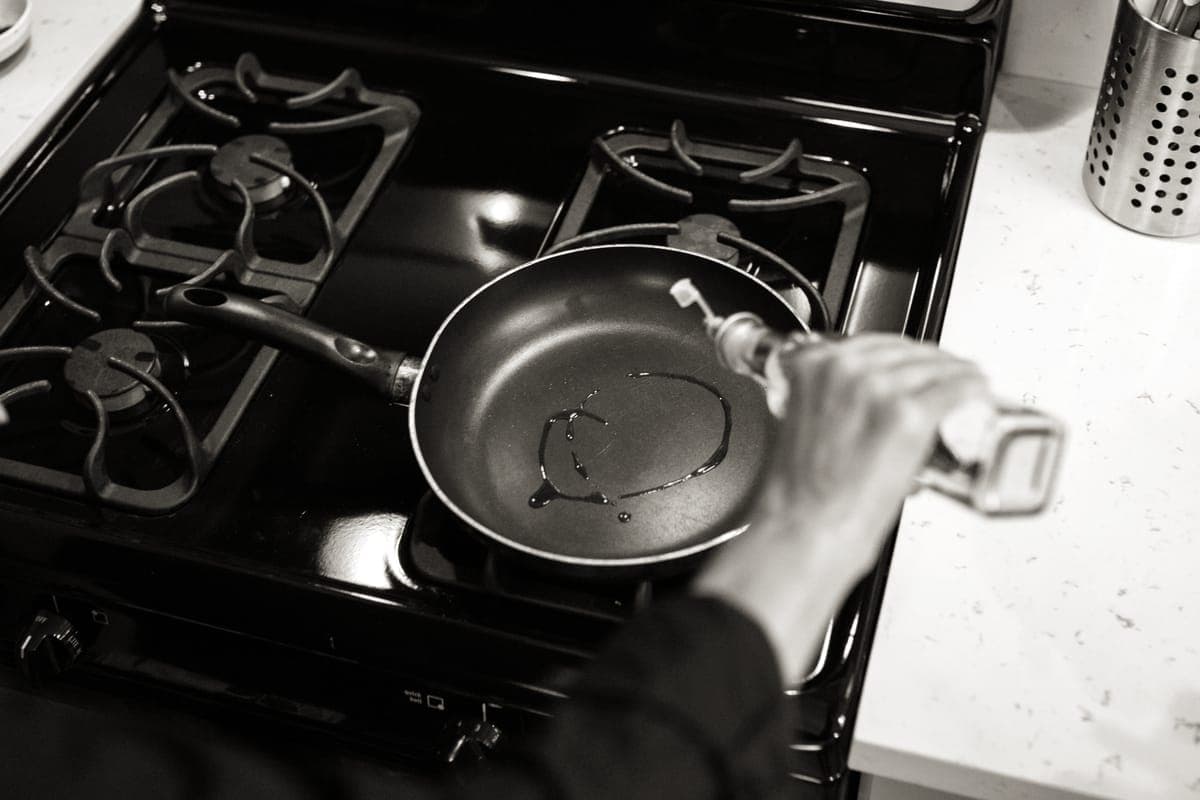
Never preheat a coated pan empty. Put the fat in first. This one rule prevents nearly every real-world case.
Medium heat only. These pans are for eggs and delicate fish. Sear in stainless or cast iron.
Never broil in one, and do not put one under a grill element.
Ventilate. Extractor on, window open. Good practice regardless of what you are cooking in.
Keep pet birds out of the kitchen while you cook. Not a nonstick issue specifically — birds are sensitive to cooking fumes generally — but this is the one exposure caution that is not overstated.
Fat in the pan before the heat goes on. That single habit removes the main hazard of coated cookware.
Is a scratched nonstick pan dangerous?
Not in the way people fear. PTFE is chemically inert and biologically inactive — flakes that come off in food pass through the body without being absorbed. The problem with a scratched pan is that it has stopped doing its job.
Replace it because food is sticking, not because you think you are being poisoned. And use wooden or silicone utensils to delay that day, since a coating is the pan.
The unanswered question, again
No PTFE maker publishes how long the coating lasts, exactly as no ceramic maker does. That silence is consistent across the whole category and it is the reason the recommendation on this site is always the same: buy one coated pan, cheaply, treat it well, and replace it without regret.
An expensive coated pan is a wear item at a keepsake price. Picks in the best nonstick pans.
If you would rather avoid it entirely
Perfectly reasonable, and there are two routes. Ceramic gives you release without fluoropolymer, at the cost of a shorter release life — see is ceramic cookware safe. Uncoated cookware sidesteps the question completely: clad stainless, cast iron and carbon steel have no coating to worry about at all.
What you give up by going fully uncoated is honest to state: nothing releases an omelette like a coated pan, and a properly seasoned iron pan does not change that. Most kitchens are best served by uncoated cookware for everything plus one cheap coated pan for eggs.
What to buy, if you are buying
These are the products this page's reasoning actually points at. Same rules as everywhere else on the site: published specs, a stated trade-off, and a live price only where one exists.
Top pick · PTFE, bought sensiblySpecs read September 3, 2026
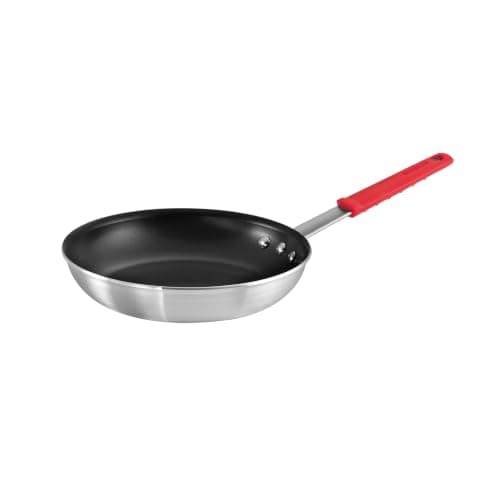
Tramontina Professional Restaurant Fry Pan, 10 in
Cheap enough to replace before it degrades, which is the practical answer to most of the concerns on this page.
Best for: Eggs, pancakes and fish, in a kitchen that also owns a stainless or iron pan
Published specifications for the Tramontina Professional Restaurant Fry Pan, 10 in
Body
Heavy-gauge aluminum
Coating
PTFE nonstick
Induction
No - aluminum body is not ferrous
Coating lifespan
Not published, by this or any nonstick maker
Good
Cheap enough that replacing it every couple of years is a real plan rather than a failure
Heavy gauge for a nonstick pan, so it does not warp on the first hot burner
Silicone handle sleeve that actually stays cool
Not good
Not induction compatible
PTFE, which some buyers will rule out on principle
No published coating lifespan, so the value case is unverifiable by design
The trade-off. It is PTFE. That is fine at normal cooking temperatures, and it is not a pan to preheat empty on high.
Skip this if. You want to avoid PTFE entirely. Buy ceramic instead and accept the shorter release life rather than pretending either one lasts forever.
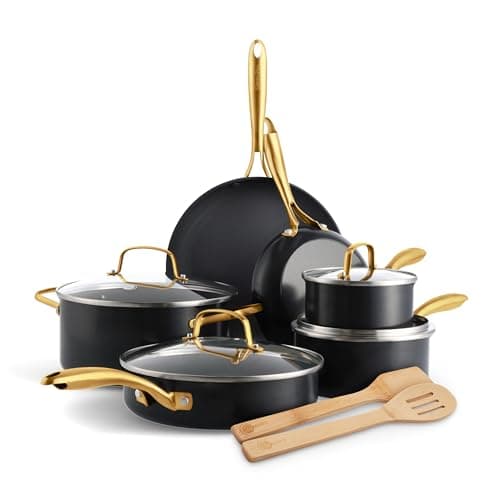
Published specifications for the GreenPan Ceramic Nonstick Cookware Set
Coating
Thermolon, from sand-derived Silicon Dioxide (SiO2), sprayed
Coating chemistry
PFAS-free, PFOA-free, free of lead and cadmium (GreenPan published)
Coating heat resistance
850F / 450C for the coating itself (GreenPan published)
Body oven maximum
Varies by line and is lower than the coating figure - check the specific line
Coating lifespan
Not published. No ceramic maker publishes one
Good
GreenPan publishes what the coating is made of in plain terms, which most ceramic brands do not
The coating will not release fumes if you overheat it the way PTFE can
Genuinely good release when new
Not good
Release degrades and nobody will tell you how fast
The 850F figure is for the coating, not the pan, and gets quoted as if it were the pan
Ceramic dislikes high heat and dishwashers, which is most of what a set gets used for
The trade-off. Ceramic nonstick loses release with use and no maker publishes a lifespan, GreenPan included. Treat it as a consumable, not a lifetime purchase.
Skip this if. You are buying a set expecting it to last as long as clad stainless. It will not, and the honest move is to buy one ceramic pan alongside a stainless set.
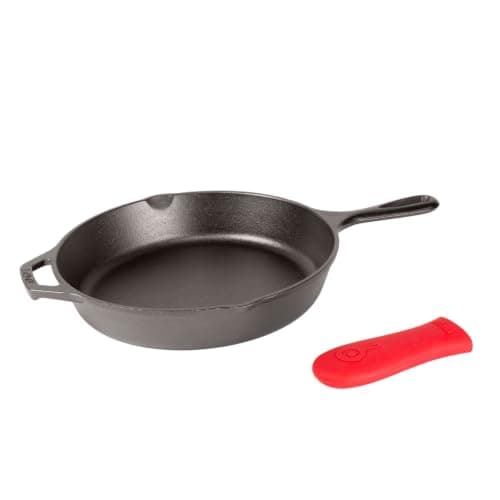
Published specifications for the Lodge Seasoned Cast Iron Skillet, 10.25 in (L8SK3)
Diameter
10.25 in
Weight
5.66 lb
Oven maximum
550F
Induction
Yes - bare iron is ferrous
Seasoning
Pre-seasoned with soy-based vegetable oil, no synthetic chemicals
Warranty
Lifetime
Made in
USA
Care
Hand wash. Lodge's own instructions permit warm soapy water
Good
Effectively unbreakable and fully restorable - a rusted one can be stripped and re-seasoned
Holds heat better than anything else at the price, which is what a sear needs
Lodge publishes its seasoning method openly, so the maintenance is not a mystery
Not good
Heavy
Heats unevenly on a small burner: cast iron conducts at roughly 50 W/m-K, so it is slow to spread and slow to react
Bare iron is reactive; long tomato braises will taste of it
The trade-off. It weighs 5.66 lb empty. You will feel that every time you move it full, and it is the single most common reason a cast iron skillet ends up in a cupboard.
Skip this if. You have wrist or shoulder trouble, or you cook mostly acidic braises. Carbon steel does most of the same jobs at roughly half the weight.
At normal cooking temperatures, yes. PTFE is authorized for food contact under 21 CFR 177.1550 and the FDA states that studies show negligible amounts of PFAS in the coating can migrate to food. The genuine caution is overheating an empty pan.
›Is Teflon the same as PFAS?
Teflon is a brand name for PTFE, which is one specific fluoropolymer within the PFAS class of thousands of chemicals. A headline about PFAS in drinking water is not a statement about an intact frying pan.
›What happens if you overheat a nonstick pan?
Well above normal cooking temperatures the coating degrades and can release fumes, which can cause temporary flu-like symptoms in people and can be fatal to pet birds. Never preheat a coated pan empty, and keep the heat at medium.
›Is it safe to use a scratched nonstick pan?
PTFE is chemically inert and flakes pass through the body without being absorbed, so it is not a poisoning risk. The reason to replace a scratched pan is that it has stopped releasing food.
›Does PFOA still exist in nonstick pans?
No. PFOA was a processing aid used to manufacture PTFE and has been phased out of US manufacturing. Pans made today are not produced with it, which is why every listing says PFOA-free.
Sources
Every figure on this page came from one of these. Follow them and check our arithmetic — that is the point.