Heads up: some links on this page earn us a commission at no extra cost to you. It does not change what we recommend or the order. How we are funded.
The short answer
Hard-anodized cookware is safe in normal use, and the reason is that your food almost never touches the anodized aluminum. Anodizing converts the surface of the aluminum into a hard, sealed oxide layer, and on virtually every hard-anodized pan sold there is then a nonstick coating on top of that. So the safety question is the coating's safety question, not aluminum's - which means heat limits and scratches, not leaching. Bare anodized aluminum, as used in some bakeware, is also stable and far less reactive than plain aluminum.
Two questions, asked as one
"Is hard-anodized cookware safe" bundles two completely different concerns, and keeping them apart is most of the answer.
Is the aluminum a health problem? This is the question people mean, and it is largely a non-issue on a coated pan because food does not contact the aluminum.
Is the coating a health problem? This is the question that actually matters, and it is the same question you would ask of any nonstick pan - is nonstick safe.
What anodizing actually does
Anodizing is an electrochemical process that grows a layer of aluminum oxide out of the metal itself. It is not a coating applied on top - it is converted surface, which is why it cannot chip or peel the way a coating can. Hard anodizing runs the process longer and colder to build a thicker, denser layer, which is what makes the pan gray-black and much harder than raw aluminum.
Two useful consequences. The oxide layer is chemically stable and far less reactive than bare aluminum, so an anodized surface does not pit and discolor the way a bare aluminum pan does when acidic food sits in it - cooking acidic foods and reactive cookware. And the harder body resists denting and warping better than plain aluminum of the same thickness.
The sentence that resolves most confusion, and it is worth repeating: hard anodizing hardens the aluminum body. It does nothing whatsoever to the coating on top of it. A hard-anodized pan is not a more durable nonstick surface.
The aluminum question, addressed directly
Aluminum is everywhere in cooking - it is the core of nearly every clad stainless pan, it is what almost all sheet pans are made from, and it is in foil and in many baking pans. The concern people are usually reaching for is a historical association between dietary aluminum and neurological disease, which is not supported as a cookware issue by the regulatory bodies that look at food contact materials.
On a coated hard-anodized pan the point is close to moot anyway: the coating is between the food and the metal. If you want to reason about aluminum exposure, bare aluminum pans and uncoated aluminum bakeware are the relevant cases, not anodized ones - and anodized is the more stable of the two. Non-toxic bakeware addresses the bakeware side, and healthiest cookware materials ranks the whole field.
The coating question, which is the real one
Almost every hard-anodized pan on sale has a PTFE coating. That brings the category's genuine considerations, none of which have anything to do with anodizing:
Concern
The accurate position
Overheating
The real risk. PTFE degrades and off-gasses when badly overheated - an empty pan on high is how that happens.
Scratches
Flakes of PTFE are inert and pass through the body. The reason to replace a scratched pan is lost release, not poisoning.
PFOA
Phased out of US manufacturing years ago. Every modern pan qualifies, so the claim distinguishes nothing.
PFAS generally
PTFE is itself a fluoropolymer. If your objection is to the whole class, a PTFE pan does not satisfy it regardless of the body.
Published lifespan
Nobody publishes one, in any material, at any price - and every warranty in the category excludes coating wear.
Our audits found that no coated cookware maker we checked - Calphalon, OXO, T-fal, GreenPan or Tramontina - publishes a coating lifespan. How long nonstick lasts is the honest version of that, and nonstick coating names decoded translates what the branded names actually describe.
What the makers actually publish
Disclosure quality varies sharply inside the category, and it is the most useful way to choose between otherwise similar pans.
Calphalon publishes a 450F ceiling and states its multi-layer PTFE is metal-utensil safe. That is the most anyone in the category commits to - the Calphalon review.
OXO publishes a three-layer coating as PFOA-free and a 430F ceiling, and does not publish metal-utensil safety - so use silicone, nylon or wood - the OXO review.
Circulon publishes raised circles and thirty-five years of the design, and does not publish what its surface is actually made of - the Circulon review.
A brand that will not name its coating chemistry is telling you something, and it is the single most useful signal available when the bodies are all the same gray-black aluminum - how to read a cookware listing.
The anodized body is underneath. This is the surface your food touches, and it is the one the safety question is really about.
Using one safely, which is simple
Never preheat it empty on high. This is the entire safety protocol. Fat or food in the pan keeps the surface temperature well below anything that matters.
Then hard-anodized is the wrong shelf to be shopping on, because the anodizing is not the part you are objecting to. The options that actually address it:
Ceramic coatings, which are silica-based rather than fluoropolymer - and which wear faster - is ceramic cookware safe.
These are the products this page's reasoning actually points at. Same rules as everywhere else on the site: published specs, a stated trade-off, and a live price only where one exists.
Top pick · Best documented hard-anodized panSpecs read September 3, 2026
Calphalon Premier Hard-Anodized Nonstick Fry Pan, 10 in
450F published, multi-layer PTFE published as metal-utensil safe - the most disclosure anyone in the coated category offers.
Best for: A nonstick pan in a kitchen where the utensil drawer is not going to be policed
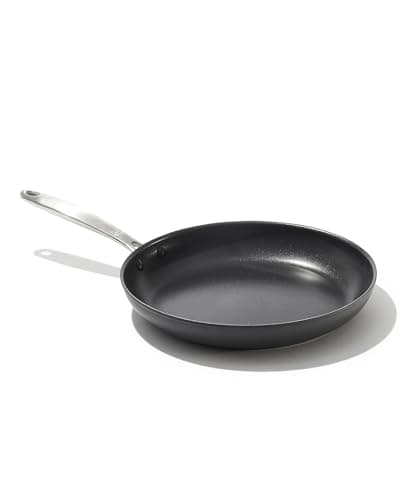
Published specifications for the OXO Good Grips Pro Hard-Anodized Nonstick Fry Pan, 10 in
Body
Hard-anodized aluminum
Coating
Three-layer PTFE nonstick, published PFOA-free
Oven maximum
430F published for the line
Induction
No on the standard hard-anodized line
Dishwasher
Dishwasher safe
Edge
Rolled, for pouring without dripping down the side
Coating lifespan
Not published
Good
The rolled pour edge is a small thing you notice every single time you use it
The hard-anodized body resists the denting that ruins cheap aluminum pans
Handle stays cool and does not rotate the way riveted plastic ones eventually do
Not good
Not induction compatible
Oven ceiling capped by the handle, not the pan
Still a coating, still a consumable, still no published lifespan
The trade-off. The handle that makes it comfortable is a stainless-and-silicone assembly, and that is what caps the oven rating below the body's own limit.
Skip this if. You need induction. The standard hard-anodized body is not ferrous.
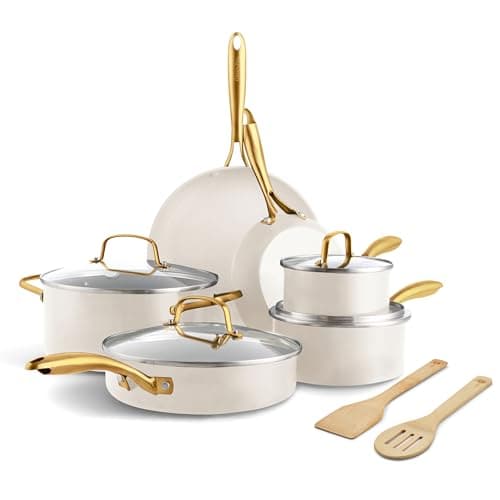
Published specifications for the GreenPan Ceramic Nonstick Cookware Set
Coating
Thermolon, from sand-derived Silicon Dioxide (SiO2), sprayed
Coating chemistry
PFAS-free, PFOA-free, free of lead and cadmium (GreenPan published)
Coating heat resistance
850F / 450C for the coating itself (GreenPan published)
Body oven maximum
Varies by line and is lower than the coating figure - check the specific line
Coating lifespan
Not published. No ceramic maker publishes one
Good
GreenPan publishes what the coating is made of in plain terms, which most ceramic brands do not
The coating will not release fumes if you overheat it the way PTFE can
Genuinely good release when new
Not good
Release degrades and nobody will tell you how fast
The 850F figure is for the coating, not the pan, and gets quoted as if it were the pan
Ceramic dislikes high heat and dishwashers, which is most of what a set gets used for
The trade-off. Ceramic nonstick loses release with use and no maker publishes a lifespan, GreenPan included. Treat it as a consumable, not a lifetime purchase.
Skip this if. You are buying a set expecting it to last as long as clad stainless. It will not, and the honest move is to buy one ceramic pan alongside a stainless set.
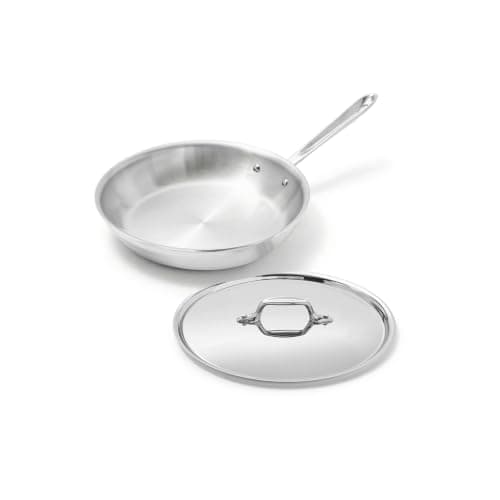
Published specifications for the All-Clad D3 Stainless 10 in Fry Pan
Construction
Fully bonded tri-ply, aluminum core
Oven maximum
600F, oven and broiler safe
Induction
Yes - compatible with any stovetop
Dishwasher
Handwash only (All-Clad published)
Handle
Double-riveted stainless
Weight
3.0 lb (model 4110)
Warranty
Limited lifetime
Made in
Bonded, engineered and assembled in Canonsburg, PA
Good
600F is the highest oven ceiling of any stainless pan on this site
The one pan here whose manufacturing location is published down to the town
Genuinely repairable-adjacent: rivets are the only failure point and the warranty covers them
Not good
Hand wash only
The flared rim makes it a poor pan for anything with liquid
Costs several times what a Tramontina or Cuisinart pan of the same construction costs
The trade-off. Hand wash only. All-Clad publishes that plainly, and it is a real daily cost on a pan you will use every day.
Skip this if. You want a dishwasher-safe pan, or you are buying a whole kitchen on a fixed budget - one D3 skillet costs what a full clad set can cost.
Yes in normal use. Food almost never touches the anodized aluminum, because virtually every hard-anodized pan has a nonstick coating on top of it. That makes the real safety question the coating's - heat limits and scratches - rather than a question about aluminum leaching.
›Does hard-anodized cookware leach aluminum?
Not meaningfully. Anodizing converts the surface into a stable, sealed aluminum oxide layer that is far less reactive than bare aluminum, and on a coated pan the coating sits between the food and the metal anyway. Bare aluminum pans are the relevant case for that concern, not anodized ones.
›Is hard-anodized the same as nonstick?
No, and conflating them is the most common mistake in the category. Hard anodizing hardens the aluminum body underneath. The nonstick property comes from a separate coating applied on top, and anodizing does nothing to make that coating last longer.
›Is scratched hard-anodized cookware dangerous?
Not in the way people fear - PTFE is inert and flakes pass through the body without being absorbed. The reason to replace a scratched pan is that it has stopped releasing food. Exposed anodized aluminum underneath is stable and not a hazard either.
›What temperature is hard-anodized cookware safe to?
Whatever the maker publishes for the coating, not for the metal. Calphalon publishes 450F and OXO publishes 430F on the pans we audited. Never use a coated pan under a broiler, and never preheat one empty on high heat.
Sources
Every figure on this page came from one of these. Follow them and check our arithmetic — that is the point.