Heads up: some links on this page earn us a commission at no extra cost to you. It does not change what we recommend or the order. How we are funded.
The short answer
Hard-anodized is worth the premium if you want a coated pan that stays flat and resists denting for years, and if you are buying from a brand that publishes a high oven ceiling and metal-utensil safety. It is not worth it if you assumed the anodizing makes the nonstick last longer - it does not, and the coating is still the part that wears out and decides the pan's life. If you replace coated pans every few years anyway, plain heavy-gauge aluminum costs less and fails at the same time.
What the premium actually buys
Hard anodizing is a real manufacturing process with a real cost, and it delivers three things:
A harder, denser body. The pan resists denting, and it holds its shape under heat better than plain aluminum of the same gauge. Fewer warped pans - why pans warp.
A far less reactive surface. Where the coating is worn or absent, the anodized oxide layer does not pit and discolor in acidic food the way bare aluminum does.
Usually a higher oven ceiling. The pans that publish 430F to 450F tend to be the hard-anodized ones, and the ceiling is set by the coating and handle rather than the anodizing - but the categories correlate.
What it does not buy, and this is the important part
Hard anodizing hardens the aluminum body. It does nothing to the coating on top. The nonstick surface on a hard-anodized pan wears out on exactly the same timetable as the nonstick surface on a cheap aluminum pan, because it is the same kind of surface doing the same job under the same abuse.
This matters because the coating, not the body, is what ends a coated pan's useful life. Nobody throws away a nonstick pan because the body dented. They throw it away because eggs started sticking. How long nonstick lasts makes the case that no manufacturer publishes a lifespan for it, at any price.
The marketing does not say "the coating lasts longer." It says the pan is harder and more durable, which is true of the body. The inference that the whole pan therefore lasts longer is the reader's, and it is wrong.
The arithmetic that decides it
Your situation
Worth the premium?
You replace coated pans every 2-3 years regardless
No - both pans fail at the same time. Buy plain aluminum.
You want a coated pan that looks decent for years
Yes - the body is what stays presentable.
You want the highest published oven ceiling
Yes, in practice - the 450F pans are hard-anodized.
You use metal utensils
Only if metal-utensil safety is published. Calphalon publishes it; OXO does not.
You have induction
Check first - many anodized aluminum lines are not compatible.
You cook acidic food in a worn pan
Yes - anodized does not pit where plain aluminum will.
You want one pan to last a decade
No - buy clad stainless or carbon steel instead.
The induction catch
Aluminum is not magnetic, so hard-anodized lines need a bonded steel disc to work on induction, and many do not have one. This trips up more buyers than any other specification in the category, because the pans look premium and heavy and the listing often does not mention it. The magnet test settles it in a second - nonstick cookware for induction and cookware for induction.
The two honest alternatives
Plain heavy-gauge aluminum, bought cheap on purpose
If the coating is the wear part and the coating is the same, then the cheapest competent body is the rational purchase. Commercial aluminum pans are light, heat fast, and cost little enough that replacement is a plan rather than a failure. This is what professional kitchens do, for exactly this reason - restaurant cookware for home kitchens.
Skip the coating entirely
The other direction is to stop buying a wear surface. Clad stainless and seasoned carbon steel both have no coating to fail, and both outlive any coated pan by a wide margin. The trade is technique - why food sticks to stainless steel - and in carbon steel's case, maintenance - is carbon steel worth it.
This is how a coated pan ends, hard-anodized or not. The body is usually still fine.
The verdict
Buy hard-anodized when you have decided you want a coated pan and you want the best-built version of one - and buy it from the brand that publishes the most, because inside the category the bodies are nearly interchangeable and the disclosure is not.
Do not buy it expecting to escape the replacement cycle. That is not what it does, and the only ways to escape the cycle are to stop buying coated pans or to accept them as consumables and stop paying a premium for them - are expensive pans worth it runs the same argument across the whole kitchen.
The premium, the value, and the way out
Two hard-anodized pans worth the money, the plain-aluminum counter-argument, and the pan that has no wear surface at all.
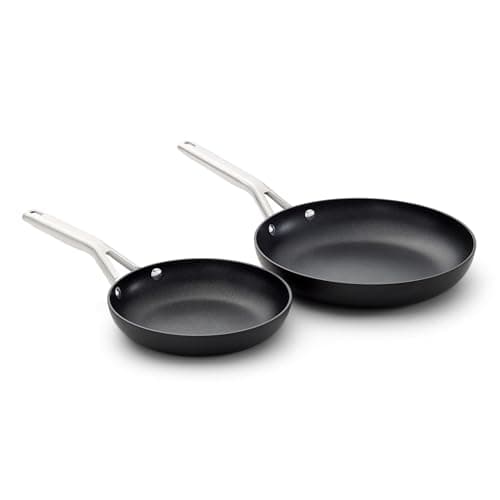
Calphalon Premier Hard-Anodized Nonstick Fry Pan, 10 in
A nonstick pan in a kitchen where the utensil drawer is not going to be policed
These are the products this page's reasoning actually points at. Same rules as everywhere else on the site: published specs, a stated trade-off, and a live price only where one exists.
Top pick · Where the premium is justifiedSpecs read September 3, 2026
Calphalon Premier Hard-Anodized Nonstick Fry Pan, 10 in
Hard-anodized body, 450F published, metal-utensil safety published - you are paying for disclosure and a high ceiling, both of which are real.
Best for: A nonstick pan in a kitchen where the utensil drawer is not going to be policed
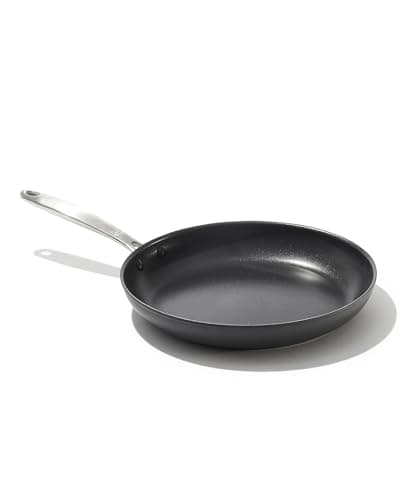
Published specifications for the OXO Good Grips Pro Hard-Anodized Nonstick Fry Pan, 10 in
Body
Hard-anodized aluminum
Coating
Three-layer PTFE nonstick, published PFOA-free
Oven maximum
430F published for the line
Induction
No on the standard hard-anodized line
Dishwasher
Dishwasher safe
Edge
Rolled, for pouring without dripping down the side
Coating lifespan
Not published
Good
The rolled pour edge is a small thing you notice every single time you use it
The hard-anodized body resists the denting that ruins cheap aluminum pans
Handle stays cool and does not rotate the way riveted plastic ones eventually do
Not good
Not induction compatible
Oven ceiling capped by the handle, not the pan
Still a coating, still a consumable, still no published lifespan
The trade-off. The handle that makes it comfortable is a stainless-and-silicone assembly, and that is what caps the oven rating below the body's own limit.
Skip this if. You need induction. The standard hard-anodized body is not ferrous.
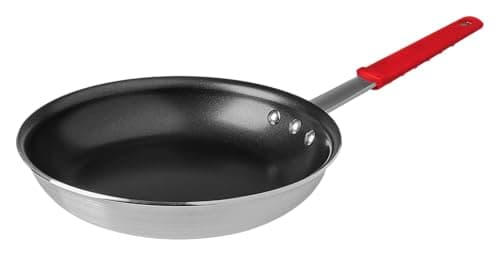
Published specifications for the Tramontina Professional Restaurant Fry Pan, 10 in
Body
Heavy-gauge aluminum
Coating
PTFE nonstick
Induction
No - aluminum body is not ferrous
Coating lifespan
Not published, by this or any nonstick maker
Good
Cheap enough that replacing it every couple of years is a real plan rather than a failure
Heavy gauge for a nonstick pan, so it does not warp on the first hot burner
Silicone handle sleeve that actually stays cool
Not good
Not induction compatible
PTFE, which some buyers will rule out on principle
No published coating lifespan, so the value case is unverifiable by design
The trade-off. It is PTFE. That is fine at normal cooking temperatures, and it is not a pan to preheat empty on high.
Skip this if. You want to avoid PTFE entirely. Buy ceramic instead and accept the shorter release life rather than pretending either one lasts forever.
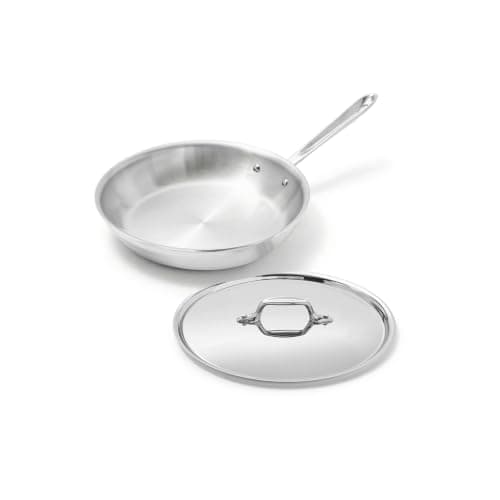
Published specifications for the All-Clad D3 Stainless 10 in Fry Pan
Construction
Fully bonded tri-ply, aluminum core
Oven maximum
600F, oven and broiler safe
Induction
Yes - compatible with any stovetop
Dishwasher
Handwash only (All-Clad published)
Handle
Double-riveted stainless
Weight
3.0 lb (model 4110)
Warranty
Limited lifetime
Made in
Bonded, engineered and assembled in Canonsburg, PA
Good
600F is the highest oven ceiling of any stainless pan on this site
The one pan here whose manufacturing location is published down to the town
Genuinely repairable-adjacent: rivets are the only failure point and the warranty covers them
Not good
Hand wash only
The flared rim makes it a poor pan for anything with liquid
Costs several times what a Tramontina or Cuisinart pan of the same construction costs
The trade-off. Hand wash only. All-Clad publishes that plainly, and it is a real daily cost on a pan you will use every day.
Skip this if. You want a dishwasher-safe pan, or you are buying a whole kitchen on a fixed budget - one D3 skillet costs what a full clad set can cost.
It is if you want a coated pan with a body that resists denting and warping and a high published oven ceiling. It is not if you expected the nonstick to last longer - anodizing hardens the aluminum body and does nothing to the coating, which is the part that actually wears out.
›Does hard-anodized nonstick last longer?
No. The coating on a hard-anodized pan wears out on the same timetable as the coating on a cheap aluminum pan, because it is the same kind of surface doing the same job. What lasts longer is the body, and the body is not what makes people replace the pan.
›Is hard-anodized better than stainless steel?
Different rather than better. Hard-anodized releases food without technique and needs replacing when the coating goes. Clad stainless needs preheating technique but has no wear surface and lasts indefinitely. For one pan kept for a decade, stainless wins on cost per year.
›Does hard-anodized cookware work on induction?
Only if it has a bonded magnetic base, and many anodized aluminum lines do not. Aluminum is not magnetic, so compatibility depends on added steel. Test with a refrigerator magnet against the base - if it grips firmly, the pan will work.
›Can you use metal utensils on hard-anodized pans?
Only where the maker publishes it. Calphalon publishes metal-utensil safety for its multi-layer coating; OXO does not publish it for its three-layer coating. The anodized body is hard, but the coating on top of it is what a metal edge damages.
Sources
Every figure on this page came from one of these. Follow them and check our arithmetic — that is the point.