Heads up: some links on this page earn us a commission at no extra cost to you. It does not change what we recommend or the order. How we are funded.
The short answer
Professional kitchens buy light bare aluminum saute pans, aluminum sheet pans, plain stainless stockpots and inexpensive high-carbon knives, because equipment there is a consumable bought on cost per replacement rather than on longevity. Sheet pans, tongs, plastic-handled knives and sizing discipline transfer beautifully to a home kitchen. Bare aluminum pans and the no-nonstick policy mostly do not, because your constraints are not a restaurant's.
Why professional kitchens buy differently
A restaurant pan is used twenty times a day by people who did not buy it, washed in a machine that runs at temperatures no domestic dishwasher reaches, stacked hot, dropped, and replaced on a schedule. The purchasing logic follows: buy cheap, buy light, buy many, replace often, and never buy anything whose loss would hurt.
A home pan is used a few times a week by the person who bought it, washed by hand, and expected to last a decade or more. Those are opposite optimization problems, which is why "what restaurants use" is useful information and terrible advice when applied wholesale.
What is actually on the shelf in a commercial kitchen
Item
What professionals use
Why
Saute pans
Bare or coated aluminum, thin, light
Fast to heat, light to toss all shift, cheap to replace
Sheet pans
Bare aluminum half and full sheets
Universal size, stackable, indestructible enough
Stockpots
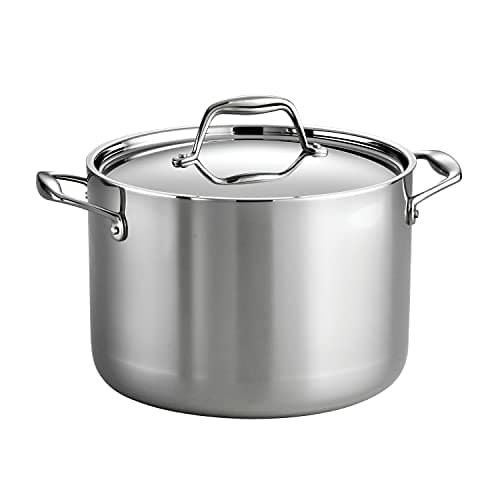
Plain stainless, disc bottom, very large
Nothing sticks in stock, so cladding is wasted money
The pattern across every row is replaceability, not performance.
What genuinely transfers
The half sheet pan
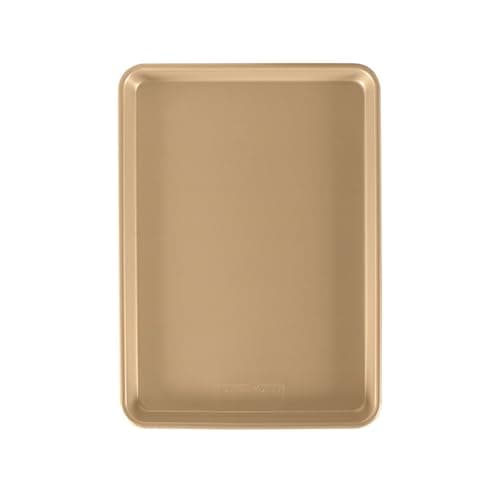
This is the clearest case. The pan a restaurant uses and the pan you should own are literally the same object: bare aluminum, rimmed, standardized. It is cheap, it lasts, it does roasting, baking, resting, organizing and marinating, and professionals use dozens of them a day for a reason - best sheet pans.
Buying by size rather than by set
No restaurant has ever bought a twelve-piece matching set. They buy the sizes they need in the quantities they need, and replace individual pieces. Open stock is the professional model and it is usually the better home model too - set versus open stock.
The cheap knife
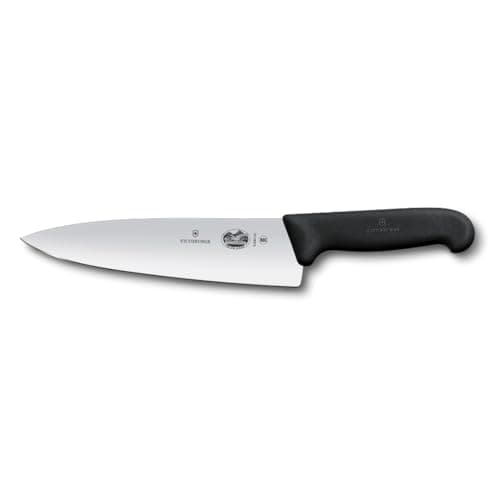
The plastic-handled Victorinox Fibrox is in more professional kitchens than any prestige brand, because it takes an edge, is easy to sharpen, is sanitary and costs little enough to replace without thought. There is no home reason to spend more unless you want to - best chef knives.
Tongs, and the general point about tools
Professionals use a small number of tools constantly rather than a drawer of specialists. Spring tongs, a fish spatula, a bench scraper and a good peeler do most of it - best tongs and turners, and what you actually need makes the same argument for pans.
Mise en place
Not cookware, but the highest-value thing on this list. Prepping everything into small containers before the heat goes on is the entire reason professional cooking looks calm, and it costs nothing - best mixing bowls.
What does not transfer
Bare aluminum pans. They are light and fast, and they are reactive: cook tomato, wine or lemon in one and you get a metallic taste and a discolored pan. Restaurants accept this because pans are replaced constantly and acidic work goes in stainless. At home it is a real limitation - cooking acidic foods and reactive cookware.
The no-nonstick culture. Professionals avoid coated pans because commercial dish machines destroy them, not because coatings are bad. Your dishwasher is gentler and your eggs will be better - best nonstick pans for eggs.
Volume sizing. An eight-quart stockpot is small in a restaurant and large at home. Scale to your actual household - how many pans you need.
Burner output. Commercial ranges put out several times the heat of a domestic hob, which is why thin pans work there and why recipes written for them stall at home. Thermal mass compensates for weak burners, which is the opposite conclusion - cookware for electric stoves.
Buying cheap on purpose. The logic depends on high replacement frequency. At home, a pan used twice a week for fifteen years has an entirely different cost per use - are expensive pans worth it.
The word "commercial" on a home-retail listing is unregulated and usually decorative. Genuine restaurant-supply equipment is identifiable by being plainer, heavier on specifications and lighter on adjectives than the consumer version.
Restaurant-supply listings read like parts catalogs. That is a feature - the specifications are there because buyers compare them.
Buying from a restaurant supplier
It is entirely possible, and often good value. A few things to expect:
No sets. Everything is sold individually, which is the point.
Plainer finishes. Brushed, unpolished, unbranded. Nothing is styled.
NSF certification marks, which certify sanitation and cleanability rather than cooking performance.
Sizes in quarts and inches, stated plainly, and usually measured more honestly than consumer listings.
Handles that get hot. Commercial pans often have bare metal handles and silicone sleeves are bought separately.
No warranty theater. Equipment is expected to wear out.
The professional logic, in home-retail form
Each of these is chosen the way a restaurant would choose it: on job, size and replaceability rather than on prestige.
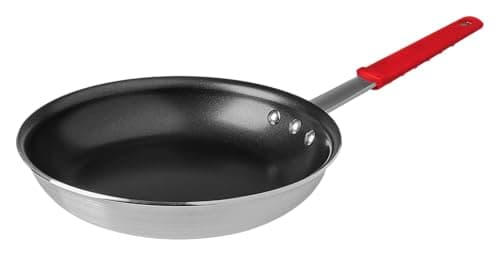
Tramontina Professional Restaurant Fry Pan, 10 in
Eggs, pancakes and fish, in a kitchen that also owns a stainless or iron pan
These are the products this page's reasoning actually points at. Same rules as everywhere else on the site: published specs, a stated trade-off, and a live price only where one exists.
Top pick · The commercial line you can actually buySpecs read September 3, 2026
Tramontina Professional Restaurant Fry Pan, 10 in
The restaurant-supply pattern in a home-retail box: light aluminum, silicone sleeve, priced to be replaced rather than treasured.
Best for: Eggs, pancakes and fish, in a kitchen that also owns a stainless or iron pan
Published specifications for the Tramontina Professional Restaurant Fry Pan, 10 in
Body
Heavy-gauge aluminum
Coating
PTFE nonstick
Induction
No - aluminum body is not ferrous
Coating lifespan
Not published, by this or any nonstick maker
Good
Cheap enough that replacing it every couple of years is a real plan rather than a failure
Heavy gauge for a nonstick pan, so it does not warp on the first hot burner
Silicone handle sleeve that actually stays cool
Not good
Not induction compatible
PTFE, which some buyers will rule out on principle
No published coating lifespan, so the value case is unverifiable by design
The trade-off. It is PTFE. That is fine at normal cooking temperatures, and it is not a pan to preheat empty on high.
Skip this if. You want to avoid PTFE entirely. Buy ceramic instead and accept the shorter release life rather than pretending either one lasts forever.
Published specifications for the Nordic Ware Naturals Half Sheet, 18 x 13 in
Exterior dimensions
17.9 x 12.9 x 1 in
Material
Aluminum
Rim
Encapsulated steel rim
Gauge
Not published by Nordic Ware
Warranty
Lifetime
Dishwasher
Hand wash recommended. Automatic dishwasher use is not advised
Made in
America of domestic and imported materials
Good
Aluminum conducts at 237 W/m-K, which is why it browns evenly and a steel pan does not
The encapsulated steel rim is the reason it does not warp in a hot oven
Lifetime warranty on a pan this cheap
Not good
Nordic Ware does not publish a gauge figure, so thickness cannot be compared like for like
Bare aluminum stains and reacts with acid
Not dishwasher safe by the maker's own advice
The trade-off. Bare aluminum discolors and reacts with acid. It will look used within a month and Nordic Ware advises against the dishwasher.
Skip this if. You want a pan that stays looking new, or you will not hand wash. Buy an aluminized-steel coated pan instead and accept the coating as a wear item.
Published specifications for the Victorinox Fibrox Chef's Knife Extra Wide, 8 in
Blade length
7.9 in
Overall length
13.4 in
Weight
6.4 oz
Handle
Thermoplastic elastomer (TPE)
Edge
Straight edge
Blade steel
Not published by Victorinox
Hardness (HRC)
Not published
Dishwasher
Yes (Victorinox published)
Made in
Switzerland
Warranty
Lifetime
Good
Swiss manufacture and a lifetime warranty, both published
6.4 oz is light for an 8 in chef's knife, which matters over a long prep session
Published dishwasher safe, which almost no premium knife maker will say
Not good
No published steel grade and no published hardness figure
A stamped blade with no bolster - it will not feel like a forged German knife
The TPE handle is grippy and unlovely
The trade-off. Victorinox publishes the handle material, the weight and the country - and not the steel grade or the hardness. You are buying a reputation on that point, not a number.
Skip this if. You want a forged knife with a bolster and heft. This is a stamped blade with a plastic handle and it feels like one.
Mostly light bare or coated aluminum saute pans, bare aluminum sheet pans, plain stainless stockpots and saucepans, and inexpensive plastic-handled knives. The common thread is replaceability rather than performance, because commercial equipment is a consumable used dozens of times a day.
›Should I buy restaurant cookware for home use?
Some of it. Sheet pans, tongs, cheap sharp knives and buying open stock rather than sets all transfer well. Bare aluminum pans mostly do not, because they react with acidic food, and the no-nonstick habit exists because of commercial dishwashers rather than because coatings are bad.
›Why do chefs use cheap knives?
Because a knife in a professional kitchen is sharpened constantly, washed harshly and occasionally lost, so cost per replacement matters more than prestige. A plastic-handled high-carbon stainless knife takes a good edge, is easy to sharpen and is sanitary, which is all the job requires.
›Is commercial cookware better quality?
Different rather than better. It is built for cleanability, stackability and replacement, and is usually plainer and lighter than consumer cookware at a similar price. The word commercial on a home-retail listing, by contrast, is unregulated and usually decorative.
›Why do restaurants not use cast iron?
It is too heavy for line work, too slow to change temperature, and it needs seasoning maintenance that a commercial dish pit destroys. Where it appears, it is usually for serving rather than cooking, such as fajita platters and skillet desserts.
Sources
Every figure on this page came from one of these. Follow them and check our arithmetic — that is the point.