Heads up: some links on this page earn us a commission at no extra cost to you. It does not change what we recommend or the order. How we are funded.
The short answer
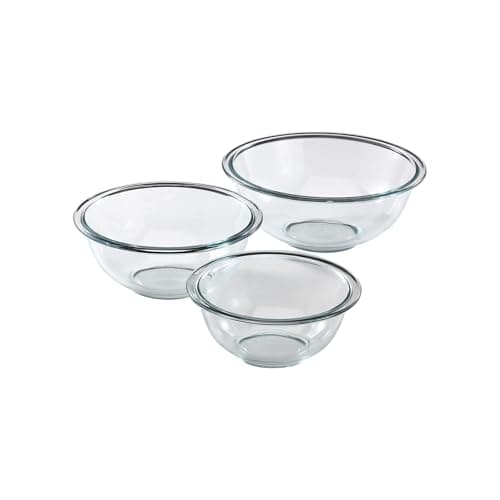
Buy a nesting set of three glass bowls if you want one set to do everything: the Pyrex 3-piece publishes 1, 1.5 and 2.5 quart sizes in tempered glass, dishwasher and microwave safe, nesting to save space. Buy stainless instead if you whip by hand or carry bowls around a kitchen — it is far lighter and it will not shatter. Most kitchens end up with both, because the two materials fail in opposite ways.
Quick picks
The whole answer, on one screen. Tap a row to jump to the full write-up. Every pick below carries a stated trade-off further down — including the one at the top.
#
Product
Best for
Price
1
Pyrex 3-Piece Glass Mixing Bowl Set
1, 1.5 and 2.5 qt of tempered glass that nests, goes in the microwave and shows you the bottom of the bowl.
Prices last checked October 24, 2026. Prices move constantly — the number on Amazon when you click is the real one.
How we chose these
We have not mixed anything in them. This page compares published capacity, material, nesting, dishwasher and microwave guidance, and warranty terms. The method is here, and where a maker publishes nothing the product card says so.
Our audited ledger is deep in cookware and thin in prep tools, so the documented product on this page is the Pyrex set. Where the page recommends stainless or plastic it points at a tagged category search rather than naming a model we have not read specs for.
The three materials
Glass
Stainless
Plastic
Weight
Heavy
Very light
Light
Microwave
Yes
No, ever
Usually, check the item
Reactive with acid
No
No
No, but it stains
Absorbs odor and grease
No
No
Yes, over time
Survives a drop
No - it shatters
Yes, it dents
Yes
You can see the contents
Yes
No
Sometimes
Chills quickly for whipping cream
Slowly
Quickly - it is the reason to own one
Slowly
Nests
Usually
Usually, and tightest
Usually
Dishwasher
Pyrex publishes yes
Yes
Usually top rack
The microwave row and the drop row are the whole decision. Glass does one thing stainless cannot and fails at the other.
Glass is non-reactive and microwave safe, which means you can melt butter, temper chocolate or warm milk in the bowl you are about to mix in. That is a genuine workflow saving and it is why the Pyrex set is the pick.
Stainless is the professional default for a different reason: it weighs almost nothing, it chills fast in a refrigerator or over ice, and it survives being dropped. If you whip cream or egg whites by hand, a chilled stainless bowl is meaningfully better than a glass one.
Sizes worth owning
Around 1 quart. Dressings, a beaten egg, melted butter, spice mixes. The one used most often and the one people under-buy.
Around 1.5 to 2 quarts. Dry ingredients for a cake, a small batch of batter, marinating.
Around 2.5 to 3 quarts. The main mixing bowl — creaming butter and sugar, bread dough for one loaf, a salad for four.
5 quarts and up. Only if you make large batches of dough or salad for a crowd. It will not nest usefully with the rest.
The Pyrex set publishes exactly the first three: 1 qt, 1.5 qt and 2.5 qt, at 7, 8.5 and 10 inches across. That is the working range for a domestic kitchen.
Buy a set that nests. Bowls that do not nest are the single worst use of cupboard space in a kitchen, and it is the same storage arithmetic as pans and lids in how to store pots and pans.
What Pyrex publishes, and what it does not
The 3-piece set publishes tempered glass construction described as triple-layer-strong, the three capacities and their dimensions, nesting, dishwasher safety, microwave safety and a 2-year limited warranty.
Three absences worth knowing. There is no freezer guidance, no refrigerator guidance and no oven guidance on the product page — which matters because Pyrex bakeware does publish a thermal-shock rule, and a mixing bowl is glass in the same way. Treat the bakeware guidance in glass versus metal bakeware as the conservative default: no sudden temperature change, no hot bowl onto a wet counter.
The 2-year limited warranty is also notably shorter than the lifetime terms the metal bakeware brands offer, which is set out in our Pyrex review.
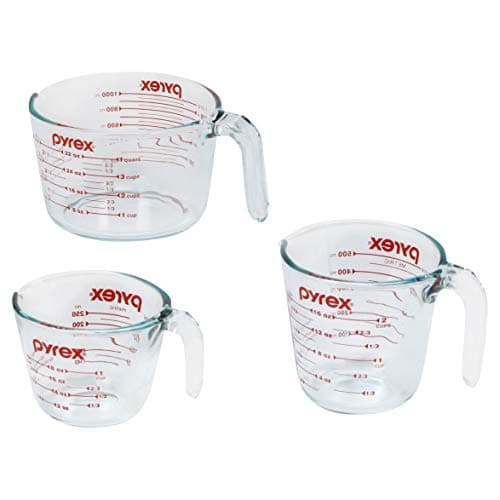
Bowls and measures are usually bought together and usually from the same material family. Glass for both is the simplest kitchen to run.
The features that are worth something
A non-slip base. On stainless and plastic bowls this is the single most useful feature, because a bowl that skates while you whisk needs a second hand you do not have.
A pouring lip. Rare on mixing bowls and genuinely useful for batter.
Lids. Turn a bowl into storage and remove a container from the cycle. The Pyrex 3-piece set does not include them; larger Pyrex sets do.
Wide, shallow shapes for folding; tall, narrow shapes for whipping. Most sets are a compromise and that is fine.
What to avoid
Melamine and decorative ceramic as working bowls. Heavy, chippable, and not microwave safe in many cases.
Very thin stainless. It flexes when you press on it and dents permanently.
Plastic for anything oily. It holds grease and odor, and no amount of washing fully reverses it.
Sets that do not nest, whatever they are made of.
Copper bowls bought for egg whites unless you know why you want one. They are a specialist purchase with real maintenance — best copper cookware covers what copper asks of you.
You whip by hand or carry bowls: add stainless — nesting stainless bowls, which we have not audited a specific model of.
You want storage as well: a glass set with lids, which Pyrex sells in larger counts.
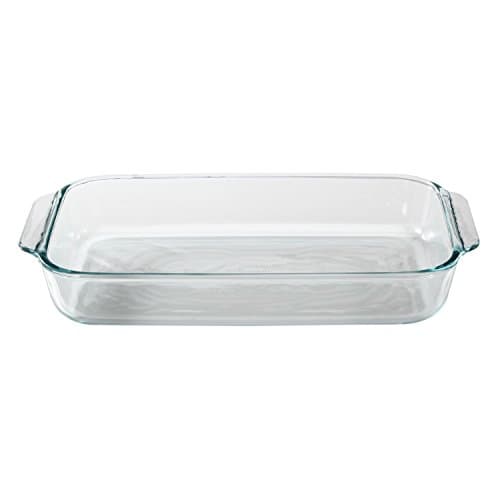
You need it to go in the oven: that is bakeware rather than a bowl — a glass baking dish.
The prep set, and the pieces that work with it
Every product here has published specifications we have read. Stainless bowls are recommended on this page as a category, via a tagged search, because we have not audited a model.
Pyrex 3-Piece Glass Mixing Bowl Set
Everyday prep, batters, and anything you want to microwave in the bowl you mixed it in
Each write-up below gives the published specs, what the pan is genuinely good at, what it costs you, and who should skip it. The trade-off line is there on the top pick too — a recommendation with no downside is an advertisement.
Top pick · Best mixing bowlsSpecs read September 3, 2026
Pyrex 3-Piece Glass Mixing Bowl Set
1, 1.5 and 2.5 qt of tempered glass that nests, goes in the microwave and shows you the bottom of the bowl.
Best for: Everyday prep, batters, and anything you want to microwave in the bowl you mixed it in
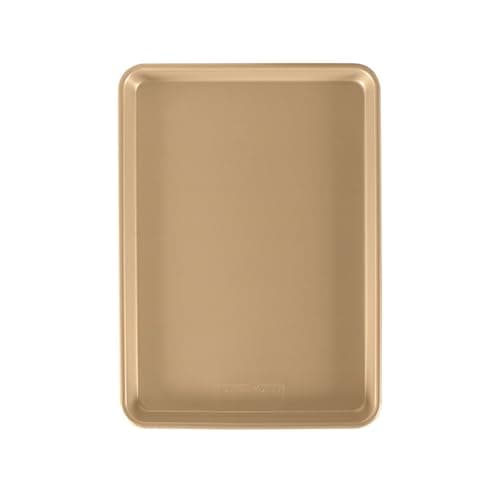
Published specifications for the Nordic Ware Naturals Half Sheet, 18 x 13 in
Exterior dimensions
17.9 x 12.9 x 1 in
Material
Aluminum
Rim
Encapsulated steel rim
Gauge
Not published by Nordic Ware
Warranty
Lifetime
Dishwasher
Hand wash recommended. Automatic dishwasher use is not advised
Made in
America of domestic and imported materials
Good
Aluminum conducts at 237 W/m-K, which is why it browns evenly and a steel pan does not
The encapsulated steel rim is the reason it does not warp in a hot oven
Lifetime warranty on a pan this cheap
Not good
Nordic Ware does not publish a gauge figure, so thickness cannot be compared like for like
Bare aluminum stains and reacts with acid
Not dishwasher safe by the maker's own advice
The trade-off. Bare aluminum discolors and reacts with acid. It will look used within a month and Nordic Ware advises against the dishwasher.
Skip this if. You want a pan that stays looking new, or you will not hand wash. Buy an aluminized-steel coated pan instead and accept the coating as a wear item.
A nesting set of three glass bowls covers the most ground - the Pyrex 3-piece publishes 1, 1.5 and 2.5 quart sizes in tempered glass, dishwasher and microwave safe. Add stainless if you whip by hand, because it is far lighter and chills quickly.
›Glass or stainless mixing bowls?
Glass is microwave safe and lets you see the contents; stainless weighs almost nothing, chills fast for whipping, and survives being dropped. They fail in opposite ways, which is why most kitchens end up with both.
›What sizes of mixing bowl do you need?
Three: around 1 quart for dressings and melted butter, around 1.5 to 2 quarts for dry ingredients, and around 2.5 to 3 quarts as the main mixing bowl. Anything above 5 quarts is a batch-cooking specialist that will not nest usefully.
›Can Pyrex mixing bowls go in the freezer or the oven?
The product page publishes dishwasher and microwave safety and does not publish freezer, refrigerator or oven guidance. Since Pyrex publishes a thermal-shock rule for its bakeware, treat that as the conservative default: no sudden temperature change.
›Are plastic mixing bowls fine?
For dry ingredients and light mixing, yes, and they are light and unbreakable. They absorb grease and odor over time in a way glass and stainless do not, so they are a poor choice for anything oily.
Sources
Every figure on this page came from one of these. Follow them and check our arithmetic — that is the point.