Heads up: some links on this page earn us a commission at no extra cost to you. It does not change what we recommend or the order. How we are funded.
The short answer
Copper conducts at roughly 401 watts per meter-kelvin against aluminum's 237 and stainless steel's 15 to 16, so it responds faster than anything else you can cook in. It also has to be lined - unlined copper reacts with acidic food - and tin linings wear and need replacing. For most kitchens, fully clad stainless with an aluminum core delivers most of the benefit with none of the maintenance. Buy copper if you make sugar work or delicate sauces and want the response; do not buy copper-colored anything.
Quick picks
The whole answer, on one screen. Tap a row to jump to the full write-up. Every pick below carries a stated trade-off further down — including the one at the top.
#
Product
Best for
Price
1
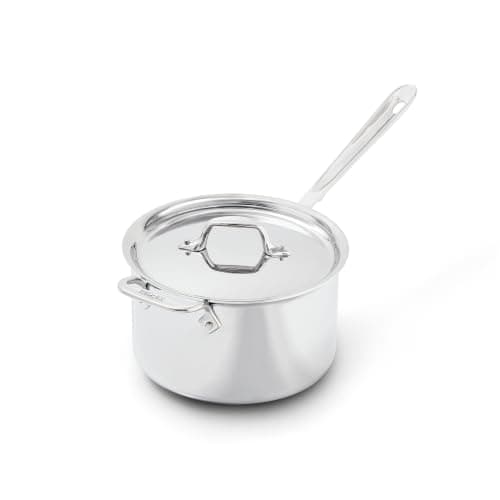
All-Clad D3 Stainless Saucepan, 3 qt
Fully clad with aluminum up the walls and a 600F ceiling - the response copper buyers want, without the lining problem.
Prices last checked October 23, 2026. Prices move constantly — the number on Amazon when you click is the real one.
What we can tell you here
Our audited product ledger contains no copper cookware — we only put a spec table on a product whose published specifications we have read, and the method is here. So this page explains the material honestly, recommends the audited pans that compete with it, and points at a tagged category search for copper itself rather than naming a model we cannot cite.
That is a real limitation and worth stating plainly rather than dressing a material explainer up as a product roundup.
The physics, which are not in dispute
Metal
Thermal conductivity
Relative to copper
Copper
401 W/m-K
The reference
Aluminum
237 W/m-K
About 59 percent
Cast iron (gray)
About 50 W/m-K
About 12 percent
Carbon steel
About 45 W/m-K
About 11 percent
Stainless type 304
15 to 16 W/m-K
About 4 percent
Copper genuinely is the best practical conductor in a kitchen. The question this page answers is what that buys you in cooking rather than in physics.
High conductivity means two things in practice: heat spreads across the base almost instantly, so there are no hot spots; and the pan responds to a change in burner setting immediately, so turning the heat down actually turns the food down.
Neither of those matters for boiling, braising or searing. Boiling is governed by the water, braising by thermal mass, and searing by stored heat — which is why a heavy cast iron pan out-sears a copper one, as set out in best pans for searing steak.
The two jobs copper genuinely wins
Sugar work
Caramel and confectionery live in narrow temperature bands where a few degrees is the difference between amber and burnt. Even heating with no hot spots is the whole game, and copper is the traditional material for exactly this reason.
Delicate sauces
Custards, hollandaise, beurre blanc — anything that splits or scrambles if one part of the pan runs ahead. Instant response means you can pull the temperature back before the eggs notice. The shape argument that pairs with it is in best sauciers.
If neither of those is regular in your kitchen, the case for copper is aesthetic. That is a legitimate reason to buy something, and it should be an admitted one.
The lining, which is the ownership problem
Copper reacts with acidic food, so cooking surfaces are lined. Which lining you get changes the pan completely.
Lining
Behavior
The catch
Tin
Traditional; slightly non-stick when new
Wears through and must be re-tinned by a specialist; melts around 450F
Stainless
Modern default; durable and low maintenance
Adds a poorly conducting layer, which blunts the copper advantage
Unlined
Used for sugar work and egg-white bowls only
Reacts with acid - not a general cooking surface
Nickel
Older lining, rare now
Wears like tin; nickel is a consideration for some buyers
Tin gives the best performance and the worst maintenance. Stainless gives the reverse - and a stainless-lined copper pan is closer to clad cookware than most buyers expect.
The nickel point matters if you are nickel-sensitive, which is the same consideration discussed for 18/10 stainless in is stainless steel cookware safe.
Thickness is the specification that matters
Serious copper cookware is 2 to 3 mm thick. Below about 1.5 mm the pan does not hold enough heat to be stable and the conductivity advantage is wasted on a thin shell that swings with the burner.
That is the specification to look for and it is frequently absent from listings — the same gap that makes carbon steel hard to compare, where de Buyer publishes 3 mm and most competitors publish nothing — blue steel versus black steel covers that pattern.
A thin copper pan with a stainless lining and a copper-colored exterior is not copper cookware in any meaningful sense. Which brings us to the real warning on this page.
Copper-colored is not copper
A large share of what sells as "copper cookware" is aluminum with a copper-toned exterior finish and a nonstick coating inside. There is no copper doing any thermal work at all. The pan is a coated aluminum pan wearing a color.
Copper-core clad — genuine, and usually a thin copper layer between aluminum layers whose thickness nobody publishes — copper core versus aluminum core.
A copper-toned base is a finish far more often than it is a conductor. Read the construction description rather than the color.
What copper asks of you
Polishing, if you want it bright. Copper tarnishes to brown within weeks. That is purely cosmetic and entirely optional — a tarnished pan cooks identically.
Hand washing. Dishwasher detergent is hard on copper and on tin.
Watching the heat, if it is tin-lined. Tin melts at a temperature a hot dry pan can reach, so no empty preheating and no searing.
Re-tinning eventually, which is a specialist service and a real ongoing cost.
Accepting it will not work on induction unless it has a magnetic base added, since copper is not ferromagnetic — cookware for induction.
The honest alternative
For nearly every domestic kitchen, fully clad stainless with an aluminum core is the right answer. Aluminum conducts at 59 percent of copper's rate, which is more than enough for even heating, and the pan is non-reactive, dishwasher tolerant, induction compatible and permanent.
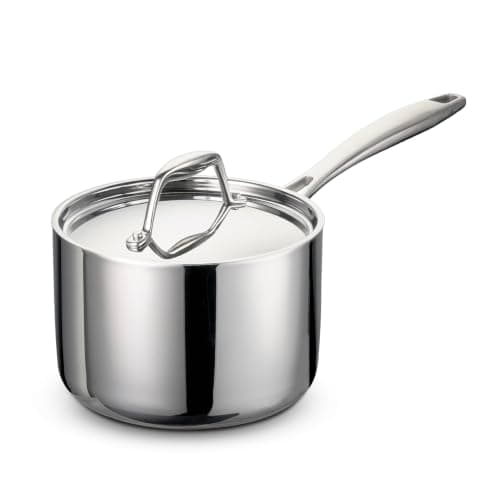
The shape where the difference is most visible is the saucepan, because it is mostly sidewall — which is why our picks lean that way. If you want to spend more, spend it on construction and shape rather than on a metal that will need re-tinning.
You make caramel or delicate sauces regularly and want copper: buy 2 to 3 mm, lined, from a maker that publishes the thickness.
You want the look: that is fine, and buy real copper rather than a copper-toned coated pan.
You are braising:enameled cast iron, where mass matters and conduction does not.
The audited pans copper competes with
We have not audited a copper pan, so none appears as a product card here. These are the clad and cast pieces that deliver most of what copper buyers are after.
All-Clad D3 Stainless Saucepan, 3 qt
Rice, custards and reductions - anything that scorches in a disc-bottom pan
Each write-up below gives the published specs, what the pan is genuinely good at, what it costs you, and who should skip it. The trade-off line is there on the top pick too — a recommendation with no downside is an advertisement.
Top pick · Best copper alternativeSpecs read September 3, 2026
All-Clad D3 Stainless Saucepan, 3 qt
Fully clad with aluminum up the walls and a 600F ceiling - the response copper buyers want, without the lining problem.
Best for: Rice, custards and reductions - anything that scorches in a disc-bottom pan
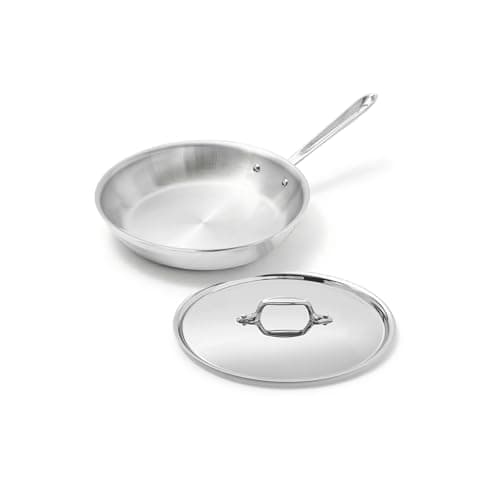
Published specifications for the All-Clad D3 Stainless 10 in Fry Pan
Construction
Fully bonded tri-ply, aluminum core
Oven maximum
600F, oven and broiler safe
Induction
Yes - compatible with any stovetop
Dishwasher
Handwash only (All-Clad published)
Handle
Double-riveted stainless
Weight
3.0 lb (model 4110)
Warranty
Limited lifetime
Made in
Bonded, engineered and assembled in Canonsburg, PA
Good
600F is the highest oven ceiling of any stainless pan on this site
The one pan here whose manufacturing location is published down to the town
Genuinely repairable-adjacent: rivets are the only failure point and the warranty covers them
Not good
Hand wash only
The flared rim makes it a poor pan for anything with liquid
Costs several times what a Tramontina or Cuisinart pan of the same construction costs
The trade-off. Hand wash only. All-Clad publishes that plainly, and it is a real daily cost on a pan you will use every day.
Skip this if. You want a dishwasher-safe pan, or you are buying a whole kitchen on a fixed budget - one D3 skillet costs what a full clad set can cost.
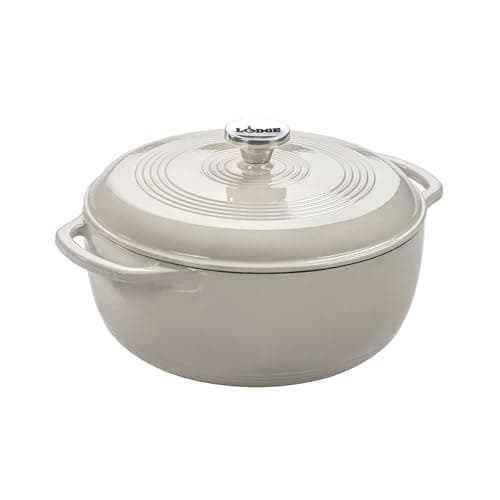
Published specifications for the Lodge Enameled Cast Iron Dutch Oven, 6 qt
Material
Cast iron with porcelain enamel, inside and out
Capacity
6 qt
Induction
Yes - the iron under the enamel is ferrous
Seasoning
None required - enamel is not a seasoning surface
Acid
Safe for tomato and wine, unlike bare iron
Oven maximum
Set by the knob material - check the specific SKU; Lodge publishes a lower ceiling than for bare iron
Good
Non-reactive, so it handles the acidic cooking bare iron cannot
No seasoning to maintain
Considerably cheaper than the French enameled pots it copies
Not good
Chipped enamel is not repairable, unlike bare iron's seasoning
Oven ceiling is lower than bare cast iron because of the knob
Heavy, and the enamel makes it heavier than bare iron of the same capacity
The trade-off. The enamel is a glass layer. Chip it and the pot is not restorable the way bare iron is, and Lodge's enamel chips more readily than the premium brands'.
Skip this if. You already own a large stainless stockpot and rarely braise. This duplicates it for most weeknight cooking.
For sugar work and delicate sauces, where instant response and no hot spots decide the result, yes. For boiling, braising and searing it offers nothing, and it has to be lined, hand washed and eventually re-tinned. Clad stainless suits most kitchens better.
›Why does copper cookware need a lining?
Unlined copper reacts with acidic food. Tin linings perform best and wear through, needing a specialist to re-tin them; stainless linings are durable and low maintenance but add a poorly conducting layer that blunts the copper advantage.
›How thick should copper cookware be?
Two to three millimeters. Below about 1.5 mm the pan does not hold enough heat to be stable and the conductivity advantage is wasted. Thickness is frequently absent from listings, which is the specification to insist on.
›Is copper-colored cookware the same as copper?
No. Much of what sells as copper cookware is aluminum with a copper-toned exterior and a nonstick coating inside, with no copper doing any thermal work. Judge those as coated aluminum pans, on the coating chemistry and the oven ceiling.
›Does copper cookware work on induction?
Not unless it has a magnetic base layer added, because copper is not ferromagnetic. That is worth checking before buying, and a magnet on the base settles it in five seconds.
Sources
Every figure on this page came from one of these. Follow them and check our arithmetic — that is the point.