Heads up: some links on this page earn us a commission at no extra cost to you. It does not change what we recommend or the order. How we are funded.
The short answer
They are the same material with different factory finishes. Carbon steel is the material name. Black steel and blue steel describe surface treatments applied at the factory - blue steel is heat-treated for a temporary rust barrier, black steel usually means a plain or lightly treated dark finish. All three season identically, and the finish disappears under your own seasoning within weeks. Buy on published thickness, handle design and size, which are the things that actually differ.
What each term means
Carbon steel
The material: iron with a small proportion of carbon, rolled into sheet and formed into pans. Every pan on this page is carbon steel. This is the only one of the three terms that describes what the pan is made of.
Black steel
A finish description rather than a distinct alloy. It usually indicates plain or lightly treated steel with a dark gray-black appearance, and it is the term French and commercial suppliers use most - Matfer's pans are sold as black steel, and the specification our ledger records is simply that the pan is bare steel throughout.
Blue steel
Steel that has been heat-treated at the factory until the surface oxidizes into a blue-gray layer. That layer is a mild, temporary rust barrier - useful in transit and in storage, and not a substitute for seasoning. Blued pans still need seasoning and still rust if neglected.
Blue steel is sometimes described as pre-seasoned. It is not. Bluing is an oxide layer; seasoning is polymerized oil. They are different things and the pan needs the second one - seasoning carbon steel is the method.
Side by side
Black steel
Blue steel
Pre-seasoned carbon steel
What it is
Bare or lightly treated steel
Factory heat-treated oxide layer
Steel with polymerized oil applied at the factory
Rust resistance out of the box
None
Mild and temporary
Real, and it improves with use
Needs seasoning before use
Yes
Yes
No - cook in it on arrival
Factory coating to strip
Usually a wax or protective film
Usually a wax or protective film
No
Appearance when new
Dark gray
Blue-gray
Dark brown to black
Appearance after a month
Identical to the others
Identical to the others
Identical to the others
Seasons differently
No
No
It has a head start, that is all
Examples in our ledger
Matfer Bourgeat
Sold across the category
Lodge carbon steel
The sixth row is the point of this page. Within a month of regular cooking, all three pans look and behave the same.
What actually differs between carbon steel pans
If the finish is not the variable, what is? Four things, and they are worth checking before any of the naming.
Thickness, and almost nobody publishes it. de Buyer publishes 3 mm at 11 inches. That figure predicts heat retention, warping resistance and weight better than any other spec, and its absence elsewhere is why weight in the hand is the usable proxy. Warping is the one unfixable carbon steel fault, covered in carbon steel problems and fixes.
Handle attachment. Welded handles - the commercial standard on Matfer - conduct heat and need a towel, with nothing protruding inside the pan. Riveted handles are shaped and more comfortable, with two rivet heads to clean around.
Rim diameter against cooking surface. A sloped pan's base is typically two inches smaller than the advertised diameter - what size carbon steel pan has the arithmetic.
Whether it is pre-seasoned. Not a finish question but a genuine convenience, since first-use strip-and-season is where most beginner problems start.
Why restaurants buy black steel
Commercial kitchens use plain black steel pans almost exclusively, and the reasons are instructive. They are cheap enough to treat as consumable equipment, there is nothing on them to fail, they take any heat a range produces, and a stripped pan is re-seasoned by the next service rather than replaced.
The welded handle is part of that: no rivets means nothing to loosen and nothing protruding into the cooking surface. It also means a handle that gets hot, which a professional kitchen handles with a side towel and a domestic cook may not want. The roundup that weighs this is best carbon steel pans.
The same question in woks
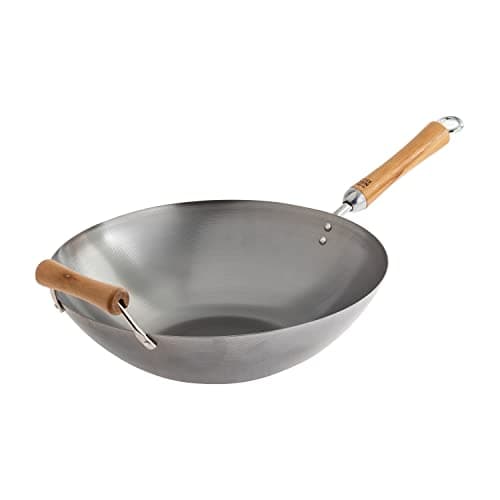
Woks are sold bare, blued and pre-seasoned, and the terminology confusion is identical. What matters far more in a wok is the base shape, because a round-bottom wok on a flat domestic cooktop touches the element across a patch the size of a coin.
Flat bottom first, seasoning state second, finish a distant third - that is the ordering in best carbon steel woks, and it holds regardless of what the listing calls the surface.
A note on other names you will see
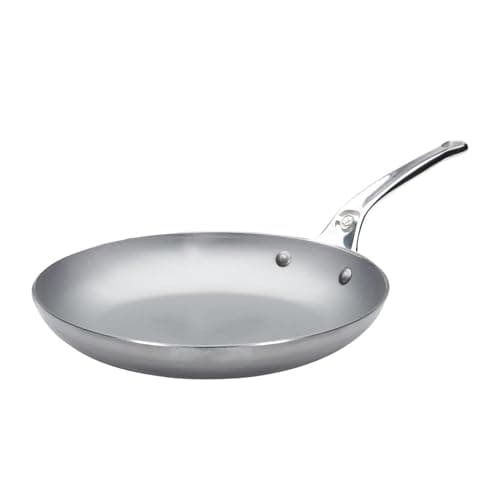
Mineral steel - de Buyer's brand name for its carbon steel line, with a beeswax finish on some models rather than a distinct alloy.
Iron pan - often just carbon steel, particularly in Japanese and Chinese product listings.
Spun steel - a forming method, not a finish. Common in woks and functionally similar to pressed.
Nitrided or nitrocarburized steel - a genuine surface treatment that hardens the steel and adds real corrosion resistance. This one is a material difference rather than a cosmetic one, and it is rarer in domestic cookware.
We do not make or sell black steel pans or blue steel pans. Both link to the same retailer, both pay us the same commission rate, and we earn exactly the same whichever one you buy — or nothing at all if you buy neither, which is sometimes the right answer. Most of the comparison pages that rank for this question are published by companies that sell one of the two. How we are funded.
What to buy, if you are buying
These are the products this page's reasoning actually points at. Same rules as everywhere else on the site: published specs, a stated trade-off, and a live price only where one exists.
Top pick · The black steel referenceSpecs read September 3, 2026
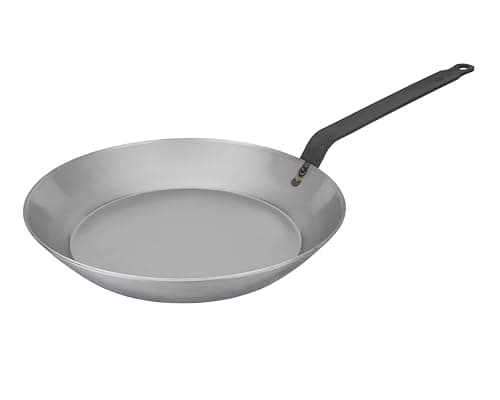
Matfer Bourgeat Black Carbon Steel Fry Pan, 11 in (062004)
Bare black steel throughout with a welded handle and no coating anywhere - the restaurant standard, unchanged for decades.
Best for: Someone who would rather buy the pan a commercial kitchen buys
›What is the difference between blue steel and black steel pans?
The factory finish, not the material. Both are carbon steel. Blue steel has been heat-treated until the surface oxidizes into a blue-gray layer that resists rust temporarily; black steel is plain or lightly treated dark steel. Both need seasoning and both look identical after a month of cooking.
›Is blue steel pre-seasoned?
No, and the terms get conflated. Bluing is an oxide layer created by heat; seasoning is polymerized oil created by cooking. A blued pan still needs seasoning and will still rust if neglected.
›Which carbon steel finish is best?
None of them, meaningfully - the finish is gone within weeks. Buy on published thickness, handle attachment and size instead. de Buyer publishes 3 mm at 11 inches, which is the one specification in this category that predicts behavior.
›Why do restaurants use black steel pans?
They are cheap, there is nothing on them to fail, they take any heat a range produces, and a stripped pan is re-seasoned by the next service rather than replaced. The welded handle has no rivets to loosen, at the cost of getting hot.
›Is nitrided steel the same as blue steel?
No. Nitriding is a genuine surface treatment that hardens the steel and adds real corrosion resistance, so it is a material difference rather than a cosmetic finish. It is much rarer in domestic cookware than bluing is.
Sources
Every figure on this page came from one of these. Follow them and check our arithmetic — that is the point.