Heads up: some links on this page earn us a commission at no extra cost to you. It does not change what we recommend or the order. How we are funded.
The short answer
11 inches for most kitchens. It gives a cooking surface around nine inches, which is two portions with room, and de Buyer publishes 3 mm at this size.
9 to 10 inches for one or two people, or if weight is a concern - this is the size that gets used daily.
12.5 inches and up only if you cook for four regularly and have the arm for it. A 3 mm pan at this diameter is heavy.
Always check the cooking surface, not the rim. Carbon steel pans are steeply sloped and the difference is around two inches.
Rim diameter and cooking surface are not the same number
Carbon steel pans have steeply sloped sides. That slope is a feature - it is what lets you toss food, and it is one of the real advantages over a cast iron skillet with vertical walls. It also means the flat base is much smaller than the rim.
An 11-inch carbon steel pan typically has a cooking surface around nine inches. A 12.5-inch pan gives you around ten and a half. Listings advertise the rim, because the rim is the bigger number.
Rim diameter
Approximate cooking surface
Portions
Published thickness
8 in
About 6 in
One
de Buyer publishes 2.5 mm at this size
9.5 in
About 7.5 in
One to two
de Buyer publishes 2.5 mm
11 in
About 9 in
Two, or three at a push
de Buyer publishes 3 mm; Matfer's round pans are listed at 3 mm
12.5 in
About 10.5 in
Three to four
3 mm, and heavy with it
de Buyer publishes cooking surface diameter, thickness and weight per size, which is why its figures anchor this table. Most makers publish none of the three.
If a listing gives only one diameter, assume it is the rim and subtract about two inches to estimate the surface you will actually cook on.
Weight is the reason people stop using a pan
Thickness and diameter multiply. de Buyer publishes 4.6 lb for its 11-inch MINERAL B PRO at 3 mm; a 12.5-inch pan at the same thickness is meaningfully heavier again, and that is before food goes in it.
Carbon steel's selling point against cast iron is that it is lighter at the same diameter. That is true, and it stops being true in a useful way once you go up two sizes. A 12.5-inch carbon steel pan weighs about what a 10.25-inch cast iron skillet does - and the cast iron pan is cheaper and needs no beeswax removal.
Nine and a half inches. It gives a cooking surface of about seven and a half, which is one portion covering roughly two thirds of the base - the target described in cookware for cooking for one. An 11-inch pan will work but a single portion in it browns unevenly.
Two people
Eleven inches, and this is the size to buy if you are only buying one. Check price on Amazon.
Three or four
Twelve and a half, or an 11-inch pan and cooking in two batches. Batching is genuinely better than crowding a bigger pan, and it is what most people end up doing anyway.
A second pan
If you already own one and want another, go two sizes apart rather than one. An 11 and a 9.5 cover different jobs; an 11 and a 12.5 are the same pan with a weight penalty.
The sloped wall that makes the cooking surface smaller is also what lets you toss food. It is a trade, not a defect.
Thickness changes with size, and it is not marketed
The same line will often be thinner in its small sizes. de Buyer publishes 2.5 mm on its 8 and 9.5-inch MINERAL B PRO pans and 3 mm on the 11 and 12.5-inch. That is sensible engineering - a small pan does not need the mass - but it means "a 3 mm de Buyer pan" is only true above a certain size.
It matters if you are buying small specifically for searing, which is the one job thickness is for. A thin small pan heats fast, responds fast and drops temperature the moment food lands. If searing in a small pan is the goal, cast iron at that diameter is the better tool.
Size and the oven
Carbon steel handles are long, straight and steel, which is excellent for oven finishing and awkward for oven fitting. Measure the oven, including the handle, before buying a 12.5-inch pan - a pan that fits diagonally is a pan you will burn yourself on.
Note that de Buyer publishes no oven maximum at all for the MINERAL B PRO; retailers list 500F, which is a retailer figure rather than a manufacturer one. That distinction is on the product card and it is the sort of thing this site exists to flag.
The short version
Buying one pan: 11 inches. It is the size that fits the most kitchens and the size the makers document best.
Cooking for one: 9.5 inches, and expect a thinner pan.
Cooking for four: 12.5 inches, and be honest about the weight, or buy 11 and cook in batches.
Wanting small and heavy: buy cast iron instead.
Sizes worth owning
Two 11-inch pans at 3 mm, one larger pre-seasoned pan, and the cast iron alternative for anything small.
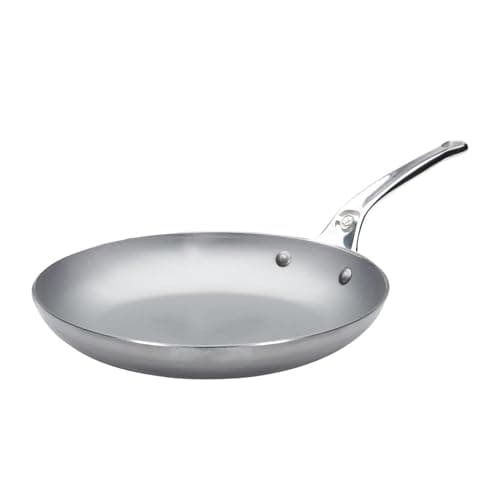
de Buyer MINERAL B PRO Carbon Steel Fry Pan, 11 in
Someone who wants cast-iron searing without cast-iron weight
These are the products this page's reasoning actually points at. Same rules as everywhere else on the site: published specs, a stated trade-off, and a live price only where one exists.
Top pick · The size most people should buySpecs read September 3, 2026
de Buyer MINERAL B PRO Carbon Steel Fry Pan, 11 in
Eleven inches at 3 mm, with the published weight and cooking-surface figures that make it possible to compare at all.
Best for: Someone who wants cast-iron searing without cast-iron weight
Eleven inches for most kitchens. That gives a cooking surface of about nine inches, which handles two portions comfortably, and it is the size at which de Buyer publishes 3 mm thickness rather than 2.5 mm.
›Why is the cooking surface smaller than the pan?
Because carbon steel pans have steeply sloped sides, which is what lets you toss food. The flat base is typically about two inches smaller than the advertised rim diameter, and listings quote the rim because it is the bigger number.
›How heavy is an 11 inch carbon steel pan?
de Buyer publishes 4.6 lb for its 11-inch MINERAL B PRO at 3 mm. That is lighter than cast iron at the same diameter, but a 12.5-inch carbon steel pan weighs roughly what a 10.25-inch cast iron skillet does.
›Are all carbon steel pans in a line the same thickness?
No. de Buyer publishes 2.5 mm on its 8 and 9.5-inch MINERAL B PRO pans and 3 mm on the 11 and 12.5-inch. Smaller pans in the same line are usually thinner, which matters if you are buying small specifically to sear.
›Should I buy two carbon steel pans in different sizes?
If you do, go two sizes apart rather than one. An 11-inch and a 9.5-inch cover genuinely different jobs, whereas an 11 and a 12.5 are close to the same pan with a weight penalty on the larger one.
Sources
Every figure on this page came from one of these. Follow them and check our arithmetic — that is the point.