Heads up: some links on this page earn us a commission at no extra cost to you. It does not change what we recommend or the order. How we are funded.
The short answer
For a first carbon steel pan, Lodge's pre-seasoned skillet, because it skips the beeswax-removal step that makes people give up. For a pan you intend to keep, the de Buyer MINERAL B PRO at 3 mm with its published composition and Heat Stop handle. If you would rather buy what restaurants buy, Matfer Bourgeat at 3 mm - and keep a towel nearby for the handle.
Quick picks
The whole answer, on one screen. Tap a row to jump to the full write-up. Every pick below carries a stated trade-off further down — including the one at the top.
#
Product
Best for
Price
1
de Buyer MINERAL B PRO Carbon Steel Fry Pan, 11 in
3 mm, 4.6 lb, published as 99% iron and 1% carbon, with a riveted Heat Stop handle. More documentation than anyone else offers.
Lodge Seasoned Cast Iron Skillet, 10.25 in (L8SK3)
If you are not going to dry the pan on the burner every time, cast iron is more forgiving and cheaper. Buy the material whose maintenance you will actually do.
Prices last checked October 19, 2026. Prices move constantly — the number on Amazon when you click is the real one.
How we chose these
We have not cooked in them. We collected the published thickness, weight, handle construction, composition and country of manufacture, and noted where the manufacturer publishes nothing at all — which in this category happens more than you would expect. The method is here.
One thing that emerged from doing this: de Buyer publishes considerably more about its pans than anyone else in the category, including the actual iron and carbon percentages. It also publishes no oven maximum, no dishwasher guidance and no warranty term on its MINERAL B PRO page. Both facts are on the product card.
Thickness is the spec, not the brand
Carbon steel is sold between roughly 1.5 mm and 3 mm, and that number changes the pan more than the badge on it does.
Thickness
Weight
Behaves like
Best for
1.5-2 mm
Light
A responsive skillet you can toss food in
Vegetables, quick sautes, anything you flip
2.5 mm
Moderate - de Buyer publishes 3 lb for its 9.5 in
A middle ground
General purpose, one-pan cooking
3 mm
de Buyer publishes 4.6 lb for its 11 in
Cast iron with faster response
Searing, and sitting flat on a glass cooktop
de Buyer publishes 2.5 mm on its 8 and 9.5-inch MINERAL B PRO pans and 3 mm on the 11 and 12.5-inch. Matfer's round fry pans are listed at 3 mm in commercial catalogs.
Thin pans heat and respond fast, weigh little, and warp on a hot burner. Thick pans hold heat through a sear and stay flat, and give back some of the weight advantage over cast iron. Three millimeters is where most people land.
Handles are where the brands genuinely differ
This is not a detail. It is the part of the pan you touch every time, and the two leading French makers have taken opposite positions.
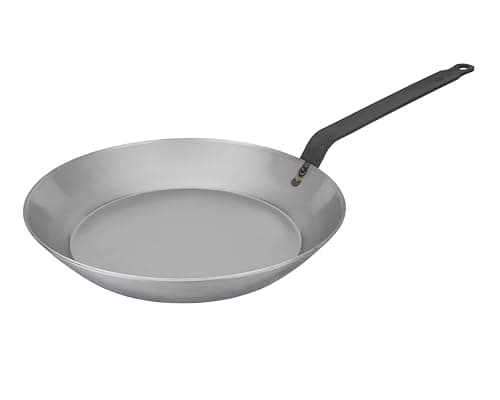
de Buyer publishes "Riveted, Heat Stop" on the MINERAL B PRO — a handle geometry deliberately designed to slow heat traveling up from the pan. Matfer's black steel pans use a riveted steel strip with no heat break of any kind, which conducts pan temperature straight into your hand.
Neither is wrong. Matfer's is a commercial design that assumes a towel and gives you an unbreakable, oven-indifferent pan. de Buyer's costs more and is friendlier at home. Decide which you are before buying, because it is not something you get used to.
The sloped side is the other quiet advantage. A pressed pan lets you toss food; a cast iron skillet's vertical wall does not.
The beeswax step, and why one pick exists to skip it
Most French carbon steel arrives coated in beeswax to prevent rust in transit, and it has to come off before the pan is usable. de Buyer publishes the instruction: "wash the pan thoroughly with hot water and a scrub brush or sponge to remove all beeswax — no soap needed", then oil with grapeseed or avocado and "heat until the oil begins to smoke lightly, then let it cool."
Twenty minutes and a smoky kitchen. It is not difficult and it is the step where people give up, particularly on a pan they were not certain about in the first place.
Lodge's carbon steel arrives pre-seasoned, so you can cook in it the day it lands. It is thinner than the French pans and warps more readily, and Lodge does not publish a country of manufacture for the line the way it does for its cast iron. For a first carbon steel pan those are the right trades. Full method in how to season a carbon steel pan.
What each maker will and will not tell you
de Buyer publishes composition ("Iron 99%, Carbon 1%"), thickness per size, weight, cooking surface diameter, handle material and fixing, country of manufacture, and first-use instructions. It publishes no oven maximum, no dishwasher guidance and no warranty term.
Matfer Bourgeat publishes very little directly; the thickness, sizes and induction compatibility come from commercial catalog listings rather than the brand.
Lodge publishes seasoning and care guidance across its seasoned lines and a 550F ceiling, but not a country of manufacture for its carbon steel — which is notable given how prominently it does so for its cast iron.
None of that makes any of them a bad pan. It is a real difference in how much a buyer can verify before spending, and on this site that counts.
The honest skip
Carbon steel asks for a routine. You dry it on the burner after every wash and wipe a trace of oil on it, or it rusts — not eventually, overnight. If that sounds like a thing you will resent, this is the wrong material, and cast iron is more forgiving, cheaper, and arrives ready to use.
There is no shame in that answer and it is the right one for a lot of kitchens. Worked through properly in is carbon steel worth it.
Which to buy
Trying the material for the first time: Lodge pre-seasoned. Skip the beeswax, find out if you like it.
Committing to it: de Buyer MINERAL B PRO at 3 mm. The best- documented pan here and the friendliest handle.
You want what a restaurant uses: Matfer at 3 mm. Bring a towel.
Each write-up below gives the published specs, what the pan is genuinely good at, what it costs you, and who should skip it. The trade-off line is there on the top pick too — a recommendation with no downside is an advertisement.
Top pick · Best overallSpecs read September 3, 2026
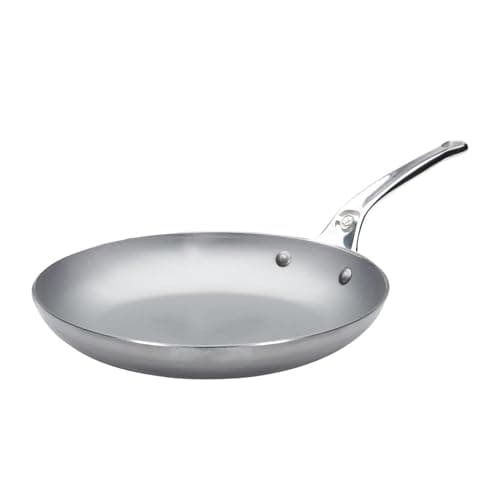
de Buyer MINERAL B PRO Carbon Steel Fry Pan, 11 in
3 mm, 4.6 lb, published as 99% iron and 1% carbon, with a riveted Heat Stop handle. More documentation than anyone else offers.
Best for: Someone who wants cast-iron searing without cast-iron weight
#4 · Skip carbon steel for this if you never searSpecs read September 3, 2026
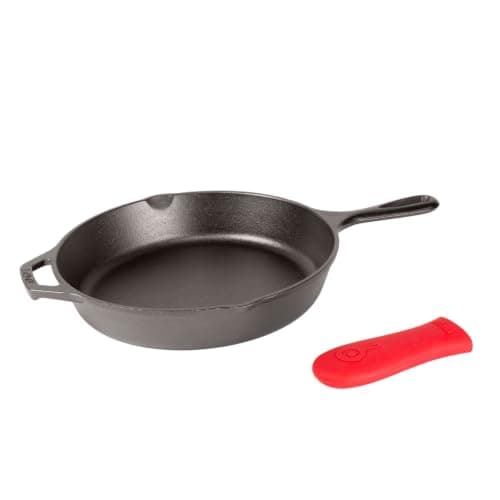
Lodge Seasoned Cast Iron Skillet, 10.25 in (L8SK3)
If you are not going to dry the pan on the burner every time, cast iron is more forgiving and cheaper. Buy the material whose maintenance you will actually do.
Best for: Searing, cornbread, and anyone who wants one pan that cannot be worn out
Published specifications for the Lodge Seasoned Cast Iron Skillet, 10.25 in (L8SK3)
Diameter
10.25 in
Weight
5.66 lb
Oven maximum
550F
Induction
Yes - bare iron is ferrous
Seasoning
Pre-seasoned with soy-based vegetable oil, no synthetic chemicals
Warranty
Lifetime
Made in
USA
Care
Hand wash. Lodge's own instructions permit warm soapy water
Good
Effectively unbreakable and fully restorable - a rusted one can be stripped and re-seasoned
Holds heat better than anything else at the price, which is what a sear needs
Lodge publishes its seasoning method openly, so the maintenance is not a mystery
Not good
Heavy
Heats unevenly on a small burner: cast iron conducts at roughly 50 W/m-K, so it is slow to spread and slow to react
Bare iron is reactive; long tomato braises will taste of it
The trade-off. It weighs 5.66 lb empty. You will feel that every time you move it full, and it is the single most common reason a cast iron skillet ends up in a cupboard.
Skip this if. You have wrist or shoulder trouble, or you cook mostly acidic braises. Carbon steel does most of the same jobs at roughly half the weight.
For a first pan, Lodge's pre-seasoned carbon steel, because it skips the beeswax removal that makes people abandon the material. For a pan to keep, the de Buyer MINERAL B PRO at 3 mm, which publishes its composition, weight and handle construction.
›How thick should a carbon steel pan be?
Around 3 mm for searing and for sitting flat on a glass cooktop, around 2 mm if you want a light pan you can toss food in. de Buyer publishes 2.5 mm on its 8 and 9.5-inch pans and 3 mm on the larger ones.
›Why do carbon steel pans come coated in wax?
Beeswax prevents rust in transit on bare steel. de Buyer's instruction is to scrub it off with hot water and no soap before seasoning. It takes about twenty minutes and it is the step where most people give up.
›Do carbon steel pan handles get hot?
It depends on the pan. Matfer's riveted steel strip handle has no heat break at all and gets as hot as the pan. de Buyer publishes a Heat Stop geometry on the MINERAL B PRO designed to slow that.
›Can carbon steel pans go in the oven?
The pan is bare steel with a steel handle, so the practical limit is the seasoning rather than the pan. de Buyer publishes no oven maximum for the MINERAL B PRO; retailers list 500F for the PRO line, which is a retailer figure rather than a manufacturer one.
Sources
Every figure on this page came from one of these. Follow them and check our arithmetic — that is the point.