Heads up: some links on this page earn us a commission at no extra cost to you. It does not change what we recommend or the order. How we are funded.
The short answer
Scrub off the beeswax with hot water and a brush. de Buyer: "no soap needed".
Dry the pan completely, on the burner. Bare steel rusts within minutes.
Wipe on a thin layer of high smoke point oil — grapeseed or avocado.
Heat until the oil just begins to smoke lightly, then let it cool. Repeat two or three times.
What you are actually doing
Seasoning is polymerization. You heat a very thin film of fat past its smoke point, and the fat molecules cross-link into a hard, slick, plastic-like layer that bonds chemically to the steel. It is not a coating applied at a factory and it is not oil sitting on the surface.
The consequences are worth understanding because they explain every rule below. A bonded polymer is not removed by dish soap. It is broken down by acid. And it needs a clean, dry, bare metal surface to bond to in the first place — which is why the beeswax has to go completely.
Step 1: remove the beeswax
Most French carbon steel pans ship coated in beeswax to stop them rusting in transit. de Buyer's published instruction is to "wash the pan thoroughly with hot water and a scrub brush or sponge to remove all beeswax — no soap needed."
Use water as hot as you can stand and scrub properly. The wax is not obvious once wet, so go over the whole pan including the sides and under the rim, and take longer than feels necessary. Any wax left behind will stop the seasoning bonding in that spot and you will get a patchy result.
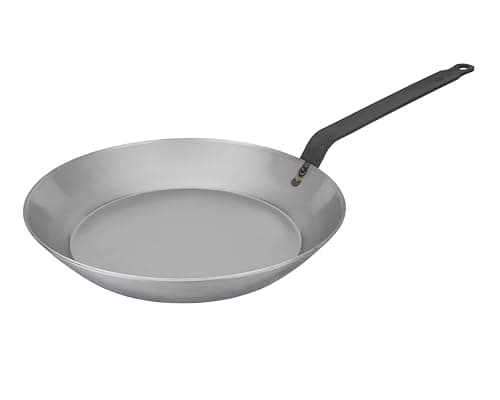
Lodge's carbon steel arrives pre-seasoned, so this step does not apply. Matfer's black steel pans are bare rather than waxed — wash and dry, then go straight to seasoning.
Step 2: dry it completely, on the heat
This is not a formality. Bare stripped steel flash-rusts within minutes of being wet, and you will watch it happen. Put the pan straight on the burner over medium and leave it until every trace of water has gone and the surface looks dull and dry.
If you see faint orange bloom, wipe it away with a paper towel while the pan is warm and carry on. It is superficial at this stage.
Step 3: the oil, and how little of it
de Buyer names grapeseed or avocado — high smoke point oils, which matter because you need to get past the smoke point to polymerize, and a low smoke point oil will fill the kitchen with smoke long before it does anything useful.
Oil
Approx. smoke point
Verdict
Grapeseed
About 420F
Named by de Buyer. Works well and is easy to find
Avocado (refined)
About 500F+
Named by de Buyer. The highest practical smoke point
Canola / vegetable
About 400F
Named by Lodge for cast iron. Perfectly serviceable
Flaxseed
About 225F
Polymerizes very hard and is well known for flaking off in sheets later
Olive oil
About 375F (extra virgin lower)
Smokes too early and leaves a soft, tacky layer
Smoke points vary by refinement and freshness. Any high smoke point neutral oil works; the amount matters far more than the choice.
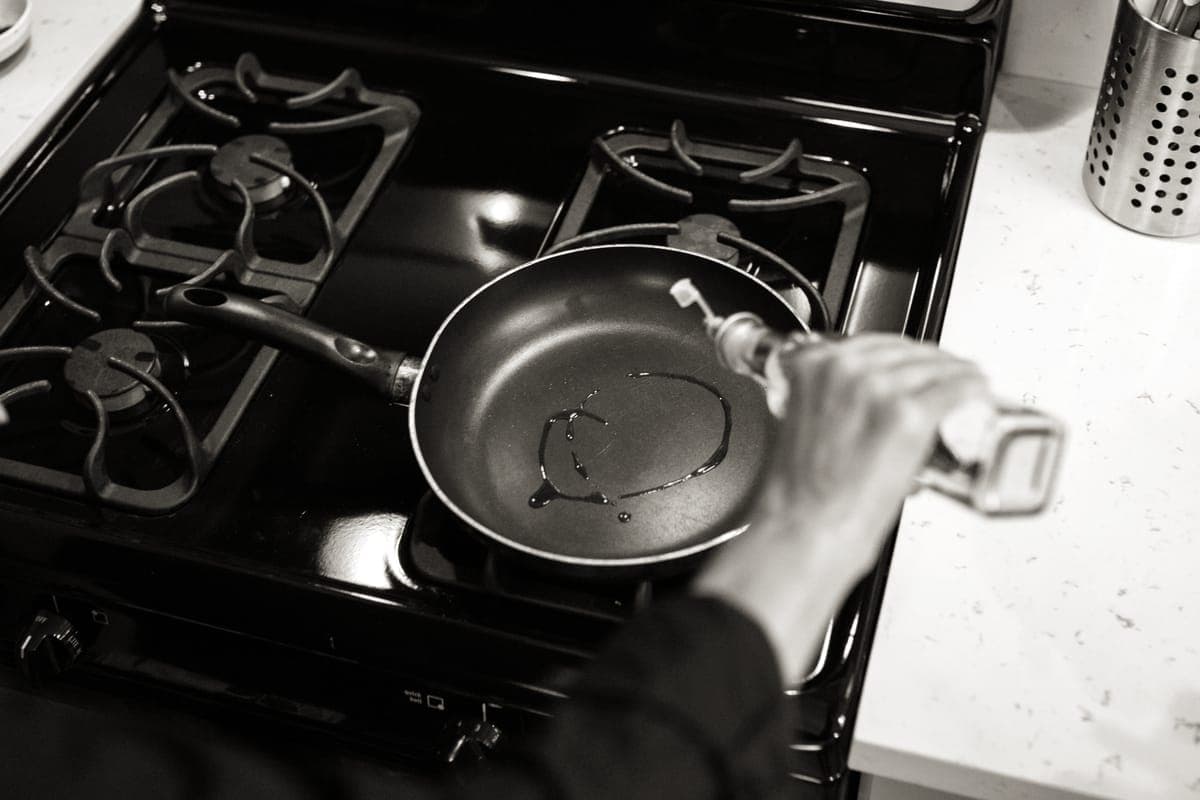
Use almost none. Pour in a few drops, spread them over the whole interior with a paper towel, then wipe the pan as though you were trying to remove the oil entirely. What stays in the metal's texture is the correct amount.
Too much oil is the single most common failure. A thick layer cures on the outside while staying liquid underneath, producing a sticky, patchy finish that peels — which people then try to fix with more oil.
If the oil pools or runs when you tilt the pan, there is far too much. Wipe it back until the pan looks almost dry.
Step 4: heat until it just smokes
de Buyer's instruction: "heat until the oil begins to smoke lightly, then let it cool."
Note the word lightly. You want a thin wisp, held for a minute or so — not a rolling cloud. Medium-high heat on the hob, tilting the pan to bring the sides into contact with the burner as well. Open a window; there will be some smoke and there is no way around that.
Let the pan cool until you can touch it, then repeat. Two or three rounds gives you a working base. The pan will go from silver to bronze to brown, and eventually to near-black with use. That progression is the point.
The oven alternative
If your kitchen extraction is poor or the pan has an oven-safe handle, the oven method is gentler and more even. It is Lodge's published method for cast iron and it works identically on carbon steel: oil the pan thinly, place it upside down on the center rack with foil below, bake at 450-500F for one hour, and let it cool in the oven.
It takes longer and produces a more uniform result, particularly on the sides. Check that your handle can take the temperature first — de Buyer publishes no oven maximum for the MINERAL B PRO, and its handle is cast stainless with a Heat Stop.
The first few cooks matter
Seasoning built in the oven or on the hob is thin and fragile. The first few things you cook in the pan will either strengthen it or damage it.
Do cook: bacon, sausages, potatoes, mushrooms, anything fatty. Fat plus heat is exactly how the layer thickens.
Do not cook: tomato, wine, vinegar, lemon, or anything you plan to deglaze. Acid strips a young seasoning layer immediately.
Do not boil water in it for the first few weeks.
Do not scrub it hard. Hot water and a brush is enough; save the aggressive cleaning for a pan with a mature layer.
The daily routine, which is the actual commitment
Cook. Get the pan hot before food goes in.
While it is warm, rinse with hot water and use a brush or scraper for stuck bits. Soap is fine on a mature layer; skip it while the seasoning is young.
Dry on the burner. Not a towel, not a rack. Back on the heat until bone dry.
Wipe a trace of oil around the warm interior. A few drops on a paper towel.
Store uncovered and dry.
A minute, maybe less. That is the entire ongoing cost of owning carbon steel, and whether it sounds trivial or intolerable is the honest test of whether the material suits you — see is carbon steel worth it.
When it goes wrong
Symptom
Cause
Fix
Sticky or tacky surface
Too much oil, or not heated past the smoke point
Scrub back with hot water and a brush, then redo with far less oil
Patchy, uneven color
Beeswax not fully removed, or uneven heating
Cosmetic. It evens out with use. Re-season if it bothers you
Seasoning flaking in sheets
Too-thick layers, or flaxseed oil
Scrub the loose material off and re-season thinly
Orange rust spots
Left wet
Scrub off with steel wool, dry on the heat, re-season that area
Bare silver patch after a sauce
Acid stripped it
Normal. Re-oil and cook something fatty in it
Nothing on this list is permanent. Carbon steel can be taken back to bare metal and started again as many times as you like, which is a genuine advantage over any coated pan and the reason these pans last generations in professional kitchens.
What to buy, if you are buying
These are the products this page's reasoning actually points at. Same rules as everywhere else on the site: published specs, a stated trade-off, and a live price only where one exists.
Top pick · The pan this method is written forSpecs read September 3, 2026
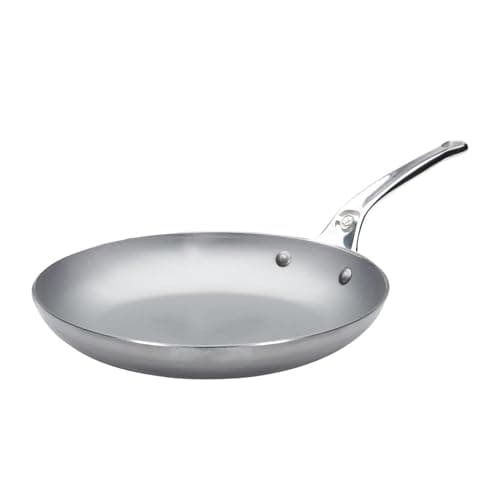
de Buyer MINERAL B PRO Carbon Steel Fry Pan, 11 in
de Buyer publishes the first-use instruction this page follows, including the beeswax removal step.
Best for: Someone who wants cast-iron searing without cast-iron weight
de Buyer's published method: scrub off the factory beeswax with hot water and no soap, dry the pan on the burner, wipe on a very thin layer of high smoke point oil such as grapeseed or avocado, and heat until the oil just begins to smoke lightly. Repeat two or three times.
›What oil is best for seasoning carbon steel?
A high smoke point neutral oil. de Buyer names grapeseed and avocado. Canola and vegetable oil work too. Avoid flaxseed, which polymerizes very hard and is known for flaking off in sheets, and olive oil, which smokes too early.
›Why is my carbon steel pan sticky after seasoning?
Too much oil, or the pan was not taken past the oil's smoke point. A thick layer cures on the surface while staying liquid underneath. Scrub it back with hot water and a brush and redo it with far less oil.
›Do you need to season a carbon steel pan in the oven?
No, the hob works and is faster. The oven method - upside down on the center rack at 450 to 500F for an hour - is gentler and gives a more even result, especially on the sides. Check your handle can take the temperature first.
›What should you not cook in a newly seasoned pan?
Anything acidic: tomato, wine, vinegar, lemon, or anything you plan to deglaze. Acid strips a young seasoning layer immediately. Cook fatty things instead - bacon, sausages, potatoes - which thicken the layer.
Sources
Every figure on this page came from one of these. Follow them and check our arithmetic — that is the point.