Heads up: some links on this page earn us a commission at no extra cost to you. It does not change what we recommend or the order. How we are funded.
The short answer
On a normal Western stove, buy a flat-bottom carbon steel wok around 14 inches - the Joyce Chen Classic is the standard answer and has been for decades. If you want the restaurant object and will season it properly, the Craft Wok hand-hammered pan is it, sold in both base shapes. If the seasoning step is what would stop you, buy a pre-seasoned Yosukata and cook in it the day it arrives. Avoid nonstick woks entirely: the whole technique depends on heat a coating cannot survive.
Quick picks
The whole answer, on one screen. Tap a row to jump to the full write-up. Every pick below carries a stated trade-off further down — including the one at the top.
#
Product
Best for
Price
1
Joyce Chen Classic Series Carbon Steel Wok, 14 in
A flat base that sits still on a normal burner, a wooden handle that stays cool, and bare steel that improves with use.
Prices last checked October 19, 2026. Prices move constantly — the number on Amazon when you click is the real one.
Your stove decides this before your budget does
Wok cooking is built around a very hot, very concentrated flame that licks up the sides of a round bowl. A restaurant wok burner puts out several times what a domestic one does, and a wok ring holds the bowl in the middle of it.
On a domestic stove that geometry mostly does not exist, which produces the single most common disappointment in this category: a round-bottom wok bought for a flat electric cooktop, where it touches the element across a patch the size of a coin and never gets hot.
The other wide carbon steel shape has the same problem in a different direction — paella pans are flat but far wider than any domestic ring, and the traditional pressed-steel ones are published as unsuitable for induction outright.
Your stove
Base to buy
What to expect
Gas, with a wok ring
Round bottom
The real thing - flame up the sides, proper tossing
Gas, no ring
Flat bottom
Very good. Most of the benefit, none of the wobble
Electric coil
Flat bottom
Workable. Preheat much longer than feels right
Smooth top / radiant
Flat bottom
Workable, and lift rather than slide it
Induction
Flat bottom, and check it is magnetic
Good heat, but only in the flat disc - the sides stay cool
Carbon steel is ferrous, so every wok here works on induction in principle. The limitation is geometric, not magnetic.
We have not cooked in them. Woks are the least-documented category on this site by some distance - not one of these makers publishes a gauge figure, which is the number that would actually let you compare them. Where a spec is missing the product card says "Not published" rather than guessing. The method is here.
What can be compared: base shape, seasoning state on arrival, handle material and therefore oven compatibility, diameter, and manufacturing origin where it is stated. That covers most of what separates them in a kitchen.
Hand hammered, spun or pressed
Hand hammered
Made by striking a steel disc into shape, which leaves a dimpled surface. The dimples are functional: they give food somewhere to sit slightly off the hottest metal, which is how a cook parks half a dish up the sides while searing the rest at the bottom. This is the traditional Cantonese construction.
Spun
Formed on a lathe, leaving fine concentric rings. Smooth, consistent, cheaper to make, and functionally very close. Most mass-market carbon steel woks are spun.
Pressed or stamped
Formed in a press. Usually thinner, sometimes with a welded rather than riveted handle. Fine for the money and more prone to warping and to hot spots.
The construction matters much less than the base shape and the gauge. Since nobody publishes the gauge, weight is the usable proxy - a wok that feels flimsy is flimsy.
Seasoning a wok is different from seasoning a skillet
A new bare wok arrives with a factory anti-rust coating that has to come off - often scrubbed with an abrasive and hot water, no soap needed, exactly as de Buyer instructs for its pans. Then it is seasoned, and here the method genuinely diverges from a skillet.
Heat it dry and rotate it until the steel turns blue-black, working the flame up the sides. This is the step that gives a wok its patina and it does not exist in skillet seasoning.
Wipe an extremely thin film of high-smoke-point oil over the hot surface, then wipe it back off.
Repeat, working up the sides, until the whole interior is dark.
Then cook in it, hard and often. A wok seasons through use far more than through ceremony - stir frying with aromatics is itself the seasoning process.
A wok is seasoned dry and hot, working up the sides, rather than baked in an oven. Wooden handles are the reason the oven method does not apply.
Handles, and why almost no wok goes in the oven
Every wok on this page has a wooden main handle. That is deliberate - a steel handle on a pan designed to sit in a flame would be unusable - and it means the oven is out. A wok is a stovetop tool.
The second handle question is whether there is a helper handle on the far rim. On a 14-inch wok full of food there should be, because the alternative is lifting several pounds at the end of a long lever. All three woks here have one.
What to avoid
Nonstick woks. The technique requires a surface hot enough to damage a coating, so a nonstick wok is either a coating being destroyed or a wok not being used properly. Both are bad.
Round bottoms on flat stoves. Covered above, and it is the single most common purchase mistake here.
Anything under 12 inches. The point of a wok is space to move food. A small wok is a bowl-shaped skillet.
Stainless woks. They exist. They stick, they weigh more, and they cost more, and the seasoning that makes carbon steel work is not available to them.
Cast iron woks. Heavy enough that the tossing motion is gone, and slow to respond in a technique built entirely on response.
Each write-up below gives the published specs, what the pan is genuinely good at, what it costs you, and who should skip it. The trade-off line is there on the top pick too — a recommendation with no downside is an advertisement.
Top pick · Best for a Western stoveSpecs read September 3, 2026
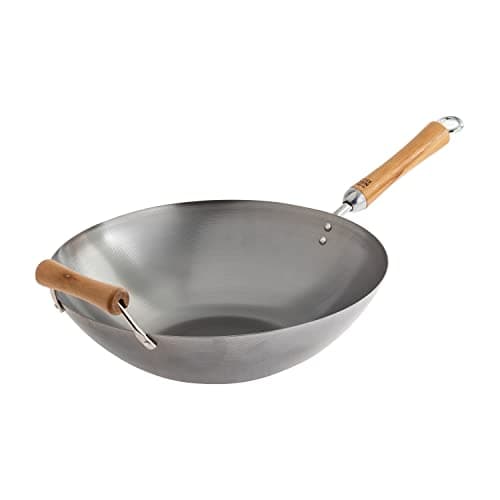
Joyce Chen Classic Series Carbon Steel Wok, 14 in
A flat base that sits still on a normal burner, a wooden handle that stays cool, and bare steel that improves with use.
Best for: A first wok on a gas or electric range that has no wok ring
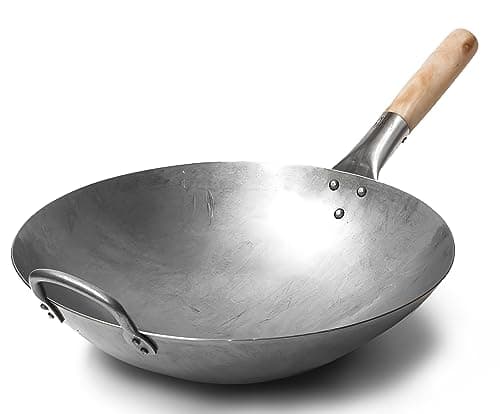
Published specifications for the Craft Wok Traditional Hand Hammered Carbon Steel Wok, 14 in
Material
Hand hammered carbon steel
Diameter
14 in
Base
Sold in both flat-bottom and round-bottom versions
Handles
Wooden main handle, steel helper handle
Seasoning
Ships with a protective coating that must be removed, then seasoned
Gauge
Not published
Made in
Guangzhou, China
Good
The hammered dimples give food somewhere to sit off the hottest part of the base
Both bottom shapes are sold, so you can match it to the burner you actually have
Nothing on it can wear out - there is no coating to fail
Not good
Requires stripping and seasoning before first use
Wooden handle is not oven safe
Rusts overnight if it is put away damp
The trade-off. It arrives coated in factory oil that has to be scrubbed off and seasoned before the first cook, and it will rust if you leave it wet once.
Skip this if. You want a pan you can put in the dishwasher and forget about. This is the least forgiving object on this site.
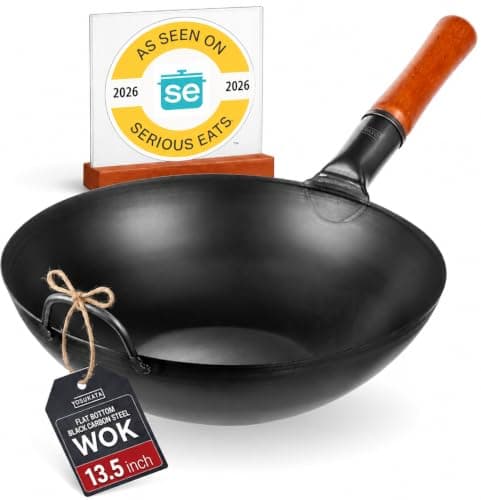
Published specifications for the Yosukata Black Carbon Steel Wok, 13.5 in
Material
Black carbon steel
Diameter
13.5 in
Seasoning
Pre-seasoned at the factory - usable on arrival
Base
Sold flat-bottom and round-bottom
Handles
Wooden handle, steel helper handle
Gauge
Not published
Dishwasher
No
Good
Cook in it the day it arrives, which is the single biggest reason woks get used rather than stored
Lighter than the hand-hammered pans, so the tossing motion is realistic for most arms
Sold in both base shapes
Not good
Factory seasoning can flake early and needs rebuilding anyway
No published gauge
Wooden handle, so no oven finishing
The trade-off. Pre-seasoning is a starting layer, not a finished surface. It still needs building up, and the factory layer can flake in patches early on.
Skip this if. You want a lifetime object rather than a good working pan. The hand-hammered woks are built heavier.
For a Western stove, a flat-bottom 14-inch wok - the Joyce Chen Classic is the long-standing default. If you want the traditional hand-hammered object and will season it yourself, Craft Wok makes it in both flat and round bottom.
›Should I buy a flat bottom or round bottom wok?
Flat bottom, unless you have a gas stove with a wok ring. A round-bottom wok on a flat electric or induction cooktop makes contact across a patch the size of a coin and never gets properly hot.
›Do you need to season a new wok?
Yes, unless it is sold pre-seasoned. A bare wok arrives with a factory anti-rust coating that has to be scrubbed off, then the steel is heated dry until it turns blue-black and wiped with a very thin film of oil, working up the sides.
›Can you use a wok on an induction cooktop?
A flat-bottom one, yes - carbon steel is magnetic. The limitation is geometric rather than magnetic: induction only heats the flat disc in contact with the hob, so the sides of the wok stay comparatively cool.
›Are nonstick woks any good?
No. Stir frying needs a surface hotter than a nonstick coating can survive, so a nonstick wok is either a coating being slowly destroyed or a wok not being used at wok temperatures. Bare carbon steel is the correct material.
Sources
Every figure on this page came from one of these. Follow them and check our arithmetic — that is the point.