Heads up: some links on this page earn us a commission at no extra cost to you. It does not change what we recommend or the order. How we are funded.
The short answer
On a standard domestic hob, a large flat skillet stir-fries better than a wok. A wok's curved walls are designed to be surrounded by the huge flame of a wok burner, which heats the sides as well as the base; on an ordinary burner you get one hot spot at the bottom and cool walls, so food steams instead of searing. A wok wins on a wok burner, an outdoor ring, or a powerful gas hob with a flat-bottomed wok - and for deep frying, steaming and tossing large volumes.
What a wok is designed around
A traditional wok is a thin carbon steel bowl used over a burner producing many times the output of a domestic ring. The flame does not just heat the base - it licks up and around the curved walls, so the entire interior surface is hot. That is what makes wok cooking work: you sear at the bottom, push food up the hot sides to hold it, and bring it back down.
Thin steel is chosen deliberately, because it responds instantly. Curved walls are chosen because they let you toss food without it leaving the pan, and because they give you a temperature gradient to park things on.
Remove the big flame and every one of those design choices becomes a liability. A domestic burner heats a circle at the bottom of the bowl - often only four or five inches of it - and the walls stay comparatively cool. Thin steel over a small hot spot is the worst combination for even cooking.
Where each one wins
Job
Better
Why
Stir-fry on a domestic hob
Skillet
Full-diameter contact beats a small hot spot in a bowl
Stir-fry on a wok burner
Wok
This is what the shape exists for, and it is not close
Searing steak or chops
Skillet
Flat surface, full contact, thermal mass
Deep frying
Wok
Curved shape needs less oil for the same depth
Steaming
Wok
A bamboo steamer sits in the curve perfectly
Tossing large volumes
Wok
High walls keep food in as you move it
Sauces and reductions
Skillet
Even heat across the base
Eggs and delicate fish
Skillet
A flat surface and a spatula that reaches
Small kitchens
Skillet
A wok stores badly and does less
Induction
Skillet
Round-bottomed woks make almost no contact
The flat-bottomed wok compromise
A flat-bottomed wok is the sensible middle. It has a machined flat base that makes genuine contact with a domestic burner, and curved walls above it for tossing and volume. It is not a traditional wok and it will not replicate one, but it is far better on a home hob than a round-bottomed wok with a ring under it.
The round-bottomed version plus a wok ring is the worst of both worlds on most hobs: the ring lifts the pan away from the burner, so you lose what little heat you had - best carbon steel woks covers the choice properly, and wok accessories covers rings, spatulas and steamers.
If your hob is electric, radiant or induction, buy a flat-bottomed wok or do not buy a wok. A round bottom on a flat contact surface transfers almost no heat at all - cookware for glass top stoves.
Making a skillet stir-fry properly
The technique matters more than the pan, and most home stir-fry problems are technique rather than equipment.
Use the biggest pan you own, 12 inches or more. Surface area is the whole game.
Preheat until it is genuinely hot, then add oil. Carbon steel and cast iron hold the heat that a thin wok loses.
Cook in batches. Crowding is why home stir-fries steam. Two batches in a hot pan beats one batch in a crowded one, every time.
Prep everything first. The cooking takes three minutes; there is no time to chop.
Dry the ingredients. Surface water has to boil off before anything browns.
Add sauce at the end, off heat or briefly, or it cools the pan.
Stir-frying without a wok goes further on this, and it is the page to read if you have decided against buying one.
Material, for either shape
Carbon steel is the right answer for both. It is what woks are traditionally made from, it takes any heat, it builds a seasoned surface that releases food, and it weighs much less than cast iron so you can actually toss with it - is carbon steel worth it.
Cast iron: superb skillet, poor wok - too heavy to toss and too slow to respond.
Clad stainless: good skillet, takes high heat, no maintenance, food sticks more.
Coated: the coating caps your heat well below stir-fry temperature, which defeats the purpose - best nonstick woks explains where a coated wok does make sense.
Stir-frying wants the pan hotter than most home cooks take it. That is the real gap, and it is free to close.
Which to buy
Ordinary hob, and you stir-fry sometimes: a large carbon steel skillet. It does stir-fry and everything else - a 12 inch carbon steel skillet.
These are the products this page's reasoning actually points at. Same rules as everywhere else on the site: published specs, a stated trade-off, and a live price only where one exists.
Top pick · Best stir-fry pan for a domestic hobSpecs read September 3, 2026
No photo
Lodge Seasoned Carbon Steel Skillet, 12 in
A large flat carbon steel skillet gives you a full-diameter hot surface, which is what a home burner can actually deliver.
Best for: A first carbon steel pan, bought to find out whether you like the material
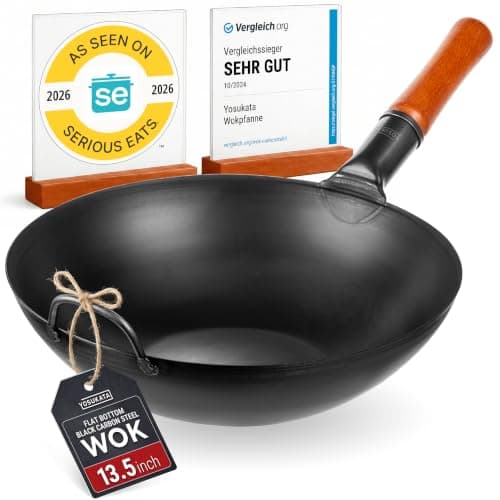
Published specifications for the Yosukata Black Carbon Steel Wok, 13.5 in
Material
Black carbon steel
Diameter
13.5 in
Seasoning
Pre-seasoned at the factory - usable on arrival
Base
Sold flat-bottom and round-bottom
Handles
Wooden handle, steel helper handle
Gauge
Not published
Dishwasher
No
Good
Cook in it the day it arrives, which is the single biggest reason woks get used rather than stored
Lighter than the hand-hammered pans, so the tossing motion is realistic for most arms
Sold in both base shapes
Not good
Factory seasoning can flake early and needs rebuilding anyway
No published gauge
Wooden handle, so no oven finishing
The trade-off. Pre-seasoning is a starting layer, not a finished surface. It still needs building up, and the factory layer can flake in patches early on.
Skip this if. You want a lifetime object rather than a good working pan. The hand-hammered woks are built heavier.
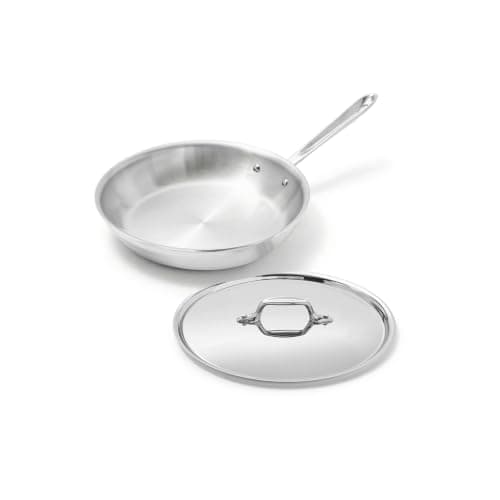
Published specifications for the All-Clad D3 Stainless 10 in Fry Pan
Construction
Fully bonded tri-ply, aluminum core
Oven maximum
600F, oven and broiler safe
Induction
Yes - compatible with any stovetop
Dishwasher
Handwash only (All-Clad published)
Handle
Double-riveted stainless
Weight
3.0 lb (model 4110)
Warranty
Limited lifetime
Made in
Bonded, engineered and assembled in Canonsburg, PA
Good
600F is the highest oven ceiling of any stainless pan on this site
The one pan here whose manufacturing location is published down to the town
Genuinely repairable-adjacent: rivets are the only failure point and the warranty covers them
Not good
Hand wash only
The flared rim makes it a poor pan for anything with liquid
Costs several times what a Tramontina or Cuisinart pan of the same construction costs
The trade-off. Hand wash only. All-Clad publishes that plainly, and it is a real daily cost on a pan you will use every day.
Skip this if. You want a dishwasher-safe pan, or you are buying a whole kitchen on a fixed budget - one D3 skillet costs what a full clad set can cost.
Only if you have the burner for it. A wok's curved walls are designed to be surrounded by the huge flame of a wok burner, which heats the sides as well as the base. On an ordinary domestic burner you get one hot spot at the bottom and cool walls, and a large flat skillet stir-fries better.
›Can you use a wok on an electric or induction stove?
Only a flat-bottomed one. A round-bottomed wok makes almost no contact with a flat radiant or induction surface, so it transfers very little heat. A wok ring makes it worse by lifting the pan further from the heat source.
›Do I need a wok?
Not unless you have a wok burner or an outdoor ring, or you stir-fry weekly and want a flat-bottomed wok for the extra volume and tossing room. For occasional stir-frying, a 12 inch carbon steel or cast iron skillet does it better and does everything else too.
›What is a wok better at than a skillet?
Deep frying, because the curved shape reaches a useful oil depth with less oil; steaming, because a bamboo steamer sits in the curve; and tossing large volumes, because the high walls keep food in the pan. Those advantages hold on any hob.
›Why does my stir-fry come out soggy?
Crowding and moisture rather than the pan. Too much food in the pan drops the temperature so ingredients steam in their own liquid instead of searing. Cook in two batches, dry the ingredients first, get the pan properly hot, and add sauce only at the end.
Sources
Every figure on this page came from one of these. Follow them and check our arithmetic — that is the point.