Heads up: some links on this page earn us a commission at no extra cost to you. It does not change what we recommend or the order. How we are funded.
The short answer
Buy the skillet first. Sloped sides let you slide a spatula under food and toss without a spoon, which is what most weeknight cooking is. A saute pan is the second purchase: straight walls hold roughly twice the liquid at the same rim diameter, so it is the pan for braises, shallow frying and anything with a sauce you do not want reduced away. If your set already includes a covered deep saute - most clad sets do - you already own one, and the money is better spent on a larger skillet.
The only difference that matters is the wall
A skillet - frying pan, fry pan, the words are used interchangeably - has walls that flare outward at roughly forty-five degrees. A saute pan has walls that rise straight up from the base at ninety degrees, and it almost always comes with a lid and a helper handle.
Everything else follows from that one angle. The sloped wall gives you a shallow ramp, so a spatula meets the food rather than the side of the pan, and a flick of the wrist throws the contents up and back. The straight wall gives you a bucket: more volume, more depth, far less splashing, and no ramp at all.
Skillet
Saute pan
Wall angle
Sloped, around 45 degrees
Straight, 90 degrees
Cooking surface at the same rim size
Smaller - the slope eats diameter
Larger - the base runs almost to the rim
Liquid capacity
Low. A 10 in skillet holds very little before it slops
Roughly double at the same rim diameter
Evaporation
Fast, which is what you want for a sear
Slow, which is what you want for a braise
Tossing
Designed for it
Not really possible
Lid
Often sold without one
Almost always included
Second handle
Rare below 12 in
Usual, and needed - these pans get heavy
Wall angle is the whole comparison. Every other line in this table is a consequence of it.
The cooking surface arithmetic
Cookware is sold by rim diameter, and a sloped wall means the base is meaningfully smaller than the number on the box. That is the same trap covered in what size carbon steel pan and what size cast iron skillet, and it applies to every sloped pan regardless of material.
On a straight-walled saute pan the base is close to the rim measurement, which is why a 10-inch saute pan browns more food at once than a 10-inch skillet. If you have ever crowded a pan and steamed chicken instead of searing it, the saute pan's extra base area is the fix that costs nothing in technique.
The trade is real in both directions: the same straight wall that adds base area also traps steam against the food. A saute pan sears well and then holds the moisture it drives off, which is why the sear-then-braise sequence works so well in one and so badly in the other.
What each one is actually for
Buy a skillet for
Eggs, pancakes, grilled cheese - anything you slide out rather than lift out.
Searing steaks and chops where you want the moisture gone, fast.
Stir-frying on a Western stove, if you are not buying a wok.
Anything you want to finish in the oven, which is why the oven ceiling on a skillet matters more than on most pans.
Buy a saute pan for
Braises that start with a sear: chicken thighs, short ribs, pork chops in cider.
Shallow frying, where an inch of oil in a skillet is an inch of oil on your stove.
Pan sauces that need to reduce without going over the side.
Risotto and anything that gets stirred for twenty minutes, because the straight wall gives the spoon something to work against.
The spatula test settles it faster than any spec sheet: if the tool has to climb the wall, you wanted a skillet.
You may already own a saute pan
This is the part the shape comparisons usually skip. Almost every clad set on the market includes a covered saute, and it is often the piece buyers ignore because the listing calls it something else - "deep saute", "chef's pan", "everyday pan", or simply "casserole".
Set
The saute piece it includes
What it leaves you needing
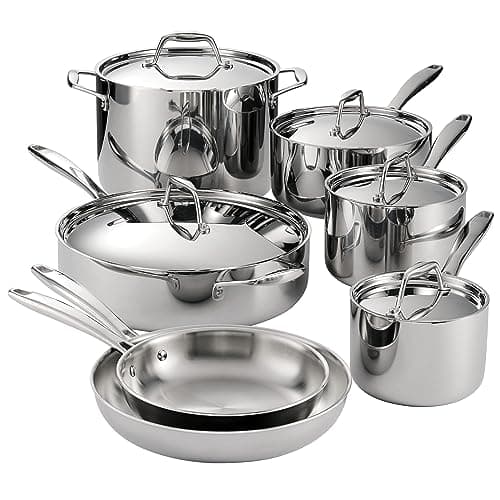
Tramontina Signature tri-ply 12-piece
5 qt covered deep saute
A 12 in skillet - the set stops at 10 in
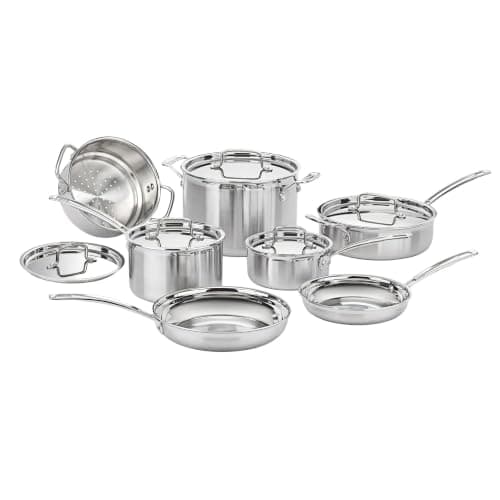
Cuisinart MultiClad Pro MCP-12N
3.5 qt covered saute
A 12 in skillet, same gap
Both figures are from the published piece lists in the product ledger. Neither set includes a skillet larger than 10 inches.
If either of those is your set, the honest advice is that you own the saute pan already. The piece-count reasoning is in what piece count you need, and set versus open stock covers when to stop buying boxes and start buying pans.
Material changes the answer slightly
In stainless, both shapes work and the choice is purely about what you cook. Cladding matters more in the saute pan, because a straight wall is a tall wall and a disc-bottom pot puts no aluminum in it at all - the reason for that is set out in disc bottom versus fully clad.
In cast iron, the skillet dominates and saute pans barely exist, because a straight-walled iron pan of any size is too heavy to lift comfortably and the shape that actually replaces it is a Dutch oven. In carbon steel, the sloped skillet is essentially the only shape sold, for the same reason.
In nonstick, buy the skillet. A nonstick saute pan is a pan built for liquid cooking wearing a coating that liquid cooking does not need, and the coated surface is the thing you are trying to preserve. The lifespan case is in how long nonstick lasts.
Which to buy
You own neither: buy the skillet. A 10-inch clad skillet covers more of a week's cooking than any other single pan.
You own a skillet and braise often: add a covered saute, or buy a set that includes one - the Tramontina set has the largest at 5 qt.
You already own a clad set: you have the saute. Buy a 12-inch skillet, which is the piece both sets here leave out.
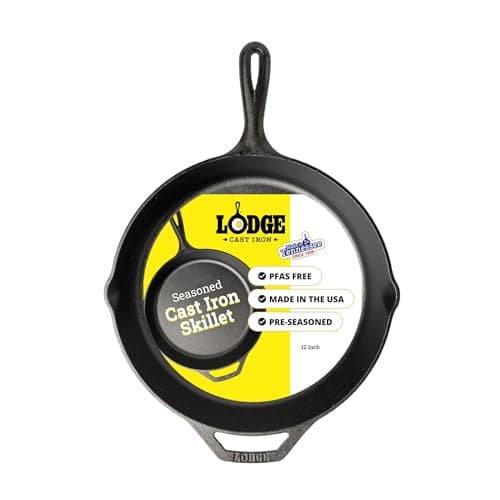
You want one pan for searing and nothing else:a 12-inch cast iron skillet, and skip the shape debate entirely.
The pans this comparison points at
Shape first, material second. A set that already contains a saute pan changes the answer more than any spec on it does.
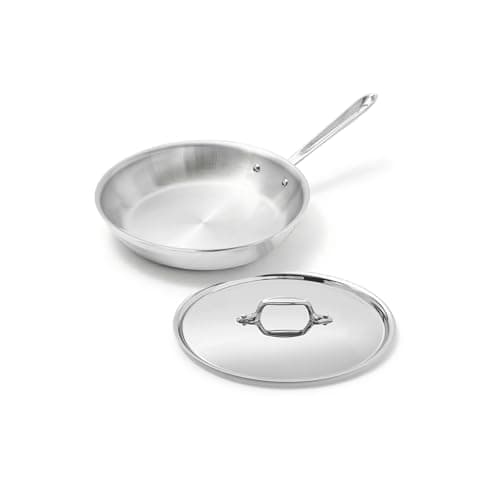
All-Clad D3 Stainless 10 in Fry Pan
One good open-stock stainless pan bought instead of a cheap full set
If you want to see how the category is priced before committing to either shape, covered saute pans on Amazon and 12-inch skillets are the two searches worth running side by side.
Where we stand
We do not make or sell saute pans or skillets. Both link to the same retailer, both pay us the same commission rate, and we earn exactly the same whichever one you buy — or nothing at all if you buy neither, which is sometimes the right answer. Most of the comparison pages that rank for this question are published by companies that sell one of the two. How we are funded.
What to buy, if you are buying
These are the products this page's reasoning actually points at. Same rules as everywhere else on the site: published specs, a stated trade-off, and a live price only where one exists.
Top pick · The skillet to own firstSpecs read September 3, 2026
All-Clad D3 Stainless 10 in Fry Pan
Sloped walls, a 600F oven ceiling and fully bonded construction that makes the sidewalls do work rather than just hold food in.
Best for: One good open-stock stainless pan bought instead of a cheap full set
Published specifications for the All-Clad D3 Stainless 10 in Fry Pan
Construction
Fully bonded tri-ply, aluminum core
Oven maximum
600F, oven and broiler safe
Induction
Yes - compatible with any stovetop
Dishwasher
Handwash only (All-Clad published)
Handle
Double-riveted stainless
Weight
3.0 lb (model 4110)
Warranty
Limited lifetime
Made in
Bonded, engineered and assembled in Canonsburg, PA
Good
600F is the highest oven ceiling of any stainless pan on this site
The one pan here whose manufacturing location is published down to the town
Genuinely repairable-adjacent: rivets are the only failure point and the warranty covers them
Not good
Hand wash only
The flared rim makes it a poor pan for anything with liquid
Costs several times what a Tramontina or Cuisinart pan of the same construction costs
The trade-off. Hand wash only. All-Clad publishes that plainly, and it is a real daily cost on a pan you will use every day.
Skip this if. You want a dishwasher-safe pan, or you are buying a whole kitchen on a fixed budget - one D3 skillet costs what a full clad set can cost.
Published specifications for the Cuisinart MultiClad Pro MCP-12N 12-Piece Set
Construction
Tri-ply: 18/10 stainless interior, pure aluminum core, brushed stainless exterior
Pieces
1.5 and 3 qt covered saucepans; 8 in and 10 in skillets; 3.5 qt covered saute; 8 qt covered stockpot; steamer insert
Oven maximum
500F per the Cuisinart use-and-care manual, which the Amazon listing we cite now matches. Major retail listings still advertise 550F; Cuisinart has confirmed the manual figure
Induction
Yes
Dishwasher
Dishwasher safe
Handles
Riveted solid stainless, cool-grip profile
Warranty
Lifetime
Good
Heat runs up the sidewalls, not just across the base
Genuinely dishwasher safe, which the pricier clad brands often are not
Lifetime warranty on a set at this price
Not good
Published oven maximum contradicts the retail listing for the same product
Handle spine is divisive
No 12-inch skillet in the box, which is the pan most people reach for second
The trade-off. The cool-grip handles have a sharp spine that some people find uncomfortable on a full 8-quart stockpot.
Skip this if. You want the higher oven ceiling that major retail listings advertise. The manual says 500F and Cuisinart has confirmed the manual is correct.
Published specifications for the Tramontina Signature Tri-Ply Clad 12-Piece Set
Construction
Tri-ply: 18/10 stainless, aluminum core, magnetic stainless exterior
Pieces
8 in and 10 in fry pans; 1.5, 2 and 3 qt covered saucepans; 5 qt covered deep saute; 8 qt covered stockpot
Oven maximum
500F on the 80116-249DS listing; other SKUs in the line are listed at 350F
Induction
Yes - magnetic stainless exterior
Dishwasher
Listed dishwasher safe
Handles
Precision cast, riveted
Certification
NSF-certified on the 80116-249DS line
Country of origin
Not asserted - retail listings disagree across SKUs (Brazil and China both appear)
Good
Fully clad, not disc-bottom: the aluminum runs up the sidewalls, so sauces do not scorch in a ring at the base
NSF certification on the flagship SKU is a real, checkable third-party mark rather than a marketing badge
Induction-ready without paying an induction premium
Not good
Retail listings disagree on the oven maximum across SKUs in the same line, which is a documentation problem, not a cooking one
Handles run hot on gas
The 12-piece count includes lids; the useful-item count is seven
The trade-off. Handles are the weak point. They are riveted and sturdy, but they get hot on a gas ring in a way the more expensive clad brands' do not.
Skip this if. You want a set you can leave in the oven above 500F, or you cook mostly eggs and pancakes and would rather spend the money on one good nonstick pan.
›What is the difference between a saute pan and a skillet?
The wall angle. A skillet has sloped walls that let you slide a spatula under food and toss it; a saute pan has straight walls that rise vertically from the base, holding roughly twice the liquid at the same rim diameter and almost always coming with a lid.
›Do I need both a saute pan and a skillet?
Not to start. A skillet covers more weeknight cooking. Add a saute pan when you find yourself braising or shallow frying regularly - and check your existing set first, because most clad sets already include a covered saute under a different name.
›Which is better for searing?
A saute pan of the same rim diameter has a larger flat base, so it browns more food at once. A skillet drives moisture off faster because the sloped wall lets steam escape. Sear in the saute pan if you are crowding it, in the skillet if you are not.
›Can you use a saute pan as a skillet?
Mostly, but not for anything you toss or slide out. Eggs, pancakes and omelets need the ramp a sloped wall gives you, and a spatula meets a straight wall head on.
›Is a chef's pan the same as a saute pan?
No. A chef's pan or everyday pan has gently curved walls - halfway between the two shapes - which is a compromise rather than a third category. It holds more than a skillet and is easier to stir than a saute pan, and it does neither job as well as the specialist shape.
Sources
Every figure on this page came from one of these. Follow them and check our arithmetic — that is the point.