Heads up: some links on this page earn us a commission at no extra cost to you. It does not change what we recommend or the order. How we are funded.
The short answer
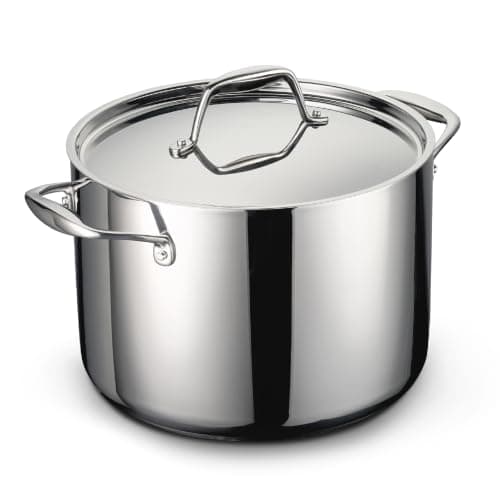
For a household of two to four, buy an 8-quart clad stainless stockpot - the Tramontina tri-ply is the straightforward answer and it costs little more than a disc-bottom pot of the same size. Fully clad matters here only if you cook thick things in it; for pasta water and blanching, a disc bottom is genuinely fine. If you cook for one or two and mainly braise rather than boil, skip the stockpot entirely and buy a 6-quart enameled Dutch oven instead, which does more jobs in less cupboard space.
Quick picks
The whole answer, on one screen. Tap a row to jump to the full write-up. Every pick below carries a stated trade-off further down — including the one at the top.
#
Product
Best for
Price
1
Tramontina Tri-Ply Clad Covered Stock Pot, 8 qt
Eight quarts, fully clad through the walls, two riveted handles and a lid - the pot a household of four actually needs.
Prices last checked October 20, 2026. Prices move constantly — the number on Amazon when you click is the real one.
How we chose these
We have not cooked in any of them. This page compares capacity, construction, handle design, lid, induction compatibility and published dishwasher guidance - all of it from the manufacturers' own material. The method is here, and where a maker publishes nothing the product card says so.
The stockpot is also the shape where our usual advice softens. In a saucepan, construction is the whole story. In a stockpot, capacity is the story and construction is a footnote - which is worth saying plainly, because most roundups in this category argue the opposite.
Size is the decision
Capacity
Who it suits
What it will and will not do
4 qt
One person
Pasta for two, small soups. Too small for stock or a pound of pasta
6 qt
Two people
A pound of pasta at a push, soup for four, small batches of stock
8 qt
Two to four, and most kitchens
Pasta comfortably, chili for a week, a real batch of stock
12 qt
Batch cooks, canners, large families
Everything, and it will not fit in most cupboards
16 qt and up
Brewing, canning, crab boils
A specialist purchase, not a kitchen pot
Eight quarts is the size that suits the most households. Below it you will hit the ceiling on pasta; above it you will hit the ceiling on storage.
The practical constraint people forget is the burner. A 12-quart pot on a domestic ring heats slowly and boils reluctantly, because the base is far wider than the flame. That same mismatch is why pan diameter matters on electric stoves and why skillet size is a burner question as much as a portion question.
Where cladding matters and where it does not
A stockpot is tall and narrow relative to its base, and most of what happens in it happens in liquid at a rolling boil, where convection moves the heat rather than the metal. That is why a disc bottom, which is a genuine handicap in a saucepan, is close to harmless here. The full construction argument is in disc bottom versus fully clad.
There is one exception and it is the reason we still recommend clad: anything thick. Chili, bolognese, a reduced stock, a big pot of oatmeal. In a disc-bottom pot those scorch in a ring at the edge of the aluminum slug. In a clad pot they do not. If your stockpot is exclusively a pasta pot, buy on price. If it is also your chili pot, buy clad.
A clad 8-quart pot full of stock is heavy. Two riveted handles are not a luxury at this size, and a pot with one long handle at 8 quarts is a design mistake you will notice at the sink.
Lids, handles and the parts people ignore
The lid should be included. Buying an 8-quart lid separately is surprisingly annoying and often costs a third of the pot.
Riveted handles beat welded ones at this size and weight, though rivets mean two small protrusions inside the pot to clean around.
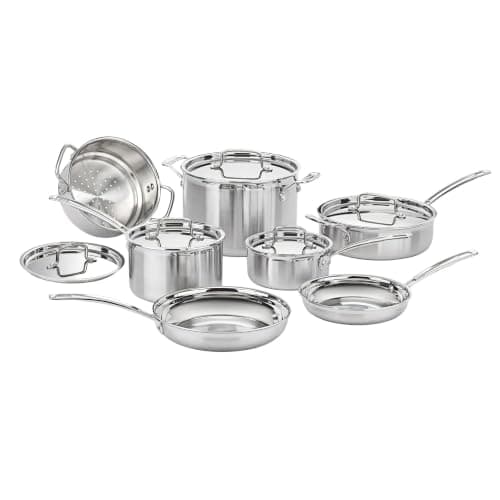
A steamer or pasta insert turns one pot into three. The Cuisinart set includes one; most standalone pots do not.
A tall narrow profile reduces evaporation, which is what you want for stock and not what you want for reduction.
The pot that might replace it
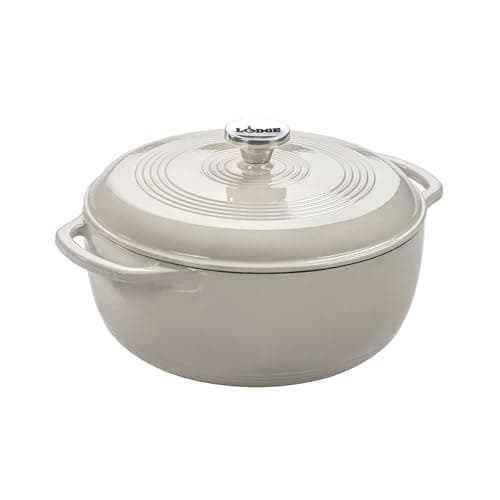
For a one or two person household, a 6-quart enameled Dutch oven does more of the same jobs in less space: soup, stock in modest batches, braises a stockpot cannot do well, bread a stockpot cannot do at all. It is heavier, it holds less, and it is non-reactive so acidic cooking is a non-issue.
What it will not do is boil a pound of pasta comfortably or hold a large batch of anything. If you cook for four, you want both. The sizing case is in what size Dutch oven, and the roundup is best enameled Dutch ovens.
Three ways to buy one
Standalone.An 8 qt clad stockpot on its own, which is the cleanest purchase if the rest of your kitchen is sorted.
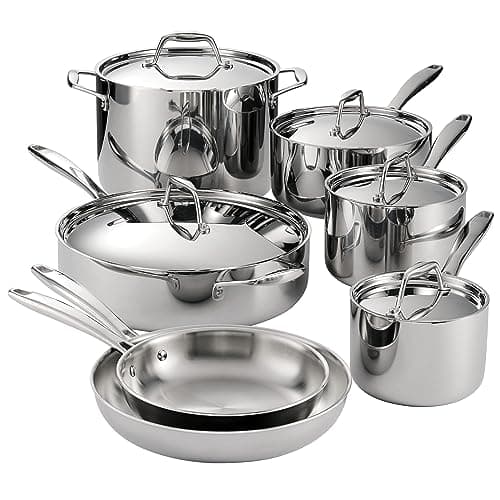
Inside a set. Both clad sets we recommend include an 8 qt clad stockpot - the Tramontina set and the Cuisinart MultiClad Pro, the latter with a steamer insert. If you need pans anyway, the pot is close to free.
Nonstick stockpots. Nothing sticks in boiling water, the coating adds a wear surface to a pot that would otherwise be permanent, and the oven ceiling drops.
Aluminum stockpots without a stainless lining, which react with tomato and wine.
Anything over 12 quarts bought "just in case". It will live in a garage.
Thin-walled pots with a heavy base and a light rim. They dent, and the rim is what you grab.
Glass lids on a pot you will use for stock, which is a long low simmer where the lid gets no benefit and can craze over time.
Every pot on this page, plus the alternative to owning one
Capacity is the decision. Construction only matters if you cook thick things in it, and for a small household the Dutch oven may be the better purchase entirely.
Tramontina Tri-Ply Clad Covered Stock Pot, 8 qt
Stock, chili, pasta for a family, and batch cooking on a Sunday
If you want to see the range before committing to a size, 8-quart stockpots on Amazon covers the sizes most households land on.
Every pick, in full
Each write-up below gives the published specs, what the pan is genuinely good at, what it costs you, and who should skip it. The trade-off line is there on the top pick too — a recommendation with no downside is an advertisement.
Top pick · Best stockpotSpecs read September 3, 2026
Tramontina Tri-Ply Clad Covered Stock Pot, 8 qt
Eight quarts, fully clad through the walls, two riveted handles and a lid - the pot a household of four actually needs.
Best for: Stock, chili, pasta for a family, and batch cooking on a Sunday
Published specifications for the Cuisinart MultiClad Pro MCP-12N 12-Piece Set
Construction
Tri-ply: 18/10 stainless interior, pure aluminum core, brushed stainless exterior
Pieces
1.5 and 3 qt covered saucepans; 8 in and 10 in skillets; 3.5 qt covered saute; 8 qt covered stockpot; steamer insert
Oven maximum
500F per the Cuisinart use-and-care manual, which the Amazon listing we cite now matches. Major retail listings still advertise 550F; Cuisinart has confirmed the manual figure
Induction
Yes
Dishwasher
Dishwasher safe
Handles
Riveted solid stainless, cool-grip profile
Warranty
Lifetime
Good
Heat runs up the sidewalls, not just across the base
Genuinely dishwasher safe, which the pricier clad brands often are not
Lifetime warranty on a set at this price
Not good
Published oven maximum contradicts the retail listing for the same product
Handle spine is divisive
No 12-inch skillet in the box, which is the pan most people reach for second
The trade-off. The cool-grip handles have a sharp spine that some people find uncomfortable on a full 8-quart stockpot.
Skip this if. You want the higher oven ceiling that major retail listings advertise. The manual says 500F and Cuisinart has confirmed the manual is correct.
Published specifications for the Tramontina Signature Tri-Ply Clad 12-Piece Set
Construction
Tri-ply: 18/10 stainless, aluminum core, magnetic stainless exterior
Pieces
8 in and 10 in fry pans; 1.5, 2 and 3 qt covered saucepans; 5 qt covered deep saute; 8 qt covered stockpot
Oven maximum
500F on the 80116-249DS listing; other SKUs in the line are listed at 350F
Induction
Yes - magnetic stainless exterior
Dishwasher
Listed dishwasher safe
Handles
Precision cast, riveted
Certification
NSF-certified on the 80116-249DS line
Country of origin
Not asserted - retail listings disagree across SKUs (Brazil and China both appear)
Good
Fully clad, not disc-bottom: the aluminum runs up the sidewalls, so sauces do not scorch in a ring at the base
NSF certification on the flagship SKU is a real, checkable third-party mark rather than a marketing badge
Induction-ready without paying an induction premium
Not good
Retail listings disagree on the oven maximum across SKUs in the same line, which is a documentation problem, not a cooking one
Handles run hot on gas
The 12-piece count includes lids; the useful-item count is seven
The trade-off. Handles are the weak point. They are riveted and sturdy, but they get hot on a gas ring in a way the more expensive clad brands' do not.
Skip this if. You want a set you can leave in the oven above 500F, or you cook mostly eggs and pancakes and would rather spend the money on one good nonstick pan.
Published specifications for the Lodge Enameled Cast Iron Dutch Oven, 6 qt
Material
Cast iron with porcelain enamel, inside and out
Capacity
6 qt
Induction
Yes - the iron under the enamel is ferrous
Seasoning
None required - enamel is not a seasoning surface
Acid
Safe for tomato and wine, unlike bare iron
Oven maximum
Set by the knob material - check the specific SKU; Lodge publishes a lower ceiling than for bare iron
Good
Non-reactive, so it handles the acidic cooking bare iron cannot
No seasoning to maintain
Considerably cheaper than the French enameled pots it copies
Not good
Chipped enamel is not repairable, unlike bare iron's seasoning
Oven ceiling is lower than bare cast iron because of the knob
Heavy, and the enamel makes it heavier than bare iron of the same capacity
The trade-off. The enamel is a glass layer. Chip it and the pot is not restorable the way bare iron is, and Lodge's enamel chips more readily than the premium brands'.
Skip this if. You already own a large stainless stockpot and rarely braise. This duplicates it for most weeknight cooking.
Eight quarts suits most households of two to four - it boils a pound of pasta comfortably and holds a real batch of stock or chili. Six quarts is enough for two people, and anything over twelve quarts is a specialist purchase that heats slowly on a domestic burner.
›Does a stockpot need to be fully clad?
Less than any other shape. Most of what happens in a stockpot happens in boiling liquid, where convection moves the heat. Cladding matters if you also cook thick things - chili, bolognese, reduced stock - because those scorch in a ring in a disc-bottom pot.
›Can a Dutch oven replace a stockpot?
For one or two people, often yes. A 6 qt enameled Dutch oven does soup, small batches of stock, braises and bread. It will not boil a pound of pasta comfortably or hold a large batch, so a household of four wants both.
›Are nonstick stockpots any good?
No, and the reason is simple: nothing sticks in boiling water. A coating adds a wear surface to a pot that would otherwise last decades, and it lowers the oven ceiling for no benefit.
›Should a stockpot have one handle or two?
Two, at 8 quarts and above. A full 8-quart pot is heavy enough that a single long handle is a design mistake, and riveted loop handles are what you want at the sink.
Sources
Every figure on this page came from one of these. Follow them and check our arithmetic — that is the point.