Heads up: some links on this page earn us a commission at no extra cost to you. It does not change what we recommend or the order. How we are funded.
The short answer
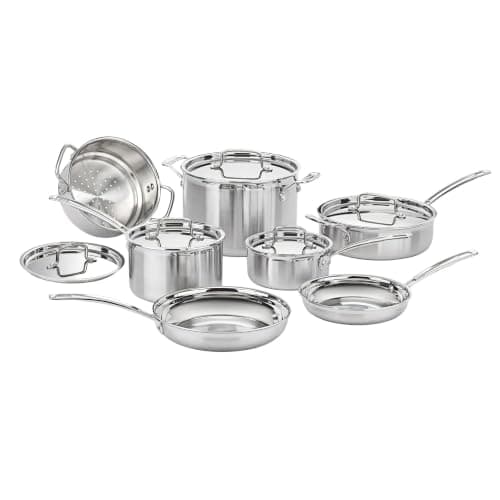
Most kitchens do not need a dedicated pasta pot. An 8 quart clad stockpot plus a colander does the same job and the pot is useful for a dozen other things - best colanders and strainers covers which strainer to pair with it. Where an insert genuinely earns its place is steaming: a perforated basket turns a pot you already own into a steamer without buying a vessel. The Cuisinart MultiClad Pro set is the one in our ledger that ships with a steamer insert included rather than sold separately.
Quick picks
The whole answer, on one screen. Tap a row to jump to the full write-up. Every pick below carries a stated trade-off further down — including the one at the top.
#
Product
Best for
Price
1
Tramontina Tri-Ply Clad Covered Stock Pot, 8 qt
Eight quarts of fully clad stainless with two riveted handles - the pot a pasta pot is pretending to be.
Prices last checked October 24, 2026. Prices move constantly — the number on Amazon when you click is the real one.
What we can tell you here
Our audited ledger contains clad stockpots and one set that includes a steamer insert. It does not contain a separately audited strainer-lid pasta pot or a standalone steamer basket, so those are pointed at with tagged category searches rather than product cards. The method is here.
Three products that get shopped as one
Product
What it is
Worth buying?
Stockpot plus colander
A plain pot and a separate strainer
Yes - what most kitchens should own
Pasta pot with a strainer insert
A pot with a perforated inner basket you lift out
Sometimes - see below
Pot with a locking strainer lid
A lid with holes you drain through
Rarely - it strains slowly and burns hands
Steamer insert
A perforated basket that sits above water
Yes - the genuinely useful one
Multi-cooker set
Pot, pasta insert, steamer insert, lid
Only if you use all three
The middle row is the one people mean by pasta pot, and it is the one with the weakest case.
The pasta insert, honestly assessed
A pasta insert is a perforated basket that fills the pot. You lift it, the water drains back, and you never carry a heavy pot of boiling water to a sink. That is a genuine safety improvement and the best argument for the format.
Three real drawbacks:
It reduces usable capacity. The basket takes up volume, so an 8 quart pot holds noticeably less water than 8 quarts of pasta water.
It is one more bulky item to store, and it does not nest with anything.
It gets in the way the rest of the time, when the pot is being used as a pot.
Weigh that against a colander, which costs very little, stores flat and does the same job. For most households the colander wins. For someone who finds lifting a full pot genuinely difficult, the insert is worth the compromises — and that is a real accessibility argument rather than a convenience one.
The locking strainer lid is the weakest version of this idea. It drains through a small hole area, so it is slow, and it puts your hands next to escaping steam — the failure mode described in best oven mitts and pot holders.
The steamer insert, which is the useful one
A steamer basket sits above a shallow layer of water and turns a pot you already own into a steamer. It is cheap, it stores small, and it does something no other item in the kitchen does.
Two formats. A collapsible perforated basket with folding petals fits many pot diameters and costs almost nothing. A fitted insert made for a specific pot sits more stably and holds more, and only fits that pot.
The Cuisinart MultiClad Pro set is the one product in our ledger that includes a fitted steamer insert with its 8 qt stockpot, which is why it appears here — the rest of that set is audited in our Cuisinart review.
Whatever accessory you buy, it is sitting in a pot, and the pot is the part that determines whether the thing is any good.
Eight quarts suits two to four people — a pound of pasta needs real volume. Sizing is in best stockpots.
Fully clad if you cook thick things in it. For boiling water alone a disc bottom is fine, and for chili it scorches in a ring — disc bottom versus fully clad.
Two riveted handles, not one long one. Eight quarts of water is heavy and a single handle at that weight is a design error.
A lid included, because buying an 8-quart lid separately is expensive.
The insert is an accessory. The pot is the purchase, and an 8 qt clad stockpot is useful every week whether or not anything sits inside it.
If you cook for one or two
An 8 quart pot is more than you need and a pasta insert is definitely more than you need. A 4 to 6 quart saucepan or an enameled Dutch oven boils enough pasta for two, and both are useful daily in a way a pasta pot is not.
That is the same reasoning as best small cookware sets: in a small household the constraint is cupboard space, and single-purpose vessels are the first thing to cut.
Each write-up below gives the published specs, what the pan is genuinely good at, what it costs you, and who should skip it. The trade-off line is there on the top pick too — a recommendation with no downside is an advertisement.
Top pick · Best pasta potSpecs read September 3, 2026
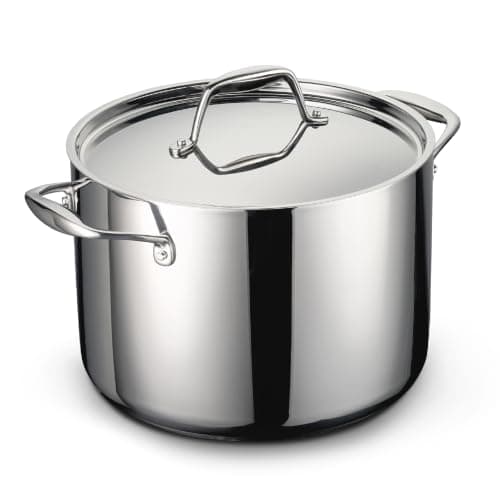
Tramontina Tri-Ply Clad Covered Stock Pot, 8 qt
Eight quarts of fully clad stainless with two riveted handles - the pot a pasta pot is pretending to be.
Best for: Stock, chili, pasta for a family, and batch cooking on a Sunday
Published specifications for the Cuisinart MultiClad Pro MCP-12N 12-Piece Set
Construction
Tri-ply: 18/10 stainless interior, pure aluminum core, brushed stainless exterior
Pieces
1.5 and 3 qt covered saucepans; 8 in and 10 in skillets; 3.5 qt covered saute; 8 qt covered stockpot; steamer insert
Oven maximum
500F per the Cuisinart use-and-care manual, which the Amazon listing we cite now matches. Major retail listings still advertise 550F; Cuisinart has confirmed the manual figure
Induction
Yes
Dishwasher
Dishwasher safe
Handles
Riveted solid stainless, cool-grip profile
Warranty
Lifetime
Good
Heat runs up the sidewalls, not just across the base
Genuinely dishwasher safe, which the pricier clad brands often are not
Lifetime warranty on a set at this price
Not good
Published oven maximum contradicts the retail listing for the same product
Handle spine is divisive
No 12-inch skillet in the box, which is the pan most people reach for second
The trade-off. The cool-grip handles have a sharp spine that some people find uncomfortable on a full 8-quart stockpot.
Skip this if. You want the higher oven ceiling that major retail listings advertise. The manual says 500F and Cuisinart has confirmed the manual is correct.
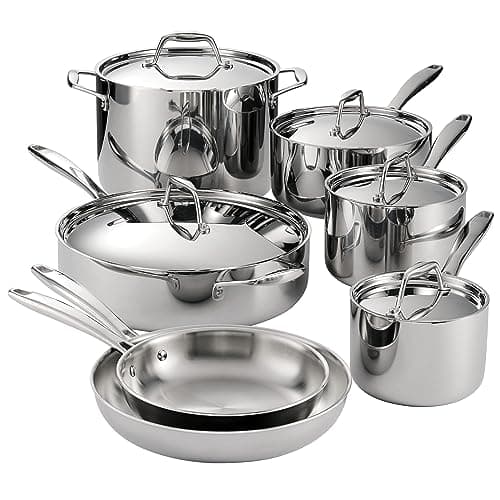
Published specifications for the Tramontina Signature Tri-Ply Clad 12-Piece Set
Construction
Tri-ply: 18/10 stainless, aluminum core, magnetic stainless exterior
Pieces
8 in and 10 in fry pans; 1.5, 2 and 3 qt covered saucepans; 5 qt covered deep saute; 8 qt covered stockpot
Oven maximum
500F on the 80116-249DS listing; other SKUs in the line are listed at 350F
Induction
Yes - magnetic stainless exterior
Dishwasher
Listed dishwasher safe
Handles
Precision cast, riveted
Certification
NSF-certified on the 80116-249DS line
Country of origin
Not asserted - retail listings disagree across SKUs (Brazil and China both appear)
Good
Fully clad, not disc-bottom: the aluminum runs up the sidewalls, so sauces do not scorch in a ring at the base
NSF certification on the flagship SKU is a real, checkable third-party mark rather than a marketing badge
Induction-ready without paying an induction premium
Not good
Retail listings disagree on the oven maximum across SKUs in the same line, which is a documentation problem, not a cooking one
Handles run hot on gas
The 12-piece count includes lids; the useful-item count is seven
The trade-off. Handles are the weak point. They are riveted and sturdy, but they get hot on a gas ring in a way the more expensive clad brands' do not.
Skip this if. You want a set you can leave in the oven above 500F, or you cook mostly eggs and pancakes and would rather spend the money on one good nonstick pan.
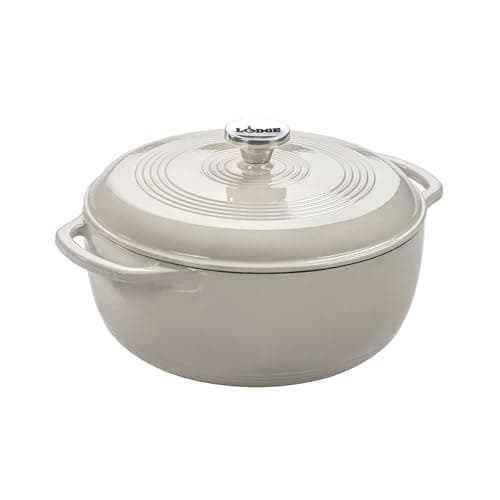
Published specifications for the Lodge Enameled Cast Iron Dutch Oven, 6 qt
Material
Cast iron with porcelain enamel, inside and out
Capacity
6 qt
Induction
Yes - the iron under the enamel is ferrous
Seasoning
None required - enamel is not a seasoning surface
Acid
Safe for tomato and wine, unlike bare iron
Oven maximum
Set by the knob material - check the specific SKU; Lodge publishes a lower ceiling than for bare iron
Good
Non-reactive, so it handles the acidic cooking bare iron cannot
No seasoning to maintain
Considerably cheaper than the French enameled pots it copies
Not good
Chipped enamel is not repairable, unlike bare iron's seasoning
Oven ceiling is lower than bare cast iron because of the knob
Heavy, and the enamel makes it heavier than bare iron of the same capacity
The trade-off. The enamel is a glass layer. Chip it and the pot is not restorable the way bare iron is, and Lodge's enamel chips more readily than the premium brands'.
Skip this if. You already own a large stainless stockpot and rarely braise. This duplicates it for most weeknight cooking.
Most kitchens do not. An 8 quart clad stockpot and a colander do the same job, and the pot is useful for stock, soup and chili the rest of the week. A pasta insert reduces usable capacity and does not store well.
›Is a pasta insert worth it?
It is worth it if lifting a full pot of boiling water to a sink is difficult - lifting a basket out instead is a genuine safety improvement. Otherwise a colander costs less, stores flat and does not take up volume inside the pot.
›Are strainer lids any good?
They are the weakest version of the idea. The hole area is small so draining is slow, and they put your hands close to escaping steam. A colander or a lift-out basket is safer and faster.
›What is a steamer insert for?
It sits above a shallow layer of water and turns a pot you already own into a steamer. It is cheap, stores small and does something nothing else in the kitchen does - which makes it the genuinely useful insert.
›What size pot do you need for pasta?
Eight quarts for two to four people, because a pound of pasta needs real volume to move in. For one or two people a 4 to 6 quart saucepan or a Dutch oven is enough, and far more useful the rest of the week.
Sources
Every figure on this page came from one of these. Follow them and check our arithmetic — that is the point.