Heads up: some links on this page earn us a commission at no extra cost to you. It does not change what we recommend or the order. How we are funded.
The short answer
Buy fully clad for anything that simmers. A disc-bottom pan puts aluminum only in a slug attached to the base, so the walls stay comparatively cool and a sauce scorches in a ring where the disc ends. A fully clad pan has aluminum running up the sidewalls, so the whole vessel heats. The exception is a tall stockpot used mostly for boiling water, where the walls do no work and a disc bottom is genuinely fine - and where the disc, being thicker, can even be the better base.
Why stainless needs aluminum at all
Stainless steel is a poor conductor of heat. That is not a flaw in cheap stainless - it is what the alloy is. Steel conducts at roughly 15 to 45 watts per meter-kelvin depending on the grade, while aluminum runs around 237. A pan made only of stainless develops hot spots directly over the burner and cool zones an inch away.
So every usable stainless pan is a composite: stainless for the food-contact surface, which is non-reactive and hard-wearing, and aluminum somewhere inside it to move the heat around. The only question is where the aluminum goes.
The two answers
Disc bottom
A thick aluminum disc - sometimes aluminum plus a magnetic steel layer for induction - is bonded to the underside of a stainless shell, usually by impact bonding, and capped with a stainless plate. The walls of the pan are single-layer stainless with nothing in them.
Listings describe this as "encapsulated base", "impact-bonded base", "capsule bottom" or, most misleadingly, "tri-ply base" - which is technically accurate and reads exactly like tri-ply construction.
Fully clad
The whole pan is a bonded sandwich: stainless, aluminum, stainless, roll-bonded as sheet and then formed. The aluminum runs from the center of the base up to the rim. Tri-ply is the common form; five-ply adds layers, and what that does and does not buy is in tri-ply versus five-ply.
Disc bottom
Fully clad
Where the aluminum is
A slug on the base only
Base and sidewalls, up to the rim
Sidewall heating
Almost none - the walls are single-layer steel
Yes, and it is the whole point
Scorching
A visible ring where the disc ends, on anything thick
Even, because there is no edge to the heated zone
Base thickness
Often thicker than a clad base
Determined by the sheet, usually thinner
Weight
Lower - only the base is heavy
Higher, distributed
Boiling water
Perfectly good
Perfectly good, no advantage
Delamination risk
Real - the base can separate
Effectively none, it is one bonded sheet
Typical price
Lower
Higher, though Tramontina closes most of the gap
The disc bottom is not a scam. It is a different engineering answer that is right for one shape and wrong for the others.
The scorch ring, which is the whole argument
Put a thick tomato sauce or a chili in a disc-bottom pot on medium heat and come back in twenty minutes. There will be a browned ring around the base at exactly the diameter of the aluminum disc - hot inside it, cooler outside it - and the transition is sharp because the disc has an edge.
The same dish in a clad pot browns evenly or not at all, because there is no boundary. This is the single most common reason people conclude their stainless pans are "bad", when what they own is a construction mismatch. Sticking, by contrast, is usually technique rather than construction, and that is covered in why food sticks to stainless steel.
The ring is most visible in wide, shallow pots and least visible in tall narrow ones, which is why a disc-bottom stockpot is a reasonable purchase and a disc-bottom saucier is not.
On a clad pan you can read the construction at the rim. On a disc-bottom pan the rim shows a single sheet of steel and the aluminum is hidden under a plate.
Shape by shape
Shape
How much sidewall does work
Buy
Saucepan
A great deal - it is mostly wall
Fully clad. This is the shape that justifies the money
Saucier
Almost all of it - curved walls, constant stirring
Fully clad, no exceptions
Skillet
Some, at the flared edge
Fully clad, but the gap is smaller here
Saute pan
A lot - straight walls, and braising liquid touches all of it
Fully clad
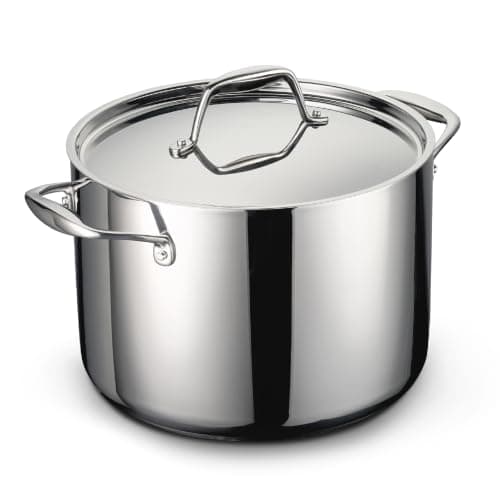
Stockpot
Little, if you mostly boil
Either. Clad if you make chili and stock; disc bottom if it is a pasta pot
Steamer insert or pasta insert
None - it never touches the burner
Irrelevant
The rule underneath the table: the more of the food that touches a wall rather than the base, the more cladding is worth.
How to tell which one you are looking at
Read the rim in the photos. A clad pan shows a uniform edge with a faint line of aluminum. A disc-bottom pan shows a single thin sheet.
Look for a visible seam or step on the outside of the base. A disc has a diameter and you can usually see where it ends.
Read the words carefully. "Tri-ply base", "encapsulated base", "impact-bonded" and "capsule bottom" all mean disc. "Fully clad", "bonded through the walls" and unqualified "tri-ply" usually mean clad.
Weigh it in your hand if you can. A disc-bottom pan is base-heavy and feels light at the rim.
This language trap is one of the nine catalogued in cookware set buying mistakes, and it is the most expensive of them.
The honest case for a disc bottom
Three things a disc bottom genuinely does better, and they are not nothing:
A thicker base. A disc can be considerably thicker than the aluminum layer in a clad sheet, which means more thermal mass exactly where a pot sits on the burner. For boiling and for holding a simmer, that is an advantage.
Less weight. A large clad stockpot full of stock is heavy before you add the stock.
Lower price on big shapes, where cladding a large vessel costs the most and delivers the least.
The counterweight is delamination. A bonded disc can separate from the shell after years of thermal cycling, and when it does the pot is finished - there is no repair. A clad pan cannot fail this way because it is one sheet. That is one of the terminal faults listed in when to replace your cookware.
Fully clad saucepans on Amazon is the search that separates the two constructions fastest, because the shape is where the difference is largest.
Where we stand
We do not make or sell disc-bottom cookware or fully clad cookware. Both link to the same retailer, both pay us the same commission rate, and we earn exactly the same whichever one you buy — or nothing at all if you buy neither, which is sometimes the right answer. Most of the comparison pages that rank for this question are published by companies that sell one of the two. How we are funded.
What to buy, if you are buying
These are the products this page's reasoning actually points at. Same rules as everywhere else on the site: published specs, a stated trade-off, and a live price only where one exists.
Top pick · Where cladding matters mostSpecs read September 3, 2026
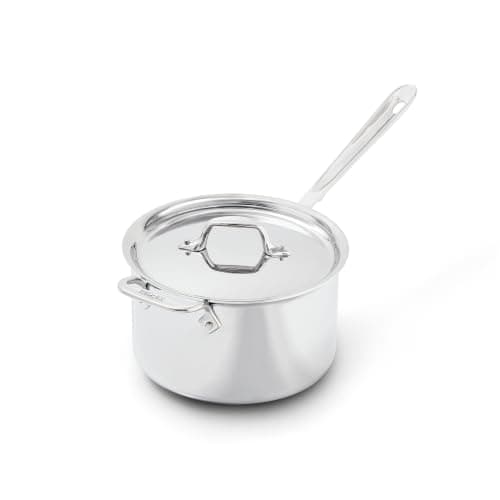
All-Clad D3 Stainless Saucepan, 3 qt
A saucepan is nearly all sidewall, which makes it the shape where fully clad construction earns its price and a disc bottom fails hardest.
Best for: Rice, custards and reductions - anything that scorches in a disc-bottom pan
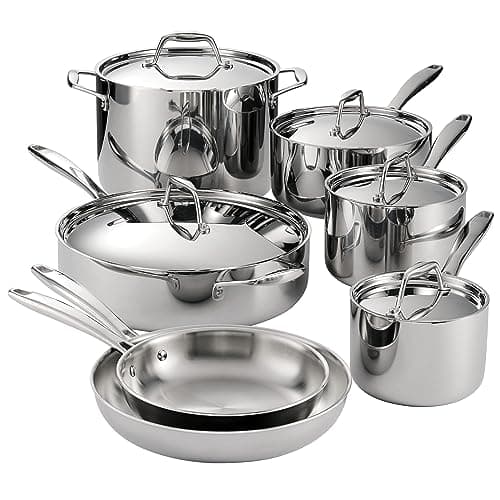
Published specifications for the Tramontina Signature Tri-Ply Clad 12-Piece Set
Construction
Tri-ply: 18/10 stainless, aluminum core, magnetic stainless exterior
Pieces
8 in and 10 in fry pans; 1.5, 2 and 3 qt covered saucepans; 5 qt covered deep saute; 8 qt covered stockpot
Oven maximum
500F on the 80116-249DS listing; other SKUs in the line are listed at 350F
Induction
Yes - magnetic stainless exterior
Dishwasher
Listed dishwasher safe
Handles
Precision cast, riveted
Certification
NSF-certified on the 80116-249DS line
Country of origin
Not asserted - retail listings disagree across SKUs (Brazil and China both appear)
Good
Fully clad, not disc-bottom: the aluminum runs up the sidewalls, so sauces do not scorch in a ring at the base
NSF certification on the flagship SKU is a real, checkable third-party mark rather than a marketing badge
Induction-ready without paying an induction premium
Not good
Retail listings disagree on the oven maximum across SKUs in the same line, which is a documentation problem, not a cooking one
Handles run hot on gas
The 12-piece count includes lids; the useful-item count is seven
The trade-off. Handles are the weak point. They are riveted and sturdy, but they get hot on a gas ring in a way the more expensive clad brands' do not.
Skip this if. You want a set you can leave in the oven above 500F, or you cook mostly eggs and pancakes and would rather spend the money on one good nonstick pan.
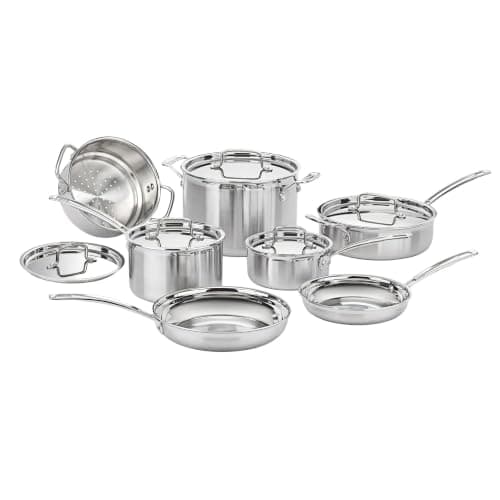
Published specifications for the Cuisinart MultiClad Pro MCP-12N 12-Piece Set
Construction
Tri-ply: 18/10 stainless interior, pure aluminum core, brushed stainless exterior
Pieces
1.5 and 3 qt covered saucepans; 8 in and 10 in skillets; 3.5 qt covered saute; 8 qt covered stockpot; steamer insert
Oven maximum
500F per the Cuisinart use-and-care manual, which the Amazon listing we cite now matches. Major retail listings still advertise 550F; Cuisinart has confirmed the manual figure
Induction
Yes
Dishwasher
Dishwasher safe
Handles
Riveted solid stainless, cool-grip profile
Warranty
Lifetime
Good
Heat runs up the sidewalls, not just across the base
Genuinely dishwasher safe, which the pricier clad brands often are not
Lifetime warranty on a set at this price
Not good
Published oven maximum contradicts the retail listing for the same product
Handle spine is divisive
No 12-inch skillet in the box, which is the pan most people reach for second
The trade-off. The cool-grip handles have a sharp spine that some people find uncomfortable on a full 8-quart stockpot.
Skip this if. You want the higher oven ceiling that major retail listings advertise. The manual says 500F and Cuisinart has confirmed the manual is correct.
›What is the difference between disc bottom and fully clad cookware?
A disc-bottom pan has an aluminum slug bonded to the base only, with single-layer stainless walls. A fully clad pan is a bonded sandwich of stainless, aluminum and stainless running from the base up to the rim, so the sidewalls heat too.
›Is fully clad cookware worth the extra money?
In saucepans, sauciers and saute pans, yes - those shapes are mostly sidewall, and a disc bottom leaves the walls cool so thick sauces scorch in a ring. In a stockpot used mainly for boiling, the difference is small and a disc bottom is a reasonable buy.
›How can you tell if a pan is fully clad?
Read the rim in the product photos - a clad pan shows a uniform bonded edge, a disc-bottom pan shows a single thin sheet of steel. In the text, encapsulated base, impact-bonded, capsule bottom and tri-ply base all mean disc bottom.
›Does a disc bottom heat more evenly?
Across the base it can, because a disc is often thicker than the aluminum layer inside a clad sheet. Across the whole pan it does not, because the walls have no aluminum in them at all.
›Can a disc bottom fall off a pan?
It can separate after years of thermal cycling, and a delaminated base ends the pot - there is no repair. A fully clad pan cannot fail this way because it is formed from a single bonded sheet.
Sources
Every figure on this page came from one of these. Follow them and check our arithmetic — that is the point.