We do not make or sell tri-ply cookware or five-ply cookware. Both link to the same retailer, both pay us the same commission rate, and we earn exactly the same whichever one you buy — or nothing at all if you buy neither, which is sometimes the right answer. Most of the comparison pages that rank for this question are published by companies that sell one of the two. How we are funded.
What a ply actually is
Clad cookware is a metal sandwich, roll-bonded under pressure and then formed into a pan. A ply is one layer of that sandwich. Tri-ply is stainless, aluminum, stainless. Five-ply adds two more layers, usually a second aluminum layer and an extra steel divider, or sometimes a copper layer in the middle.
The outer layers are almost always the same in both: a magnetic stainless exterior so the pan works on induction, and an 18/10 or similar non-reactive interior. The numbers behind those grades are explained in stainless steel grades explained.
More layers does not mean more conduction
The intuitive reading of "five-ply" is that it conducts better than tri-ply. It does not follow. Steel is a poor conductor at roughly 15 W/m-K; aluminum is excellent at 237. Adding a steel divider between two aluminum layers adds a poor conductor to the stack.
What five-ply usually does add is total aluminum thickness, and that is the thing that matters. A five-ply pan with 2 mm of total aluminum and a tri-ply pan with 2 mm of total aluminum will behave very similarly. A five-ply pan exists mainly because the extra steel divider lets a maker build a thicker sandwich without it delaminating or bowing.
Which is why the useful question at the counter is not "how many plies" but "how thick is the pan, in total, and how much of that is aluminum" - and almost nobody publishes the second half of that.
What the difference actually feels like
Situation
Tri-ply
Five-ply
Boiling water
Faster to the boil
Slower, and you will notice
Searing four pieces of meat
Temperature drops when the food goes in
Holds temperature better - the real advantage
Reducing a sauce
Even
Even
Moving from high to low heat
Responsive
Sluggish - all that mass has to shed heat
Lifting it full, one-handed
Manageable
Often a two-hand job
Warping on a hot burner
Rare on a good pan
Rarer
Read that list honestly and the five-ply case narrows to one thing: recovery under load. If you routinely sear a full pan of food, the extra mass keeps the surface hot when the cold food lands. If you mostly cook one or two portions, you are paying and lifting for a benefit that never arrives.
Where the layer count matters least
In a saucepan and a stock pot, almost none. The food is a column touching the walls, so what matters is whether the walls are clad at all, not how many times. That argument is made at length in best stainless steel saucepans.
In a fry pan it matters more, because searing is the one job where recovery under load is the whole game. Even there, a heavy tri-ply pan will beat a thin five-ply one, which is why the ply count on its own tells you very little.
The exterior grade is chosen for induction compatibility, the interior for corrosion resistance. Neither of those changes with ply count.
The vocabulary problem
"Tri-ply" on a disc-bottom pan. Some listings describe a three-layer base disc as tri-ply while the walls are single-ply steel. That is not a clad pan. Check the rim.
"Seven-ply" and up. Real, and used mostly to build copper-cored pans. The same reasoning applies, only more so - the diminishing return is steep.
"Impact bonded". This means a disc is bonded to the base by impact. It is a disc-bottom pan by another name.
Copper cores. Copper conducts better than aluminum, at roughly 400 W/m-K, and it also costs and weighs more. In a five-ply pan the copper layer is usually thin enough that the practical difference against aluminum is smaller than the price difference implies.
The verdict
Buy tri-ply. It is the right default for almost every kitchen, and the money saved buys the pieces a set is short of - a large clad pot, a Dutch oven, a decent sheet pan.
Buy five-ply if you sear large quantities regularly, you already own good tri-ply and know what you are missing, and you have honestly assessed whether you want to lift it. It is a genuine upgrade in one narrow situation and a heavier, slower, more expensive pan in every other.
Tri-ply, which is the answer for most kitchens
If you want to see how the five-ply lines are priced against these before deciding, it is worth comparing directly.
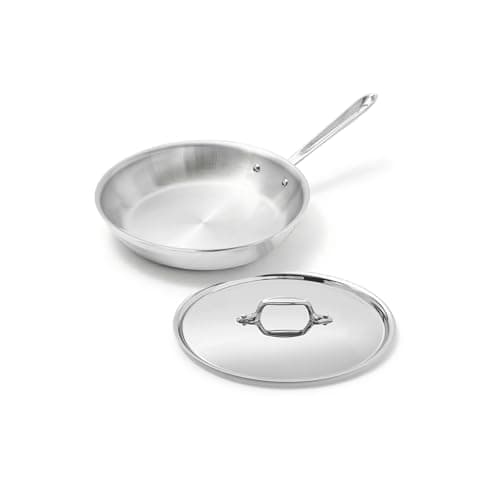
All-Clad D3 Stainless 10 in Fry Pan
One good open-stock stainless pan bought instead of a cheap full set
Five-ply sets on Amazon sit roughly double these, brand for brand, which is the number the decision actually turns on.
What to buy, if you are buying
These are the products this page's reasoning actually points at. Same rules as everywhere else on the site: published specs, a stated trade-off, and a live price only where one exists.
Top pick · The tri-ply referenceSpecs read September 3, 2026
All-Clad D3 Stainless 10 in Fry Pan
Three layers, 600F, bonded in Pennsylvania. This is the pan the whole ply argument is conducted around.
Best for: One good open-stock stainless pan bought instead of a cheap full set
Published specifications for the All-Clad D3 Stainless 10 in Fry Pan
Construction
Fully bonded tri-ply, aluminum core
Oven maximum
600F, oven and broiler safe
Induction
Yes - compatible with any stovetop
Dishwasher
Handwash only (All-Clad published)
Handle
Double-riveted stainless
Weight
3.0 lb (model 4110)
Warranty
Limited lifetime
Made in
Bonded, engineered and assembled in Canonsburg, PA
Good
600F is the highest oven ceiling of any stainless pan on this site
The one pan here whose manufacturing location is published down to the town
Genuinely repairable-adjacent: rivets are the only failure point and the warranty covers them
Not good
Hand wash only
The flared rim makes it a poor pan for anything with liquid
Costs several times what a Tramontina or Cuisinart pan of the same construction costs
The trade-off. Hand wash only. All-Clad publishes that plainly, and it is a real daily cost on a pan you will use every day.
Skip this if. You want a dishwasher-safe pan, or you are buying a whole kitchen on a fixed budget - one D3 skillet costs what a full clad set can cost.
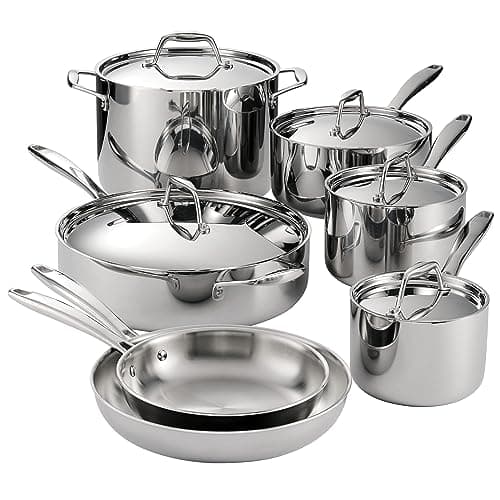
Published specifications for the Tramontina Signature Tri-Ply Clad 12-Piece Set
Construction
Tri-ply: 18/10 stainless, aluminum core, magnetic stainless exterior
Pieces
8 in and 10 in fry pans; 1.5, 2 and 3 qt covered saucepans; 5 qt covered deep saute; 8 qt covered stockpot
Oven maximum
500F on the 80116-249DS listing; other SKUs in the line are listed at 350F
Induction
Yes - magnetic stainless exterior
Dishwasher
Listed dishwasher safe
Handles
Precision cast, riveted
Certification
NSF-certified on the 80116-249DS line
Country of origin
Not asserted - retail listings disagree across SKUs (Brazil and China both appear)
Good
Fully clad, not disc-bottom: the aluminum runs up the sidewalls, so sauces do not scorch in a ring at the base
NSF certification on the flagship SKU is a real, checkable third-party mark rather than a marketing badge
Induction-ready without paying an induction premium
Not good
Retail listings disagree on the oven maximum across SKUs in the same line, which is a documentation problem, not a cooking one
Handles run hot on gas
The 12-piece count includes lids; the useful-item count is seven
The trade-off. Handles are the weak point. They are riveted and sturdy, but they get hot on a gas ring in a way the more expensive clad brands' do not.
Skip this if. You want a set you can leave in the oven above 500F, or you cook mostly eggs and pancakes and would rather spend the money on one good nonstick pan.
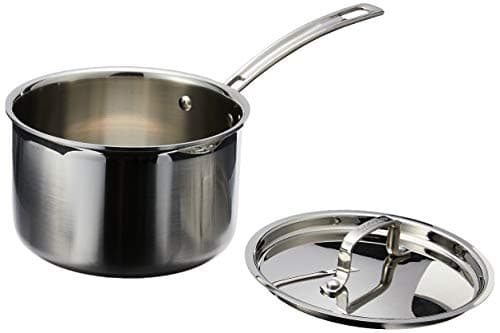
Published specifications for the Cuisinart MultiClad Pro Saucepan, 3 qt
Construction
Tri-ply: 18/10 stainless interior, pure aluminum core, brushed stainless exterior
Capacity
3 qt with lid
Oven maximum
500F per the Cuisinart use-and-care manual; retail listings say 550F
Induction
Yes
Dishwasher
Dishwasher safe
Handle
Riveted solid stainless, cool-grip profile
Warranty
Lifetime
Good
Genuinely dishwasher-safe clad stainless, which the premium brands are not
Fully clad rather than disc-bottom at an open-stock price
Lifetime warranty
Not good
Published oven maximum contradicts the retail listing for the same pan
The handle spine is divisive on larger pieces
No published country of manufacture
The trade-off. The oven ceiling is 500F per Cuisinart's manual, not the 550F some retail listings advertise. That is a documentation problem the buyer inherits.
Skip this if. You want the higher oven ceiling or the published US factory. That is All-Clad, and you pay for it.
Only for searing large quantities, where the extra mass holds temperature when cold food goes in. Five-ply is heavier, slower to heat and roughly double the price. For most cooking tri-ply is the better buy.
›Does five-ply conduct heat better than tri-ply?
Not necessarily. Five-ply usually adds a steel divider between two aluminum layers, and steel conducts poorly at around 15 W/m-K against aluminum's 237. What matters is total aluminum thickness, which few makers publish.
›What does ply mean in cookware?
A ply is one layer of the bonded metal sandwich a clad pan is made from. Tri-ply is stainless, aluminum, stainless. Five-ply adds two more layers, usually a second aluminum layer and a steel divider.
›Is a copper core worth it in five-ply cookware?
Copper conducts at roughly 400 W/m-K against aluminum's 237, so it is genuinely better. In practice the copper layer in a five-ply pan is thin enough that the cooking difference is smaller than the price difference suggests.
›How can you tell if a pan is fully clad or disc bottom?
Look at the rim. On a fully clad pan the aluminum layer is visible sandwiched between steel all the way up the cut edge. A disc-bottom pan has a plain steel rim and a step at the base where the disc is attached.
Sources
Every figure on this page came from one of these. Follow them and check our arithmetic — that is the point.