Two numbers, two alloys, one pan. The interior grade is chosen for corrosion resistance and the exterior for magnetism, and neither is a quality ranking.
Heads up: some links on this page earn us a commission at no extra cost to you. It does not change what we recommend or the order. How we are funded.
The short answer
18/10 and 18/8 mean 18% chromium with 10% or 8% nickel. Both are austenitic, non-magnetic and highly corrosion resistant. Both are used for the food-contact interior.
304 is the industry designation for that same family. 18/8 and 304 describe the same steel from two naming systems.
18/0, or 430, has essentially no nickel, is magnetic, and is used for the exterior so the pan works on induction.
A higher nickel number is not a quality ranking. It buys corrosion resistance and a slightly warmer sheen, not better cooking.
What the two numbers mean
"18/10" is a ratio of two alloying elements by weight: 18% chromium and 10% nickel, with the rest mostly iron and a little carbon.
Chromium is what makes stainless steel stainless. It reacts with oxygen to form a very thin, self-repairing oxide film on the surface. Scratch it and it re-forms within seconds. Below about 11% chromium the film does not establish and the steel rusts like any other.
Nickel changes the crystal structure to austenitic, which is tougher, more formable, more resistant to acids and chlorides - and non-magnetic. It also costs considerably more than chromium, which is why it is the number that varies.
So 18/10 and 18/8 are the same steel with slightly different nickel content. The practical difference between them in a kitchen is small. The marketing difference is not.
Why your pan has two different grades in it
A clad pan is a sandwich, and the two outer layers do different jobs.
Layer
Typical grade
Why that grade
Interior, food contact
18/10 or 18/8 (304)
Maximum corrosion resistance against salt, acid and long cooking
Core
Aluminum, sometimes copper
Conduction - this is the layer doing the cooking
Exterior, stove contact
18/0 (430)
Magnetic, so the pan works on an induction hob
This is why a magnet sticks to the outside of a good clad pan but not to the inside. Both are stainless steel; they are different alloys chosen for different jobs.
That single fact explains a question that comes up constantly: why does a magnet stick to my expensive pan when I was told good stainless is non-magnetic? Because the exterior is deliberately magnetic. It is a feature.
304, 316, 430 and the other naming system
The 18/10 notation is a consumer convention. The industrial system uses AISI numbers, and the two overlap:
Designation
Also called
Where you meet it
304
18/8, and loosely 18/10
The standard food-contact grade for cookware and sinks
316
Marine grade, adds molybdenum
Rare in cookware; common in labware and marine hardware
430
18/0
Magnetic exterior layers, cheap flatware, some disc bottoms
201
A lower-nickel substitute for 304
Budget cookware and flatware; less corrosion resistant
Grade 201 is the one worth watching for. It substitutes manganese for some of the nickel to cut cost, and it is measurably less resistant to pitting from salt. It is rarely disclosed on a listing, which is itself informative.
Which of this a buyer should actually care about
That the food-contact surface is 304-family steel. 18/10 or 18/8, either is fine. If a listing will not say, that is a signal.
That the pan is fully clad, not disc bottom. This matters far more than the alloy numbers, and it is covered in tri-ply versus five-ply.
That the exterior is magnetic if there is any chance of induction in your future - see cookware for induction.
Nothing else. The nickel percentage is not a cooking specification and no grade of stainless conducts heat well. The aluminum in the middle does that work.
The magnet test reads the exterior layer, not the interior. A pan can be 18/10 inside and still be strongly magnetic outside - that is how it is meant to be built.
Nickel sensitivity, honestly
A minority of people react to nickel on skin contact. Whether cookware releases enough nickel into food to matter is a genuinely open question and depends heavily on what is cooked, for how long, and how new the pan is - acidic food in a brand new pan releases the most.
If it is a concern, the options are 18/0 interiors, which exist but are rare and less corrosion resistant, or a different material entirely. Enameled cast iron and glass are both completely non-reactive, which is one of the arguments in best non-toxic cookware sets and in glass versus metal bakeware. We are not in a position to tell anyone what is safe for them, and we do not pretend otherwise.
Rainbow stains, white spots and pitting
Rainbow tint
A blue-gold iridescence is a thickened chromium oxide layer, caused by heat. It is cosmetic and harmless, and a wipe of vinegar removes it.
White chalky spots
Calcium from hard water, deposited when a pan is heated dry or water boils away. Also cosmetic; vinegar removes it too.
Small pits
These are real damage, and they are caused by salt added to cold water and left to sit undissolved on the base. Chloride ions attack the passive layer at a point. Add salt after the water is boiling and it does not happen. The cleaning end of this is in cleaning burnt stainless.
Pans that state their construction
All three publish the sandwich: 18/10 interior, aluminum core, magnetic exterior. That disclosure is a reasonable proxy for a maker that documents the rest properly.
If you want to compare how openly different lines describe their alloys before buying, 18/10 clad cookware on Amazon is a quick way to see which listings state it and which do not.
What to buy, if you are buying
These are the products this page's reasoning actually points at. Same rules as everywhere else on the site: published specs, a stated trade-off, and a live price only where one exists.
Top pick · Grades published clearlySpecs read September 3, 2026
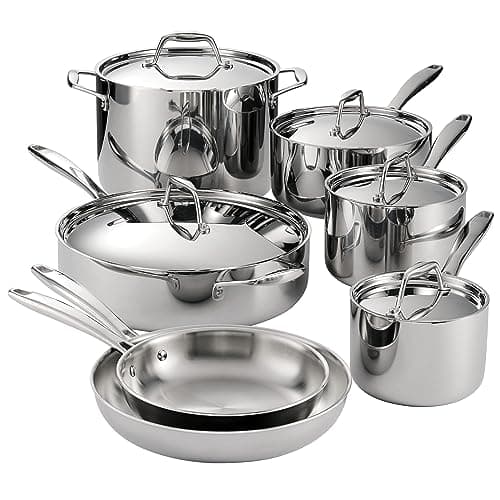
Tramontina Signature Tri-Ply Clad 12-Piece Set
18/10 interior, aluminum core, magnetic stainless exterior - stated plainly, which is more than most lines manage.
Best for: A first kitchen that should not need replacing
Published specifications for the Tramontina Signature Tri-Ply Clad 12-Piece Set
Construction
Tri-ply: 18/10 stainless, aluminum core, magnetic stainless exterior
Pieces
8 in and 10 in fry pans; 1.5, 2 and 3 qt covered saucepans; 5 qt covered deep saute; 8 qt covered stockpot
Oven maximum
500F on the 80116-249DS listing; other SKUs in the line are listed at 350F
Induction
Yes - magnetic stainless exterior
Dishwasher
Listed dishwasher safe
Handles
Precision cast, riveted
Certification
NSF-certified on the 80116-249DS line
Country of origin
Not asserted - retail listings disagree across SKUs (Brazil and China both appear)
Good
Fully clad, not disc-bottom: the aluminum runs up the sidewalls, so sauces do not scorch in a ring at the base
NSF certification on the flagship SKU is a real, checkable third-party mark rather than a marketing badge
Induction-ready without paying an induction premium
Not good
Retail listings disagree on the oven maximum across SKUs in the same line, which is a documentation problem, not a cooking one
Handles run hot on gas
The 12-piece count includes lids; the useful-item count is seven
The trade-off. Handles are the weak point. They are riveted and sturdy, but they get hot on a gas ring in a way the more expensive clad brands' do not.
Skip this if. You want a set you can leave in the oven above 500F, or you cook mostly eggs and pancakes and would rather spend the money on one good nonstick pan.
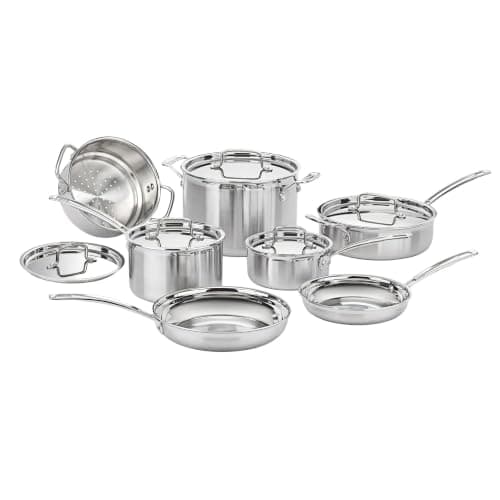
Published specifications for the Cuisinart MultiClad Pro MCP-12N 12-Piece Set
Construction
Tri-ply: 18/10 stainless interior, pure aluminum core, brushed stainless exterior
Pieces
1.5 and 3 qt covered saucepans; 8 in and 10 in skillets; 3.5 qt covered saute; 8 qt covered stockpot; steamer insert
Oven maximum
500F per the Cuisinart use-and-care manual, which the Amazon listing we cite now matches. Major retail listings still advertise 550F; Cuisinart has confirmed the manual figure
Induction
Yes
Dishwasher
Dishwasher safe
Handles
Riveted solid stainless, cool-grip profile
Warranty
Lifetime
Good
Heat runs up the sidewalls, not just across the base
Genuinely dishwasher safe, which the pricier clad brands often are not
Lifetime warranty on a set at this price
Not good
Published oven maximum contradicts the retail listing for the same product
Handle spine is divisive
No 12-inch skillet in the box, which is the pan most people reach for second
The trade-off. The cool-grip handles have a sharp spine that some people find uncomfortable on a full 8-quart stockpot.
Skip this if. You want the higher oven ceiling that major retail listings advertise. The manual says 500F and Cuisinart has confirmed the manual is correct.
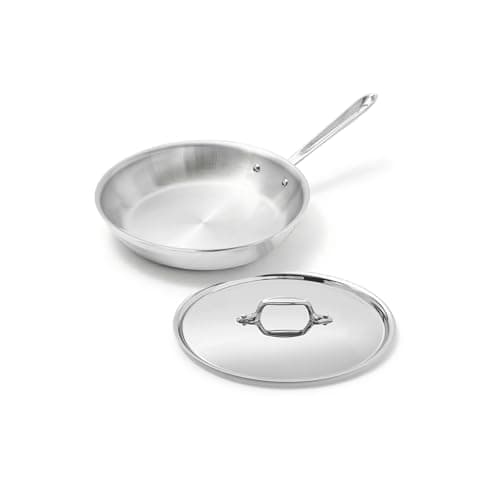
Published specifications for the All-Clad D3 Stainless 10 in Fry Pan
Construction
Fully bonded tri-ply, aluminum core
Oven maximum
600F, oven and broiler safe
Induction
Yes - compatible with any stovetop
Dishwasher
Handwash only (All-Clad published)
Handle
Double-riveted stainless
Weight
3.0 lb (model 4110)
Warranty
Limited lifetime
Made in
Bonded, engineered and assembled in Canonsburg, PA
Good
600F is the highest oven ceiling of any stainless pan on this site
The one pan here whose manufacturing location is published down to the town
Genuinely repairable-adjacent: rivets are the only failure point and the warranty covers them
Not good
Hand wash only
The flared rim makes it a poor pan for anything with liquid
Costs several times what a Tramontina or Cuisinart pan of the same construction costs
The trade-off. Hand wash only. All-Clad publishes that plainly, and it is a real daily cost on a pan you will use every day.
Skip this if. You want a dishwasher-safe pan, or you are buying a whole kitchen on a fixed budget - one D3 skillet costs what a full clad set can cost.
Eighteen percent chromium and ten percent nickel by weight, with the rest mostly iron. Chromium forms the self-repairing oxide film that makes the steel stainless; nickel makes it tougher, more acid resistant and non-magnetic.
›Is 18/10 better than 18/8 stainless steel?
Marginally, and only for corrosion resistance. Both are 304-family austenitic steels and both are entirely suitable for cookware interiors. The difference is far smaller than the difference between fully clad and disc-bottom construction.
›Why is a magnet sticking to my stainless steel pan?
Because the exterior layer is meant to be magnetic. Clad pans use 18/0, also called 430, on the outside so they work on induction, and 18/10 on the inside for corrosion resistance. Two grades, one pan, by design.
›What is 430 stainless steel used for in cookware?
The magnetic exterior layer of clad pans, cheap flatware and some disc bottoms. It has essentially no nickel, which makes it magnetic and cheaper, but also less resistant to acid and salt than the 304-family interior.
›Why does my stainless pan have small pits in it?
Salt added to cold water and left sitting undissolved on the base. Chloride ions attack the passive chromium oxide layer at that point. Adding salt once the water is boiling prevents it entirely; existing pits are permanent but harmless.
Sources
Every figure on this page came from one of these. Follow them and check our arithmetic — that is the point.