Heads up: some links on this page earn us a commission at no extra cost to you. It does not change what we recommend or the order. How we are funded.
The short answer
The most genuinely non-toxic cookware has no coating at all: clad stainless, cast iron and carbon steel. They have always qualified and nobody markets them that way because there is no premium in it. If you want a coated pan without PTFE, buy one ceramic pan rather than a ceramic set — every coating is a consumable and no maker publishes a lifespan.
Quick picks
The whole answer, on one screen. Tap a row to jump to the full write-up. Every pick below carries a stated trade-off further down — including the one at the top.
#
Product
Best for
Price
1
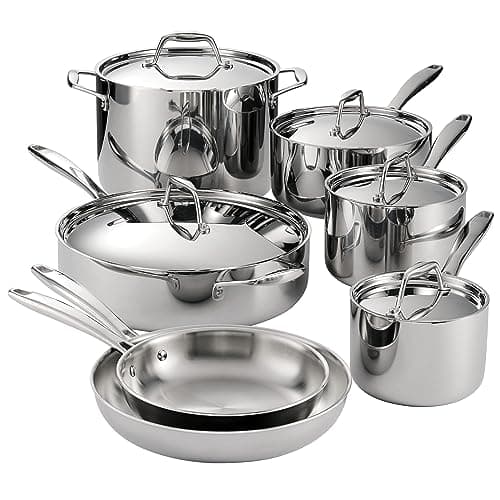
Tramontina Signature Tri-Ply Clad 12-Piece Set
No coating, nothing to wear off, nothing to migrate. 18/10 stainless food contact over an aluminum core that never touches food.
The clearest published account of what the coating is - sand-derived silicon dioxide, PFAS-free - and the honest caveat that nobody publishes how long it lasts.
Prices last checked October 19, 2026. Prices move constantly — the number on Amazon when you click is the real one.
What "non-toxic" means here, and does not
It is not a regulated term. No agency defines it, no body certifies it, and any manufacturer can print it. In practice, on cookware listings, it means one of three things: no PTFE, no PFAS of any kind, or no lead and cadmium.
Those are different claims with different weight. "No lead or cadmium" is nearly universal in cookware sold in the US and is close to meaningless as a differentiator. "No PTFE" is a real, checkable statement. "No PFAS" is broader and, for a coated pan, is essentially the same claim as no PTFE, since PTFE is the fluoropolymer in question.
What the regulators actually say
Worth reading before deciding how much this matters to you, because the regulatory record is more specific than the marketing.
The FDA authorizes PTFE for food contact under 21 CFR 177.1550 and states, of nonstick cookware coatings, that "studies show negligible amounts of PFAS in this coating can migrate to food."
In January 2025 the FDA announced that 35 food contact notifications for PFAS-containing grease-proofers had ceased to be effective "based on the abandonment of these uses." That action was about grease-proofing agents on paper and paperboard food packaging — takeout containers and wrappers — where the FDA identified "potential for PFAS to migrate to food at levels that may result in a potential safety concern."
It was not about cookware coatings. You will nonetheless see it cited on ceramic cookware listings as though it were. That does not make ceramic a bad choice — it makes that particular argument for it dishonest, and there are honest ones.
The EPA describes PFAS as "widely used, long lasting chemicals, components of which break down very slowly over time", present in the blood of people and animals worldwide. That is a serious environmental concern about a class of thousands of chemicals, and it is a perfectly coherent reason to avoid buying more fluoropolymer even if your own exposure from an intact pan is negligible. Just be clear which argument you are making.
The genuinely non-toxic answer nobody markets
Cookware with no coating cannot have a coating problem. Clad stainless, bare cast iron and carbon steel have always been in this category, are cheaper than the ceramic sets marketed at it, and last decades rather than years.
Clad stainless. 18/10 stainless on the food side, aluminum sealed in the middle where it never touches food. Non-reactive with acid and effectively permanent.
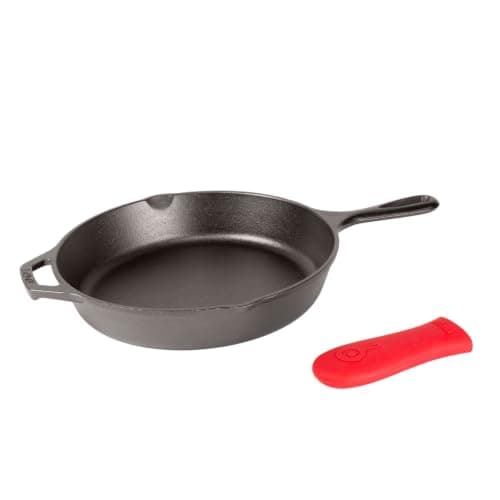
Cast iron. Lodge's pre-seasoning is published as soy-based vegetable oil with "no synthetic chemicals". The seasoning is polymerized oil, not an applied coating in the nonstick sense.
Carbon steel. de Buyer publishes its composition as "Iron 99%, Carbon 1%". It arrives with a beeswax anti-rust film you wash off before use.
The reason these are not marketed as non-toxic is that there is no premium available in it. That is the whole explanation. Full material reasoning in cookware materials compared.
If you do want ceramic
It is a legitimate choice and there is a real case for it: you get PTFE-free release, which uncoated pans cannot offer at all. Nobody fries an egg in bare stainless every morning with a smile.
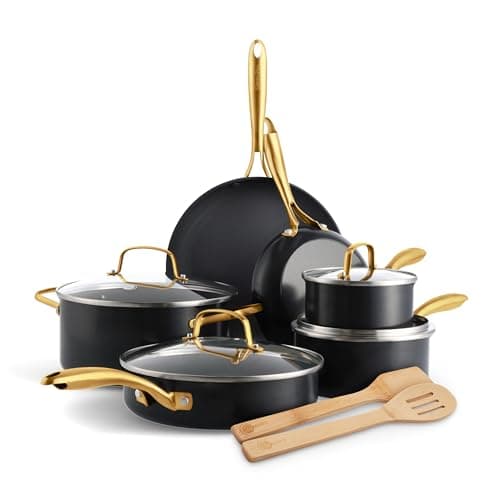
GreenPan publishes more about its coating than any competitor. Thermolon is "crafted from sand-derived raw materials, Silicon Dioxide (SiO2), and turned into a sprayable solution", it is PFAS-free, PFOA-free and free of lead and cadmium, and the coating withstands 850F.
Two caveats, both important. The 850F figure is for the coating, not the pan — the aluminum body and the handle have their own, lower limits, and the big number gets quoted as though it were the pan's. And no ceramic maker publishes a lifespan, because coating life depends on heat, utensils and washing and nobody wants a number on the record.
So: one ceramic pan, not a ceramic set. A set puts five or six consumables on the same clock at a price that implies permanence. More in is ceramic cookware safe.
Option
Coating
Release
Lifespan
Genuine non-toxic claim?
Clad stainless
None
Poor without fat
Decades
Yes, trivially - nothing to migrate
Cast iron
Seasoning (polymerized oil)
Good once built
Effectively permanent
Yes - Lodge publishes soy-based oil, no synthetic chemicals
Carbon steel
Seasoning
Good once built
Effectively permanent
Yes - de Buyer publishes 99% iron, 1% carbon
Ceramic (sol-gel silica)
Sprayed silica
Excellent when new
Not published by anyone
Yes for PFAS, but the lifespan is unstated
PTFE
Fluoropolymer
Excellent, longer than ceramic
Not published by anyone
No - it is a PFAS, though FDA-authorized for food contact
What actually matters for coated pans
If you use a coated pan of either type, the genuine safety guidance is short and it is about temperature, not chemistry.
Never preheat a coated pan empty. This is the one that matters. An empty pan on high heat reaches coating-damaging temperatures within a couple of minutes.
Medium heat only. Sear in stainless or iron. That is what they are for.
Replace it when it stops releasing. A worn coated pan is a bad pan, not a cheaper one.
Keep birds out of the kitchen when cooking. Pet birds are genuinely far more sensitive to fumes from overheated coatings than people are — this is the one exposure caution that is not overstated.
Every pick, in full
Each write-up below gives the published specs, what the pan is genuinely good at, what it costs you, and who should skip it. The trade-off line is there on the top pick too — a recommendation with no downside is an advertisement.
Top pick · Best uncoated setSpecs read September 3, 2026
Tramontina Signature Tri-Ply Clad 12-Piece Set
No coating, nothing to wear off, nothing to migrate. 18/10 stainless food contact over an aluminum core that never touches food.
Best for: A first kitchen that should not need replacing
Published specifications for the Tramontina Signature Tri-Ply Clad 12-Piece Set
Construction
Tri-ply: 18/10 stainless, aluminum core, magnetic stainless exterior
Pieces
8 in and 10 in fry pans; 1.5, 2 and 3 qt covered saucepans; 5 qt covered deep saute; 8 qt covered stockpot
Oven maximum
500F on the 80116-249DS listing; other SKUs in the line are listed at 350F
Induction
Yes - magnetic stainless exterior
Dishwasher
Listed dishwasher safe
Handles
Precision cast, riveted
Certification
NSF-certified on the 80116-249DS line
Country of origin
Not asserted - retail listings disagree across SKUs (Brazil and China both appear)
Good
Fully clad, not disc-bottom: the aluminum runs up the sidewalls, so sauces do not scorch in a ring at the base
NSF certification on the flagship SKU is a real, checkable third-party mark rather than a marketing badge
Induction-ready without paying an induction premium
Not good
Retail listings disagree on the oven maximum across SKUs in the same line, which is a documentation problem, not a cooking one
Handles run hot on gas
The 12-piece count includes lids; the useful-item count is seven
The trade-off. Handles are the weak point. They are riveted and sturdy, but they get hot on a gas ring in a way the more expensive clad brands' do not.
Skip this if. You want a set you can leave in the oven above 500F, or you cook mostly eggs and pancakes and would rather spend the money on one good nonstick pan.
Published specifications for the Lodge Seasoned Cast Iron Skillet, 10.25 in (L8SK3)
Diameter
10.25 in
Weight
5.66 lb
Oven maximum
550F
Induction
Yes - bare iron is ferrous
Seasoning
Pre-seasoned with soy-based vegetable oil, no synthetic chemicals
Warranty
Lifetime
Made in
USA
Care
Hand wash. Lodge's own instructions permit warm soapy water
Good
Effectively unbreakable and fully restorable - a rusted one can be stripped and re-seasoned
Holds heat better than anything else at the price, which is what a sear needs
Lodge publishes its seasoning method openly, so the maintenance is not a mystery
Not good
Heavy
Heats unevenly on a small burner: cast iron conducts at roughly 50 W/m-K, so it is slow to spread and slow to react
Bare iron is reactive; long tomato braises will taste of it
The trade-off. It weighs 5.66 lb empty. You will feel that every time you move it full, and it is the single most common reason a cast iron skillet ends up in a cupboard.
Skip this if. You have wrist or shoulder trouble, or you cook mostly acidic braises. Carbon steel does most of the same jobs at roughly half the weight.
#3 · Best if you want ceramicSpecs read September 3, 2026
GreenPan Ceramic Nonstick Cookware Set
The clearest published account of what the coating is - sand-derived silicon dioxide, PFAS-free - and the honest caveat that nobody publishes how long it lasts.
Best for: Someone who wants nonstick without PTFE and has read what that trades away
Published specifications for the GreenPan Ceramic Nonstick Cookware Set
Coating
Thermolon, from sand-derived Silicon Dioxide (SiO2), sprayed
Coating chemistry
PFAS-free, PFOA-free, free of lead and cadmium (GreenPan published)
Coating heat resistance
850F / 450C for the coating itself (GreenPan published)
Body oven maximum
Varies by line and is lower than the coating figure - check the specific line
Coating lifespan
Not published. No ceramic maker publishes one
Good
GreenPan publishes what the coating is made of in plain terms, which most ceramic brands do not
The coating will not release fumes if you overheat it the way PTFE can
Genuinely good release when new
Not good
Release degrades and nobody will tell you how fast
The 850F figure is for the coating, not the pan, and gets quoted as if it were the pan
Ceramic dislikes high heat and dishwashers, which is most of what a set gets used for
The trade-off. Ceramic nonstick loses release with use and no maker publishes a lifespan, GreenPan included. Treat it as a consumable, not a lifetime purchase.
Skip this if. You are buying a set expecting it to last as long as clad stainless. It will not, and the honest move is to buy one ceramic pan alongside a stainless set.
Cookware with no coating at all: clad stainless, bare cast iron and carbon steel. There is nothing to wear off and nothing to migrate, they cost less than the ceramic sets marketed at this term, and they last decades.
›Is non-toxic cookware a regulated term?
No. No agency defines or certifies it. On listings it usually means no PTFE, sometimes no PFAS of any kind, and sometimes only no lead or cadmium, which is near-universal in US cookware anyway.
›Did the FDA ban PFAS from cookware?
No. The January 2025 FDA action concerned 35 notifications for PFAS grease-proofers on paper and paperboard food packaging, which had been abandoned. PTFE remains authorized for food contact under 21 CFR 177.1550.
›Is ceramic cookware safer than nonstick?
It contains no PFAS, which is a real difference and a coherent reason to choose it. Regulators treat intact PTFE at normal cooking temperatures as safe, so the practical exposure difference is small; the environmental argument is the stronger one.
›Should I buy a whole non-toxic cookware set?
If it means uncoated stainless, yes. If it means ceramic, buy one pan rather than a set, because every coating is a consumable with no published lifespan and a set puts several of them on the same clock.
Sources
Every figure on this page came from one of these. Follow them and check our arithmetic — that is the point.