Heads up: some links on this page earn us a commission at no extra cost to you. It does not change what we recommend or the order. How we are funded.
The short answer
For most kitchens the answer is a fully clad tri-ply stainless set, and the two worth shortlisting are the Tramontina Signature Tri-Ply Clad and the Cuisinart MultiClad Pro. Both put an aluminum core through the whole pan rather than a disc on the base, both work on induction, and both cost a fraction of premium clad. Choose on dishwasher tolerance and handle feel, not on brand.
Quick picks
The whole answer, on one screen. Tap a row to jump to the full write-up. Every pick below carries a stated trade-off further down — including the one at the top.
#
Product
Best for
Price
1
Tramontina Signature Tri-Ply Clad 12-Piece Set
Fully clad construction, NSF certification on the flagship SKU, and seven real vessels. The default recommendation for a first kitchen.
A good ceramic pan sold as a set you should not buy. Coatings are consumables and no maker publishes a lifespan - buy one pan, not a matching family of them.
Prices last checked October 19, 2026. Prices move constantly — the number on Amazon when you click is the real one.
How we chose these
We have not cooked in any of them. What we did was collect the construction specifications each manufacturer publishes, read the use-and-care manuals rather than the retail listings, note the warranty terms, and count what is actually in the box. The full method is here and it takes two minutes.
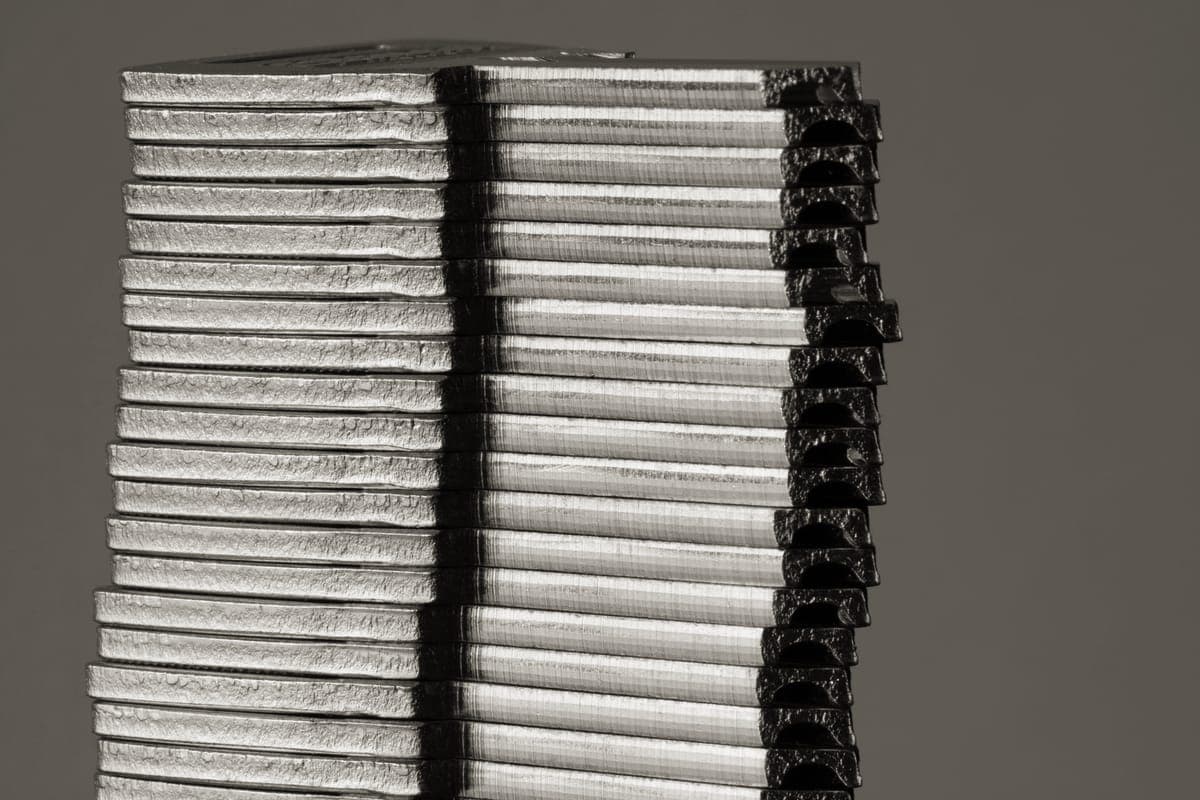
One filter did most of the work: fully clad only. Disc-bottom sets are excluded regardless of price, because the aluminum stops at the base, the sidewalls stay cool, and sauces scorch in a ring in the middle. That is not a preference, it is a construction fact you notice the first week.
What actually separates these sets
Less than the marketing suggests. All the clad sets here are stainless-aluminum- stainless sandwiches, and on a weeknight they cook alike. The real differences are in three places, and none of them is heat performance.
Oven ceiling, which decides whether you can finish a pan sauce under the broiler. And which is documented inconsistently — see below.
Dishwasher tolerance, which is a daily quality-of-life question. Cuisinart says yes; All-Clad says handwash only.
Handles, which is what you actually interact with and the thing people most often dislike years later.
Set
Construction
Oven max
Induction
Dishwasher
Warranty
Tramontina Signature Tri-Ply Clad
Tri-ply, aluminum core, magnetic exterior
500F on the 249DS listing; 350F on some SKUs in the line
Yes
Listed safe
Not published on the listings read
Cuisinart MultiClad Pro
Tri-ply, pure aluminum core
500F per the manual; listings say 550F
Yes
Yes
Lifetime
All-Clad D3 (open stock)
Bonded tri-ply, aluminum core
600F, oven and broiler
Yes
Handwash only
Limited lifetime
GreenPan ceramic
Aluminum body, Thermolon coating
Coating rated 850F; body lower, varies by line
Varies by line
Not advised
Varies
Every figure read from the manufacturer's published material or, where noted, from a retail listing on 2026-09-03.
The oven-ceiling problem, which is the most useful thing here
This is what reading manuals gets you. Cuisinart's MultiClad Pro is listed by major retailers as oven safe to 550F. Cuisinart's own use-and-care guide says 500F, and a Cuisinart product specialist has confirmed the manual is the correct figure. A fifty-degree gap between the marketing and the instructions, on the same product.
Tramontina has the same problem in a different shape. Retail listings across the Tri-Ply Clad line give 350F on some SKUs and 500F on others, which cannot both be true of the same construction and is more likely a listing transcription error than a design difference.
We do not resolve those disagreements by choosing the friendlier number. We report both and use the conservative one. If you routinely finish dishes in a hot oven, that is the single specification worth deciding on — and it is the one argument for All-Clad's 600F that is genuinely about capability rather than prestige.
Look at the rim. On a clad pan you can see the layer line running up the wall; on a disc-bottom pan the wall is single-layer steel.
Count the vessels, not the pieces
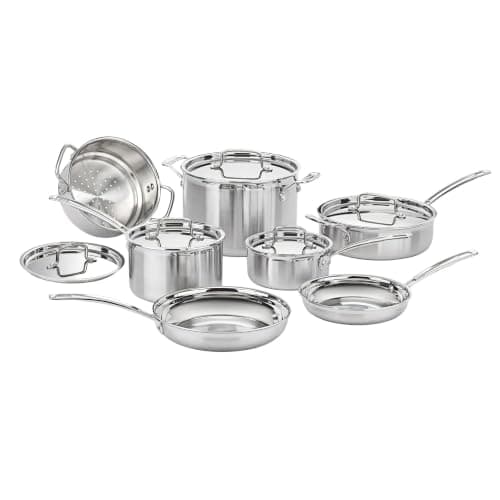
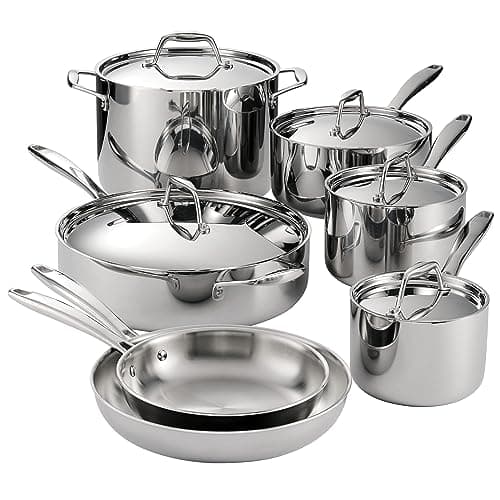
Both twelve-piece sets here contain seven or fewer vessels. Tramontina's is two fry pans, three covered saucepans, a covered deep saute and a covered stockpot — seven vessels, five lids. Cuisinart's is two skillets, two covered saucepans, a covered saute, a covered stockpot and a steamer insert — six vessels, five lids, one insert.
Both are honest sets. Neither is twelve things you will use. And both are missing a 12-inch skillet, which is the pan most people reach for second — worth budgeting separately rather than buying a larger set to get it. The arithmetic is worked through in what "12-piece" actually means.
Why the ceramic set is here as a skip
GreenPan makes a genuinely good ceramic pan and publishes more about its coating than any competitor: Thermolon is "crafted from sand-derived raw materials, Silicon Dioxide (SiO2)", it is PFAS-free, PFOA-free and free of lead and cadmium, and the coating withstands 850F.
What GreenPan does not publish — and neither does anyone else — is how long the release lasts. Every coated pan is a consumable. Buying a coated set means buying five or six consumables at once, on the same clock, at a price that implies permanence.
So the honest recommendation is: buy one ceramic pan if you want ceramic, alongside a clad stainless set that lasts. Not a matching ceramic family. That is not a criticism of the coating, it is a criticism of the format. More in is ceramic cookware safe.
The case for buying no set at all
One All-Clad D3 skillet costs roughly what a full budget clad set costs. That sounds like an easy dismissal and it is not, because the two purchases are answering different questions.
A set gets you seven adequate vessels. One premium pan gets you a single excellent one — 600F oven and broiler, bonded and assembled in a named Pennsylvania town, a limited lifetime warranty — and nothing else. If you already own a stockpot and a saucepan and are replacing a worn-out skillet, the pan is the better purchase. If your kitchen is empty, the set is.
Empty kitchen, normal budget: the Tramontina. Fully clad, induction ready, NSF-certified on the flagship SKU.
You will not hand wash: the Cuisinart. It is explicitly dishwasher safe and carries a lifetime warranty.
Replacing one worn pan: the All-Clad D3, open stock. Do not buy a set to replace a pan.
You want ceramic: one pan, not a set, and read the nonstick hub first.
Whichever you choose, add a cast iron skillet for searing. It is the cheapest genuine capability upgrade you can make to a clad kitchen, and clad stainless does searing adequately rather than well.
Every pick, in full
Each write-up below gives the published specs, what the pan is genuinely good at, what it costs you, and who should skip it. The trade-off line is there on the top pick too — a recommendation with no downside is an advertisement.
Top pick · Best overallSpecs read September 3, 2026
Tramontina Signature Tri-Ply Clad 12-Piece Set
Fully clad construction, NSF certification on the flagship SKU, and seven real vessels. The default recommendation for a first kitchen.
Best for: A first kitchen that should not need replacing
Published specifications for the Tramontina Signature Tri-Ply Clad 12-Piece Set
Construction
Tri-ply: 18/10 stainless, aluminum core, magnetic stainless exterior
Pieces
8 in and 10 in fry pans; 1.5, 2 and 3 qt covered saucepans; 5 qt covered deep saute; 8 qt covered stockpot
Oven maximum
500F on the 80116-249DS listing; other SKUs in the line are listed at 350F
Induction
Yes - magnetic stainless exterior
Dishwasher
Listed dishwasher safe
Handles
Precision cast, riveted
Certification
NSF-certified on the 80116-249DS line
Country of origin
Not asserted - retail listings disagree across SKUs (Brazil and China both appear)
Good
Fully clad, not disc-bottom: the aluminum runs up the sidewalls, so sauces do not scorch in a ring at the base
NSF certification on the flagship SKU is a real, checkable third-party mark rather than a marketing badge
Induction-ready without paying an induction premium
Not good
Retail listings disagree on the oven maximum across SKUs in the same line, which is a documentation problem, not a cooking one
Handles run hot on gas
The 12-piece count includes lids; the useful-item count is seven
The trade-off. Handles are the weak point. They are riveted and sturdy, but they get hot on a gas ring in a way the more expensive clad brands' do not.
Skip this if. You want a set you can leave in the oven above 500F, or you cook mostly eggs and pancakes and would rather spend the money on one good nonstick pan.
Published specifications for the Cuisinart MultiClad Pro MCP-12N 12-Piece Set
Construction
Tri-ply: 18/10 stainless interior, pure aluminum core, brushed stainless exterior
Pieces
1.5 and 3 qt covered saucepans; 8 in and 10 in skillets; 3.5 qt covered saute; 8 qt covered stockpot; steamer insert
Oven maximum
500F per the Cuisinart use-and-care manual, which the Amazon listing we cite now matches. Major retail listings still advertise 550F; Cuisinart has confirmed the manual figure
Induction
Yes
Dishwasher
Dishwasher safe
Handles
Riveted solid stainless, cool-grip profile
Warranty
Lifetime
Good
Heat runs up the sidewalls, not just across the base
Genuinely dishwasher safe, which the pricier clad brands often are not
Lifetime warranty on a set at this price
Not good
Published oven maximum contradicts the retail listing for the same product
Handle spine is divisive
No 12-inch skillet in the box, which is the pan most people reach for second
The trade-off. The cool-grip handles have a sharp spine that some people find uncomfortable on a full 8-quart stockpot.
Skip this if. You want the higher oven ceiling that major retail listings advertise. The manual says 500F and Cuisinart has confirmed the manual is correct.
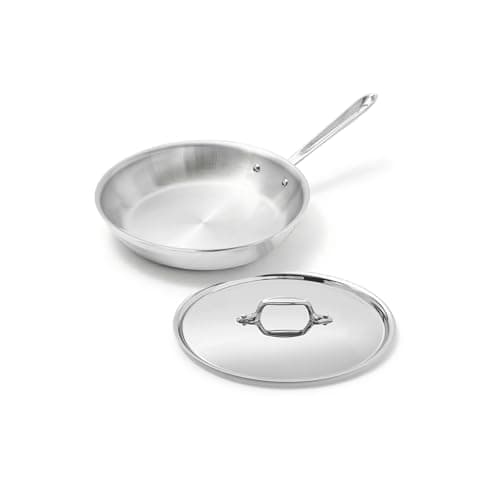
Published specifications for the All-Clad D3 Stainless 10 in Fry Pan
Construction
Fully bonded tri-ply, aluminum core
Oven maximum
600F, oven and broiler safe
Induction
Yes - compatible with any stovetop
Dishwasher
Handwash only (All-Clad published)
Handle
Double-riveted stainless
Weight
3.0 lb (model 4110)
Warranty
Limited lifetime
Made in
Bonded, engineered and assembled in Canonsburg, PA
Good
600F is the highest oven ceiling of any stainless pan on this site
The one pan here whose manufacturing location is published down to the town
Genuinely repairable-adjacent: rivets are the only failure point and the warranty covers them
Not good
Hand wash only
The flared rim makes it a poor pan for anything with liquid
Costs several times what a Tramontina or Cuisinart pan of the same construction costs
The trade-off. Hand wash only. All-Clad publishes that plainly, and it is a real daily cost on a pan you will use every day.
Skip this if. You want a dishwasher-safe pan, or you are buying a whole kitchen on a fixed budget - one D3 skillet costs what a full clad set can cost.
#4 · Skip this as a setSpecs read September 3, 2026
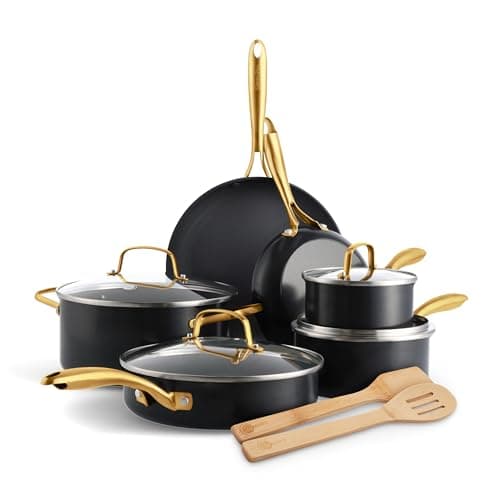
GreenPan Ceramic Nonstick Cookware Set
A good ceramic pan sold as a set you should not buy. Coatings are consumables and no maker publishes a lifespan - buy one pan, not a matching family of them.
Best for: Someone who wants nonstick without PTFE and has read what that trades away
Published specifications for the GreenPan Ceramic Nonstick Cookware Set
Coating
Thermolon, from sand-derived Silicon Dioxide (SiO2), sprayed
Coating chemistry
PFAS-free, PFOA-free, free of lead and cadmium (GreenPan published)
Coating heat resistance
850F / 450C for the coating itself (GreenPan published)
Body oven maximum
Varies by line and is lower than the coating figure - check the specific line
Coating lifespan
Not published. No ceramic maker publishes one
Good
GreenPan publishes what the coating is made of in plain terms, which most ceramic brands do not
The coating will not release fumes if you overheat it the way PTFE can
Genuinely good release when new
Not good
Release degrades and nobody will tell you how fast
The 850F figure is for the coating, not the pan, and gets quoted as if it were the pan
Ceramic dislikes high heat and dishwashers, which is most of what a set gets used for
The trade-off. Ceramic nonstick loses release with use and no maker publishes a lifespan, GreenPan included. Treat it as a consumable, not a lifetime purchase.
Skip this if. You are buying a set expecting it to last as long as clad stainless. It will not, and the honest move is to buy one ceramic pan alongside a stainless set.
A fully clad tri-ply stainless set. The Tramontina Signature Tri-Ply Clad and the Cuisinart MultiClad Pro are the two worth shortlisting; both run an aluminum core through the whole pan rather than a disc on the base, and both work on induction.
›Is Tramontina as good as All-Clad?
For construction, they are the same idea: tri-ply with an aluminum core. All-Clad publishes a 600F oven and broiler ceiling against Tramontina's 500F, and states that it is bonded and assembled in Canonsburg, Pennsylvania. Those are real differences; a noticeably better weeknight dinner is not.
›How many pieces should a cookware set have?
Count vessels rather than pieces. A twelve-piece set is usually six or seven vessels plus five lids, which is about right. Sets advertising twenty-one pieces get there with duplicates, inserts and utensils.
›Are ceramic cookware sets worth buying?
A ceramic pan can be. A ceramic set generally is not, because every coating is a consumable and no manufacturer publishes a lifespan. Buying a matching set means putting five or six wear items on the same clock at a price that implies permanence.
›What does fully clad mean?
The aluminum core runs through the whole pan including the sidewalls, rather than being a disc welded to the base. It is the difference between a sauce reducing evenly and a sauce scorching in a ring over the burner.
Sources
Every figure on this page came from one of these. Follow them and check our arithmetic — that is the point.