Heads up: some links on this page earn us a commission at no extra cost to you. It does not change what we recommend or the order. How we are funded.
The short answer
Buy a fully clad tri-ply stainless set and one cheap coated pan. Clad is the most forgiving construction because the aluminum core evens out the hot spots that cause food to catch, and the coated pan means eggs never become a battle. Skip the beginner traps: disc-bottom sets, all-nonstick sets, and anything with more than about fourteen pieces.
Quick picks
The whole answer, on one screen. Tap a row to jump to the full write-up. Every pick below carries a stated trade-off further down — including the one at the top.
#
Product
Best for
Price
1
Cuisinart MultiClad Pro MCP-12N 12-Piece Set
Dishwasher safe, lifetime warranty, and heat that runs up the sidewalls rather than concentrating at the base. Fewer ways to go wrong.
Prices last checked October 19, 2026. Prices move constantly — the number on Amazon when you click is the real one.
What "beginner" should actually mean
It does not mean cheap, and it definitely does not mean nonstick. A beginner set is one that fails gracefully: when you put food in before the pan is hot, when you walk away for a minute, when you forget to stir. Those are the mistakes everyone makes at first, and cookware differs enormously in how much it punishes them.
Fully clad stainless is the most forgiving construction for exactly that reason. Type 304 stainless conducts heat at around 15 to 16 W/m-K, which is terrible; the aluminum core at 237 does the spreading. The result is a pan without a scorching hot spot directly over the burner, which is the specific thing that makes food catch while you are not watching.
The all-nonstick trap
Beginner sets are usually pitched as nonstick, and it is the wrong advice. A nonstick set teaches you nothing about heat control, cannot brown properly, cannot go under a broiler, and will look tired within two years while you are still learning.
Worse, it hides the feedback you need. Fond — the browned residue that sticks to a stainless pan — is where pan sauces come from and is a signal that you got the heat right. A nonstick pan gives you neither.
One coated pan is genuinely useful and everyone should own one. A coated set is a wear item bought at a keepsake price, and no maker publishes a lifespan. The reasoning is in the nonstick hub.
The one technique that changes everything
Nearly every "stainless is impossible" complaint is a preheat problem, and there is a physical test that removes the guesswork. It is the single most useful thing on this page.
Heat the dry pan over medium for two to three minutes.
Flick in a few drops of water. If they sizzle and evaporate, it is not ready.
When the droplets bead up and skate across the surface like mercury, the pan is at temperature.
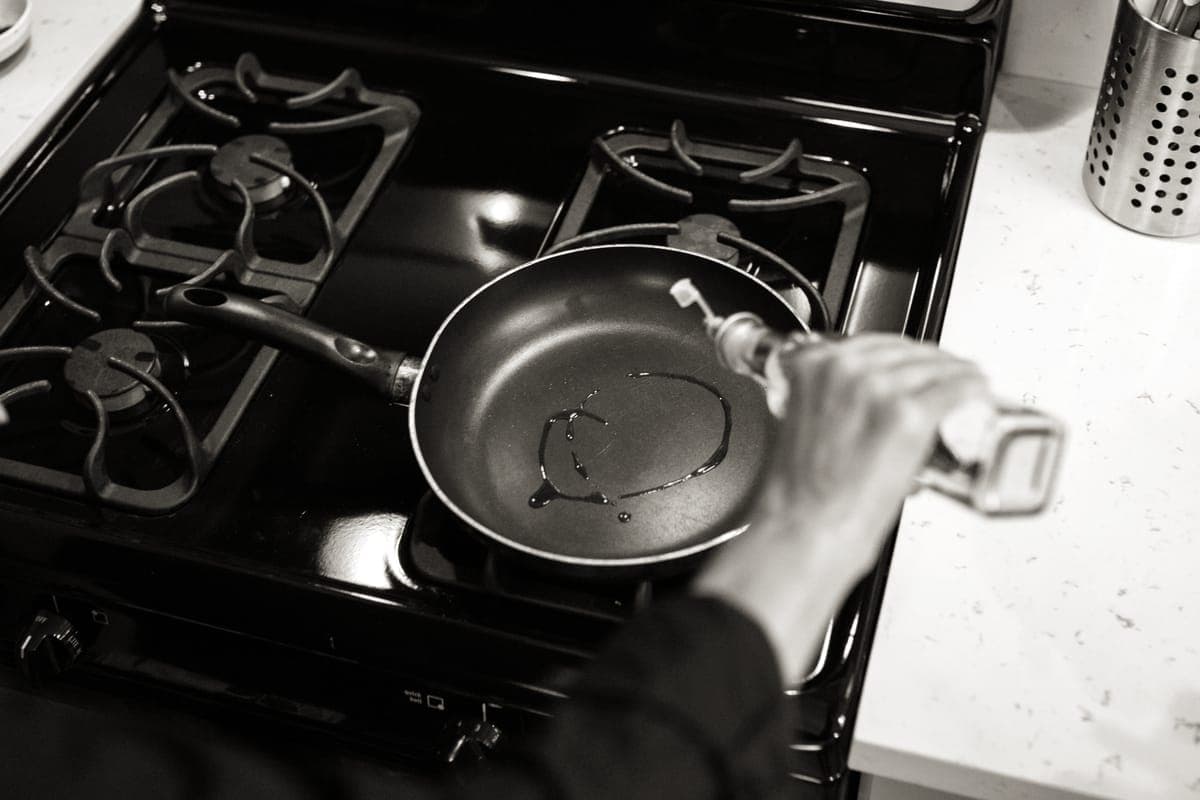
Add fat, let it shimmer, then add food. It will release.
That is the Leidenfrost effect, and it is a temperature indicator that works on any pan, on any hob, for free. The full explanation is in why food sticks to stainless.
Pan first, then fat, then food. Reversing that order is the most common reason stainless gets a reputation for sticking.
What to avoid when you are starting
Disc-bottom sets. Cheaper, and the base-only aluminum produces exactly the hot spot a beginner does not need. Check the listing for "clad" or "tri-ply".
Huge piece counts. A twenty-one-piece set is not more capability, it is duplicates and utensils, and it fills the cupboard you need.
Cast iron as a first and only pan. Excellent material, poor first pan: heavy, slow to respond, reactive with anything acidic, and requiring maintenance you have not learned yet. Add it later.
Very thin pans. They warp, and a warped pan rocks on the hob and heats unevenly, which reads as bad cooking rather than a bad pan.
Glass lids at the top end of the oven range. They lower whatever oven ceiling the pan has and they break first.
Care that keeps a beginner set looking new
Clad stainless is close to indestructible, which is part of why it suits a beginner. It survives metal utensils, steel wool, dishwashers and being left on a hot burner. The two things worth knowing:
Rainbow marks are not damage. A thin oxide layer forms with heat. It is cosmetic and comes off with vinegar if it bothers you.
Burnt-on food is not a disaster. Deglaze while the pan is still warm, or use an oxalic-acid cleaner. Step by step in how to clean a burnt stainless pan.
Your coated pan is the opposite: medium heat only, never preheated empty, hand wash, and replace it when it stops releasing. Two very different maintenance regimes in one kitchen, which is another reason not to buy a coated set.
Every pick, in full
Each write-up below gives the published specs, what the pan is genuinely good at, what it costs you, and who should skip it. The trade-off line is there on the top pick too — a recommendation with no downside is an advertisement.
Top pick · Most forgivingSpecs read September 3, 2026
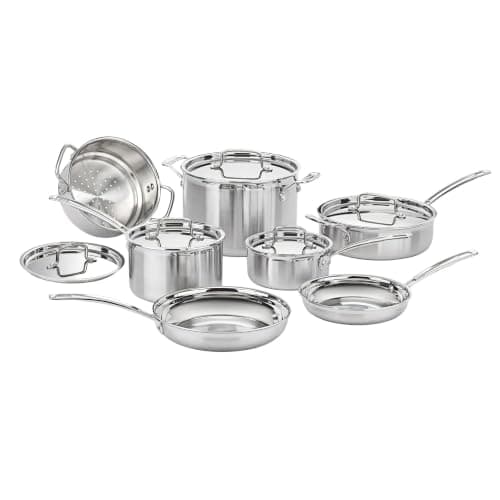
Cuisinart MultiClad Pro MCP-12N 12-Piece Set
Dishwasher safe, lifetime warranty, and heat that runs up the sidewalls rather than concentrating at the base. Fewer ways to go wrong.
Best for: A cook who wants a dishwasher-safe clad set and a lifetime warranty
Published specifications for the Cuisinart MultiClad Pro MCP-12N 12-Piece Set
Construction
Tri-ply: 18/10 stainless interior, pure aluminum core, brushed stainless exterior
Pieces
1.5 and 3 qt covered saucepans; 8 in and 10 in skillets; 3.5 qt covered saute; 8 qt covered stockpot; steamer insert
Oven maximum
500F per the Cuisinart use-and-care manual, which the Amazon listing we cite now matches. Major retail listings still advertise 550F; Cuisinart has confirmed the manual figure
Induction
Yes
Dishwasher
Dishwasher safe
Handles
Riveted solid stainless, cool-grip profile
Warranty
Lifetime
Good
Heat runs up the sidewalls, not just across the base
Genuinely dishwasher safe, which the pricier clad brands often are not
Lifetime warranty on a set at this price
Not good
Published oven maximum contradicts the retail listing for the same product
Handle spine is divisive
No 12-inch skillet in the box, which is the pan most people reach for second
The trade-off. The cool-grip handles have a sharp spine that some people find uncomfortable on a full 8-quart stockpot.
Skip this if. You want the higher oven ceiling that major retail listings advertise. The manual says 500F and Cuisinart has confirmed the manual is correct.
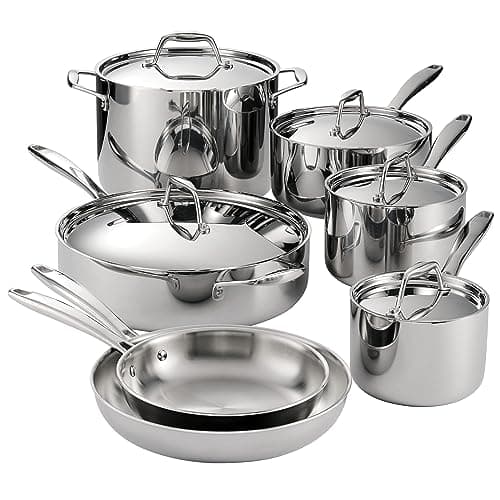
Published specifications for the Tramontina Signature Tri-Ply Clad 12-Piece Set
Construction
Tri-ply: 18/10 stainless, aluminum core, magnetic stainless exterior
Pieces
8 in and 10 in fry pans; 1.5, 2 and 3 qt covered saucepans; 5 qt covered deep saute; 8 qt covered stockpot
Oven maximum
500F on the 80116-249DS listing; other SKUs in the line are listed at 350F
Induction
Yes - magnetic stainless exterior
Dishwasher
Listed dishwasher safe
Handles
Precision cast, riveted
Certification
NSF-certified on the 80116-249DS line
Country of origin
Not asserted - retail listings disagree across SKUs (Brazil and China both appear)
Good
Fully clad, not disc-bottom: the aluminum runs up the sidewalls, so sauces do not scorch in a ring at the base
NSF certification on the flagship SKU is a real, checkable third-party mark rather than a marketing badge
Induction-ready without paying an induction premium
Not good
Retail listings disagree on the oven maximum across SKUs in the same line, which is a documentation problem, not a cooking one
Handles run hot on gas
The 12-piece count includes lids; the useful-item count is seven
The trade-off. Handles are the weak point. They are riveted and sturdy, but they get hot on a gas ring in a way the more expensive clad brands' do not.
Skip this if. You want a set you can leave in the oven above 500F, or you cook mostly eggs and pancakes and would rather spend the money on one good nonstick pan.
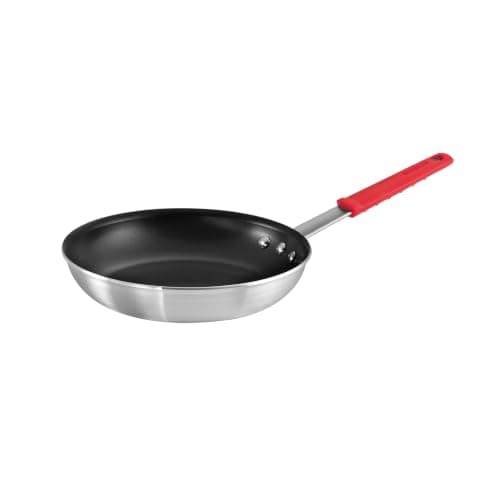
Published specifications for the Tramontina Professional Restaurant Fry Pan, 10 in
Body
Heavy-gauge aluminum
Coating
PTFE nonstick
Induction
No - aluminum body is not ferrous
Coating lifespan
Not published, by this or any nonstick maker
Good
Cheap enough that replacing it every couple of years is a real plan rather than a failure
Heavy gauge for a nonstick pan, so it does not warp on the first hot burner
Silicone handle sleeve that actually stays cool
Not good
Not induction compatible
PTFE, which some buyers will rule out on principle
No published coating lifespan, so the value case is unverifiable by design
The trade-off. It is PTFE. That is fine at normal cooking temperatures, and it is not a pan to preheat empty on high.
Skip this if. You want to avoid PTFE entirely. Buy ceramic instead and accept the shorter release life rather than pretending either one lasts forever.
A fully clad tri-ply stainless set plus one cheap coated pan. Clad construction spreads heat through the sidewalls, which removes the hot spot that causes food to catch, and the coated pan handles eggs without a learning curve.
›Should beginners buy nonstick cookware?
One nonstick pan, not a nonstick set. An all-nonstick kitchen cannot brown, cannot go under a broiler, hides the heat feedback you are trying to learn, and wears out within a couple of years.
›Why does food stick to my new stainless pan?
The pan was not hot enough when the food went in. Heat the dry pan over medium until a flicked droplet of water beads and skates across the surface, then add fat, then food. That is the Leidenfrost effect and it works as a free thermometer.
›Is cast iron good for beginners?
It is an excellent material and a poor first pan. It is heavy, slow to respond, reactive with acidic food, and needs maintenance you have not learned yet. Add it once you are comfortable, not before.
Sources
Every figure on this page came from one of these. Follow them and check our arithmetic — that is the point.