Heads up: some links on this page earn us a commission at no extra cost to you. It does not change what we recommend or the order. How we are funded.
The short answer
Heat the dry pan over medium for two to three minutes. Do not add oil yet.
Flick in a few drops of water. If they sizzle and vanish, it is not ready. If they bead into a ball and skate across the surface, it is.
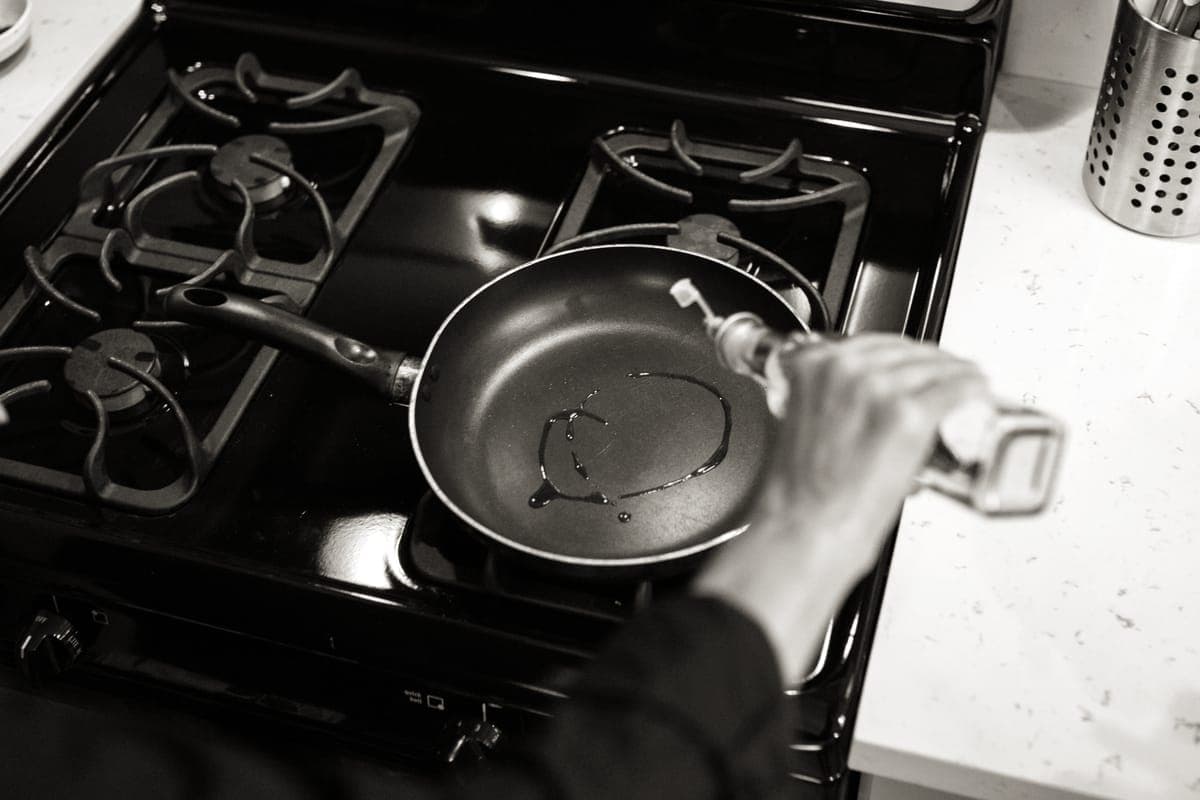
Add fat and let it shimmer — a few seconds.
Add the food and leave it alone. It will stick at first, then release on its own once a crust forms.
What is actually happening
Stainless steel looks smooth and is not. At a microscopic level the surface is a landscape of pores and ridges, and when protein meets warm-but-not-hot metal, it settles into that landscape and forms chemical bonds with it — sulfur in the protein bonding to iron and other metal atoms in the steel. That is a weld, not a smear, and no amount of oil beforehand prevents it.
Get the pan properly hot and something different happens. The moisture at the contact surface flashes instantly to steam, and that steam layer physically holds the food off the metal for the crucial first seconds while a crust forms. Once there is a crust, there is no raw protein touching steel, and the food lifts away.
So the entire problem is a timing one: the food went in during the window when the pan was warm enough to bond and not hot enough to steam.
The water-droplet test, which costs nothing
There is a physical phenomenon that tells you exactly when the pan has crossed that threshold, and it is visible from across the kitchen.
Flick a few drops of water into the dry, heating pan.
The drops spread out and hiss away quickly. Too cool. Wait.
The drops shatter into many small drops that dance and vanish. Nearly there.
The drops merge into one or two balls that glide around the pan like mercury. Ready. Add your fat now.
The drops evaporate instantly with a bang. Too hot. Pull the pan off the heat for thirty seconds.
The gliding ball is the Leidenfrost effect: the droplet is sitting on its own cushion of steam, insulated from the metal. That is the same cushion that will hold your food off the surface, which is why it is such a good indicator.
Order matters: pan, then fat, then food. Oil added to a cold pan just sits there polymerizing while you wait.
The four mistakes, in order of frequency
1. The pan was not hot enough
By far the most common. Most people heat a pan for under a minute, which is not close to enough. Clad stainless takes two to three minutes over medium because the aluminum core has to come up to temperature through the steel layers.
2. Oil went in cold
Oil added to a cold pan spends the whole preheat sitting on the metal, thinning out, and starting to polymerize. Heat the pan first, then add oil, then wait for it to shimmer — a few seconds, not minutes.
3. The food came straight from the fridge
A cold steak drops the pan temperature the moment it lands, and if the pan was marginal to begin with, that drop pushes it back into the sticking window. Let protein sit out for fifteen to twenty minutes, and pat it dry — surface water has to boil off before browning can start, and it steals heat while it does.
4. You moved it too early
Food sticks initially even in a properly heated pan. That is normal. As the crust forms, the bond to the metal breaks and the food releases by itself. Poke it at thirty seconds and you tear the crust off and leave it welded to the pan.
The rule: if it does not move when you nudge the pan, it is not ready to move. Wait. Properly seared protein tells you when it is done.
The one that is not about heat: crowding
Fill the pan and the moisture coming out of the food cannot escape fast enough. The pan temperature crashes, everything steams in its own liquid, and nothing browns. Then it sticks, because there is no crust forming.
Cook in batches, leaving space between pieces. This is also the argument for buying a 12-inch skillet rather than a 10 if you cook for three or more — see what size skillet.
What does not help
"Seasoning" a stainless pan. Seasoning works on iron and carbon steel, which are porous and react with polymerized oil. Stainless is passivated and does not build a durable seasoning layer. You will just make it sticky.
More oil. It does not prevent bonding, it just fries the outside of the food while the bond forms anyway.
Non-stick sprays. They build a polymerized varnish on the pan that is genuinely hard to remove and makes sticking worse over time.
Buying a more expensive pan. An All-Clad D3 sticks exactly as readily as a Tramontina if you put food in cold. This is not a construction problem.
When it sticks anyway
It happens, and stainless is close to indestructible so the recovery is easy. Deglaze while the pan is still warm: add a splash of water, wine or stock, and the fond lifts off in seconds. If it has genuinely burnt on, an oxalic-acid cleaner handles it. Step by step in how to clean a burnt stainless pan.
Fond — the browned residue stuck to the pan — is not a mistake. It is where pan sauces come from and it is the thing a nonstick pan can never give you. Deglazing it into a sauce is the whole reason to cook in stainless in the first place.
What to buy, if you are buying
These are the products this page's reasoning actually points at. Same rules as everywhere else on the site: published specs, a stated trade-off, and a live price only where one exists.
Top pick · The pan the technique works best inSpecs read September 3, 2026
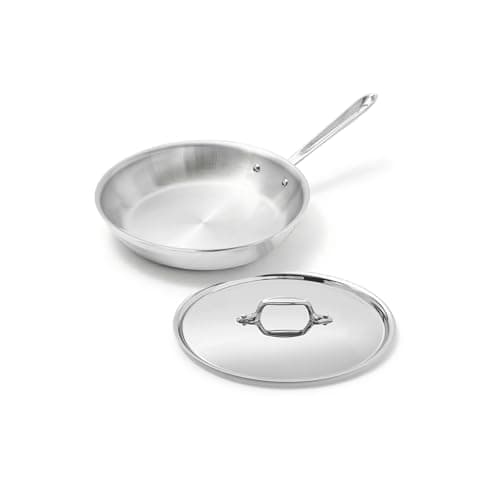
All-Clad D3 Stainless 10 in Fry Pan
Fully clad and heavy enough to hold temperature when cold food lands, which is when sticking actually happens.
Best for: One good open-stock stainless pan bought instead of a cheap full set
Published specifications for the All-Clad D3 Stainless 10 in Fry Pan
Construction
Fully bonded tri-ply, aluminum core
Oven maximum
600F, oven and broiler safe
Induction
Yes - compatible with any stovetop
Dishwasher
Handwash only (All-Clad published)
Handle
Double-riveted stainless
Weight
3.0 lb (model 4110)
Warranty
Limited lifetime
Made in
Bonded, engineered and assembled in Canonsburg, PA
Good
600F is the highest oven ceiling of any stainless pan on this site
The one pan here whose manufacturing location is published down to the town
Genuinely repairable-adjacent: rivets are the only failure point and the warranty covers them
Not good
Hand wash only
The flared rim makes it a poor pan for anything with liquid
Costs several times what a Tramontina or Cuisinart pan of the same construction costs
The trade-off. Hand wash only. All-Clad publishes that plainly, and it is a real daily cost on a pan you will use every day.
Skip this if. You want a dishwasher-safe pan, or you are buying a whole kitchen on a fixed budget - one D3 skillet costs what a full clad set can cost.
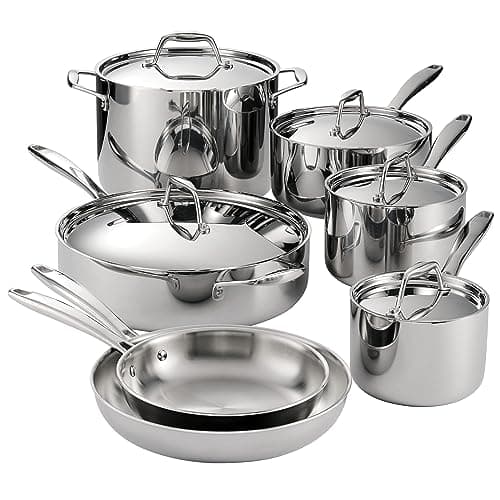
Published specifications for the Tramontina Signature Tri-Ply Clad 12-Piece Set
Construction
Tri-ply: 18/10 stainless, aluminum core, magnetic stainless exterior
Pieces
8 in and 10 in fry pans; 1.5, 2 and 3 qt covered saucepans; 5 qt covered deep saute; 8 qt covered stockpot
Oven maximum
500F on the 80116-249DS listing; other SKUs in the line are listed at 350F
Induction
Yes - magnetic stainless exterior
Dishwasher
Listed dishwasher safe
Handles
Precision cast, riveted
Certification
NSF-certified on the 80116-249DS line
Country of origin
Not asserted - retail listings disagree across SKUs (Brazil and China both appear)
Good
Fully clad, not disc-bottom: the aluminum runs up the sidewalls, so sauces do not scorch in a ring at the base
NSF certification on the flagship SKU is a real, checkable third-party mark rather than a marketing badge
Induction-ready without paying an induction premium
Not good
Retail listings disagree on the oven maximum across SKUs in the same line, which is a documentation problem, not a cooking one
Handles run hot on gas
The 12-piece count includes lids; the useful-item count is seven
The trade-off. Handles are the weak point. They are riveted and sturdy, but they get hot on a gas ring in a way the more expensive clad brands' do not.
Skip this if. You want a set you can leave in the oven above 500F, or you cook mostly eggs and pancakes and would rather spend the money on one good nonstick pan.
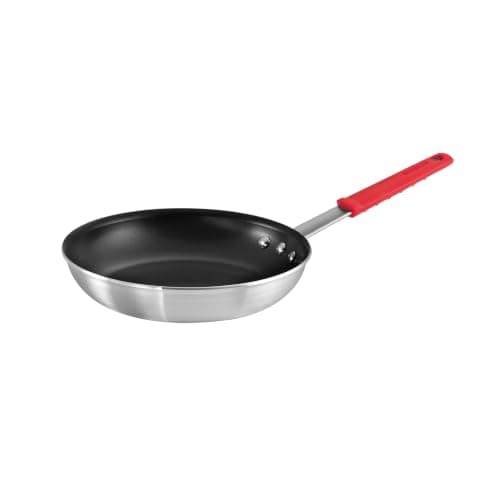
Published specifications for the Tramontina Professional Restaurant Fry Pan, 10 in
Body
Heavy-gauge aluminum
Coating
PTFE nonstick
Induction
No - aluminum body is not ferrous
Coating lifespan
Not published, by this or any nonstick maker
Good
Cheap enough that replacing it every couple of years is a real plan rather than a failure
Heavy gauge for a nonstick pan, so it does not warp on the first hot burner
Silicone handle sleeve that actually stays cool
Not good
Not induction compatible
PTFE, which some buyers will rule out on principle
No published coating lifespan, so the value case is unverifiable by design
The trade-off. It is PTFE. That is fine at normal cooking temperatures, and it is not a pan to preheat empty on high.
Skip this if. You want to avoid PTFE entirely. Buy ceramic instead and accept the shorter release life rather than pretending either one lasts forever.
The pan was not hot enough when the food went in. Cold protein bonds chemically to the steel surface; a properly heated pan flashes surface moisture to steam, which holds the food off the metal until a crust forms and it releases.
›How do I know when a stainless pan is hot enough?
Flick in a few drops of water. If they sizzle and spread, wait. When they merge into a ball that glides across the surface like mercury, the pan is ready. That is the Leidenfrost effect and it works as a free thermometer.
›Should you add oil to a cold or hot stainless pan?
Hot. Heat the dry pan first, add oil once it passes the water test, let it shimmer for a few seconds, then add food. Oil added cold thins out and starts polymerizing during the preheat.
›Can you season a stainless steel pan like cast iron?
Not durably. Seasoning relies on polymerized oil bonding into a porous, reactive surface, and stainless is passivated. Attempts to season it usually just produce a sticky film that makes the problem worse.
›Why does my food stick even in a hot pan?
Usually crowding or moving it too soon. A full pan cannot vent moisture, so the temperature crashes and everything steams. And food sticks briefly even when the pan is right - it releases on its own once a crust forms, so wait rather than prising it up.
Sources
Every figure on this page came from one of these. Follow them and check our arithmetic — that is the point.