Heads up: some links on this page earn us a commission at no extra cost to you. It does not change what we recommend or the order. How we are funded.
The short answer
Buy a 10.25-inch skillet if you cook for one or two, or if your largest burner is around 8 inches or smaller. Buy a 12-inch if you regularly cook for three or more and have a large burner. Cast iron conducts at only around 50 W/m-K, so a pan that overhangs the burner has a genuinely cooler rim.
Two questions, and one of them gets forgotten
Everyone asks the first: how many people are you cooking for? Almost nobody asks the second: how big is your burner? On most cookware the second question barely matters, because the pan spreads the heat. On cast iron it matters a great deal.
Cast iron conducts at roughly 50 W/m-K. Aluminum, for comparison, is 237. That means heat delivered to the middle of a cast iron pan moves outward slowly and reluctantly. A 12-inch pan on an 8-inch burner will have a hot center and a rim you can genuinely measure as cooler, and it will stay that way for as long as you cook.
By household
You cook for
Size
Why
One
8 or 10.25 in
The 8 is genuinely useful for one portion and lighter to handle. The 10.25 is more versatile
Two
10.25 in
Two portions in a single layer with room to move them
Three or four
12 in
Four portions without crowding - but check your burner first
Five or more
12 in and cook in batches
A 15-inch pan exists and is too heavy for most people to use safely
Crowding is the constraint. Food that does not fit in a single layer steams instead of browning.
The overhang problem, in practical terms
Measure the burner you would use, edge to edge of the flame ring or the element. Most domestic large burners are 7 to 9 inches. Then compare.
Pan base at or under the burner diameter: even heating, no problem.
Pan overhangs by an inch or so: manageable. Preheat slowly over medium for six to eight minutes and move the pan around while it warms.
Pan overhangs by two inches or more: the rim will be noticeably cooler and stay that way. Buy the smaller pan.
Note that a skillet's stated size is the top diameter, not the cooking surface. A 10.25-inch Lodge skillet has a flat base considerably smaller than 10.25 inches because the walls flare. Compare base to burner, not rim to burner.
Induction changes this in an interesting way: because induction generates heat inside the pan rather than under it, an induction element heats only the area it covers, so overhang is if anything more punishing. See the best cookware for induction cooktops.
Weight scales badly
Lodge publishes 5.66 lb for the 10.25-inch skillet. A 12-inch pan is not 17 percent heavier as the diameter suggests — area scales with the square of the radius, so it is closer to a third heavier, and the weight is further from your wrist when you lift it by the handle.
Full of food, a 12-inch cast iron skillet is a genuine two-handed lift for most people. Lodge puts a helper handle on the far side for exactly this reason, and it is not decorative.
If that is a concern, the honest answer is not a smaller cast iron pan — it is carbon steel, where de Buyer publishes 4.6 lb for an 11-inch pan.
Space around the food is the point of buying a larger pan. Crowded food releases moisture faster than it can evaporate, and steams.
Should you own two sizes?
Usually not, and this is where cast iron differs from other materials. A second cast iron skillet is heavy, takes real cupboard space, and duplicates a capability rather than adding one. Most kitchens are better served by one cast iron skillet and one pan in a different material.
The exception: a small 8-inch pan alongside a 12-inch is genuinely useful if you cook single eggs or toast spices, because heating a 12-inch pan for one egg is slow and wasteful. Two sizes that are close together — a 10.25 and a 12 — is the combination worth avoiding.
Beyond skillets
Griddle or grill pan. Flat is more useful than ridged. Ridges brown less of the food and are harder to clean.
Dutch oven, 5 to 6 quarts. A genuinely different capability rather than a bigger skillet, and if you braise, more useful than a second skillet. See bare versus enameled.
Combo cooker. A Dutch oven whose lid is a skillet. Genuinely clever, and heavy.
If you are buying your first cast iron and cannot decide: 10.25 inches. It fits every domestic burner, it is liftable, and it handles two to three portions. It is the size most people should own and the size most people who bought a 12 wish they had bought.
What to buy, if you are buying
These are the products this page's reasoning actually points at. Same rules as everywhere else on the site: published specs, a stated trade-off, and a live price only where one exists.
Top pick · The right size for most kitchensSpecs read September 3, 2026
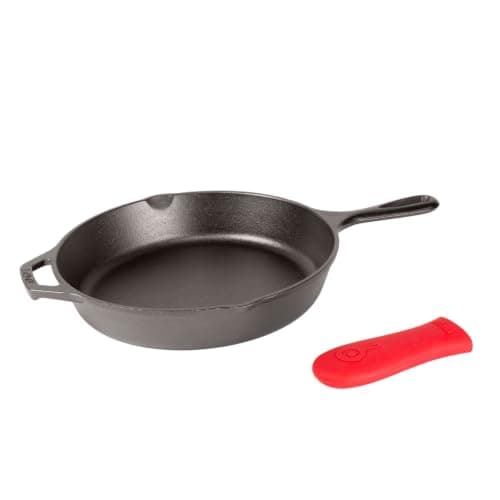
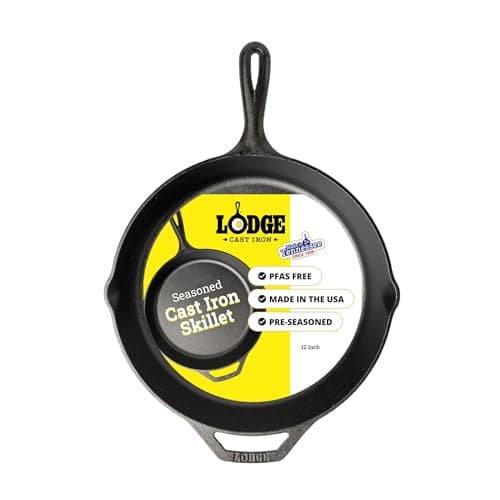
Lodge Seasoned Cast Iron Skillet, 10.25 in (L8SK3)
5.66 lb, fits a standard burner without overhang, and handles two to three portions without crowding.
Best for: Searing, cornbread, and anyone who wants one pan that cannot be worn out
Published specifications for the Lodge Seasoned Cast Iron Skillet, 10.25 in (L8SK3)
Diameter
10.25 in
Weight
5.66 lb
Oven maximum
550F
Induction
Yes - bare iron is ferrous
Seasoning
Pre-seasoned with soy-based vegetable oil, no synthetic chemicals
Warranty
Lifetime
Made in
USA
Care
Hand wash. Lodge's own instructions permit warm soapy water
Good
Effectively unbreakable and fully restorable - a rusted one can be stripped and re-seasoned
Holds heat better than anything else at the price, which is what a sear needs
Lodge publishes its seasoning method openly, so the maintenance is not a mystery
Not good
Heavy
Heats unevenly on a small burner: cast iron conducts at roughly 50 W/m-K, so it is slow to spread and slow to react
Bare iron is reactive; long tomato braises will taste of it
The trade-off. It weighs 5.66 lb empty. You will feel that every time you move it full, and it is the single most common reason a cast iron skillet ends up in a cupboard.
Skip this if. You have wrist or shoulder trouble, or you cook mostly acidic braises. Carbon steel does most of the same jobs at roughly half the weight.
10.25 inches. It fits a standard domestic burner without overhang, weighs 5.66 lb which is liftable one-handed, and handles two to three portions in a single layer.
›Is a 12-inch cast iron skillet too big?
It is if your burner is small. Cast iron conducts at only about 50 W/m-K, so a pan overhanging the burner by two inches or more has a genuinely cooler rim for the whole cook. Measure your burner before buying.
›How much does a 12-inch cast iron skillet weigh?
Lodge does not publish a single figure across revisions of the 12-inch, but it is meaningfully heavier than the 5.66 lb 10.25-inch, because area scales with the square of the radius. Full of food it is a two-handed lift for most people.
›Should I own two cast iron skillets?
Rarely. A second skillet duplicates a capability, weighs a lot and takes real cupboard space. An 8-inch alongside a 12-inch is defensible for single eggs; a 10.25 alongside a 12 is the combination to avoid.
›Does the stated size mean the cooking surface?
No, it is the top diameter. The flat base of a 10.25-inch skillet is considerably smaller because the walls flare, so compare the base against your burner rather than the rim.
Sources
Every figure on this page came from one of these. Follow them and check our arithmetic — that is the point.