Heads up: some links on this page earn us a commission at no extra cost to you. It does not change what we recommend or the order. How we are funded.
The short answer
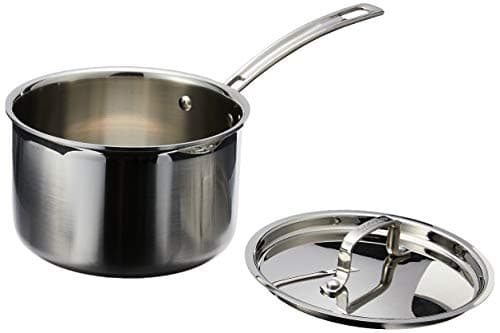
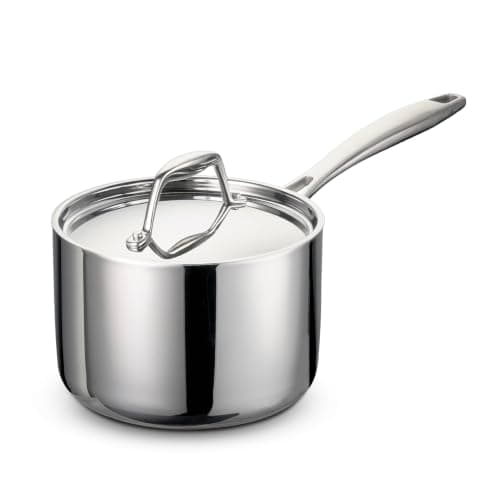
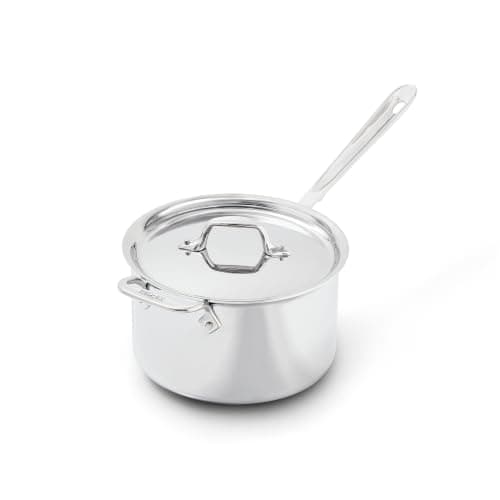
Buy a fully clad saucepan, not a disc-bottom one. In a saucepan most of the food touches the walls rather than the base, and a disc-bottom pan has cold single-ply walls above a very hot base - which is exactly how a milk sauce catches. The All-Clad D3 3 qt is the reference; the Cuisinart MultiClad Pro is the same construction, dishwasher safe, at a fraction of the price; and 2 qt is the size most kitchens reach for daily.
Quick picks
The whole answer, on one screen. Tap a row to jump to the full write-up. Every pick below carries a stated trade-off further down — including the one at the top.
#
Product
Best for
Price
1
All-Clad D3 Stainless Saucepan, 3 qt
Tri-ply the whole way up, a 600F oven ceiling and a published US factory. The reference against which the others are priced.
Prices last checked October 19, 2026. Prices move constantly — the number on Amazon when you click is the real one.
Why the saucepan is the shape that exposes cheap construction
Think about the geometry. In a fry pan the food sits on the base in a thin layer, so almost all the heat that reaches it comes up through the bottom. In a saucepan the food is a column, and a large share of its surface is in contact with the walls.
A disc-bottom saucepan has a slab of aluminum bonded to the base and thin single-ply steel walls. Steel conducts at roughly 15 W/m-K; aluminum at 237. So the base is a fast, even heat source and the walls are close to insulating. The contents in the middle of the column heat slowly while the layer touching the base gets hammered - which is how milk, custard and anything with sugar or dairy in it catches on the bottom while the top is still lukewarm.
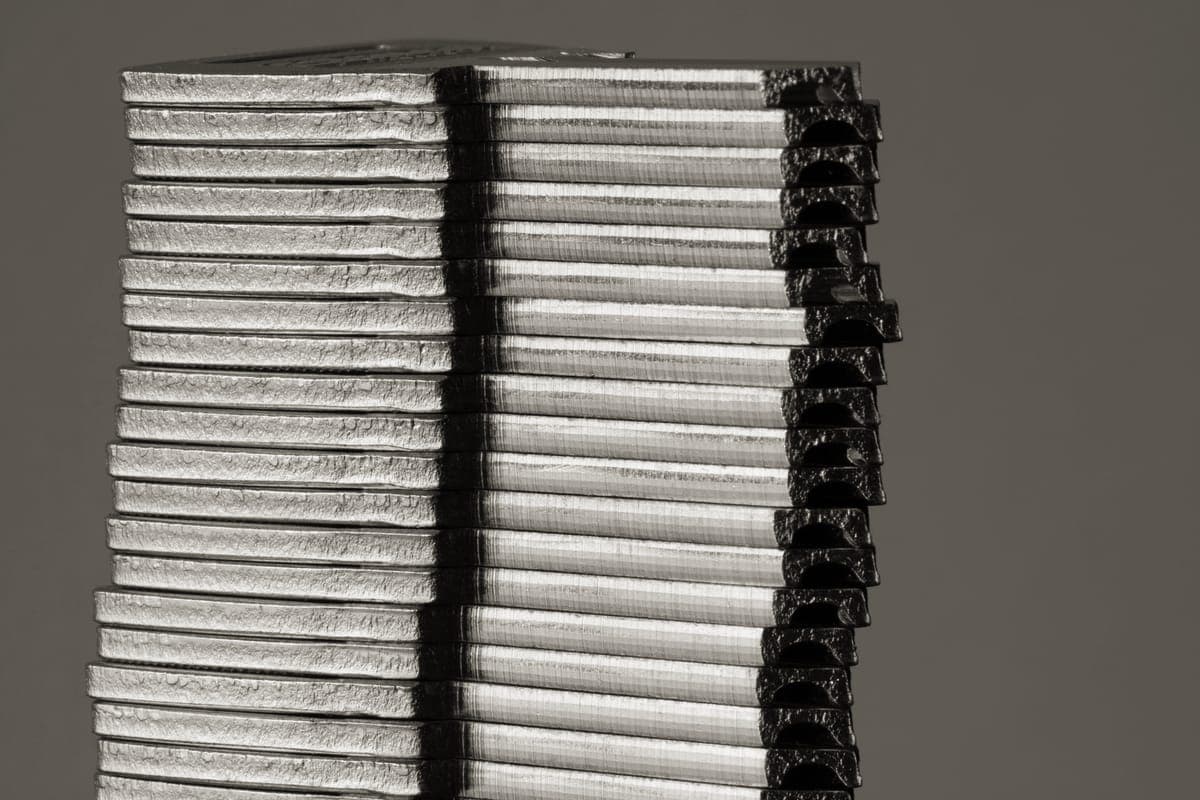
Fully clad construction runs the aluminum up the sidewalls, so the whole vessel is a heat source. That is the entire argument, and it is much stronger in a saucepan than in a skillet.
How we chose these
We have not cooked in them. Each pan is compared on published construction, capacity, oven ceiling, dishwasher rating and warranty, with the source named on every card. The method is here.
The one documented contradiction worth flagging again: Cuisinart's MultiClad Pro is advertised at 550F on major retail listings and published at 500F in Cuisinart's own use-and-care manual. We use the manual figure, because that is the document the warranty refers to.
What size, honestly
Capacity
What it is for
Who it suits
1.5-2 qt
Sauce, one or two portions of grain, reheating, melting butter
The daily pan in almost every kitchen
3 qt
Rice for four, soup for two, blanching, small pasta batches
The one to buy if you own only one
4 qt
Pasta for two to three, stock in small batches, big sauces
Households of three or more
6 qt and up
This is a stock pot, not a saucepan
Buy the pot shape instead - the walls should be taller
Most kitchens use a 2 qt daily and a 3 qt weekly. The 4 qt is the one that sits in the cupboard unless there are children in the house.
If you can only buy one, buy 3 qt: it is large enough for rice and small enough that a single portion of sauce is not lost in it. If you can buy two, buy 2 and 4 rather than 2 and 3, because they nest and cover a wider range - a point developed in cookware for a small kitchen.
Lids, spouts and the details that decide daily use
Lid material
Glass lids let you watch without lifting and cap the oven temperature at whatever the glass and its rim are rated for - typically well below the pan itself. Steel lids match the pan's oven ceiling and tell you nothing about what is happening. On a saucepan used mostly on the stovetop, either is fine; if you finish things in the oven, buy steel.
Pouring
Very few saucepans pour cleanly. A rolled or flared rim helps; a flat-cut rim dribbles down the side, and on a pan you use for sauce that is a nightly irritation. It is not usually in the specification, so it is worth looking at the rim in the listing photographs.
Handle length and balance
A 3 qt saucepan full of liquid is heavy at the end of a long handle. All-Clad and Cuisinart both use riveted stainless handles that get warm but not hot; the Tramontina handles run hotter on gas, which is the stated trade-off on that line.
You can see fully clad construction at the rim. If the cut edge is plain steel with a step at the base, it is disc bottom.
If your sauces already scorch
Before buying anything, it is worth ruling out technique. Sauces catch for three reasons and only one of them is the pan: heat too high, no stirring at the corner where the wall meets the base, or a pan whose walls are cold. The corner is the spot people miss - a flat spatula reaches it and a whisk does not.
If you are filling a gap in a set rather than starting over, set versus open stock explains when buying one piece beats buying another box, and you can compare clad saucepans on Amazon once you know the capacity you want.
Every pick, in full
Each write-up below gives the published specs, what the pan is genuinely good at, what it costs you, and who should skip it. The trade-off line is there on the top pick too — a recommendation with no downside is an advertisement.
Top pick · Best overallSpecs read September 3, 2026
All-Clad D3 Stainless Saucepan, 3 qt
Tri-ply the whole way up, a 600F oven ceiling and a published US factory. The reference against which the others are priced.
Best for: Rice, custards and reductions - anything that scorches in a disc-bottom pan
Published specifications for the Cuisinart MultiClad Pro Saucepan, 3 qt
Construction
Tri-ply: 18/10 stainless interior, pure aluminum core, brushed stainless exterior
Capacity
3 qt with lid
Oven maximum
500F per the Cuisinart use-and-care manual; retail listings say 550F
Induction
Yes
Dishwasher
Dishwasher safe
Handle
Riveted solid stainless, cool-grip profile
Warranty
Lifetime
Good
Genuinely dishwasher-safe clad stainless, which the premium brands are not
Fully clad rather than disc-bottom at an open-stock price
Lifetime warranty
Not good
Published oven maximum contradicts the retail listing for the same pan
The handle spine is divisive on larger pieces
No published country of manufacture
The trade-off. The oven ceiling is 500F per Cuisinart's manual, not the 550F some retail listings advertise. That is a documentation problem the buyer inherits.
Skip this if. You want the higher oven ceiling or the published US factory. That is All-Clad, and you pay for it.
A fully clad one. The All-Clad D3 3 qt is the reference - tri-ply the whole way up, 600F oven ceiling, hand wash only. The Cuisinart MultiClad Pro 3 qt is the same construction, dishwasher safe, for a fraction of the price.
›What size saucepan should I buy?
Three quarts if you can only own one. Two quarts is what most kitchens reach for daily, and 4 qt suits households of three or more. Above 6 qt you want a stock pot shape, with taller walls, rather than a saucepan.
›Why does milk burn in my saucepan?
Usually because the pan is disc bottom. The aluminum slab in the base runs very hot while the thin steel walls stay cool, so the layer of milk touching the base scorches before the rest of the pan is warm. Fully clad construction fixes it.
›Are glass lids worse than steel ones?
Only for oven use. A glass lid caps the oven temperature at whatever the glass and its rim are rated for, which is usually well below the pan's own ceiling. On the stovetop the visibility is worth more than the rating.
›Is a saucepan or a saucier better for sauces?
A saucier, if you whisk. Its curved base has no corner for a whisk to miss, which is where sauces catch. A straight-sided saucepan is more versatile for grains and reheating, and a flat spatula reaches the corner just as well.
Sources
Every figure on this page came from one of these. Follow them and check our arithmetic — that is the point.