Heads up: some links on this page earn us a commission at no extra cost to you. It does not change what we recommend or the order. How we are funded.
The short answer
Counting lids as pieces, so a "12-piece" set is seven usable items.
Buying disc-bottom construction described in language that sounds fully clad.
Trusting the retail listing's oven rating over the manufacturer's manual.
Buying a discontinued line you cannot add a single piece to later.
Buying nonstick as the main set, then being surprised it wears out.
1. Counting the lids
A 12-piece set typically contains seven cooking vessels and five lids. A 14-piece set often contains the same seven vessels, five lids and two nylon spoons. The number on the box is a marketing unit, not a capability.
Check instead: the itemized piece list, and count only things that hold food. Then compare that number against what piece count you need.
2. Buying disc-bottom and thinking it is clad
Fully clad means the aluminum layer runs from the base up the sidewalls. Disc bottom means a slab of aluminum is bonded to the base only, and the walls are thin single-ply steel. Both are sold using the words "tri-ply" and "impact bonded" in ways that blur into each other.
It matters for anything that touches the sides: a reduction, a risotto, a milk-based sauce. In a disc-bottom pan the walls are close to room temperature and the base is at full heat, which is what produces a scorch ring.
Check instead: a photo of the rim. On a fully clad pan you can see the aluminum layer sandwiched at the cut edge. On a disc-bottom pan the rim is plain steel and there is a visible step where the disc is attached to the base.
3. Believing the listing over the manual
This is the most common documented contradiction in the category. Cuisinart's MultiClad Pro is listed at 550F on major retail sites; its own use-and-care manual says 500F. Tramontina publishes 500F on the 80116-249DS line while other SKUs in the same family are listed at 350F.
Check instead: download the use-and-care PDF before buying. It is usually linked from the manufacturer's product page and it is the document that governs the warranty.
4. Buying a line you cannot add to
A set is a starting point. Within two years you will want a second skillet, a larger pot, or a replacement lid. If the line is discontinued or sold only as a boxed set, none of those exist.
Check instead: search the brand and line name for open-stock pieces before buying the box. If the only results are the set, treat it as disposable. Open-stock clad pieces on Amazon is a reasonable sanity check.
5. Buying nonstick as the primary set
A coated set is a consumable set. No maker publishes a coating lifespan - not Calphalon, not T-fal, not GreenPan, not one - and that silence is the most informative thing in the category.
Check instead: buy clad or iron as the backbone and one or two nonstick pans as wear items. If you genuinely want a nonstick set, buy it knowing what it is: best nonstick cookware sets and how long nonstick lasts.
6. Ignoring induction compatibility on a gas stove
Cookware outlives stoves. An induction-rated set costs nothing extra in the clad lines and it means a future kitchen does not force a second purchase. It also, incidentally, guarantees a flat magnetic base, which is a proxy for build quality.
Check instead: the words "induction ready" or a magnet against the base. Aluminum-bodied nonstick sets almost never qualify. Details in cookware for induction.
A magnet is the whole induction test, and a flat magnetic base is also a decent proxy for a pan that will sit flat on an electric element.
7. Buying for the kitchen you imagine
The 5 qt saute pan and the 12-inch skillet are the pieces people are proudest of and use least. If you cook one-pan weeknight meals for two, a 12-piece set buys you nine pieces of storage.
Check instead: write down the last ten things you cooked and size for those. The exercise is in how many pans a kitchen needs.
8. Missing the hand-wash line
All-Clad publishes hand wash only on D3. Bare cast iron, carbon steel and USA Pan's coated bakeware are all hand wash. Nordic Ware advises against the dishwasher for bare aluminum. None of that is hidden - it is just on page four of a PDF nobody opens.
Check instead: the dishwasher line in the manual, and be honest about whether the household will follow it.
9. Treating warranty length as quality
A lifetime warranty on clad stainless is meaningful, because the failure mode - a rivet loosening, a base delaminating - is exactly what it covers. A lifetime warranty on nonstick is close to meaningless, because coating wear is explicitly excluded and coating wear is the only thing that ever happens.
Check instead: what the warranty excludes, not how long it runs.
The whole thing as a checklist
Itemized piece list, lids excluded
Rim photo showing a continuous clad layer
Oven maximum from the manual, not the listing
Open-stock pieces available in the same line
Induction rated
Dishwasher line read and accepted
Warranty exclusions read
Sizes matched against what you actually cook
Coating treated as a wear item, if there is one
Sets that pass, and one that passes with conditions
The first two clear the checklist. The GreenPan set clears it only if you have accepted that a coated set is a consumable.
These are the products this page's reasoning actually points at. Same rules as everywhere else on the site: published specs, a stated trade-off, and a live price only where one exists.
Top pick · The set that survives this checklistSpecs read September 3, 2026
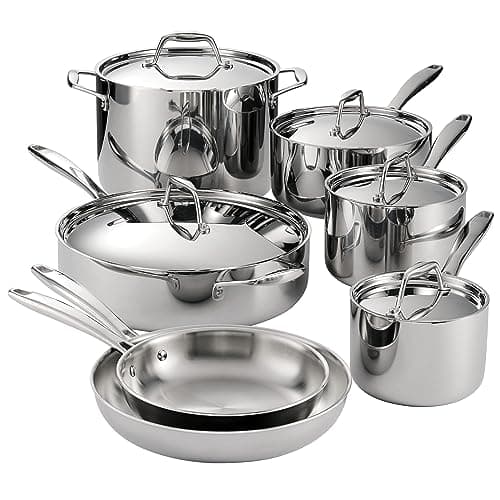
Tramontina Signature Tri-Ply Clad 12-Piece Set
Fully clad rather than disc-bottom, induction-rated, still sold in open stock, with a third-party NSF mark on the flagship SKU.
Best for: A first kitchen that should not need replacing
Published specifications for the Tramontina Signature Tri-Ply Clad 12-Piece Set
Construction
Tri-ply: 18/10 stainless, aluminum core, magnetic stainless exterior
Pieces
8 in and 10 in fry pans; 1.5, 2 and 3 qt covered saucepans; 5 qt covered deep saute; 8 qt covered stockpot
Oven maximum
500F on the 80116-249DS listing; other SKUs in the line are listed at 350F
Induction
Yes - magnetic stainless exterior
Dishwasher
Listed dishwasher safe
Handles
Precision cast, riveted
Certification
NSF-certified on the 80116-249DS line
Country of origin
Not asserted - retail listings disagree across SKUs (Brazil and China both appear)
Good
Fully clad, not disc-bottom: the aluminum runs up the sidewalls, so sauces do not scorch in a ring at the base
NSF certification on the flagship SKU is a real, checkable third-party mark rather than a marketing badge
Induction-ready without paying an induction premium
Not good
Retail listings disagree on the oven maximum across SKUs in the same line, which is a documentation problem, not a cooking one
Handles run hot on gas
The 12-piece count includes lids; the useful-item count is seven
The trade-off. Handles are the weak point. They are riveted and sturdy, but they get hot on a gas ring in a way the more expensive clad brands' do not.
Skip this if. You want a set you can leave in the oven above 500F, or you cook mostly eggs and pancakes and would rather spend the money on one good nonstick pan.
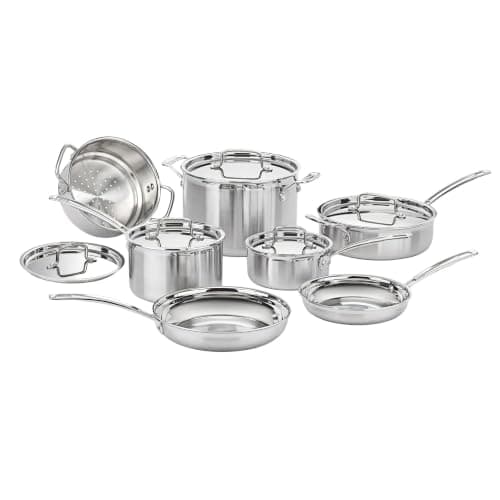
Published specifications for the Cuisinart MultiClad Pro MCP-12N 12-Piece Set
Construction
Tri-ply: 18/10 stainless interior, pure aluminum core, brushed stainless exterior
Pieces
1.5 and 3 qt covered saucepans; 8 in and 10 in skillets; 3.5 qt covered saute; 8 qt covered stockpot; steamer insert
Oven maximum
500F per the Cuisinart use-and-care manual, which the Amazon listing we cite now matches. Major retail listings still advertise 550F; Cuisinart has confirmed the manual figure
Induction
Yes
Dishwasher
Dishwasher safe
Handles
Riveted solid stainless, cool-grip profile
Warranty
Lifetime
Good
Heat runs up the sidewalls, not just across the base
Genuinely dishwasher safe, which the pricier clad brands often are not
Lifetime warranty on a set at this price
Not good
Published oven maximum contradicts the retail listing for the same product
Handle spine is divisive
No 12-inch skillet in the box, which is the pan most people reach for second
The trade-off. The cool-grip handles have a sharp spine that some people find uncomfortable on a full 8-quart stockpot.
Skip this if. You want the higher oven ceiling that major retail listings advertise. The manual says 500F and Cuisinart has confirmed the manual is correct.
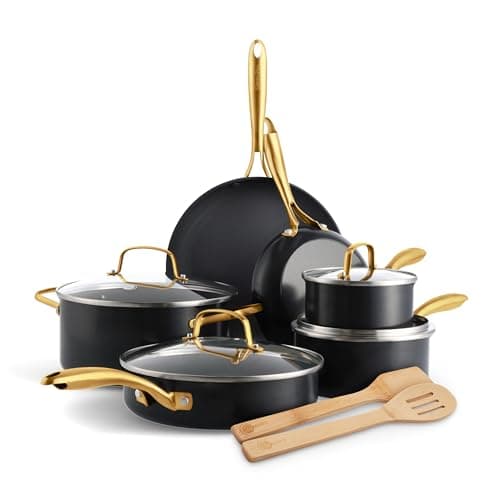
Published specifications for the GreenPan Ceramic Nonstick Cookware Set
Coating
Thermolon, from sand-derived Silicon Dioxide (SiO2), sprayed
Coating chemistry
PFAS-free, PFOA-free, free of lead and cadmium (GreenPan published)
Coating heat resistance
850F / 450C for the coating itself (GreenPan published)
Body oven maximum
Varies by line and is lower than the coating figure - check the specific line
Coating lifespan
Not published. No ceramic maker publishes one
Good
GreenPan publishes what the coating is made of in plain terms, which most ceramic brands do not
The coating will not release fumes if you overheat it the way PTFE can
Genuinely good release when new
Not good
Release degrades and nobody will tell you how fast
The 850F figure is for the coating, not the pan, and gets quoted as if it were the pan
Ceramic dislikes high heat and dishwashers, which is most of what a set gets used for
The trade-off. Ceramic nonstick loses release with use and no maker publishes a lifespan, GreenPan included. Treat it as a consumable, not a lifetime purchase.
Skip this if. You are buying a set expecting it to last as long as clad stainless. It will not, and the honest move is to buy one ceramic pan alongside a stainless set.
›How do you tell if a cookware set is fully clad or disc bottom?
Look at a photo of the rim. A fully clad pan shows the aluminum layer sandwiched between steel all the way up the cut edge. A disc-bottom pan has a plain steel rim and a visible step where the aluminum disc is bonded to the base.
›Are lids counted as pieces in a cookware set?
Almost always. A 12-piece set typically contains seven cooking vessels and five lids. Count only the items that hold food when you compare sets, because that is the number that describes what the set can actually do.
›Why do cookware oven temperature ratings vary between sites?
Because retail listings and manufacturer manuals disagree. Cuisinart's MultiClad Pro is listed at 550F on major retail sites and at 500F in its own use-and-care manual. The manual governs the warranty, so it is the figure to trust.
›Is a lifetime warranty on nonstick cookware worth anything?
Very little. Coating wear is the only failure mode nonstick has and it is explicitly excluded from essentially every lifetime warranty in the category. On clad stainless the same warranty is meaningful because it covers rivets and delamination.
›Should you buy an induction ready set for a gas stove?
Yes, if it costs nothing extra, which in the clad lines it does not. Cookware outlives stoves, and an induction-rated base also has to be flat and even, which is a useful proxy for build quality on any stove.
Sources
Every figure on this page came from one of these. Follow them and check our arithmetic — that is the point.