Heads up: some links on this page earn us a commission at no extra cost to you. It does not change what we recommend or the order. How we are funded.
The short answer
If you want a full nonstick set, GreenPan's ceramic line is the one that publishes what its coating actually is. If you would rather have PTFE and a metal- utensil-safe surface, the Calphalon Premier hard-anodized pans are the pick. But the honest recommendation for most kitchens is not a nonstick set at all: buy a clad stainless set as the backbone and two nonstick pans as wear items, because that is what a coated pan is.
Quick picks
The whole answer, on one screen. Tap a row to jump to the full write-up. Every pick below carries a stated trade-off further down — including the one at the top.
#
Product
Best for
Price
1
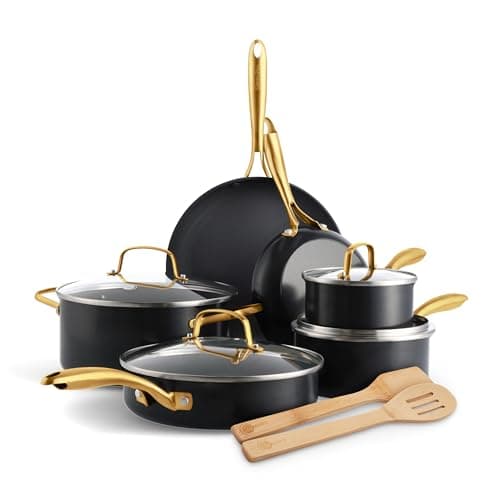
GreenPan Ceramic Nonstick Cookware Set
The only set here whose maker publishes the coating chemistry in plain terms, which on a product defined by its coating is the whole argument.
Prices last checked October 19, 2026. Prices move constantly — the number on Amazon when you click is the real one.
The thing nobody in the category will publish
There is no published coating lifespan for any nonstick pan sold in the United States. Not from Calphalon, not from T-fal, not from GreenPan, not from OXO. Every other specification on a pan is available - gauge, oven ceiling, warranty terms, coating chemistry - and the single number that determines what the pan is worth is absent everywhere.
That absence is the most useful fact in the category, because it tells you what kind of purchase this is. A clad stainless set is equipment. A nonstick set is stock, and it depreciates.
How we chose these
We have not cooked in them. The comparison is on published coating chemistry, oven ceilings, induction compatibility and what each warranty explicitly excludes. The method is here.
On chemistry, GreenPan is the outlier: it publishes that Thermolon is derived from silicon dioxide, PFAS-free and PFOA-free, and rates the coating itself to 850F. It is careful to note that the pan body has a lower ceiling than the coating, which is a distinction most brands blur.
Ceramic or PTFE, in one table
Ceramic (sol-gel)
PTFE
What it is
Silica-derived coating, applied as a spray and cured
Fluoropolymer film, usually in several layers
Release when new
Excellent
Excellent
Release after two years
Noticeably degraded
Degraded, generally more slowly
Overheating behavior
Loses release; no fume hazard
Degrades above roughly 500F and can release fumes
Metal utensils
No
Only on lines published as metal-utensil safe
Published lifespan
None
None
Both are consumables. The difference is which failure mode and which set of chemistry concerns you would rather have.
A set means every piece ages at once. Buy a 10-piece nonstick set and in three years you have ten pans with degraded release rather than two, and eight of them are pieces - a stock pot, a saucepan - where a coating was never necessary. Nothing about boiling pasta or reducing a sauce needs release.
Coating is only useful on the fry pans. Eggs, fish, pancakes. That is it.
Coated saucepans and stock pots are a downgrade. They cap the oven temperature, rule out metal utensils and add a wear item to a piece that would otherwise last forever.
Sets are rarely induction rated, because the aluminum bodies that make them cheap are not ferrous.
If a nonstick set is still the right call - shared kitchen, rental, a household that is not going to learn a stainless preheat - buy it knowingly and cheaply, and plan to replace the fry pans first.
This is what the missing specification looks like in practice. When release goes, the pan is finished, and nothing on the box told you when to expect it.
Metal-utensil safe is the one claim worth paying for
The fastest way to kill a coated pan is a metal spatula, and the second fastest is a dishwasher. Calphalon publishes its Premier multi-layer coating as metal-utensil safe, which is a specific, checkable claim rather than a vague durability boast. In a kitchen where the utensil drawer is not policed, that claim is worth more than any other difference between these pans.
It does not mean the coating is permanent. It means contact does not gouge it. Check price on Amazon.
Which to buy
You want a full set and you want ceramic: GreenPan. Published chemistry, and the shortest expected release life of the three - accept both.
You want PTFE and metal utensils: build from the Calphalon Premier pans rather than buying a boxed set.
You want the best object to use daily: the OXO pan, for the rolled edge and the handle.
You want the cheapest sane answer: a clad set plus two Tramontina Professional pans, replaced as they wear.
Nonstick, bought as a consumable
One set and three pans. If you are replacing a worn pan rather than starting over, buy the pan.
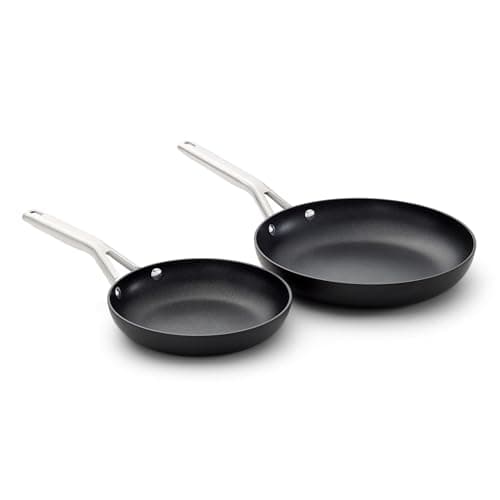
GreenPan Ceramic Nonstick Cookware Set
Someone who wants nonstick without PTFE and has read what that trades away
Still deciding whether you want a coated set at all? The main set roundup makes the case for clad as the backbone, and a broad Amazon search shows how the category is priced before you commit.
Every pick, in full
Each write-up below gives the published specs, what the pan is genuinely good at, what it costs you, and who should skip it. The trade-off line is there on the top pick too — a recommendation with no downside is an advertisement.
Top pick · Best ceramic setSpecs read September 3, 2026
GreenPan Ceramic Nonstick Cookware Set
The only set here whose maker publishes the coating chemistry in plain terms, which on a product defined by its coating is the whole argument.
Best for: Someone who wants nonstick without PTFE and has read what that trades away
Published specifications for the GreenPan Ceramic Nonstick Cookware Set
Coating
Thermolon, from sand-derived Silicon Dioxide (SiO2), sprayed
Coating chemistry
PFAS-free, PFOA-free, free of lead and cadmium (GreenPan published)
Coating heat resistance
850F / 450C for the coating itself (GreenPan published)
Body oven maximum
Varies by line and is lower than the coating figure - check the specific line
Coating lifespan
Not published. No ceramic maker publishes one
Good
GreenPan publishes what the coating is made of in plain terms, which most ceramic brands do not
The coating will not release fumes if you overheat it the way PTFE can
Genuinely good release when new
Not good
Release degrades and nobody will tell you how fast
The 850F figure is for the coating, not the pan, and gets quoted as if it were the pan
Ceramic dislikes high heat and dishwashers, which is most of what a set gets used for
The trade-off. Ceramic nonstick loses release with use and no maker publishes a lifespan, GreenPan included. Treat it as a consumable, not a lifetime purchase.
Skip this if. You are buying a set expecting it to last as long as clad stainless. It will not, and the honest move is to buy one ceramic pan alongside a stainless set.
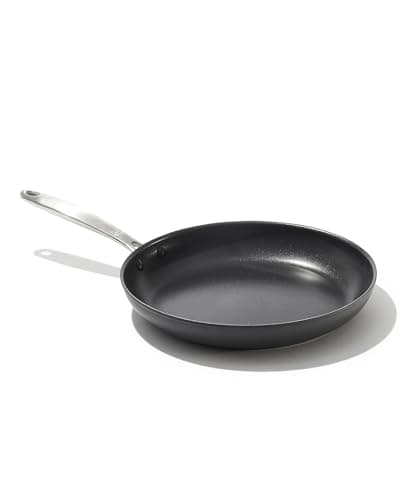
Published specifications for the OXO Good Grips Pro Hard-Anodized Nonstick Fry Pan, 10 in
Body
Hard-anodized aluminum
Coating
Three-layer PTFE nonstick, published PFOA-free
Oven maximum
430F published for the line
Induction
No on the standard hard-anodized line
Dishwasher
Dishwasher safe
Edge
Rolled, for pouring without dripping down the side
Coating lifespan
Not published
Good
The rolled pour edge is a small thing you notice every single time you use it
The hard-anodized body resists the denting that ruins cheap aluminum pans
Handle stays cool and does not rotate the way riveted plastic ones eventually do
Not good
Not induction compatible
Oven ceiling capped by the handle, not the pan
Still a coating, still a consumable, still no published lifespan
The trade-off. The handle that makes it comfortable is a stainless-and-silicone assembly, and that is what caps the oven rating below the body's own limit.
Skip this if. You need induction. The standard hard-anodized body is not ferrous.
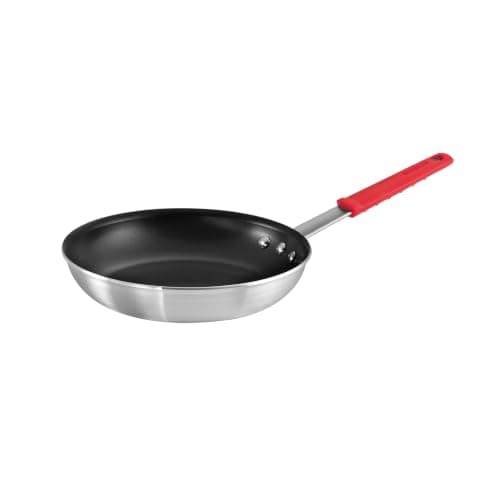
Published specifications for the Tramontina Professional Restaurant Fry Pan, 10 in
Body
Heavy-gauge aluminum
Coating
PTFE nonstick
Induction
No - aluminum body is not ferrous
Coating lifespan
Not published, by this or any nonstick maker
Good
Cheap enough that replacing it every couple of years is a real plan rather than a failure
Heavy gauge for a nonstick pan, so it does not warp on the first hot burner
Silicone handle sleeve that actually stays cool
Not good
Not induction compatible
PTFE, which some buyers will rule out on principle
No published coating lifespan, so the value case is unverifiable by design
The trade-off. It is PTFE. That is fine at normal cooking temperatures, and it is not a pan to preheat empty on high.
Skip this if. You want to avoid PTFE entirely. Buy ceramic instead and accept the shorter release life rather than pretending either one lasts forever.
GreenPan's ceramic line if you want a full set, because it is the only one that publishes what its coating actually is. If you want PTFE with a metal-utensil-safe surface, build from Calphalon Premier pans rather than buying a boxed set.
›How long does a nonstick cookware set last?
Nobody publishes a figure. Not Calphalon, not T-fal, not GreenPan, not OXO. That silence is consistent across the whole category and it is the strongest argument for treating a nonstick set as a consumable rather than as equipment.
›Is a nonstick set better than a stainless set?
For most kitchens, no. Coating is only useful on fry pans, and a coated saucepan or stock pot adds a wear item and a lower oven ceiling to a piece that would otherwise last forever. Buy clad as the backbone and nonstick as wear items.
›Are nonstick sets induction compatible?
Usually not. The aluminum bodies that make nonstick sets cheap are not ferrous, so they do not work on induction. A few lines add a bonded steel base specifically for induction, and those are worth checking with a magnet.
›Can you use metal utensils on nonstick?
Only on lines published as metal-utensil safe, which is a specific claim rather than a general durability boast. Calphalon publishes it for its Premier multi-layer coating. On everything else, a metal spatula is the fastest way to end the pan.
Sources
Every figure on this page came from one of these. Follow them and check our arithmetic — that is the point.