Heads up: some links on this page earn us a commission at no extra cost to you. It does not change what we recommend or the order. How we are funded.
The short answer
Hard anodizing is an electrochemical process that thickens the natural oxide layer on aluminum, producing a surface harder than the metal underneath and non-reactive with acidic food. It genuinely improves the body of a pan. It does nothing for the nonstick coating on top, which is still the part that fails. Of the pans here, the Calphalon Premier is the one to buy for a metal-utensil-safe surface, the OXO for the best handle and pour edge, and the T-fal if the budget rules both out.
Quick picks
The whole answer, on one screen. Tap a row to jump to the full write-up. Every pick below carries a stated trade-off further down — including the one at the top.
#
Product
Best for
Price
1
Calphalon Premier Hard-Anodized Nonstick Fry Pan, 10 in
Hard-anodized under a multi-layer PTFE coating published as metal-utensil safe, with a 450F oven ceiling - high for a coated pan.
Prices last checked October 19, 2026. Prices move constantly — the number on Amazon when you click is the real one.
What hard anodizing actually is
Aluminum forms a thin oxide layer in air automatically. Anodizing is an electrochemical process that grows that layer deliberately, and hard anodizing - sometimes called Type III - grows it thicker and denser than decorative anodizing does.
The result is a surface that is genuinely much harder than raw aluminum, does not flake because it is grown from the metal rather than applied to it, and is non-reactive, so acidic food does not pit it or pick up a metallic taste. It is also the reason these pans are dark gray: the oxide layer takes a dye or darkens in the process.
None of that is marketing. Anodized aluminum is a real material improvement over bare aluminum, and it is why anodized cake pans are a professional standard - see best cake and loaf pans.
What it does not do
Here is the part the category tends to blur. On a nonstick pan, the anodized surface is under the coating. You never touch it and food never touches it. What you cook on is PTFE or ceramic, exactly as on a non-anodized pan, and it wears out at the same kind of rate.
It does not extend coating life except indirectly, by giving the coating a harder, flatter, more dent-resistant base to sit on.
It does not make the pan induction compatible. Anodized aluminum is still aluminum and still not ferrous. Most hard-anodized lines need a separate bonded steel base to work on induction.
It does not make the pan metal-utensil safe. That is a property of the coating and it has to be published separately - Calphalon does, most do not.
It does not raise the oven ceiling much. The ceiling is set by the coating and the handle. Calphalon publishes 450F, OXO 430F. Both are below any uncoated pan on this site.
Where anodizing genuinely earns its keep is on uncoated anodized cookware and bakeware, where the anodized surface is the cooking surface. On a nonstick pan it is a better substrate, not a better pan surface.
How we chose these
We have not cooked in them. The comparison is on published body construction, coating type and any metal-utensil claim, oven ceiling, induction compatibility and dishwasher rating. The method is here.
The one claim worth paying for in this group is Calphalon's published metal-utensil-safe rating on the Premier multi-layer coating. It is specific and checkable, unlike the general durability language most of the category uses, and it removes the fastest way people destroy a coated pan. Check price on Amazon.
The three pans, compared
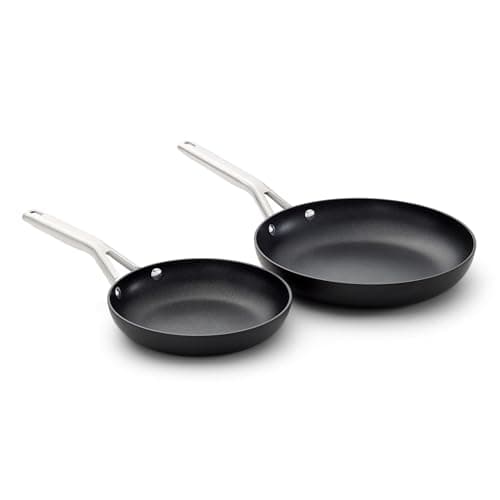
Calphalon Premier
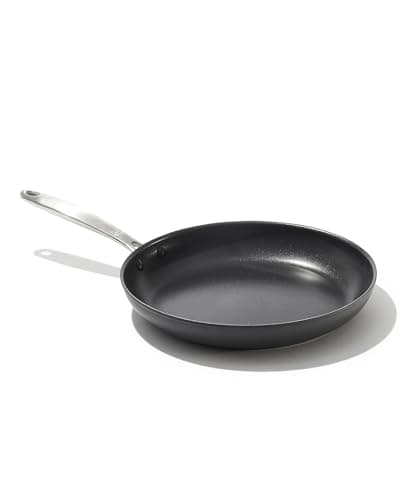
OXO Good Grips Pro
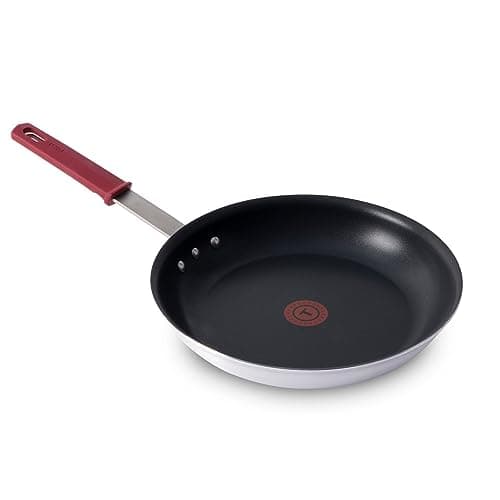
T-fal Professional
Body
Hard-anodized aluminum
Hard-anodized aluminum
Plain aluminum
Coating
Multi-layer PTFE, metal-utensil safe
Three-layer PTFE, PFOA-free
PTFE
Oven maximum
450F
430F
400F
Induction
No, on the standard line
No, on the standard line
No, on the standard line
Dishwasher
Yes
Yes
Yes
Distinguishing feature
Metal-utensil safe
Rolled pour edge, best handle
Thermo-Spot heat indicator
Coating lifespan
Not published
Not published
Not published
The last row is the same for every pan in the category, and it is the reason to think of all three as consumables.
The anodized layer is under the coating. What you cook on is the same fluoropolymer film as on a cheaper pan.
The T-fal argument, which is better than it sounds
The most common nonstick mistake is not overheating - it is under-heating. Food goes into a pan that is not up to temperature, sticks, and the pan gets blamed.
T-fal's Thermo-Spot is a pattern in the center of the pan that turns solid red at cooking temperature. It is a gimmick in the sense that any experienced cook can judge it by feel, and it is genuinely useful in the sense that most people cannot, and it costs nothing. On a cheap pan that will be replaced anyway, that is a better use of money than anodizing. Check price on Amazon.
If you have induction
Most standard hard-anodized lines will not work at all - the body is not ferrous. Several makers sell a separate induction range with a bonded steel disc on the base, and those are the ones to look for. A magnet is the entire test.
Unpoliced utensil drawer: Calphalon Premier, for the published metal-utensil-safe coating.
Daily cooking, and you care how it feels:the OXO, for the rolled edge and the handle.
Budget, and you want the heat indicator: T-fal Professional.
Budget, and you want the heaviest gauge:the Tramontina Professional, which skips anodizing and puts the money into the body.
Hard-anodized, and the two honest alternatives
Every one of these is a coated pan with an unpublished service life. Choose on handle, oven ceiling and whether metal utensils are a fact of your kitchen.
Calphalon Premier Hard-Anodized Nonstick Fry Pan, 10 in
A nonstick pan in a kitchen where the utensil drawer is not going to be policed
Each write-up below gives the published specs, what the pan is genuinely good at, what it costs you, and who should skip it. The trade-off line is there on the top pick too — a recommendation with no downside is an advertisement.
Top pick · Best overallSpecs read September 3, 2026
Calphalon Premier Hard-Anodized Nonstick Fry Pan, 10 in
Hard-anodized under a multi-layer PTFE coating published as metal-utensil safe, with a 450F oven ceiling - high for a coated pan.
Best for: A nonstick pan in a kitchen where the utensil drawer is not going to be policed
Published specifications for the OXO Good Grips Pro Hard-Anodized Nonstick Fry Pan, 10 in
Body
Hard-anodized aluminum
Coating
Three-layer PTFE nonstick, published PFOA-free
Oven maximum
430F published for the line
Induction
No on the standard hard-anodized line
Dishwasher
Dishwasher safe
Edge
Rolled, for pouring without dripping down the side
Coating lifespan
Not published
Good
The rolled pour edge is a small thing you notice every single time you use it
The hard-anodized body resists the denting that ruins cheap aluminum pans
Handle stays cool and does not rotate the way riveted plastic ones eventually do
Not good
Not induction compatible
Oven ceiling capped by the handle, not the pan
Still a coating, still a consumable, still no published lifespan
The trade-off. The handle that makes it comfortable is a stainless-and-silicone assembly, and that is what caps the oven rating below the body's own limit.
Skip this if. You need induction. The standard hard-anodized body is not ferrous.
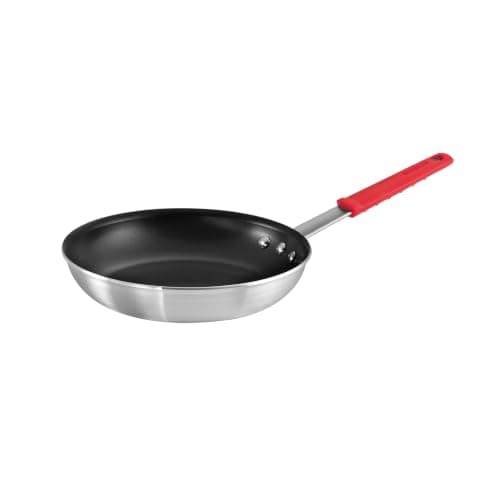
Published specifications for the Tramontina Professional Restaurant Fry Pan, 10 in
Body
Heavy-gauge aluminum
Coating
PTFE nonstick
Induction
No - aluminum body is not ferrous
Coating lifespan
Not published, by this or any nonstick maker
Good
Cheap enough that replacing it every couple of years is a real plan rather than a failure
Heavy gauge for a nonstick pan, so it does not warp on the first hot burner
Silicone handle sleeve that actually stays cool
Not good
Not induction compatible
PTFE, which some buyers will rule out on principle
No published coating lifespan, so the value case is unverifiable by design
The trade-off. It is PTFE. That is fine at normal cooking temperatures, and it is not a pan to preheat empty on high.
Skip this if. You want to avoid PTFE entirely. Buy ceramic instead and accept the shorter release life rather than pretending either one lasts forever.
Aluminum whose natural oxide layer has been thickened electrochemically, producing a surface harder than the metal underneath and non-reactive with acidic food. On a nonstick pan that anodized surface sits under the coating rather than being the cooking surface.
›Is hard-anodized cookware better than nonstick?
It is not an alternative to nonstick - most hard-anodized pans are nonstick pans with an anodized body. The anodizing improves the pan underneath the coating; the coating still wears out at the same kind of rate.
›Is hard-anodized cookware induction compatible?
Usually not. Anodized aluminum is still aluminum and is not ferrous. Several makers sell a separate induction line with a bonded steel disc on the base, and a magnet held to the bottom is the whole test.
›Can you use metal utensils on hard-anodized pans?
Only if the coating is published as metal-utensil safe, which is a property of the coating rather than of the anodizing. Calphalon publishes it for its Premier multi-layer coating; most of the category does not.
›What oven temperature can hard-anodized pans handle?
Lower than uncoated cookware. Calphalon publishes 450F for the Premier line and OXO publishes 430F. The limit comes from the coating and the handle assembly, not from the anodized body.
Sources
Every figure on this page came from one of these. Follow them and check our arithmetic — that is the point.