Heads up: some links on this page earn us a commission at no extra cost to you. It does not change what we recommend or the order. How we are funded.
The short answer
No manufacturer publishes a lifespan for a nonstick coating. Not Calphalon, not T-fal, not GreenPan, not OXO. Every other specification on a pan is available and this one is absent everywhere, which tells you it is a wear part with no defined service life. The practical consequence: buy a nonstick pan as a consumable, keep it off high heat and away from metal utensils and dishwashers, and replace it when eggs start sticking to a properly preheated, oiled pan.
The specification that does not exist
Cookware makers publish a great deal. Gauge, ply count, oven maximum, induction compatibility, dishwasher guidance, warranty term, country of manufacture, and in GreenPan's case the chemistry of the coating itself.
Not one of them publishes how long the nonstick surface will keep releasing food. That is a striking gap in a product whose entire value proposition is the coating, and it is consistent across the whole category - budget and premium, PTFE and ceramic, American and European.
The reason is straightforward: the answer depends almost entirely on use, and any number they printed would become a warranty claim. But the absence is still a fact a buyer can act on, and the action is to price a nonstick pan as stock rather than as equipment.
What actually ends a coating
Cause
How fast
Avoidable?
Metal utensils
Immediately, one gouge at a time
Yes - or buy a line published as metal-utensil safe
Preheating empty on high
Fast. PTFE degrades above roughly 500F
Yes, entirely
Dishwasher detergent
Months to a year of cycles
Yes
Aerosol cooking sprays
Builds an invisible polymerized film that will not come off
Yes - use oil from a bottle
Stacking pans without protection
Scratches from the rim of the pan above
Yes - a paper towel or felt divider
Thermal shock, hot pan into cold water
Warps the body, which lifts the coating
Yes
Ordinary correct use
Years, and nobody will say how many
No, and this is the point
Read that list and a pattern emerges: almost every fast failure mode is preventable, and the honest expectation for a well-treated pan is measured in years, not months. The pans that die in a year die of metal spatulas, high heat and dishwashers, in roughly that order.
The cooking spray problem, which nobody warns you about
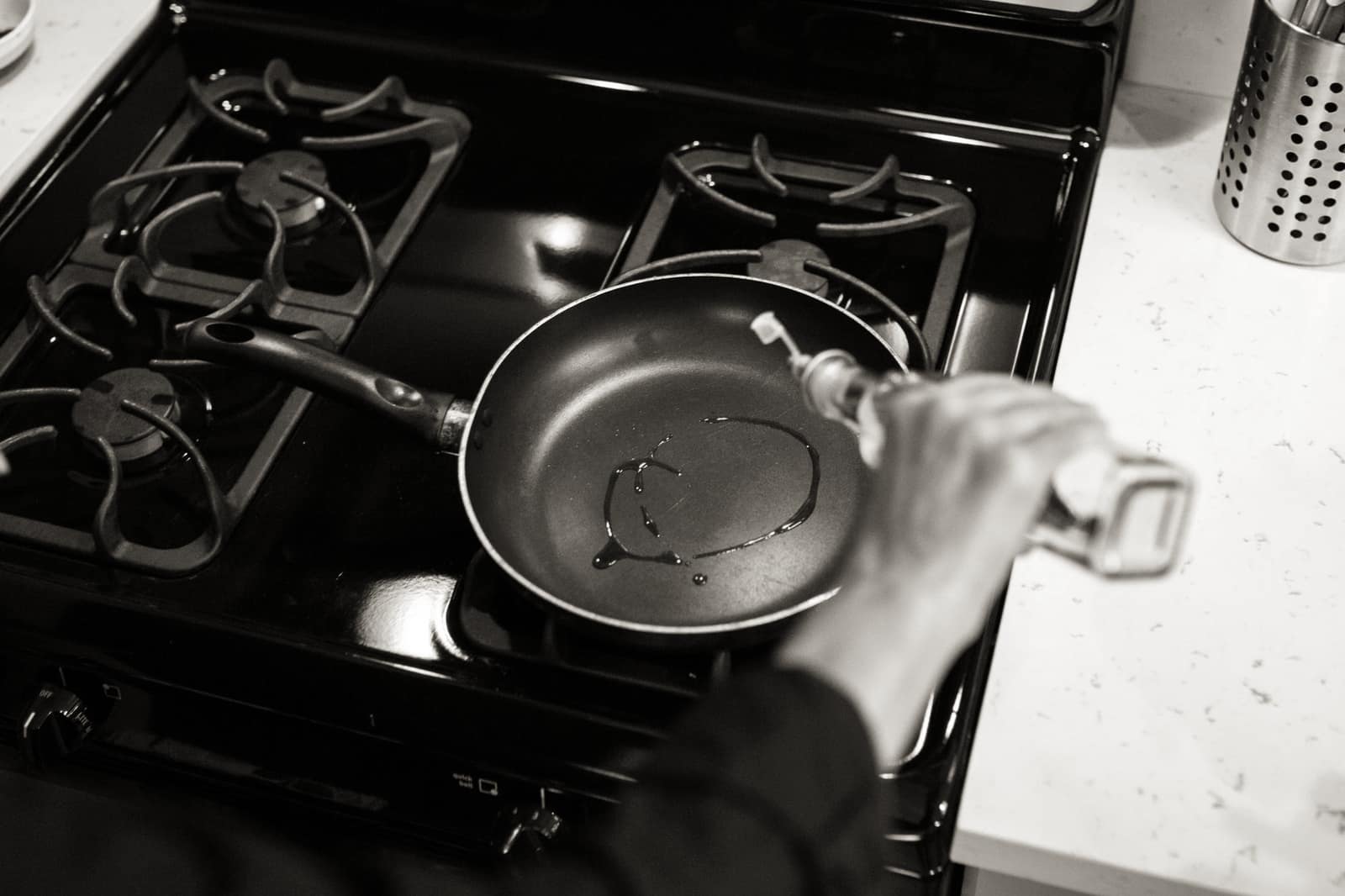
Aerosol cooking sprays contain lecithin and propellants alongside the oil. At cooking temperatures the lecithin polymerizes into a hard, tacky brown film that bonds to the coating and cannot be scrubbed off without damaging what is underneath.
The result is a pan that appears to have lost its nonstick properties when in fact it has gained a sticky layer on top of them. It is one of the most common ways a perfectly good pan gets thrown away. Use oil or butter from a bottle, in small amounts, and the problem does not exist.
If a pan has already built up this film, it is worth one attempt with a paste of baking soda and water and a soft cloth before giving up on it. Anything more abrasive will take the coating with it.
The single highest-value change is the utensil drawer. Wood and silicone cost almost nothing and remove the fastest failure mode entirely.
How to tell when it is finished
There is a real test and it removes the guesswork. Preheat the pan properly over medium heat, add a small amount of oil, and cook an egg without any other fat.
Slides freely: the pan is fine, whatever it looks like. Discoloration and light surface marks are cosmetic.
Sticks in patches: the coating is going. Keep the pan for things you do not need release for, and buy a replacement before the next holiday.
Sticks everywhere, or bare metal is visible: finished. A pan with exposed substrate is no longer doing the one job it exists for.
Flaking: replace it now. Flakes of coating in food are not considered a serious hazard - PTFE passes through unchanged - but a flaking pan is a pan whose surface has structurally failed.
Sol-gel ceramic coatings do not usually scratch off the way PTFE does. They lose release gradually as the surface chemistry changes with heat cycling, which is why a ceramic pan often looks perfect and stops working.
Every account of the two materials agrees on the direction - ceramic gives up release sooner - and none of it is documented by any maker. GreenPan publishes what Thermolon is made of and rates the coating to 850F, and publishes nothing about how long it releases. The head-to-head is in PTFE versus ceramic nonstick.
What a lifetime warranty covers, and what it does not
Essentially every nonstick pan sold with a lifetime warranty excludes coating wear from that warranty. Calphalon's lifetime cover is on the pan, not the surface. The exclusion is not hidden - it is written plainly - and it is worth reading before treating warranty length as a durability signal.
What that leaves covered is the body, the handle and manufacturing defects, which are not what fails. The general form of this trap is in cookware set buying mistakes.
The buying strategy this implies
Own one or two nonstick pans, not a set. Coating is only useful for eggs, fish and pancakes. A coated stock pot is a wear item bolted to a piece that would otherwise last forever - the argument in best nonstick cookware sets.
Either buy cheap and replace, or buy metal-utensil safe. Both are coherent. Buying expensive and then treating it badly is not.
Keep it off high heat. Nonstick is a medium-heat tool. If you want a hard sear, that is a job for stainless or cast iron.
Hand wash it. Even where the maker says dishwasher safe, the detergent shortens the life of the surface.
Three coated pans and the one that never wears out
Pick a strategy: cheap and replaced, metal-utensil safe and kept longer, or no coating at all and a proper preheat.
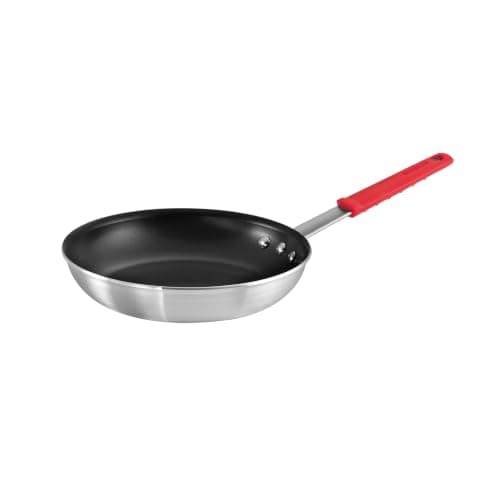
Tramontina Professional Restaurant Fry Pan, 10 in
Eggs, pancakes and fish, in a kitchen that also owns a stainless or iron pan
These are the products this page's reasoning actually points at. Same rules as everywhere else on the site: published specs, a stated trade-off, and a live price only where one exists.
Top pick · Best pan to treat as a consumableSpecs read September 3, 2026
Tramontina Professional Restaurant Fry Pan, 10 in
Cheap enough that replacing it every couple of years is a plan rather than a failure, which is the correct relationship to have with a coating.
Best for: Eggs, pancakes and fish, in a kitchen that also owns a stainless or iron pan
Published specifications for the Tramontina Professional Restaurant Fry Pan, 10 in
Body
Heavy-gauge aluminum
Coating
PTFE nonstick
Induction
No - aluminum body is not ferrous
Coating lifespan
Not published, by this or any nonstick maker
Good
Cheap enough that replacing it every couple of years is a real plan rather than a failure
Heavy gauge for a nonstick pan, so it does not warp on the first hot burner
Silicone handle sleeve that actually stays cool
Not good
Not induction compatible
PTFE, which some buyers will rule out on principle
No published coating lifespan, so the value case is unverifiable by design
The trade-off. It is PTFE. That is fine at normal cooking temperatures, and it is not a pan to preheat empty on high.
Skip this if. You want to avoid PTFE entirely. Buy ceramic instead and accept the shorter release life rather than pretending either one lasts forever.
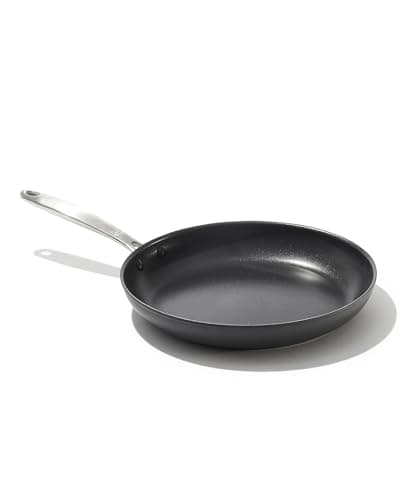
Published specifications for the OXO Good Grips Pro Hard-Anodized Nonstick Fry Pan, 10 in
Body
Hard-anodized aluminum
Coating
Three-layer PTFE nonstick, published PFOA-free
Oven maximum
430F published for the line
Induction
No on the standard hard-anodized line
Dishwasher
Dishwasher safe
Edge
Rolled, for pouring without dripping down the side
Coating lifespan
Not published
Good
The rolled pour edge is a small thing you notice every single time you use it
The hard-anodized body resists the denting that ruins cheap aluminum pans
Handle stays cool and does not rotate the way riveted plastic ones eventually do
Not good
Not induction compatible
Oven ceiling capped by the handle, not the pan
Still a coating, still a consumable, still no published lifespan
The trade-off. The handle that makes it comfortable is a stainless-and-silicone assembly, and that is what caps the oven rating below the body's own limit.
Skip this if. You need induction. The standard hard-anodized body is not ferrous.
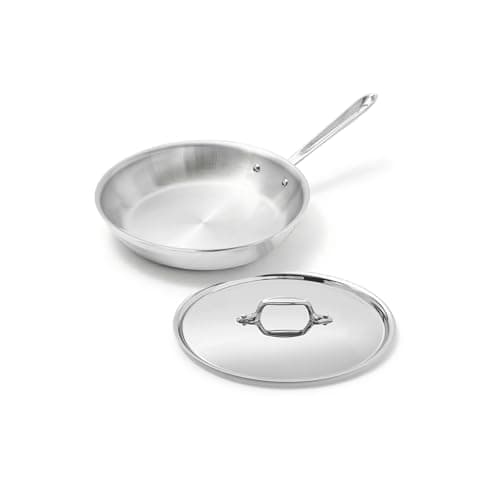
Published specifications for the All-Clad D3 Stainless 10 in Fry Pan
Construction
Fully bonded tri-ply, aluminum core
Oven maximum
600F, oven and broiler safe
Induction
Yes - compatible with any stovetop
Dishwasher
Handwash only (All-Clad published)
Handle
Double-riveted stainless
Weight
3.0 lb (model 4110)
Warranty
Limited lifetime
Made in
Bonded, engineered and assembled in Canonsburg, PA
Good
600F is the highest oven ceiling of any stainless pan on this site
The one pan here whose manufacturing location is published down to the town
Genuinely repairable-adjacent: rivets are the only failure point and the warranty covers them
Not good
Hand wash only
The flared rim makes it a poor pan for anything with liquid
Costs several times what a Tramontina or Cuisinart pan of the same construction costs
The trade-off. Hand wash only. All-Clad publishes that plainly, and it is a real daily cost on a pan you will use every day.
Skip this if. You want a dishwasher-safe pan, or you are buying a whole kitchen on a fixed budget - one D3 skillet costs what a full clad set can cost.
No manufacturer publishes a figure - not Calphalon, T-fal, GreenPan or OXO. A well-treated pan kept off high heat, away from metal utensils and out of the dishwasher lasts years; the pans that fail within a year almost always fail for one of those three reasons.
›When should you throw away a nonstick pan?
When a properly preheated, lightly oiled pan can no longer cook an egg without sticking, or when the coating is flaking or bare metal is showing. Discoloration and light surface marks on their own are cosmetic and not a reason to replace it.
›Does cooking spray ruin nonstick pans?
Yes. Aerosol sprays contain lecithin that polymerizes into a hard, tacky film bonded to the coating. The pan appears to have lost its release when in fact it has gained a sticky layer. Use oil or butter from a bottle instead.
›Does a lifetime warranty cover a worn nonstick coating?
Almost never. Essentially every lifetime warranty in the category excludes coating wear, which is the only thing that actually fails. What is covered is the body, the handle and manufacturing defects.
›Does ceramic nonstick last as long as PTFE?
Generally not. Ceramic coatings tend to lose release gradually through heat cycling rather than scratching off, so a ceramic pan often looks perfect and stops working. No maker publishes figures for either material.
Sources
Every figure on this page came from one of these. Follow them and check our arithmetic — that is the point.