Heads up: some links on this page earn us a commission at no extra cost to you. It does not change what we recommend or the order. How we are funded.
The short answer
Carbon steel — closest thing to a permanent nonstick surface. Costs you seasoning maintenance.
Cast iron — same surface, more thermal mass, far heavier.
Clad stainless — zero maintenance, lasts forever. Costs you preheating technique.
Ceramic coated — still a coating, but not a fluoropolymer. Wears faster than PTFE.
Keep one coated pan for eggs and fish. This is the answer for most kitchens.
First, be clear what you are replacing
People give up coated pans for three different reasons, and the right replacement depends entirely on which one applies.
You object to the chemistry. Then ceramic or a bare metal pan. A hard-anodized PTFE pan does not address it - is hard-anodized cookware safe.
You are tired of the replacement cycle. Then bare metal only. Any coating, including ceramic, is a wear surface - how long nonstick lasts.
You want better cooking. Then stainless or carbon steel, because browning is the thing coated pans are worst at.
Reason two is the one where people most often buy the wrong thing, switching from PTFE to ceramic and finding themselves back on the same treadmill sooner.
The four options, honestly compared
Carbon steel
Cast iron
Clad stainless
Ceramic coated
Releases eggs
Yes, once seasoned
Yes, once seasoned
With technique and fat
Yes, when new
Lasts indefinitely
Yes
Yes
Yes
No
Maintenance
Dry and oil
Dry and oil
None
None
Weight, 10 inch
Moderate
Heaviest
Moderate
Lightest
Acidic food
Short only
Short only
Unlimited
Unlimited
Heat tolerance
Unlimited
Unlimited
Very high
Lowest
Browning and searing
Excellent
Excellent
Excellent
Poor
Learning curve
Real
Real
Real
None
Only one column has no 'no' in it, and it is the one that asks most of the cook.
Carbon steel, which is the answer more often than people expect
This is the closest thing to a permanent nonstick pan. Seasoning is polymerized oil bonded to bare steel: it releases eggs well once established, it survives any heat, it takes metal utensils, and if you ruin it you scrub it back and rebuild it. There is no coating to fail, so there is no replacement cycle.
It weighs substantially less than cast iron and responds to heat changes faster, which makes it the better everyday pan of the two. A pre-seasoned pan removes the step that makes most people abandon the material - best carbon steel pans and seasoning carbon steel.
The same seasoned surface with much more thermal mass, which makes it better for searing and worse for everything requiring responsiveness. The honest obstacle is weight - a twelve-inch skillet is heavy enough that plenty of people stop using it - is cast iron worth it.
Clad stainless, if you will learn one thing
No coating, no seasoning, no reactivity, no replacement cycle, works with any utensil, goes in the dishwasher, takes any heat. The most genuinely permanent option on this page and the lowest maintenance.
The single skill it requires is preheating properly and adding fat at the right moment. Food sticks to stainless for a reason that is entirely learnable, and once learned it stays learned - why food sticks to stainless steel.
What it will not do is a delicate omelette or a thin fish fillet as easily as a coating. Be honest about whether you cook those.
Ceramic, with clear eyes
Ceramic nonstick is a silica-based sol-gel coating rather than a fluoropolymer, so it answers a chemistry objection. It does not answer a replacement-cycle objection, because it is still a coating and it generally loses release faster than PTFE - PTFE versus ceramic nonstick.
Bought with that understanding it is a reasonable purchase. Bought as a permanent solution it disappoints - is ceramic cookware worth it.
Carbon steel is the material most often reached for by people leaving coated pans, and the one they most often had not considered.
The realistic answer for most kitchens
Do not replace all of it. Replace the pans a coating was never earning its place in, and keep one small coated pan for the two or three jobs it genuinely wins.
Your main skillet becomes carbon steel or clad stainless. This is where most cooking happens and where a coating does least for you.
Your saucepans become clad stainless. Nothing sticks in liquid, so a coated saucepan was always a wear surface doing very little - best nonstick saucepans makes that case.
That leaves you with one consumable instead of a whole kitchen of them, which is the actual goal behind most of these searches. What you actually need makes the five-piece argument, and what to do with old cookware covers disposing of what you are replacing.
The four replacements, in the order most people should consider them
Listed by how completely each escapes the replacement cycle, not by price.
No photo
Lodge Seasoned Carbon Steel Skillet, 12 in
A first carbon steel pan, bought to find out whether you like the material
These are the products this page's reasoning actually points at. Same rules as everywhere else on the site: published specs, a stated trade-off, and a live price only where one exists.
Top pick · The closest replacementSpecs read September 3, 2026
No photo
Lodge Seasoned Carbon Steel Skillet, 12 in
Pre-seasoned carbon steel arrives usable, weighs far less than cast iron, and its release surface is oil you can always rebuild.
Best for: A first carbon steel pan, bought to find out whether you like the material
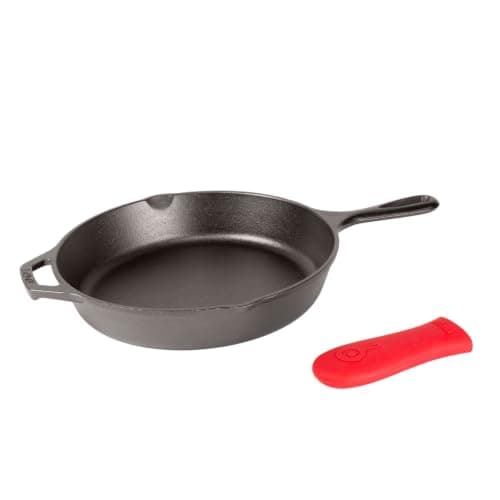
Published specifications for the Lodge Seasoned Cast Iron Skillet, 10.25 in (L8SK3)
Diameter
10.25 in
Weight
5.66 lb
Oven maximum
550F
Induction
Yes - bare iron is ferrous
Seasoning
Pre-seasoned with soy-based vegetable oil, no synthetic chemicals
Warranty
Lifetime
Made in
USA
Care
Hand wash. Lodge's own instructions permit warm soapy water
Good
Effectively unbreakable and fully restorable - a rusted one can be stripped and re-seasoned
Holds heat better than anything else at the price, which is what a sear needs
Lodge publishes its seasoning method openly, so the maintenance is not a mystery
Not good
Heavy
Heats unevenly on a small burner: cast iron conducts at roughly 50 W/m-K, so it is slow to spread and slow to react
Bare iron is reactive; long tomato braises will taste of it
The trade-off. It weighs 5.66 lb empty. You will feel that every time you move it full, and it is the single most common reason a cast iron skillet ends up in a cupboard.
Skip this if. You have wrist or shoulder trouble, or you cook mostly acidic braises. Carbon steel does most of the same jobs at roughly half the weight.
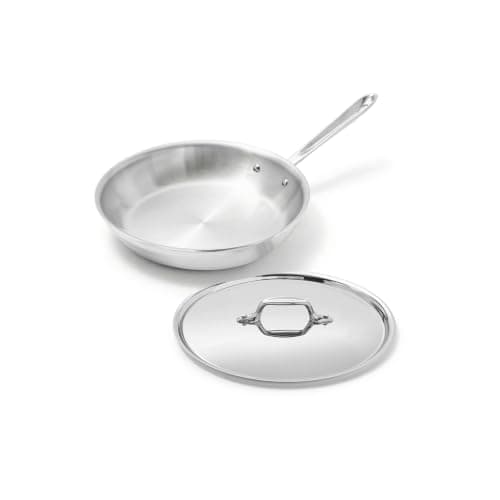
Published specifications for the All-Clad D3 Stainless 10 in Fry Pan
Construction
Fully bonded tri-ply, aluminum core
Oven maximum
600F, oven and broiler safe
Induction
Yes - compatible with any stovetop
Dishwasher
Handwash only (All-Clad published)
Handle
Double-riveted stainless
Weight
3.0 lb (model 4110)
Warranty
Limited lifetime
Made in
Bonded, engineered and assembled in Canonsburg, PA
Good
600F is the highest oven ceiling of any stainless pan on this site
The one pan here whose manufacturing location is published down to the town
Genuinely repairable-adjacent: rivets are the only failure point and the warranty covers them
Not good
Hand wash only
The flared rim makes it a poor pan for anything with liquid
Costs several times what a Tramontina or Cuisinart pan of the same construction costs
The trade-off. Hand wash only. All-Clad publishes that plainly, and it is a real daily cost on a pan you will use every day.
Skip this if. You want a dishwasher-safe pan, or you are buying a whole kitchen on a fixed budget - one D3 skillet costs what a full clad set can cost.
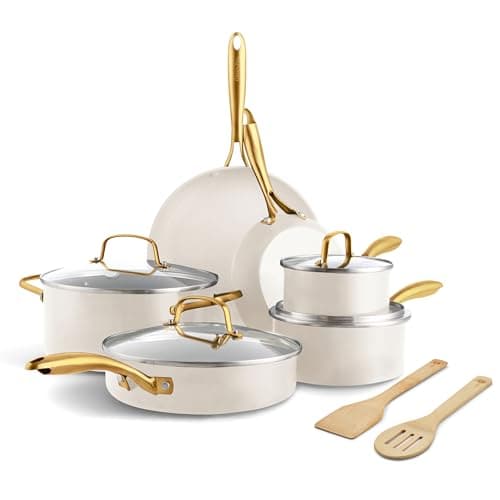
Published specifications for the GreenPan Ceramic Nonstick Cookware Set
Coating
Thermolon, from sand-derived Silicon Dioxide (SiO2), sprayed
Coating chemistry
PFAS-free, PFOA-free, free of lead and cadmium (GreenPan published)
Coating heat resistance
850F / 450C for the coating itself (GreenPan published)
Body oven maximum
Varies by line and is lower than the coating figure - check the specific line
Coating lifespan
Not published. No ceramic maker publishes one
Good
GreenPan publishes what the coating is made of in plain terms, which most ceramic brands do not
The coating will not release fumes if you overheat it the way PTFE can
Genuinely good release when new
Not good
Release degrades and nobody will tell you how fast
The 850F figure is for the coating, not the pan, and gets quoted as if it were the pan
Ceramic dislikes high heat and dishwashers, which is most of what a set gets used for
The trade-off. Ceramic nonstick loses release with use and no maker publishes a lifespan, GreenPan included. Treat it as a consumable, not a lifetime purchase.
Skip this if. You are buying a set expecting it to last as long as clad stainless. It will not, and the honest move is to buy one ceramic pan alongside a stainless set.
Carbon steel, for most people. Its seasoned surface releases eggs well, it takes any heat and any utensil, it weighs far less than cast iron, and because the surface is oil you apply yourself it can always be rebuilt. The cost is about thirty seconds of drying and oiling after each wash.
›Is stainless steel a good replacement for nonstick?
Yes, if you will learn to preheat it. Clad stainless has no coating, needs no seasoning, handles acidic food, survives the dishwasher and lasts indefinitely. It will not do a delicate omelette or thin fish as easily as a coating, so many kitchens keep one small coated pan for those.
›Is ceramic cookware a good replacement for nonstick?
It answers a chemistry objection, because ceramic is a silica-based coating rather than a fluoropolymer. It does not answer a replacement-cycle objection - it is still a coating and generally loses release faster than PTFE does.
›Do I have to replace all my nonstick pans at once?
No, and it is usually the wrong approach. Replace the pans where a coating was doing little work - the main skillet and the saucepans - and keep one small cheap coated pan for eggs, crepes and delicate fish. That leaves one consumable rather than a kitchen full of them.
›What replaces nonstick for eggs specifically?
Well-seasoned carbon steel gets there, but it takes weeks of regular cooking rather than one session. Until then, and honestly for many cooks permanently, a small inexpensive coated pan kept only for eggs is the pragmatic answer.
Sources
Every figure on this page came from one of these. Follow them and check our arithmetic — that is the point.