Heads up: some links on this page earn us a commission at no extra cost to you. It does not change what we recommend or the order. How we are funded.
The short answer
Cast iron and carbon steel: restore it. Rust and stripped seasoning are both fixable, and a restored pan is better than a new one.
Clad stainless and bare aluminum: recycle as scrap metal. Both are valuable and widely accepted at scrap yards.
Anything still usable: donate or sell. Enameled cast iron in particular has a real secondhand market.
Coated pans: the hard case. Mixed materials mean most curbside programs refuse them; check locally, and buy fewer of them instead.
First: is it actually finished?
A large share of discarded cookware is not broken. Discoloration, rainbow staining, burnt-on residue and rust all look terminal and none of them are - the full list of what ends a pan against what merely looks bad is in when to replace your cookware.
Before disposing of anything, check it against three questions. Does it sit flat? Is the handle sound? Is the surface intact - meaning no flaking coating, no chipped enamel exposing iron inside the pot, no pitting through a stainless interior? If all three are yes, the pan is not finished and this page is the wrong one for it.
Restore: cast iron and carbon steel
These two materials essentially do not die. A pan found rusted solid in a garage restores to better than new, because the surface you cook on is polymerized oil that you rebuild rather than a manufactured coating you cannot. The full process is in restoring rusty cast iron, and it applies to carbon steel almost unchanged.
Only three faults genuinely end a cast iron pan: a crack, a hole, or a warp severe enough that it spins on a flat cooktop. Everything else is an afternoon of work. If you do not want the project, this is exactly the sort of pan somebody else does - secondhand cast iron sells readily, and vintage pieces sell for real money, as covered in the vintage buying guide.
Donate or sell: anything still usable
Charity shops, thrift stores, refugee resettlement and household-goods programs, shelters and community kitchens all take cookware, and a working pan is far more useful to them than the scrap value it would fetch.
Item
Donate?
Sell?
Clad stainless in good order
Yes, readily accepted
Modest value unless a premium brand
Enameled cast iron, no interior chips
Yes
Yes - a genuine secondhand market exists
Bare cast iron, even rusty
Yes, if a program restores
Yes - collectors buy rusty pans deliberately
Bakeware, uncoated
Yes
Rarely worth listing
Coated pans with intact release
Sometimes - many programs decline
No
Coated pans that are flaking
No
No
Anything with a loose handle
No - it is a hazard
No
The rule most programs apply is whether they would cook in it themselves. A flaking coated pan fails that test everywhere.
Call before you drive. Cookware acceptance varies enormously between organizations, and a program that takes clad stainless may refuse anything coated on principle.
Recycle: the metal is worth something
Bare metal cookware is a straightforward scrap item, and scrap yards will usually take it by weight without much ceremony.
Cast iron is ferrous scrap and accepted everywhere.
Clad stainless is valuable scrap, though the aluminum core means it may be sorted as mixed metal.
Bare and anodized aluminum bakeware is aluminum scrap, and aluminum is one of the most worthwhile materials to recycle.
Carbon steel is ferrous scrap.
Enameled cast iron is usually accepted as ferrous scrap; the enamel is a contaminant but a tolerated one.
What almost never works is the curbside bin. Household recycling programs are built around packaging, and a cast iron skillet or a clad pan is neither the right shape nor the right sorting category. Take it to a scrap yard or a household recycling center instead, and check first whether they want handles removed.
The coated pan problem, stated plainly
This is the one category with no good ending, and it is worth being honest about it rather than offering a cheerful answer that does not exist.
A nonstick pan is an aluminum body, a fluoropolymer or ceramic coating, a riveted handle of a different material, and often a silicone sleeve. That mix is exactly what recycling streams are bad at. Most curbside programs refuse them outright; some scrap yards accept them as low-grade aluminum; a few manufacturers and retailers run take-back schemes worth checking for.
The realistic options, in order:
Check for a manufacturer or retailer take-back program. Several exist and they are the cleanest answer when they do.
Ask a local scrap yard whether they take coated aluminum. Some do.
Remove the handle if it detaches and present the body as aluminum scrap.
Landfill, which is where most of them go, and which is the argument for the point below.
The uncomfortable conclusion is upstream rather than downstream. Because no manufacturer publishes a coating lifespan - a silence examined in how long nonstick lasts - a coated pan is a consumable with an unknown replacement interval and a poor disposal route. Owning one cheap coated pan alongside permanent cookware produces far less waste than owning a coated set you replace every few years, which is the case made in mixed-material cookware sets.
Second uses before disposal
A pan that is finished for cooking is not always finished. A warped sheet pan makes a perfectly good drip tray or a shelf for potting; an old skillet with a sound handle becomes a camp pan where a warp on a domestic hob does not matter; a chipped enameled pot is a planter with drainage already provided by the chip.
The one thing not to repurpose is a flaking coated pan for food use of any kind, including as a pet dish.
Buying so this happens less
Buy materials with no wear surface where you can - clad stainless, bare iron, uncoated aluminum bakeware.
Buy coated pans cheap and singly, not as sets, because you will be doing this again.
Check the warranty before disposing, since loose handles and delaminating bases are exactly what those terms cover - cookware warranties explained.
Buy secondhand where it makes sense, especially enameled cast iron and vintage bare iron.
Cookware grouped by how it ends
One is restored, one is resold, one is kept, and one is thrown away. Knowing which is which before you buy is most of the point of this site.
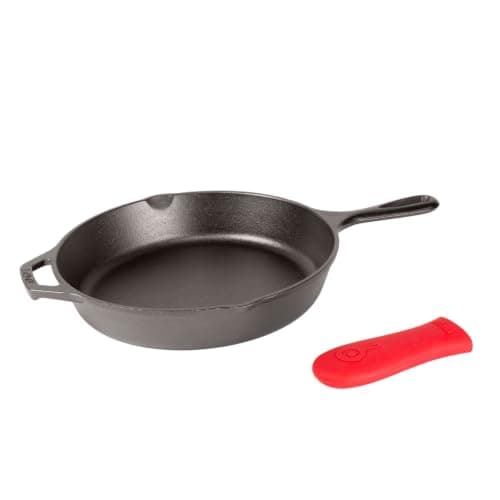
Lodge Seasoned Cast Iron Skillet, 10.25 in (L8SK3)
Searing, cornbread, and anyone who wants one pan that cannot be worn out
These are the products this page's reasoning actually points at. Same rules as everywhere else on the site: published specs, a stated trade-off, and a live price only where one exists.
Top pick · The pan that is almost never finishedSpecs read September 3, 2026
Lodge Seasoned Cast Iron Skillet, 10.25 in (L8SK3)
Rust, stripped seasoning and decades of neglect are all recoverable, so a retired cast iron pan is usually a restoration project rather than scrap.
Best for: Searing, cornbread, and anyone who wants one pan that cannot be worn out
Published specifications for the Lodge Seasoned Cast Iron Skillet, 10.25 in (L8SK3)
Diameter
10.25 in
Weight
5.66 lb
Oven maximum
550F
Induction
Yes - bare iron is ferrous
Seasoning
Pre-seasoned with soy-based vegetable oil, no synthetic chemicals
Warranty
Lifetime
Made in
USA
Care
Hand wash. Lodge's own instructions permit warm soapy water
Good
Effectively unbreakable and fully restorable - a rusted one can be stripped and re-seasoned
Holds heat better than anything else at the price, which is what a sear needs
Lodge publishes its seasoning method openly, so the maintenance is not a mystery
Not good
Heavy
Heats unevenly on a small burner: cast iron conducts at roughly 50 W/m-K, so it is slow to spread and slow to react
Bare iron is reactive; long tomato braises will taste of it
The trade-off. It weighs 5.66 lb empty. You will feel that every time you move it full, and it is the single most common reason a cast iron skillet ends up in a cupboard.
Skip this if. You have wrist or shoulder trouble, or you cook mostly acidic braises. Carbon steel does most of the same jobs at roughly half the weight.
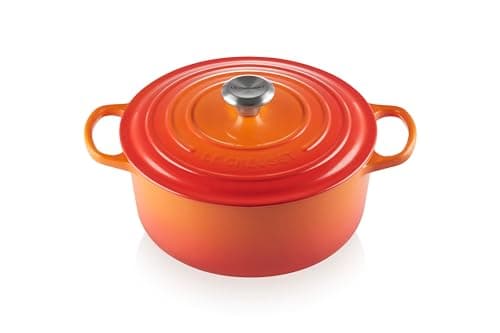
Published specifications for the Le Creuset Signature Round Dutch Oven, 5.5 qt
Material
Cast iron with porcelain enamel inside and out
Capacity
5.5 qt
Interior enamel
Sand-colored, so browning and fond stay visible
Knob
Stainless steel, rated to 500F
Induction
Yes - the iron under the enamel is ferrous
Dishwasher
Dishwasher safe; Le Creuset recommends hand washing
Warranty
Limited lifetime
Made in
France
Good
The pale interior is a genuine cooking advantage: you can see whether the fond is browning or burning
Wide, low-profile handles that a hand in an oven mitt actually fits
The one enameled pot with a real secondhand market, which changes the true cost of ownership
Not good
Costs several times a Lodge enameled pot of the same capacity
The pale interior stains permanently, and Le Creuset says so
Chipped enamel is not repairable on any enameled pot, this one included
The trade-off. You are paying a large multiple of what a Lodge enameled pot costs for a difference in enamel quality, finish and resale value rather than in cooking.
Skip this if. You braise a few times a year. The cooking difference over a Lodge enameled pot is small; the price difference is not.
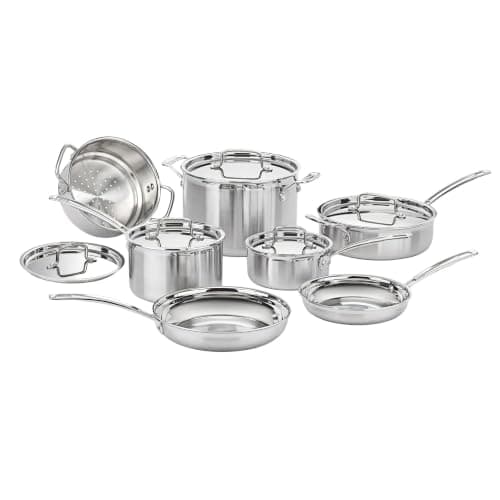
Published specifications for the Cuisinart MultiClad Pro MCP-12N 12-Piece Set
Construction
Tri-ply: 18/10 stainless interior, pure aluminum core, brushed stainless exterior
Pieces
1.5 and 3 qt covered saucepans; 8 in and 10 in skillets; 3.5 qt covered saute; 8 qt covered stockpot; steamer insert
Oven maximum
500F per the Cuisinart use-and-care manual, which the Amazon listing we cite now matches. Major retail listings still advertise 550F; Cuisinart has confirmed the manual figure
Induction
Yes
Dishwasher
Dishwasher safe
Handles
Riveted solid stainless, cool-grip profile
Warranty
Lifetime
Good
Heat runs up the sidewalls, not just across the base
Genuinely dishwasher safe, which the pricier clad brands often are not
Lifetime warranty on a set at this price
Not good
Published oven maximum contradicts the retail listing for the same product
Handle spine is divisive
No 12-inch skillet in the box, which is the pan most people reach for second
The trade-off. The cool-grip handles have a sharp spine that some people find uncomfortable on a full 8-quart stockpot.
Skip this if. You want the higher oven ceiling that major retail listings advertise. The manual says 500F and Cuisinart has confirmed the manual is correct.
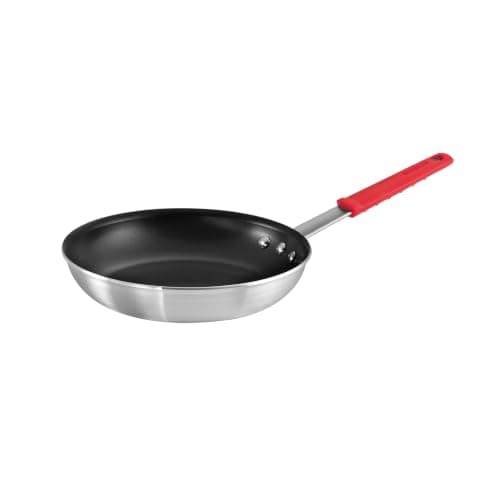
Published specifications for the Tramontina Professional Restaurant Fry Pan, 10 in
Body
Heavy-gauge aluminum
Coating
PTFE nonstick
Induction
No - aluminum body is not ferrous
Coating lifespan
Not published, by this or any nonstick maker
Good
Cheap enough that replacing it every couple of years is a real plan rather than a failure
Heavy gauge for a nonstick pan, so it does not warp on the first hot burner
Silicone handle sleeve that actually stays cool
Not good
Not induction compatible
PTFE, which some buyers will rule out on principle
No published coating lifespan, so the value case is unverifiable by design
The trade-off. It is PTFE. That is fine at normal cooking temperatures, and it is not a pan to preheat empty on high.
Skip this if. You want to avoid PTFE entirely. Buy ceramic instead and accept the shorter release life rather than pretending either one lasts forever.
Bare metal cookware, yes - cast iron, carbon steel, clad stainless and aluminum bakeware are all accepted as scrap metal by weight. What almost never works is the curbside bin, because household programs are built around packaging rather than cookware.
›How do you dispose of nonstick pans?
It is the hard case. The mix of aluminum, coating, rivets and handle materials means most curbside programs refuse them. Check for a manufacturer or retailer take-back scheme first, then ask a scrap yard about coated aluminum; landfill is where most end up.
›Is old rusty cast iron worth saving?
Almost always. Rust and stripped seasoning are both fully recoverable, and only a crack, a hole or a severe warp genuinely ends a cast iron pan. Vintage pieces are sought after and sell for real money even in rusty condition.
›Will charities take used cookware?
Many will, and a working pan is worth far more to them than its scrap value. Acceptance varies a lot between organizations, so call first. Almost none will take a coated pan whose surface is flaking.
›How do you stop replacing pans so often?
Buy materials with no wear surface - clad stainless, bare iron, uncoated aluminum bakeware - and buy coated pans cheap and one at a time rather than as sets. A coating is the only part of a kitchen with a replacement interval nobody will publish.
Sources
Every figure on this page came from one of these. Follow them and check our arithmetic — that is the point.