Heads up: some links on this page earn us a commission at no extra cost to you. It does not change what we recommend or the order. How we are funded.
The short answer
A cookware warranty covers manufacturing defects - a handle that comes loose, a base that delaminates, an enamel flaw - and almost never covers wear. "Lifetime" usually means the useful life of the product as the manufacturer judges it, not yours, and "limited" simply signals that exclusions follow. The exclusion that matters most is coating wear: Calphalon publishes a lifetime warranty that excludes it explicitly, and every other coated pan works the same way whether it says so or not.
What the words mean
Cookware warranty language is unusually consistent across brands, which makes it learnable. Four terms cover almost everything.
Term
What it actually means
Where you see it
Lifetime
The useful life of the product as the maker judges it, not your lifetime
Cuisinart, Lodge, Tramontina, Nordic Ware, USA Pan
Limited lifetime
Same duration, with a written list of exclusions
All-Clad, Le Creuset, Staub, Cuisinart enameled
Limited (a number of years)
A fixed term, after which nothing is covered
Common on budget coated lines
Against manufacturing defects
Faults present at manufacture only - never wear, never misuse
Effectively every warranty here, whatever the headline says
Every term in this table is from the published warranty language of a brand in the product ledger.
The distinction between "lifetime" and "limited lifetime" is smaller than it looks. Both are defect warranties. The word "limited" signals that exclusions are written down, and brands that omit it still exclude the same things - they simply put them further into the document.
What is actually covered
Handles that loosen, crack or detach where the rivets or welds were faulty. This is the most commonly honored claim in cookware.
Base separation on a disc-bottom pan - delamination is a manufacturing failure by definition.
Enamel flaws present from new: bubbles, thin spots, glaze faults visible before use.
Warping under normal use, though "normal" is doing heavy lifting there and empty-pan preheating on high is not it.
Bakeware structural failure: a rim separating, a seam splitting.
What is excluded, everywhere
The exclusions are more consistent than the coverage, and they are why so many claims fail.
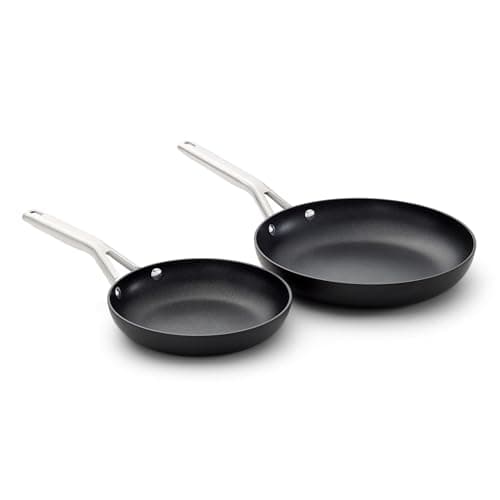
Coating wear. The single most important exclusion in the category. Calphalon publishes lifetime coverage excluding coating wear; every other nonstick warranty excludes it too. Since coating wear is the only thing that ever ends a nonstick pan, a lifetime warranty on nonstick is functionally a warranty on the handle. This connects directly to the fact that no maker publishes a coating lifespan.
Overheating. Every brand excludes damage from an empty pan on high heat, which is also the most common real-world cause of warping and coating failure. The published ceilings are collected in oven-safe cookware temperatures.
Dishwasher use where the maker said not to. Washing an All-Clad pan or a USA Pan tin in a machine is outside published guidance, and what is dishwasher safe lists who says what.
Chipped enamel from impact. Dropping it, knocking it in a rack, or metal utensils on enamel are all excluded.
Cosmetic change. Staining, discoloration, rainbow marks, dulled exteriors. Le Creuset publishes that pale interiors stain permanently, and that is a statement about the product rather than a defect.
Commercial use. Most domestic warranties are void in a restaurant, which matters if you are buying restaurant-supply lines for home.
How claims actually work
Three things decide whether a claim succeeds, and only one of them is the fault itself.
Proof of purchase
Most brands ask for it, and a lifetime warranty with a receipt requirement is a receipt-retention exercise. Photograph the receipt when the pan arrives and keep it with the online order record, which most people already have permanently.
Registration
Some brands ask you to register within a window. Registration rarely creates coverage that did not exist, but it does remove the receipt argument later.
Transferability
Cookware warranties are almost always for the original purchaser only. That makes a warranty worthless on a secondhand pan - which matters most for enameled cast iron, where the secondhand market is real and worth using anyway, as noted in best enameled Dutch ovens.
A warranty claim is a replacement, not a refund, in virtually every case, and the brand chooses the replacement item. If the line has been discontinued you get the current equivalent, which may not match the rest of your set.
What the brands in our ledger publish
Brand
Published warranty
The exclusion that matters
All-Clad
Limited lifetime
Handwash-only guidance sits alongside it
Cuisinart (MultiClad Pro)
Lifetime
The manual's 500F ceiling, not the listing's 550F
Tramontina
Lifetime on the Signature clad line
Oven ratings differ by SKU within the line
Lodge
Lifetime
Seasoning condition is not a defect - and is user-fixable
Le Creuset
Limited lifetime
Staining is published as permanent and normal
Staub
Limited lifetime
Knob-set oven ceiling varies by SKU
Cuisinart enameled
Limited lifetime
Rim chipping from impact
Calphalon
Lifetime, excluding coating wear
Stated plainly - the clearest wording in the category
Nordic Ware
Lifetime
Dishwasher use is advised against
USA Pan
Lifetime
Published not dishwasher safe
Recorded from each maker's published terms in the product ledger. Where a brand publishes nothing about warranty, no row is invented for it.
What this should change about your buying
Do not pay a premium for a lifetime warranty on a coated pan. It does not cover the coating. Buy coated pans on price and treat them as consumables - the reasoning is in when to replace your cookware.
Do value it on clad stainless and cast iron, where there is no excluded wear surface and the covered faults - handles, delamination - are the realistic ones.
Keep the receipt, because a lifetime warranty you cannot evidence is a marketing line.
Read the SKU, not the brand. Warranty terms, like oven ratings, vary within a brand's ranges more than buyers expect - one of the traps in cookware set buying mistakes.
Four warranties, four completely different values
One covers a set with no wear surface, one covers a pan that never needs it, one excludes the only part that fails, and one matters less than the resale market behind it.
Cuisinart MultiClad Pro MCP-12N 12-Piece Set
A cook who wants a dishwasher-safe clad set and a lifetime warranty
These are the products this page's reasoning actually points at. Same rules as everywhere else on the site: published specs, a stated trade-off, and a live price only where one exists.
Top pick · Lifetime, on a clad setSpecs read September 3, 2026
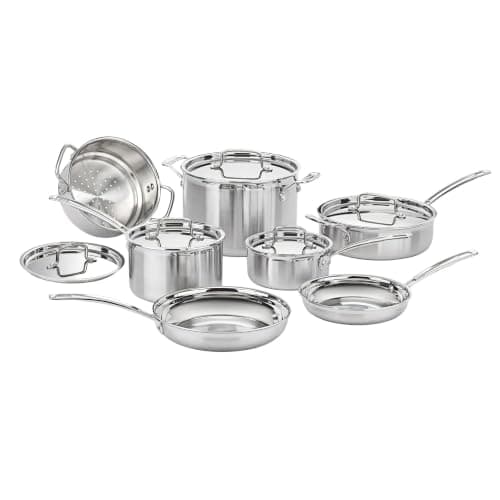
Cuisinart MultiClad Pro MCP-12N 12-Piece Set
A lifetime warranty on a fully clad set at this price is genuinely unusual, and clad stainless has no coating to be excluded.
Best for: A cook who wants a dishwasher-safe clad set and a lifetime warranty
Published specifications for the Cuisinart MultiClad Pro MCP-12N 12-Piece Set
Construction
Tri-ply: 18/10 stainless interior, pure aluminum core, brushed stainless exterior
Pieces
1.5 and 3 qt covered saucepans; 8 in and 10 in skillets; 3.5 qt covered saute; 8 qt covered stockpot; steamer insert
Oven maximum
500F per the Cuisinart use-and-care manual, which the Amazon listing we cite now matches. Major retail listings still advertise 550F; Cuisinart has confirmed the manual figure
Induction
Yes
Dishwasher
Dishwasher safe
Handles
Riveted solid stainless, cool-grip profile
Warranty
Lifetime
Good
Heat runs up the sidewalls, not just across the base
Genuinely dishwasher safe, which the pricier clad brands often are not
Lifetime warranty on a set at this price
Not good
Published oven maximum contradicts the retail listing for the same product
Handle spine is divisive
No 12-inch skillet in the box, which is the pan most people reach for second
The trade-off. The cool-grip handles have a sharp spine that some people find uncomfortable on a full 8-quart stockpot.
Skip this if. You want the higher oven ceiling that major retail listings advertise. The manual says 500F and Cuisinart has confirmed the manual is correct.
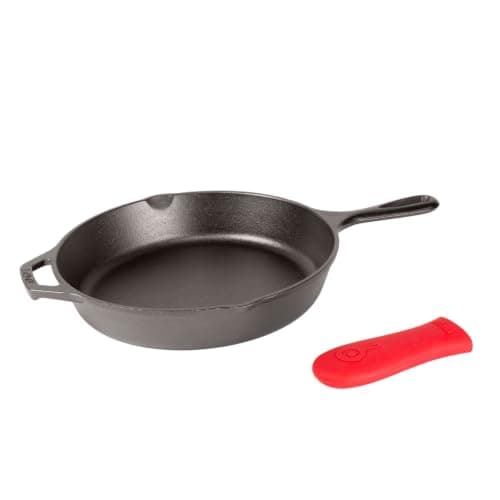
Published specifications for the Lodge Seasoned Cast Iron Skillet, 10.25 in (L8SK3)
Diameter
10.25 in
Weight
5.66 lb
Oven maximum
550F
Induction
Yes - bare iron is ferrous
Seasoning
Pre-seasoned with soy-based vegetable oil, no synthetic chemicals
Warranty
Lifetime
Made in
USA
Care
Hand wash. Lodge's own instructions permit warm soapy water
Good
Effectively unbreakable and fully restorable - a rusted one can be stripped and re-seasoned
Holds heat better than anything else at the price, which is what a sear needs
Lodge publishes its seasoning method openly, so the maintenance is not a mystery
Not good
Heavy
Heats unevenly on a small burner: cast iron conducts at roughly 50 W/m-K, so it is slow to spread and slow to react
Bare iron is reactive; long tomato braises will taste of it
The trade-off. It weighs 5.66 lb empty. You will feel that every time you move it full, and it is the single most common reason a cast iron skillet ends up in a cupboard.
Skip this if. You have wrist or shoulder trouble, or you cook mostly acidic braises. Carbon steel does most of the same jobs at roughly half the weight.
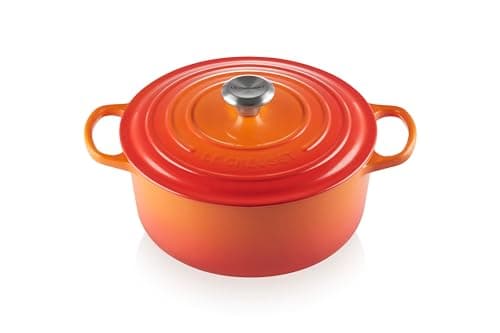
Published specifications for the Le Creuset Signature Round Dutch Oven, 5.5 qt
Material
Cast iron with porcelain enamel inside and out
Capacity
5.5 qt
Interior enamel
Sand-colored, so browning and fond stay visible
Knob
Stainless steel, rated to 500F
Induction
Yes - the iron under the enamel is ferrous
Dishwasher
Dishwasher safe; Le Creuset recommends hand washing
Warranty
Limited lifetime
Made in
France
Good
The pale interior is a genuine cooking advantage: you can see whether the fond is browning or burning
Wide, low-profile handles that a hand in an oven mitt actually fits
The one enameled pot with a real secondhand market, which changes the true cost of ownership
Not good
Costs several times a Lodge enameled pot of the same capacity
The pale interior stains permanently, and Le Creuset says so
Chipped enamel is not repairable on any enameled pot, this one included
The trade-off. You are paying a large multiple of what a Lodge enameled pot costs for a difference in enamel quality, finish and resale value rather than in cooking.
Skip this if. You braise a few times a year. The cooking difference over a Lodge enameled pot is small; the price difference is not.
›What does a lifetime cookware warranty actually cover?
Manufacturing defects for the useful life of the product as the maker judges it - loose handles, delaminating bases, enamel flaws present from new. It does not cover wear, overheating damage, impact chips or cosmetic change, and on coated pans it explicitly excludes coating wear.
›Is a nonstick pan's lifetime warranty worth anything?
Very little. Coating wear is the only thing that ends a nonstick pan and it is excluded from every warranty in the category. Calphalon publishes the exclusion plainly; the others exclude it too. Buy coated pans on price rather than on warranty.
›What is the difference between lifetime and limited lifetime?
Less than it sounds. Both are defect warranties for the product's useful life. Limited signals that exclusions are written down, but brands using the unqualified word exclude the same things.
›Do you need the receipt to claim a cookware warranty?
Usually yes. Most brands ask for proof of purchase, and warranties are almost always limited to the original purchaser and not transferable, which is why a warranty adds nothing to a secondhand pan.
›Does the dishwasher void a cookware warranty?
It can, where the maker publishes hand-wash guidance. All-Clad publishes handwash only, USA Pan publishes not dishwasher safe, and Nordic Ware advises against automatic dishwasher use. Machine washing those is outside published guidance.
Sources
Every figure on this page came from one of these. Follow them and check our arithmetic — that is the point.