Heads up: some links on this page earn us a commission at no extra cost to you. It does not change what we recommend or the order. How we are funded.
The short answer
For most kitchens, Tramontina is the brand to buy: genuinely fully clad construction at a price where most of the market sells disc-bottom, with NSF certification on its flagship set. All-Clad publishes the most - a 600F oven and broiler rating, a named factory town, and handwash-only guidance stated plainly. Lodge owns cast iron on price and documentation. Le Creuset and Staub own enameled cast iron. There is no single best brand across every material, and any page that claims otherwise is ranking marketing budgets.
Quick picks
The whole answer, on one screen. Tap a row to jump to the full write-up. Every pick below carries a stated trade-off further down — including the one at the top.
#
Product
Best for
Price
1
Tramontina Signature Tri-Ply Clad 12-Piece Set
Fully clad tri-ply with NSF certification on the flagship SKU, at a price the rest of the category charges for a disc bonded to the base.
Prices last checked October 22, 2026. Prices move constantly — the number on Amazon when you click is the real one.
How we rank a brand
We have not cooked in any of this. What we have done is read every specification sheet, use-and-care manual and warranty document these thirty companies publish, and record what they say - including what they decline to say. The method is here.
That produces a different ranking from most brand roundups, because it rewards disclosure rather than reputation. A company that publishes a gauge figure, an oven ceiling and a factory location is easier to recommend than one that publishes a lifestyle photograph, whatever the pans are like.
Four criteria, in order:
What it publishes. Construction, thickness, oven maximum, induction compatibility, dishwasher guidance, warranty terms and country of manufacture. A missing figure is a finding, not a blank.
Whether its own documents agree. Two brands here contradict themselves between a manual and a retail listing, and it is worth knowing which.
What the construction actually is. Fully clad or disc-bottom, bare metal or coated - which decides more than the badge does.
Who should skip it. Every brand here has someone it is wrong for, and a roundup that cannot say so is an advertisement.
There are no star ratings on this page or anywhere on this site, and no aggregateRating in its structured data. A score implies a test we did not run.
Brand matters less than construction
The single most useful thing to know before reading a brand roundup is that within a material, the construction question decides more than the company does. A fully clad Tramontina pan and a fully clad All-Clad pan are the same idea executed to different finishes; a disc-bottom pan from a famous brand is a worse object than a clad pan from an unglamorous one.
That is why disc bottom versus fully clad is a more important page than this one, and why we would rather you read cookware materials compared before picking a badge. Brand becomes the deciding factor only after material and construction are settled.
Clad stainless
Brand
What it publishes
Buy it if
Skip it if
Tramontina
Fully clad tri-ply, NSF on 80116-249DS, lifetime warranty, dishwasher safe
You want the most clad cookware per dollar
You cook on gas and hate hot handles
Cuisinart
Fully clad tri-ply, 500F in the manual, dishwasher safe, lifetime warranty
The dishwasher is non-negotiable
You believe the 550F on the retail listing
All-Clad
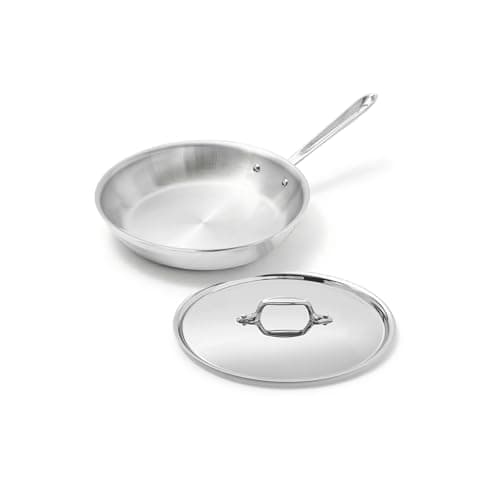
Fully bonded tri-ply, 600F oven and broiler, Canonsburg PA, handwash only
You want the highest ceiling and the most disclosure
You will not hand wash a pan
All three sell the same construction idea. The rows that differ are the paperwork and the daily cost it describes.
Tramontina is the value answer and our overall pick, because fully clad at that price is genuinely unusual and the NSF mark on the flagship SKU is a real third-party certification rather than a marketing badge. Its weakness is documentation: the same Signature line is listed at 500F on one SKU and 350F on others, with no construction difference to explain it. Buy the SKU whose listing says what you need - the full audit is here.
Cuisinart is the pick for a dishwasher household and carries a lifetime warranty, and it has its own contradiction: the manual says 500F where retail listings say 550F, and Cuisinart has confirmed the manual. Our Cuisinart review covers it.
All-Clad publishes more than anyone here and charges for it. What the premium buys is bonding consistency, finish, a 600F broiler-safe ceiling and a factory you can name - and it comes with a handwash-only instruction that a lot of buyers discover after purchase. The audit is here, and the four sets are compared directly in cookware set brands compared.
Cast iron and enameled cast iron
Brand
What it publishes
Buy it if
Skip it if
Lodge
Seasoning method, 550F range, South Pittsburg TN, lifetime warranty
You want the default first cast iron pan
Nothing, really - it is the baseline
Victoria
Seasoned cast iron, induction, made in Colombia, longer handle
A 12 in pan is at the edge of what you can lift
You want maximum heat retention per dollar
Le Creuset
France, 500F stainless knob, permanent staining, limited lifetime
You braise often and will keep it decades
You braise a few times a year
Staub
France, black matte interior, self-basting lid, limited lifetime
A stained interior would bother you
You build sauces from fond you need to see
Cuisinart (enameled)
Limited lifetime, hand wash recommended, made in China
You are finding out whether you braise
You already braise weekly
Lodge publishes a country for its cast iron and not for its carbon steel - a gap worth knowing about a brand that is otherwise unusually open.
Lodge is the cast iron answer and it is not close on value: a published seasoning method, a stated foundry and a lifetime warranty on a pan most people can buy without thinking about it. The audit is here, and Victoria is the alternative worth knowing if weight is your constraint - longer handle, lighter casting, stated origin.
In enamel, Le Creuset and Staub are the same decision in two directions: a pale interior that lets you read the fond and stains permanently, or a black matte interior that never stains and hides it. Both are French-made and both publish it. Neither cooks better than a Lodge enameled pot - what the money buys is enamel quality, handle geometry and resale value, which is set out in best enameled Dutch ovens.
Thirty audits, one pattern: the brands worth recommending are the ones that publish a number you can check against their own manual.
Carbon steel
Two brands, and they split on one specification. de Buyer publishes 3 mm at 11 inches and prints its first-use and seasoning instructions; Matfer Bourgeat publishes neither a thickness nor an oven ceiling and assumes a professional already knows.
de Buyer is the brand to buy if you want the specification that actually predicts how a pan behaves. Thickness governs heat retention and warping resistance, and almost nobody in this category states one - the audit is here.
Matfer Bourgeat is the restaurant object: bare black steel, welded handle, French manufacture, nothing on it to fail. The handle conducts heat and needs a towel, which is the trade - the audit is here.
Lodge also makes carbon steel, pre-seasoned, and this is the one place its disclosure slips: it publishes a country for its cast iron and not for the carbon steel line.
The naming confusion in this category - blue steel, black steel, carbon steel - is almost entirely about factory finish rather than material, and it is unpicked in blue steel versus black steel.
Coated pans, where every brand has the same gap
This is the category where brand ranking matters least, because all seven brands share the specification nobody publishes: how long the coating lasts. Not T-fal, not Calphalon, not OXO, not GreenPan, not Tramontina, not Circulon, not Our Place. That silence is examined in how long nonstick lasts, and it means every recommendation below is for a consumable.
Brand
Published ceiling
The reason to pick it
The catch
Calphalon
450F
Metal-utensil safe, published - almost nobody else claims it
Lifetime warranty excludes coating wear
OXO
430F
The best handle in the category, and a rolled pour edge
Ceiling capped by that handle; no metal-utensil claim
T-fal
400F
Thermo-Spot heat indicator fixes a real technique problem
Thin body warps; lowest ceiling here
GreenPan
Varies by line
Publishes a PFAS-free ceramic composition in plain terms
The 850F figure is the coating, not the pan
Tramontina
Not published
Heavy gauge and a cool handle, cheap enough to replace
Not induction compatible
Circulon
400F
Patented raised circles keep utensils off the coating
Cooking spray voids the warranty
Our Place
450F
Publishes its coating composition, and a finite 3-year warranty
Not dishwasher safe, no metal utensils
Six of these seven publish an oven ceiling. None publishes a coating lifespan, which is the figure a buyer actually wants - but two of them, Circulon and Our Place, at least attach a number to the coating in their warranty terms.
Calphalon is the pick where the utensil drawer will not be policed, because metal-utensil safety is a specific, checkable claim - the audit is here. OXO is the pick if you cook eggs daily and care how a pan feels. T-fal is the honest cheap answer, and its heat indicator is the one cookware feature on this site that solves a technique problem rather than naming a mineral.
GreenPan is the pick if avoiding PTFE is a decision you have already made, and it publishes its coating composition more clearly than any other ceramic brand. What none of them can tell you is when you will be buying the next one.
Circulon is the pick if you want the raised-surface idea without the direct-response pricing: its patented High-Low circles have been doing what a laser-etched hex grid is now marketed for, for thirty-five years. It is also the only brand here that attaches a number to a coating - a two-year coating warranty on its Halo range, against a lifetime warranty on the pan underneath. That is a warranty term rather than a predicted lifespan, and it is still the closest anyone in this table comes.
Our Place does the same thing more plainly: a finite three-year warranty on the ceramic coating rather than a lifetime one that excludes it, and a published coating composition - mainly sand derivative, water and alcohol - where the rest of this table gives you a trade name. The cost is two daily rules: the ceramic line is published as neither dishwasher safe nor metal-utensil safe.
Bakeware
Four brands, and the split here is coated against uncoated rather than premium against budget.
Nordic Ware - bare aluminum with an encapsulated steel rim and a lifetime warranty. Nothing on it can wear out, which makes it the buy-once answer for sheet pans. It does not publish a gauge, which is the one figure that would allow a like-for-like comparison. The audit is here.
USA Pan - aluminized steel with a coating published as free of PTFE, PFOA and BPA, made in Pennsylvania. That disclosure is rare in bakeware and it is why we recommend it for loaf and muffin pans, where release is genuinely hard. Published not dishwasher safe. The audit is here.
Pyrex - tempered soda-lime glass, dishwasher, microwave and freezer safe, and not broiler safe. The one genuinely carefree material in a kitchen, with a published thermal-shock rule that is a real breakage mechanism. The audit is here.
Fat Daddio's - anodized aluminum, uncoated, seamless, straight sides square to the base. The pans professional layers are baked in, and hand wash only. The audit is here.
Woks
Joyce Chen is the default and has been for decades, because the flat bottom is the adaptation that makes a wok work on a Western stove. The category-wide gap is gauge: not one wok maker publishes a thickness, so weight in the hand is the only usable proxy. The roundup is best carbon steel woks, and the honest caveat about domestic burners is in stir frying without a wok.
How to tell a manufacturer from a badge
A large share of the cookware brands with the highest search volume are not manufacturers at all. They are marketing companies that commission pans from contract factories, put a name on them and sell them direct. That is not inherently bad - plenty of good products are made that way - but it changes what a brand name tells you, and it explains why so many of them publish so little.
Four questions separate a company that makes cookware from one that orders it:
Does it name a factory or a country? All-Clad publishes Canonsburg, Pennsylvania. Lodge publishes South Pittsburg, Tennessee. Le Creuset and Staub publish France, Victoria publishes Colombia, USA Pan publishes Greater Pittsburgh. A brand that will not state a country is usually buying from whoever quoted lowest this season, and the pan you receive next year may not be the one reviewed this year.
Does the range hold together? A manufacturer's line shares a construction, a handle design and a rating. A badge's range is often a collection of unrelated factory catalog items - a clad set beside a stamped aluminum coated set beside a stone-effect pan - with nothing in common but the logo.
Does it publish an oven ceiling and a warranty with exclusions? Both require someone to have taken responsibility for a specification. A badge tends to publish adjectives instead: premium, professional, restaurant-grade.
Does the marketing lead with a finish name? Marble, granite, stone, titanium, diamond and copper-colored are appearance and filler descriptions rather than materials, and a listing that leads with one and answers none of the questions above is telling you which kind of company you are dealing with. Marble and granite coated cookware unpicks that vocabulary.
None of this means a rebadged pan is a bad buy. It means the badge is not carrying information, so judge the pan on its published construction and price it as a commodity - which for a coated pan is the right approach regardless of who made it.
What nobody publishes
Reading thirty brands the same way surfaces a pattern worth stating on its own, because it is the same gap every time.
Specification
Who publishes it
Who does not
Nonstick coating lifespan
Nobody, in any category
Every coated brand here
Gauge or thickness
de Buyer (3 mm at 11 in)
Nordic Ware, every wok maker, Matfer
Country of manufacture
All-Clad, Le Creuset, Staub, Lodge (cast iron), Victoria, USA Pan, Matfer
Tramontina (SKU to SKU), Cuisinart (manual against listing)
Third-party certification
Tramontina (NSF on one SKU)
Everyone else
The first row is the one that should change how you buy. A category where nobody states a lifespan is a category to buy cheaply and replace.
The ten newest audits
Ten brands were added to this cluster on September 12, 2026, read against the same checklist as everything above. Three patterns came out of them: the premium clad tier publishes almost everything, the direct-to-consumer brands publish thickness but not origin, and the coated brands publish chemistry but not lifespan.
Brand
The one thing it publishes that others do not
The gap
Demeyere
Fifteen specifications including cold resistance, and welded handles
A 500F ceiling it does not explain
Hestan
A 1050F ceiling, per-size induction contact areas, nickel-free
Three percentages with no test method
Made In
2.7 mm thickness and a 7.5 in cooking surface, made in Italy
Five layers counted, not named
Misen
Every one of five layers named, at 3.0 mm
No country of manufacture
Viking
The 304 grade of its cooking surface
Origin published only as "imported"
Scanpan
A rivetless handle and Danish manufacture, on a coated pan
No coating composition, no PFAS statement
Zwilling
Clad construction under ceramic, made in Vietnam
A 400F ceiling, and no warranty terms
Caraway
Third-party PFAS testing with linked results
Published NOT dishwasher safe
HexClad
Metal-utensil safety on a coated pan
A 900F claim, and a seasoning clause in the warranty
Carote
Nothing verifiable from a first-party source
That is the finding
Read down the middle column and then the right-hand one. Every brand here publishes something useful and withholds something else; no company on this page discloses everything.
Plenty of well-known names are absent from this page, and the reason is the method rather than a verdict. We only write about products whose specifications we have read from the manufacturer, and we do not test cookware. A brand we have not audited gets no entry here rather than a guess.
If you are weighing a brand that is not on this list, the questions on this page still work: does it publish a construction description, an oven ceiling, a warranty with its exclusions written down, and a country of manufacture? A company that answers all four is telling you something. A listing that leads with a finish name and answers none of them is telling you something too - nonstick coating names decoded covers how those names are built.
Which brand to buy
One brand for a whole kitchen:Tramontina, in the NSF-certified SKU.
You want the highest ceiling and the most disclosure:All-Clad, bought open stock rather than as a set.
Your first cast iron pan:Lodge, and there is no close second on value.
A pot for decades:Le Creuset or Staub, depending on which interior you want.
A coated pan: whichever is cheapest among Calphalon, OXO, T-fal and Tramontina that fits your stove - because none of them will tell you how long it lasts.
The four brand picks on this page
One for a whole kitchen, one for documentation, one for cast iron, one for a pot you keep. Every other brand here is a specialist answer rather than a starting point.
Each write-up below gives the published specs, what the pan is genuinely good at, what it costs you, and who should skip it. The trade-off line is there on the top pick too — a recommendation with no downside is an advertisement.
Top pick · Best cookware brand overallSpecs read September 3, 2026
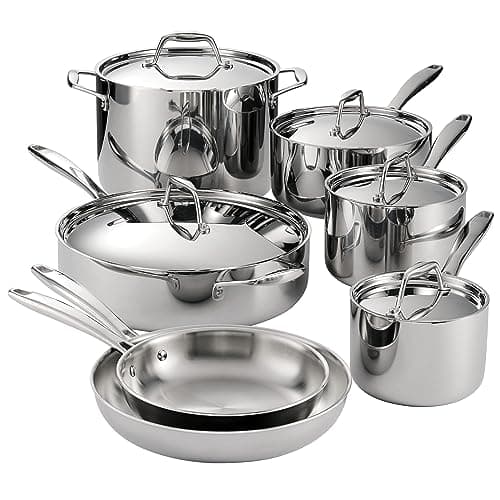
Tramontina Signature Tri-Ply Clad 12-Piece Set
Fully clad tri-ply with NSF certification on the flagship SKU, at a price the rest of the category charges for a disc bonded to the base.
Best for: A first kitchen that should not need replacing
Published specifications for the Tramontina Signature Tri-Ply Clad 12-Piece Set
Construction
Tri-ply: 18/10 stainless, aluminum core, magnetic stainless exterior
Pieces
8 in and 10 in fry pans; 1.5, 2 and 3 qt covered saucepans; 5 qt covered deep saute; 8 qt covered stockpot
Oven maximum
500F on the 80116-249DS listing; other SKUs in the line are listed at 350F
Induction
Yes - magnetic stainless exterior
Dishwasher
Listed dishwasher safe
Handles
Precision cast, riveted
Certification
NSF-certified on the 80116-249DS line
Country of origin
Not asserted - retail listings disagree across SKUs (Brazil and China both appear)
Good
Fully clad, not disc-bottom: the aluminum runs up the sidewalls, so sauces do not scorch in a ring at the base
NSF certification on the flagship SKU is a real, checkable third-party mark rather than a marketing badge
Induction-ready without paying an induction premium
Not good
Retail listings disagree on the oven maximum across SKUs in the same line, which is a documentation problem, not a cooking one
Handles run hot on gas
The 12-piece count includes lids; the useful-item count is seven
The trade-off. Handles are the weak point. They are riveted and sturdy, but they get hot on a gas ring in a way the more expensive clad brands' do not.
Skip this if. You want a set you can leave in the oven above 500F, or you cook mostly eggs and pancakes and would rather spend the money on one good nonstick pan.
Published specifications for the All-Clad D3 Stainless 10 in Fry Pan
Construction
Fully bonded tri-ply, aluminum core
Oven maximum
600F, oven and broiler safe
Induction
Yes - compatible with any stovetop
Dishwasher
Handwash only (All-Clad published)
Handle
Double-riveted stainless
Weight
3.0 lb (model 4110)
Warranty
Limited lifetime
Made in
Bonded, engineered and assembled in Canonsburg, PA
Good
600F is the highest oven ceiling of any stainless pan on this site
The one pan here whose manufacturing location is published down to the town
Genuinely repairable-adjacent: rivets are the only failure point and the warranty covers them
Not good
Hand wash only
The flared rim makes it a poor pan for anything with liquid
Costs several times what a Tramontina or Cuisinart pan of the same construction costs
The trade-off. Hand wash only. All-Clad publishes that plainly, and it is a real daily cost on a pan you will use every day.
Skip this if. You want a dishwasher-safe pan, or you are buying a whole kitchen on a fixed budget - one D3 skillet costs what a full clad set can cost.
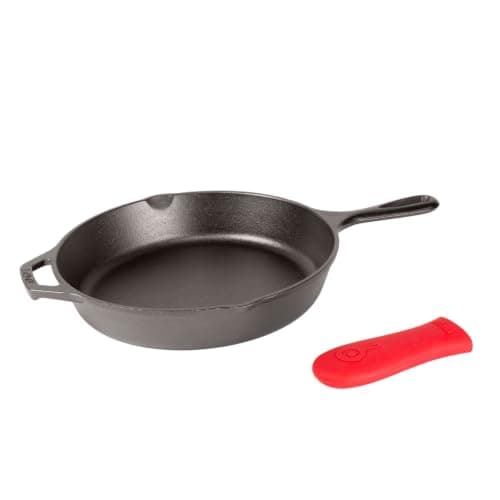
Published specifications for the Lodge Seasoned Cast Iron Skillet, 10.25 in (L8SK3)
Diameter
10.25 in
Weight
5.66 lb
Oven maximum
550F
Induction
Yes - bare iron is ferrous
Seasoning
Pre-seasoned with soy-based vegetable oil, no synthetic chemicals
Warranty
Lifetime
Made in
USA
Care
Hand wash. Lodge's own instructions permit warm soapy water
Good
Effectively unbreakable and fully restorable - a rusted one can be stripped and re-seasoned
Holds heat better than anything else at the price, which is what a sear needs
Lodge publishes its seasoning method openly, so the maintenance is not a mystery
Not good
Heavy
Heats unevenly on a small burner: cast iron conducts at roughly 50 W/m-K, so it is slow to spread and slow to react
Bare iron is reactive; long tomato braises will taste of it
The trade-off. It weighs 5.66 lb empty. You will feel that every time you move it full, and it is the single most common reason a cast iron skillet ends up in a cupboard.
Skip this if. You have wrist or shoulder trouble, or you cook mostly acidic braises. Carbon steel does most of the same jobs at roughly half the weight.
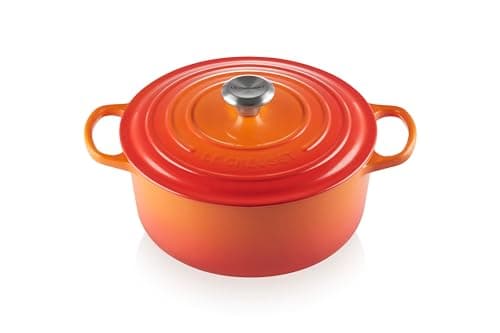
Published specifications for the Le Creuset Signature Round Dutch Oven, 5.5 qt
Material
Cast iron with porcelain enamel inside and out
Capacity
5.5 qt
Interior enamel
Sand-colored, so browning and fond stay visible
Knob
Stainless steel, rated to 500F
Induction
Yes - the iron under the enamel is ferrous
Dishwasher
Dishwasher safe; Le Creuset recommends hand washing
Warranty
Limited lifetime
Made in
France
Good
The pale interior is a genuine cooking advantage: you can see whether the fond is browning or burning
Wide, low-profile handles that a hand in an oven mitt actually fits
The one enameled pot with a real secondhand market, which changes the true cost of ownership
Not good
Costs several times a Lodge enameled pot of the same capacity
The pale interior stains permanently, and Le Creuset says so
Chipped enamel is not repairable on any enameled pot, this one included
The trade-off. You are paying a large multiple of what a Lodge enameled pot costs for a difference in enamel quality, finish and resale value rather than in cooking.
Skip this if. You braise a few times a year. The cooking difference over a Lodge enameled pot is small; the price difference is not.
Tramontina for most kitchens - genuinely fully clad construction at a price where much of the market sells disc-bottom, with NSF certification on its flagship set. All-Clad publishes the most and charges for it, and Lodge is the answer in cast iron. There is no single best brand across every material.
›Is an expensive cookware brand worth it?
Sometimes, and rarely for the reason people expect. Moving from Tramontina to All-Clad buys bonding consistency, a 600F broiler-safe ceiling against 500F, and a published factory location - not a different construction idea. Within a material, fully clad against disc-bottom decides more than the badge does.
›Which cookware brands publish the most information?
All-Clad publishes a 600F oven and broiler rating, its Canonsburg factory and handwash-only guidance. Le Creuset and Staub publish French manufacture. de Buyer publishes a 3 mm thickness, which almost nobody in carbon steel does. USA Pan publishes a coating free of PTFE, PFOA and BPA.
›Which nonstick brand lasts longest?
Nobody can tell you, and that is the finding. Not one coated cookware maker - Calphalon, OXO, T-fal, GreenPan or Tramontina - publishes a coating lifespan, and every warranty in the category excludes coating wear. Buy coated pans cheaply and plan to replace them.
›Why are some well-known cookware brands not on this page?
Because we only write about products whose specifications we have read from the manufacturer, and we do not test cookware. A brand we have not audited gets no entry rather than a guess. The four questions on this page - construction, oven ceiling, warranty exclusions, country of manufacture - work on any brand.
Sources
Every figure on this page came from one of these. Follow them and check our arithmetic — that is the point.