Heads up: some links on this page earn us a commission at no extra cost to you. It does not change what we recommend or the order. How we are funded.
The short answer
Pyrex publishes tempered soda-lime glass construction for its US-made bakeware, dishwasher, microwave and freezer safety, and guidance to avoid sudden temperature change. It publishes that glass bakeware is not broiler safe. The material is completely non-reactive with no coating, no seasoning and nothing to wear out, which makes it the least demanding thing in a kitchen. The trade is conduction: glass browns bases slowly and pale.
What this review checks
Published material, care and safety guidance, temperature behavior, warranty terms where stated, and what the company declines to state. We have not baked in any of it. The method is here.
The material, and a naming point worth knowing
Pyrex bakeware sold in the US is tempered soda-lime glass. That has been the case since the late 1990s; earlier US production used borosilicate glass, and the two behave differently under thermal stress.
We record this because it is a real and frequently confused fact, not to litigate it. Tempered soda-lime glass is strong and safe in normal use, it is what the manufacturer publishes, and the care guidance published with it reflects the material as sold today. If you own a very old dish, it may be a different glass.
What Pyrex publishes
Specification
Published guidance
Comment
Material
Tempered soda-lime glass (US production since the late 1990s)
Stated by the manufacturer
Capacity, our reference dish
3 qt, 9 x 13 in
The standard domestic oblong
Non-reactive
Yes - safe for tomato, wine and vinegar
No coating, no seasoning, no reactive metal
Broiler
No. Glass bakeware is not broiler safe
Published plainly
Thermal shock
Avoid sudden temperature change
A real breakage mechanism, not a disclaimer
Dishwasher
Dishwasher, microwave and freezer safe
The only material in our ledger that is all three
Recorded from Pyrex's published use and care guidance for glass bakeware.
Thermal shock is the whole story
Glass does not have a temperature ceiling in the way a coated pan does. What it has is a limit on how fast the temperature can change, and exceeding it breaks the dish.
No hot dish onto a wet or cold surface. A wet counter is the classic cause.
No cold liquid into a hot dish. Adding stock to a hot gratin is the classic version.
No refrigerated dish straight into a preheated oven. Let it stand while the oven comes up.
No empty dish preheated, and no dish on a burner, ever.
No broiler, which is direct radiant heat and exactly the case Pyrex publishes against.
Every one of those is a specific, avoidable action rather than a vague caution, which is why we describe it as a real mechanism. The full comparison against metal is in glass versus metal bakeware.
This is also the reason glass needs care in a countertop oven, where the top element sits inches from the dish - closer to broiler conditions than to conventional oven heat. Bakeware for toaster ovens covers it.
What glass is genuinely best at
Acidic dishes. Completely non-reactive, so tomato, wine and citrus are a non-issue - unlike bare aluminum, which reacts.
Seeing the base. The only bakeware material that lets you check whether a pastry base is actually cooked, which is why it endures for pies - pie and tart pans.
Oven to table to refrigerator. Cook, serve and store leftovers in the same dish, which no metal pan does well.
Wet dishes. Lasagne, gratins, baked pasta and casseroles, where browning the base matters least.
Being genuinely carefree. No coating, no seasoning, no reactive surface, dishwasher safe - it is the one material with no maintenance at all.
What it is bad at
Conduction. Glass conducts heat poorly, so bases brown slowly and stay pale. For anything where a crisp base is the point - roasted vegetables, cookies, a pizza, a crisp-bottomed pie - metal wins and it is not close. The figures behind that are in sheet pan materials.
It is also heavy, it chips at the rim, and it retains heat after it leaves the oven - which is useful at the table and means food carries on cooking longer than you expect.
What it gets right
Completely non-reactive, so acidic dishes are a non-issue
You can see whether the base is actually cooked
Goes oven to table to refrigerator without transferring the food
Dishwasher, microwave and freezer safe - the only material here that is all three
No coating, no seasoning, nothing that wears out
What it costs you
Poor conductor: slow, pale bases compared with metal
Not broiler safe, and Pyrex publishes it
Thermal shock is a genuine breakage risk with specific avoidable causes
Heavy, and it chips at the rim
Retains heat after the oven, so food keeps cooking
Who should buy it
Almost everyone should own one.A 9 by 13 glass dish is among the most used items in a domestic kitchen.
Buy it specifically for lasagne, gratins, casseroles and fruit pies.
Do not buy it for roasting vegetables, cookies or anything you want crisp underneath - use a bare aluminum sheet pan.
If you want non-reactive plus browning,enameled cast iron does both and works on the stove.
Glass, and what to use when glass is wrong
Glass for wet and acidic dishes, aluminum for browning, enameled iron for both plus the stove. Most kitchens want all three.
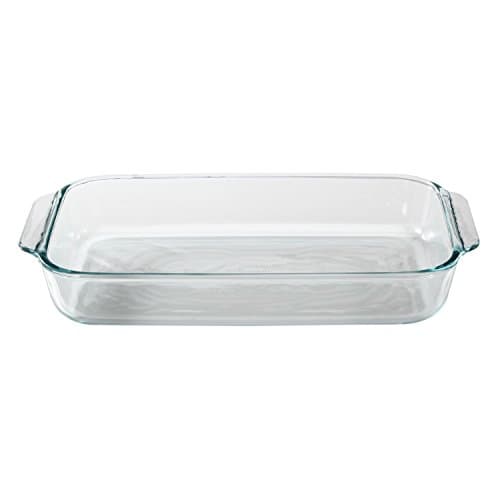
Pyrex Basics Oblong Glass Baking Dish, 3 qt
Casseroles, gratins and baked pasta - wet dishes that go oven to table to fridge
These are the products this page's reasoning actually points at. Same rules as everywhere else on the site: published specs, a stated trade-off, and a live price only where one exists.
Top pick · The dish to buySpecs read September 3, 2026
Pyrex Basics Oblong Glass Baking Dish, 3 qt
Three quarts in the standard 9 by 13 footprint - non-reactive, oven to table to refrigerator, and the most-used dish in many kitchens.
Best for: Casseroles, gratins and baked pasta - wet dishes that go oven to table to fridge
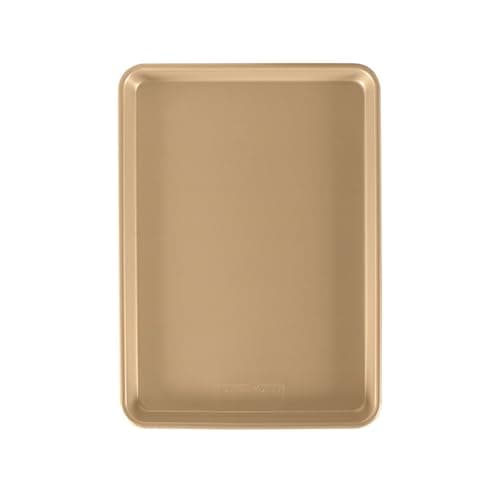
Published specifications for the Nordic Ware Naturals Half Sheet, 18 x 13 in
Exterior dimensions
17.9 x 12.9 x 1 in
Material
Aluminum
Rim
Encapsulated steel rim
Gauge
Not published by Nordic Ware
Warranty
Lifetime
Dishwasher
Hand wash recommended. Automatic dishwasher use is not advised
Made in
America of domestic and imported materials
Good
Aluminum conducts at 237 W/m-K, which is why it browns evenly and a steel pan does not
The encapsulated steel rim is the reason it does not warp in a hot oven
Lifetime warranty on a pan this cheap
Not good
Nordic Ware does not publish a gauge figure, so thickness cannot be compared like for like
Bare aluminum stains and reacts with acid
Not dishwasher safe by the maker's own advice
The trade-off. Bare aluminum discolors and reacts with acid. It will look used within a month and Nordic Ware advises against the dishwasher.
Skip this if. You want a pan that stays looking new, or you will not hand wash. Buy an aluminized-steel coated pan instead and accept the coating as a wear item.
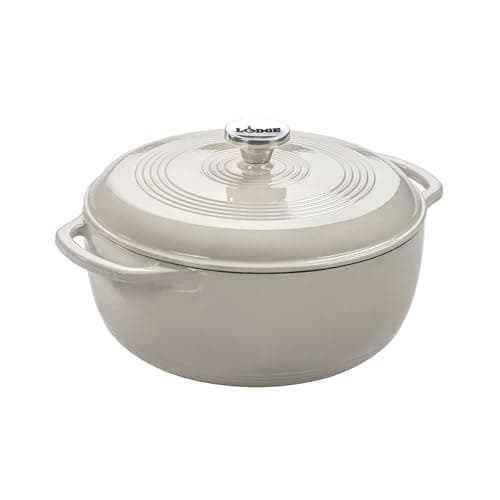
Published specifications for the Lodge Enameled Cast Iron Dutch Oven, 6 qt
Material
Cast iron with porcelain enamel, inside and out
Capacity
6 qt
Induction
Yes - the iron under the enamel is ferrous
Seasoning
None required - enamel is not a seasoning surface
Acid
Safe for tomato and wine, unlike bare iron
Oven maximum
Set by the knob material - check the specific SKU; Lodge publishes a lower ceiling than for bare iron
Good
Non-reactive, so it handles the acidic cooking bare iron cannot
No seasoning to maintain
Considerably cheaper than the French enameled pots it copies
Not good
Chipped enamel is not repairable, unlike bare iron's seasoning
Oven ceiling is lower than bare cast iron because of the knob
Heavy, and the enamel makes it heavier than bare iron of the same capacity
The trade-off. The enamel is a glass layer. Chip it and the pot is not restorable the way bare iron is, and Lodge's enamel chips more readily than the premium brands'.
Skip this if. You already own a large stainless stockpot and rarely braise. This duplicates it for most weeknight cooking.
Yes, in normal use. It is tempered soda-lime glass with no coating, no seasoning and no reactive surface, and it is published as dishwasher, microwave and freezer safe. The one real rule is avoiding sudden temperature change.
›Can Pyrex go under the broiler?
No. Pyrex publishes that glass bakeware is not broiler safe. A broiler applies direct radiant heat from inches away, which is exactly the thermal shock the material cannot take.
›Why did my Pyrex dish shatter?
Almost certainly thermal shock - a hot dish set on a wet or cold surface, cold liquid added to a hot dish, or a refrigerated dish put straight into a preheated oven. Each is a specific avoidable action rather than random failure.
›Is Pyrex borosilicate or soda-lime glass?
US Pyrex bakeware has been tempered soda-lime glass since the late 1990s; earlier US production used borosilicate. The published care guidance reflects the material as sold today, and a very old dish may be a different glass.
›Does Pyrex brown food as well as metal?
No. Glass conducts heat poorly, so bases brown slowly and stay pale. It is the right choice for lasagne, gratins and casseroles, and the wrong one for roasted vegetables, cookies or anything you want crisp underneath.
Sources
Every figure on this page came from one of these. Follow them and check our arithmetic — that is the point.