Heads up: some links on this page earn us a commission at no extra cost to you. It does not change what we recommend or the order. How we are funded.
The short answer
Glass for fruit pies, because you can see whether the base is actually cooked - which is the only reliable way to avoid a soggy bottom.
Metal for anything you want crisp, because it conducts far better and browns the base faster.
A loose-bottomed tin for tarts, which is not a preference - it is how a tart comes out of the pan.
Preheat a sheet pan underneath. The single most effective fix for a pale base, whatever the pan is made of.
What we can and cannot tell you here
Our product ledger contains audited bakeware in sheet, cake, loaf and oblong shapes. It does not contain a separately audited pie dish or tart tin, because we only list products whose specifications we have read from the manufacturer - the method is here.
So this page does what it can honestly do: explain the material physics, which are the same as for the pans we have audited, and point at tagged searches for the shapes themselves rather than inventing a spec sheet for a model we have not checked.
Everything here is about the base
A pie has a problem no other bake has: the filling is wet, it sits on pastry, and the pastry has to cook through before the filling overcooks. The top browns easily because it is exposed to radiant heat. The base is insulated by the pan and cooled by the filling.
So every decision on this page - material, color, thickness, whether you preheat a surface underneath - is a decision about getting heat into that base fast enough.
Material by material
Material
Base browning
Can you see the base?
Best for
Glass
Slow - it conducts poorly
Yes, and this is the whole point
Fruit pies, custard pies, anything you are unsure about
Bare aluminum
Fast and even, 237 W/m-K
No
Crisp bases, blind-baked shells
Anodized aluminum
Fast, slightly darker
No
Tart tins, precise edges
Aluminized steel with a coating
Fast
No
Fluted tins where release is difficult
Dark coated steel
Fastest - drop 25F
No
Deep-dish pies; watch for over-browning
Ceramic and stoneware
Slow, very even, retains heat
No
Oven-to-table presentation, long bakes
Disposable foil
Fast but flimsy
No
Transporting a pie, and nothing else
Glass loses on conduction and wins on the only diagnostic available. That trade is why it remains the traditional American pie material.
The conductivity figures are the same ones behind glass versus metal bakeware, and the conclusion is the same: metal browns, glass shows you what is happening.
Tart tins are a different object
A tart tin is shallow, straight-sided or fluted, and - crucially - has a removable base. That is not a convenience feature. A tart has a thin, brittle pastry shell with no structural top, and you cannot invert it or lever it out of a solid pan without breaking it. You push the base up and the ring falls away.
Loose bottom, always. A solid tart tin is a fruit-pie dish being sold as something else.
Fluted sides give the classic edge and more surface area, at the cost of being harder to line and harder to wash.
Metal, not glass. Tart pastry wants a crisp base and glass will not deliver it.
9 to 11 inches covers nearly every recipe; 4-inch individual tins are a specialist purchase.
Put it on a sheet pan. A loose base leaks butter, and a loose base on an oven rack is how a tart ends up on the oven floor.
Blind baking, which is the technique that matters
Blind baking means cooking the shell before the filling goes in, and it is the answer to most soggy-bottom problems - particularly for custard and cream fillings that never get hot enough to cook pastry.
Line the chilled shell with parchment, pressed into the corners.
Fill it with weights - ceramic beads, dried beans or rice - right up the sides so the walls do not slump.
Bake until the edges are set, then remove the parchment and weights.
Return it to the oven until the base looks dry and pale gold.
Seal it if the filling is wet - a brush of beaten egg white on the hot base sets into a barrier.
Put a heavy sheet pan on the middle rack and preheat it with the oven. Set the pie directly onto that hot surface.
The effect is immediate conductive heat into the base rather than slow radiant heat from the oven air, and it is the single most effective fix for a pale bottom crust - more effective than changing pan material. It also catches drips, which fruit pies produce generously.
A baking steel or a pizza stone does the same thing more dramatically, because both hold far more heat. If you own either, use it. If you do not, a bare aluminum half sheet costs a fraction as much and does most of the job.
Parchment and weights up the full height of the wall are what stop a blind-baked shell slumping. Half-filled weights give you a shell with sloped sides.
Depth and size
Standard pie dish, 9 inches, about 1.5 inches deep. What nearly every recipe assumes.
Deep dish, 9 to 10 inches and 2 inches or more. Holds roughly half again as much filling and needs a longer, lower bake.
Tart tin, 9 to 11 inches, about 1 inch deep. Shallow by design - a tart is mostly pastry and topping.
As with cake pans, capacity rises faster than the printed diameter suggests, and the substitution arithmetic in what size cake pan applies here too.
What to buy
One 9-inch glass pie dish for fruit and custard pies, where seeing the base is worth more than browning it fast.
One 9 or 10-inch loose-bottomed metal tart tin, fluted if you like the edge.
A half sheet pan to preheat underneath - bare aluminum is the one we recommend, and it is the cheapest fix on this page.
Pie weights, or a bag of dried beans you keep for the purpose.
The audited bakeware that supports this
We have not audited a specific pie dish or tart tin, so these are the pans whose specifications we can cite - and the sheet pan is genuinely the most useful item here.
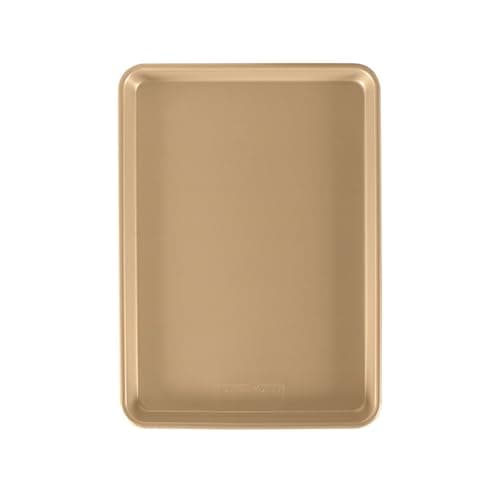
Nordic Ware Naturals Half Sheet, 18 x 13 in
Roasting vegetables, sheet-pan dinners, cookies - the pan you use most weeks
These are the products this page's reasoning actually points at. Same rules as everywhere else on the site: published specs, a stated trade-off, and a live price only where one exists.
Top pick · The glass argumentSpecs read September 3, 2026
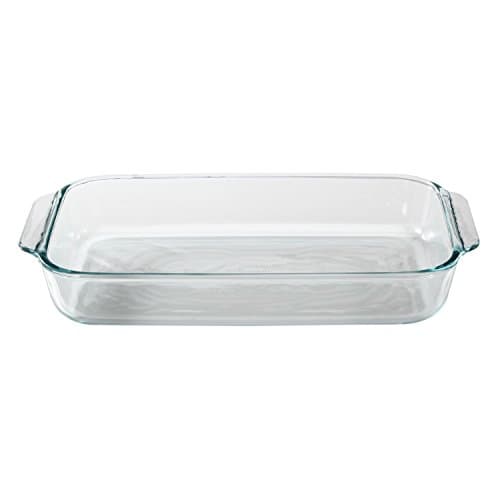
Pyrex Basics Oblong Glass Baking Dish, 3 qt
Non-reactive and transparent, which is the property that matters for fruit pies - you can see the base rather than guess at it.
Best for: Casseroles, gratins and baked pasta - wet dishes that go oven to table to fridge
Published specifications for the Nordic Ware Naturals Half Sheet, 18 x 13 in
Exterior dimensions
17.9 x 12.9 x 1 in
Material
Aluminum
Rim
Encapsulated steel rim
Gauge
Not published by Nordic Ware
Warranty
Lifetime
Dishwasher
Hand wash recommended. Automatic dishwasher use is not advised
Made in
America of domestic and imported materials
Good
Aluminum conducts at 237 W/m-K, which is why it browns evenly and a steel pan does not
The encapsulated steel rim is the reason it does not warp in a hot oven
Lifetime warranty on a pan this cheap
Not good
Nordic Ware does not publish a gauge figure, so thickness cannot be compared like for like
Bare aluminum stains and reacts with acid
Not dishwasher safe by the maker's own advice
The trade-off. Bare aluminum discolors and reacts with acid. It will look used within a month and Nordic Ware advises against the dishwasher.
Skip this if. You want a pan that stays looking new, or you will not hand wash. Buy an aluminized-steel coated pan instead and accept the coating as a wear item.
Glass lets you see whether the base is actually cooked, which is the only reliable diagnostic for a soggy bottom, and it is non-reactive. Metal conducts far better and browns the base faster. Glass for fruit and custard pies, metal for anything you want crisp.
›Why do tart tins have removable bottoms?
Because a tart shell is thin and brittle with no structural top, so it cannot be inverted or levered out of a solid pan without breaking. You push the base up and the ring falls away. A solid tart tin is a pie dish sold as something else.
›How do you stop a soggy bottom?
Preheat a heavy sheet pan in the oven and set the pie directly onto it - that conductive heat does more than any pan material. Blind bake the shell for wet or custard fillings, and seal the hot base with beaten egg white.
›What is blind baking?
Baking the pastry shell before the filling goes in. Line the chilled shell with parchment, fill it with weights right up the sides so the walls do not slump, bake until the edges set, then remove the weights and bake until the base is dry.
›What size pie dish should I buy?
Nine inches at about 1.5 inches deep is what nearly every recipe assumes. Deep-dish pans of 2 inches or more hold roughly half again as much filling and need a longer bake at a lower temperature.
Sources
Every figure on this page came from one of these. Follow them and check our arithmetic — that is the point.