Heads up: some links on this page earn us a commission at no extra cost to you. It does not change what we recommend or the order. How we are funded.
The short answer
A springform pan has a removable ring so you can release a cake you cannot invert - cheesecake, above all. A tube pan has a hollow center that conducts heat into the middle of a deep batter, which is why angel food and bundt cakes bake evenly. Both are single-purpose and both have a weakness: springforms leak, and tube pans are hard to grease. Buy a springform if you make cheesecake, and a tube pan if you make the cakes that need one.
What we can tell you here
Our ledger contains audited sheet, cake, loaf and oblong bakeware. It does not contain a separately audited springform or tube pan, because we only list products whose specifications we have read from the manufacturer - the method is here. So this page explains the shapes and the physics, and points at tagged searches for the pans rather than inventing spec sheets.
Springform pans: the release problem
Most cakes come out of a pan by being turned upside down. A cheesecake cannot: it is dense, wet, fragile and often has a loose crumb base. Inverting it destroys it.
A springform solves that by making the wall removable. A hinged or clamped ring sits around a flat base plate; release the clamp and the ring expands away from the cake, leaving it standing on the base.
What it is genuinely needed for
Cheesecake - the archetypal case, and the reason most people own one.
Deep set desserts - mousse cakes, ice cream cakes, anything chilled and set rather than baked.
Layered no-bake desserts assembled in the pan.
Tall, delicate baked cakes where inverting risks collapse.
The problem it introduces
The seam between the ring and the base is a joint, and joints leak. Melted butter from a crumb base is thin enough to find any gap, and a wet batter will too. That produces three familiar outcomes: a burnt smell, a smoking oven and a cheesecake with no butter left in its base.
Always put it on a sheet pan. This is not optional and it catches everything.
Wrap the outside in foil if you are using a water bath, in two layers, up the sides. A single layer usually fails.
Line the base with parchment before clamping the ring on, and let the excess stick out - it also makes the cake easier to move.
Check the seal by clamping the empty pan and running a hand around the joint. A pan that does not close flush will leak.
Leakage is the reason some bakers prefer a solid pan with a parchment sling for anything that can survive being lifted, and use the springform only for cheesecake. That is a reasonable position - the sling technique is in how to stop baked goods sticking.
Tube pans: the heat problem
A tube pan has a hollow column through the middle. It is not decorative - it is a conduction fix.
A deep round cake has a problem: heat reaches the outside from all around and reaches the center only by travelling through several inches of batter, which is a poor conductor. The outside sets and browns long before the middle is done. Adding a metal column through the center gives heat a second route in, so the middle cooks at roughly the same rate as the edge.
Pan
What it is
What it is for
Angel food pan
Tall, straight-sided tube, usually with a removable base and feet
Angel food and chiffon, which must cool upside down
Bundt pan
Fluted tube pan, one piece, no removable base
Dense butter cakes with a decorative surface
Tube pan, plain
Straight-sided tube, sometimes removable base
Pound cakes, coffee cakes, deep batters
Ring mold
Shallow tube, often ceramic or silicone
Set desserts and savory rings rather than baking
The feet on an angel food pan exist so the cake can be inverted to cool while still in the pan - it would collapse under its own weight otherwise.
The problem tube pans introduce
Release. A fluted bundt pan has dozens of crevices, and every one of them is somewhere batter can weld itself. This is the shape where greasing badly is most punished, because a cake that sticks in a bundt breaks in a way that cannot be hidden.
Use softened butter or shortening applied with a brush, not melted butter, which pools at the base and leaves the upper flutes bare.
Get into every crevice, then flour it and knock out the excess. Cocoa instead of flour for chocolate cakes.
Do not use aerosol spray in a bundt. It pools in the detail and burns on, building the sticky residue described in how to clean nonstick pans.
Turn it out after about ten minutes. Too early and it tears; too late and it cools, contracts and glues itself in.
Materials for both shapes
Bare or anodized aluminum browns best and has nothing to wear out. It needs proper greasing and flouring every time - the approach behind uncoated cake pans.
Aluminized steel with a published coating is the practical choice for a fluted bundt, where the release problem is worst. USA Pan's coating is published free of PTFE, PFOA and BPA.
Dark coated steel browns fast; drop the oven by about 25F or the outside of a deep cake sets too early.
Silicone releases beautifully and browns nothing, which for a bundt means a pale, soft cake with no crust - is silicone bakeware safe.
Glass and ceramic exist in these shapes and conduct poorly, which defeats the point of the tube - stoneware and ceramic bakeware.
Ten minutes in the pan, then out. It is the same rule for a springform, a bundt and a loaf, and it rescues more cakes than any pan coating.
Sizes
Pan
Common size
Capacity
Springform
9 in
The standard cheesecake size, about 2.5 to 3 in deep
Springform
8 in
A taller cheesecake from the same recipe
Springform
10 in
Shallower; check bake times, it will set faster
Bundt
10 to 12 cup
The standard, and what most recipes assume
Angel food
10 in, 16 cup
Almost always this size
Bundt pans are sold by volume rather than diameter, because the fluting makes diameter meaningless. Fill to about two-thirds, as with any cake pan.
The fill rule and substitution arithmetic are the same as everywhere else in baking and are set out in what size cake pan.
When you do not need either
Both of these are single-purpose pans, and single-purpose pans are the ones that end up unused at the back of a cupboard - a real cost in a small kitchen.
If you never make cheesecake, you do not need a springform. A parchment sling in a solid pan handles most other cakes.
If you never make bundt or angel food cakes, a tube pan will not get used. A loaf pan or two round pans cover ordinary cakes.
If you bake twice a year, buy neither and use the pans you have.
These are the products this page's reasoning actually points at. Same rules as everywhere else on the site: published specs, a stated trade-off, and a live price only where one exists.
Top pick · What every springform needs under itSpecs read September 3, 2026
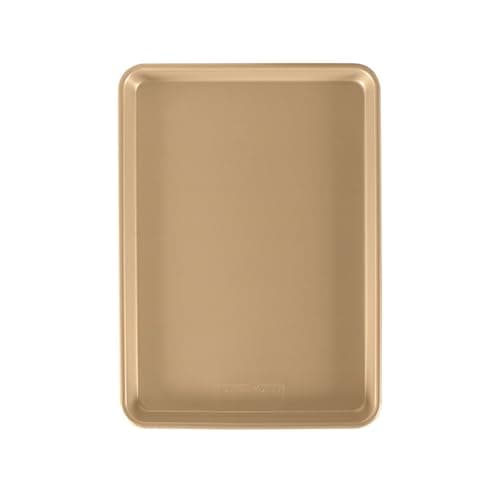
Nordic Ware Naturals Half Sheet, 18 x 13 in
Springform seams leak butter and batter, and a sheet pan underneath is the difference between a drip and an oven fire.
Best for: Roasting vegetables, sheet-pan dinners, cookies - the pan you use most weeks
Published specifications for the Nordic Ware Naturals Half Sheet, 18 x 13 in
Exterior dimensions
17.9 x 12.9 x 1 in
Material
Aluminum
Rim
Encapsulated steel rim
Gauge
Not published by Nordic Ware
Warranty
Lifetime
Dishwasher
Hand wash recommended. Automatic dishwasher use is not advised
Made in
America of domestic and imported materials
Good
Aluminum conducts at 237 W/m-K, which is why it browns evenly and a steel pan does not
The encapsulated steel rim is the reason it does not warp in a hot oven
Lifetime warranty on a pan this cheap
Not good
Nordic Ware does not publish a gauge figure, so thickness cannot be compared like for like
Bare aluminum stains and reacts with acid
Not dishwasher safe by the maker's own advice
The trade-off. Bare aluminum discolors and reacts with acid. It will look used within a month and Nordic Ware advises against the dishwasher.
Skip this if. You want a pan that stays looking new, or you will not hand wash. Buy an aluminized-steel coated pan instead and accept the coating as a wear item.
Effectively yes. A cheesecake is dense, wet and fragile with a loose crumb base, so it cannot be turned upside down to release it. A springform's removable ring lets the cake stay upright on its base plate.
›Why do springform pans leak?
The seam between the ring and the base is a joint, and melted butter from a crumb base is thin enough to find any gap. Always bake on a sheet pan, line the base with parchment, and use two layers of foil up the sides for a water bath.
›What is the hole in a tube pan for?
Conduction. Batter is a poor conductor, so the center of a deep round cake cooks far slower than the edge. A hollow metal column gives heat a second route into the middle, so it sets at roughly the same rate as the outside.
›Why does my bundt cake stick?
Almost always a missed crevice. Use softened butter or shortening applied with a brush rather than melted butter, which pools at the base and leaves the upper flutes bare, then flour and knock out the excess. Never use aerosol spray in a fluted pan.
›Why do angel food pans have feet?
So the cake can be inverted to cool while still in the pan. Angel food and chiffon cakes are so light they would collapse under their own weight if cooled upright, and the feet hold the pan clear of the counter.
Sources
Every figure on this page came from one of these. Follow them and check our arithmetic — that is the point.