Heads up: some links on this page earn us a commission at no extra cost to you. It does not change what we recommend or the order. How we are funded.
The short answer
Food-grade silicone is a stable synthetic rubber that is widely used in food contact applications and does not react with food at normal baking temperatures. The practical concerns are quality and performance rather than chemistry: cheap silicone can contain fillers, and silicone is a very poor conductor of heat, so nothing baked in it browns. Use it for flexible molds, mats and small items where release matters more than color. Do not use it where you want a crust, a browned base or a crisp edge.
What silicone bakeware actually is
Silicone here means polysiloxane - a synthetic polymer built on a silicon-oxygen backbone rather than the carbon backbone of most plastics. That backbone is what makes it stable across a wide temperature range and unreactive with food.
It is used across food contact applications, from bakeware to spatulas to gaskets in equipment you never see. Food-grade silicone is a well-established material, and this is not a case like nonstick coatings where the substance is contested. The FDA maintains its position on food contact substances generally; the specific arguments about coated cookware are in is nonstick cookware safe and is ceramic cookware safe.
The filler question, which is the real one
The legitimate concern about cheap silicone bakeware is not the silicone. It is what has been mixed into it. Fillers - typically inexpensive plastics or mineral powders - reduce cost and reduce quality, and they are the plausible source of the off smells and taints people report from bargain molds.
There is a simple, well-known test you can do on any silicone item:
Pinch and twist a flat section of the item firmly.
Watch the stressed area.
If white streaks appear, fillers are likely present.
If the color stays uniform, it is more likely to be pure silicone.
The test is a useful indicator rather than a laboratory result. It is worth doing on anything unbranded, and it is one more reason to buy bakeware from a manufacturer that publishes what its products are made of - which is the same standard applied on non-toxic bakeware.
The performance problem: silicone browns nothing
This is where silicone loses, and it is physics rather than opinion. Aluminum conducts heat at roughly 237 watts per meter-kelvin. Silicone is an insulator - orders of magnitude worse. A silicone mold does not transfer heat into the food touching it; it slows heat down.
What you want
Silicone
Metal
A browned, crisp base
No. It stays pale and soft
Yes - this is what conduction does
Sharp defined edges
No. Flexible walls give rounded shapes
Yes
Release without greasing
Yes, reliably
Only with a coating or a lining
Intricate shapes
Yes - this is its genuine advantage
No
A pan that holds its shape when full
No, it needs a tray underneath
Yes
Freezer and microwave use
Yes
Freezer yes, microwave no
Cutting in the pan
No - a knife cuts silicone
Yes on metal, carefully
Silicone wins on flexibility and release. It loses on everything that depends on getting heat into the food.
The consequence in practice: muffins from a silicone tray have pale, soft sides. Cakes come out with no crust. Bread is worse still. If the recipe has browning as part of the point, a metal pan is not a preference - it is the requirement, and the reasoning is set out in sheet pan materials.
Where silicone genuinely is the right choice
Baking mats on a metal sheet. The best of both: the pan conducts and browns, the mat releases and saves parchment. This is silicone's single best use.
Frozen and chilled preparations. Ice, semifreddo, mousse domes, anything you pop out rather than bake.
Egg bites and small steamed items, where browning is not wanted at all.
Spatulas, brushes and lids, which is where most kitchens use silicone anyway and where it is unambiguously good.
Using it properly
Always put a silicone mold on a baking sheet. Filled and flexible, it will deform on an oven rack and you cannot carry it.
Check the temperature rating. Most food-grade silicone bakeware is rated to somewhere between 400F and 500F; read the specific product rather than assuming, exactly as with every other oven ceiling.
No broiler, ever. Direct radiant heat is outside what any of it is rated for.
Wash it properly. Silicone holds grease in a way metal does not, and a greasy feel after washing means residue rather than damage. Hot water and detergent, or the dishwasher, which it tolerates well.
Do not cut in it, and keep it away from sharp utensils. A nicked mold tears.
Silicone as a coating is a different thing
Worth separating, because the word appears in two places. USA Pan's AMERICOAT is a silicone-based nonstick coating applied to aluminized steel, published free of PTFE, PFOA and BPA. That is silicone doing release work on a metal pan that does the conducting - which is exactly the division of labor this page argues for.
It is one of the very few bakeware coatings whose chemistry the maker states plainly, and it is the reason USA Pan appears on non-toxic bakeware. It is still a coating and it will still wear eventually, which is the honest caveat on any coated pan.
The verdict
Safety: fine, for food-grade silicone from a maker that documents its products. Do the pinch test on anything unbranded.
Performance: limited, because it will not brown anything.
Buy mats, not pans. A silicone mat on an aluminum sheet is better than a silicone tray at every job both can do.
Buy molds for shapes metal cannot release, and accept pale sides as the price.
For cakes, loaves and anything with a crust, buy metal.
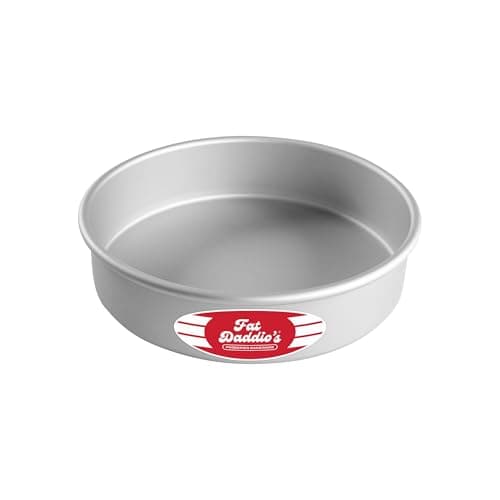
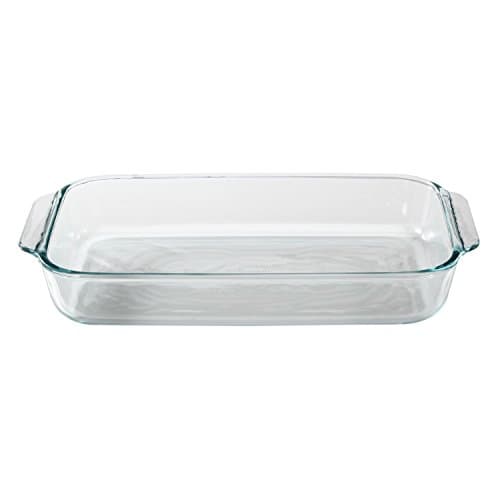
The metal and glass this page recommends instead
A silicone mat belongs on the first of these. The rest are here because browning is a conduction problem and silicone is an insulator.
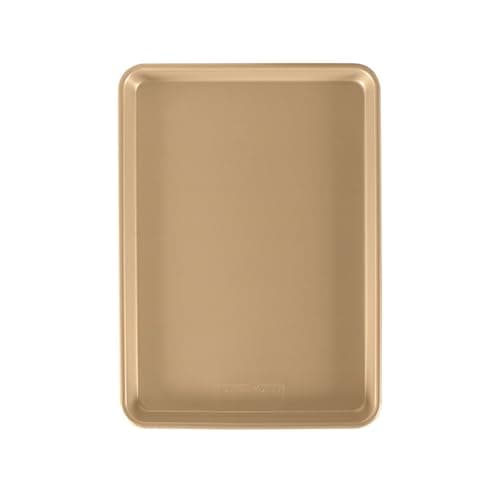
Nordic Ware Naturals Half Sheet, 18 x 13 in
Roasting vegetables, sheet-pan dinners, cookies - the pan you use most weeks
These are the products this page's reasoning actually points at. Same rules as everywhere else on the site: published specs, a stated trade-off, and a live price only where one exists.
Top pick · Silicone where it worksSpecs read September 3, 2026
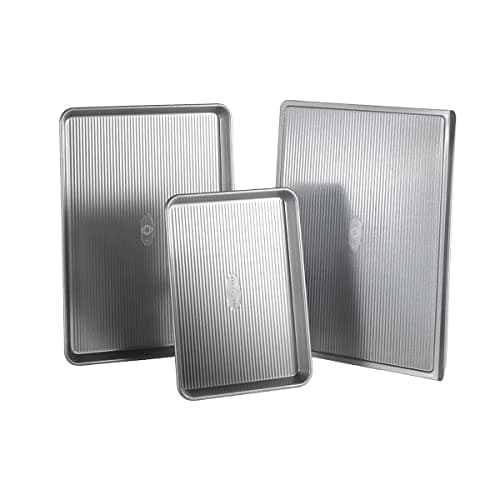
USA Pan Aluminized Steel Bakeware
A silicone-based coating on aluminized steel, published free of PTFE, PFOA and BPA - the metal browns and the silicone releases.
Best for: Loaf pans, muffin pans and cake pans that release without paper every time
Published specifications for the Nordic Ware Naturals Half Sheet, 18 x 13 in
Exterior dimensions
17.9 x 12.9 x 1 in
Material
Aluminum
Rim
Encapsulated steel rim
Gauge
Not published by Nordic Ware
Warranty
Lifetime
Dishwasher
Hand wash recommended. Automatic dishwasher use is not advised
Made in
America of domestic and imported materials
Good
Aluminum conducts at 237 W/m-K, which is why it browns evenly and a steel pan does not
The encapsulated steel rim is the reason it does not warp in a hot oven
Lifetime warranty on a pan this cheap
Not good
Nordic Ware does not publish a gauge figure, so thickness cannot be compared like for like
Bare aluminum stains and reacts with acid
Not dishwasher safe by the maker's own advice
The trade-off. Bare aluminum discolors and reacts with acid. It will look used within a month and Nordic Ware advises against the dishwasher.
Skip this if. You want a pan that stays looking new, or you will not hand wash. Buy an aluminized-steel coated pan instead and accept the coating as a wear item.
Food-grade silicone is a stable material widely used in food contact applications and does not react with food at normal baking temperatures. Check the specific product's temperature rating - most sit between 400F and 500F - and never use it under a broiler.
›How can you tell if silicone bakeware has fillers?
Pinch and twist a flat section firmly. If white streaks appear in the stressed area, fillers are likely present. If the color stays uniform, it is more likely to be pure silicone. It is an indicator rather than a lab test, and worth doing on anything unbranded.
›Why does silicone bakeware not brown food?
Because it is an insulator. Aluminum conducts heat at roughly 237 watts per meter-kelvin; silicone is orders of magnitude lower. It slows heat down rather than transferring it, so bases stay pale and soft and nothing develops a crust.
›Do you need to grease silicone bakeware?
Usually not - reliable release is silicone's genuine advantage. A very light grease helps on intricate molds and on new items, but the whole point of the material is that it flexes away from the food.
›Is a silicone baking mat better than parchment paper?
For repeated use, yes: a mat replaces hundreds of sheets of parchment and gives consistent release. Parchment still wins where you want a crisper base, because a mat adds one more insulating layer between the pan and the food.
Sources
Every figure on this page came from one of these. Follow them and check our arithmetic — that is the point.