Heads up: some links on this page earn us a commission at no extra cost to you. It does not change what we recommend or the order. How we are funded.
The short answer
Buy two 8-inch rounds if you bake layer cakes. Most American layer-cake recipes are written for them and they give a taller, better-proportioned cake.
Buy 9-inch rounds if you mostly bake single-layer cakes, or if your recipes are British in origin - a 9-inch pan has about 27 percent more area than an 8-inch.
A 9-inch square holds roughly the same volume as a 10-inch round. That is the substitution people get wrong most often.
Depth matters as much as diameter. Two inches is standard; three-inch pans need lower heat and longer bakes.
The arithmetic recipes assume
Cake pans are sold by diameter and used by area, and the relationship is not linear. An 8-inch round has about 50 square inches of base. A 9-inch round has about 64. That is roughly 27 percent more, which is why the same batter in a 9-inch pan produces a noticeably shallower cake that bakes faster and browns more.
Pan
Approximate base area
Roughly equivalent to
6 in round
28 sq in
A very small single layer
8 in round
50 sq in
An 8 in square holds about 28 percent more
9 in round
64 sq in
An 8 in square
10 in round
79 sq in
A 9 in square
8 in square
64 sq in
A 9 in round
9 in square
81 sq in
A 10 in round
9 by 13 in oblong
117 sq in
Two 9 in rounds, near enough
1 lb loaf, about 8.5 by 4.5 in
38 sq in
No round equivalent - depth is the point
Square pans hold more than the round pan of the same nominal size, because the corners are extra area. That single fact explains most failed substitutions.
The practical rule: if you swap to a pan with more area, the batter is shallower, so reduce the bake time and check early. If you swap to less area, the batter is deeper, so lower the temperature by around 25F and extend the time, or you will get a dark edge and a raw middle.
Which sizes are actually worth owning
Two 8-inch rounds
If you bake layer cakes at all, this is the pair to own. Most American layer-cake recipes are written for 8-inch pans, and two layers of the same batter are taller and better proportioned than the same batter spread into 9-inch pans. Buying two matching pans matters more than buying good ones - layers baked in mismatched pans will not stack level.
One or two 9-inch rounds
The right size for a single-layer cake, and the default in British and much European baking writing. If your recipe sources are mixed, owning both sizes removes a whole category of conversion arithmetic.
A 9 by 13 inch oblong
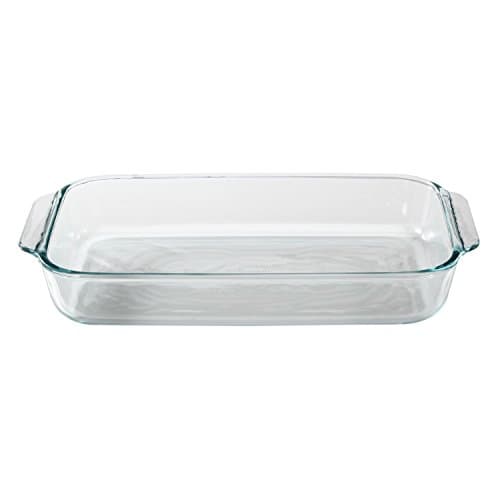
The most-used piece of bakeware in most kitchens and rarely thought of as a cake pan at all. Sheet cakes, brownies, traybakes, and every casserole you will make. Glass and metal behave differently here and the difference is real - glass versus metal bakeware covers it.
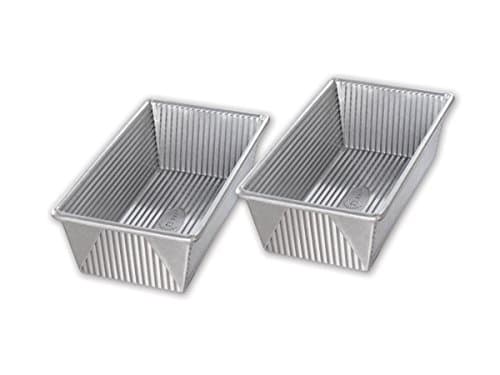
A 1 lb loaf pan
The standard size for quick breads, banana bread and a sandwich loaf. Depth and side geometry matter more than length here, and the roundup is best cake and loaf pans.
Depth, and the two-inch standard
Almost every cake recipe assumes a 2-inch deep pan. Three-inch pans exist for tall layers and tiered cakes, and they change the bake: the batter is deeper, so the outside sets long before the middle does. The standard fix is to drop the oven temperature by about 25F and bake longer.
Below 2 inches you have a sheet or a jelly-roll pan rather than a cake pan, and the batter bakes so fast that most cake recipes overcook at the edges before the middle sets.
Fill a cake pan between half and two-thirds full. Any less and the cake is thin and dries out; any more and it domes and spills. That ratio, rather than the recipe's stated pan size, is the thing to check when substituting.
Straight sides against sloped sides
Cheap cake pans often have slightly flared walls, because a tapered pan is easier to press and easier to release. It also means the layer is wider at the top than the bottom, which is why the stack leans and why the sides need trimming before frosting.
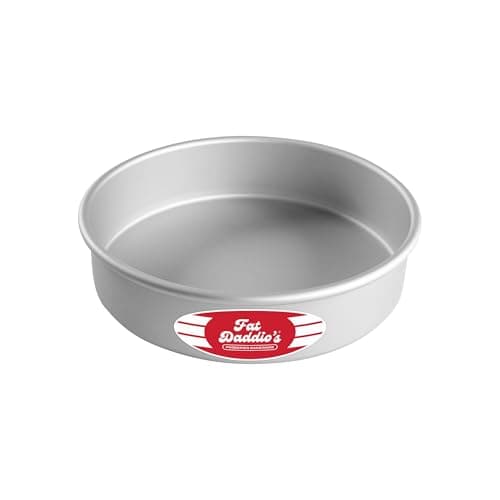
Straight, square-to-the-base sides are what professional pans have, and the Fat Daddio's 8-inch is the example in our ledger: straight walls and a seamless base with no rivets or joins for batter to leak into. If you have ever wondered why bakery layers look sharper than yours, this is a large part of it.
Side geometry is the difference between a layer you stack and a layer you trim. It is visible in every product photograph and stated in almost none.
Material, briefly, because it changes the size you need
Material
How it bakes
Size implication
Bare aluminum
Conducts at 237 W/m-K - even, level, pale sides
Bake at the temperature the recipe says
Anodized aluminum
Similar, slightly darker so slightly faster edges
Same sizes, check five minutes early
Aluminized steel with a dark coating
Absorbs more radiant heat, browns edges faster
Drop 25F on dark pans, or bake a size larger and shallower
Glass
Poor conductor, slow pale base, retains heat once hot
Drop 25F and expect longer bakes
Silicone
Very poor conductor, almost no browning
Needs support underneath and gives pale sides at any size
The conductivity figure for aluminum is the reason a plain aluminum cake pan bakes level while a dark coated pan browns its edges first.
These are the products this page's reasoning actually points at. Same rules as everywhere else on the site: published specs, a stated trade-off, and a live price only where one exists.
Top pick · The 9-inch defaultSpecs read September 3, 2026
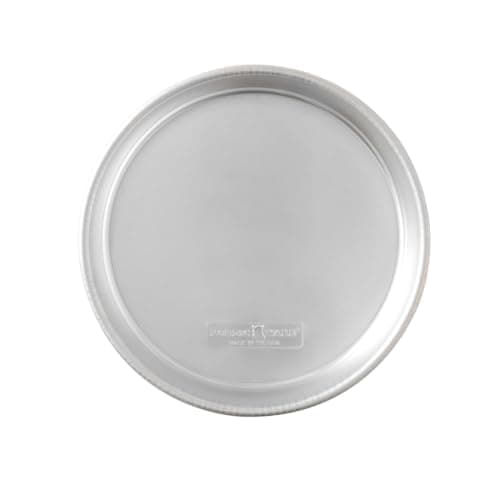
Nordic Ware Naturals Round Cake Pan, 9 in
Bare aluminum with no coating to fail, a lifetime warranty, and the conduction that keeps a cake level rather than domed.
Best for: Layer cakes, and anyone who has had a coated pan flake into a sponge
Eight inch if you bake layer cakes, because most American layer-cake recipes are written for them and the layers come out taller. Nine inch for single-layer cakes and for recipes of British origin. A 9-inch round has about 27 percent more base area than an 8-inch.
›Can I use a 9 inch square pan instead of a 9 inch round?
Not directly - a 9-inch square has about 81 square inches of base against a 9-inch round's 64, because the corners are extra area. A 9-inch square is closer to a 10-inch round. Match area rather than the printed number.
›How full should a cake pan be?
Between half and two-thirds. Less and the cake is thin and dries out; more and it domes and spills over. If a substitution takes you outside that range, use a different pan rather than adjusting the recipe.
›Do I need to change the temperature for a different pan?
Yes, in two cases. Dark coated pans and glass both absorb or retain more heat, so drop the oven by about 25F. And a deeper fill needs lower heat and longer time, or the edges set before the middle does.
›Why do my cake layers come out sloped?
Usually because the pan has flared sides. Cheap cake pans taper slightly for easier release, which makes the layer wider at the top. Straight, square-to-the-base sides are what produce layers that stack level without trimming.
Sources
Every figure on this page came from one of these. Follow them and check our arithmetic — that is the point.