Heads up: some links on this page earn us a commission at no extra cost to you. It does not change what we recommend or the order. How we are funded.
The short answer
Material
Conduction
Browning
Best for
Bare aluminum
237 W/m-K
Even and gentle
Cookies, roasting, everything flat
Aluminized steel
Aluminum surface, steel core
Even, slightly faster
Loaf pans, muffin tins, cake tins
Dark coated steel
~45 W/m-K plus high radiant absorption
Fast and uneven; burns undersides
Very little
Glass and ceramic
Very low
Slow; keeps cooking after removal
Casseroles and things you serve from the dish
Conduction is doing almost all the work
There are only two properties that matter for a flat pan in an oven: how well it moves heat sideways, and how much radiant heat its surface absorbs. Everything else in bakeware marketing is downstream of those.
Aluminum conducts at 237 W/m-K. That is second only to copper among practical metals and roughly five times better than steel. Heat arriving anywhere on an aluminum sheet spreads across it almost immediately, which is what "even browning" actually means.
Steel conducts at about 45 W/m-K. Heat stays roughly where it lands. Combine that with a dark surface, which absorbs radiant oven heat far more efficiently than a light one, and you get a pan that runs hot at the surface and cannot even itself out. Hence burnt bottoms.
The same reasoning drives every material decision on this site — the full version is in cookware materials compared.
Bare aluminum
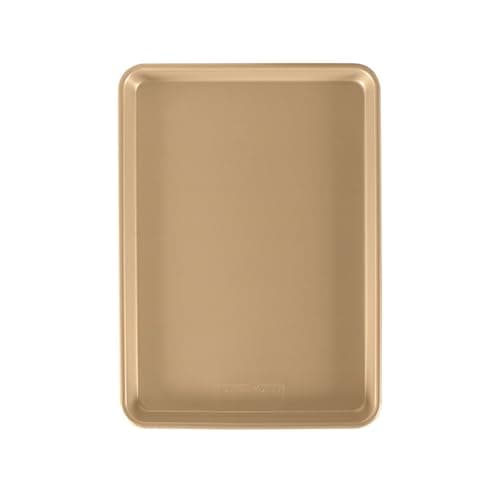
The professional standard, and the right answer for flat pans. Nordic Ware's Naturals half sheet is 17.9 by 12.9 by 1 inch with an "encapsulated steel rim", carries a lifetime warranty, and is made "in America of domestic & imported materials".
Note what Nordic Ware does not publish: a gauge figure. Sheet-pan thickness is usually described in commercial catalogs as an 18-gauge or 13-gauge equivalent, and Nordic Ware does not state one for this pan. That means thickness cannot be compared like for like between brands, and the site says so rather than repeating a number from a third party.
What it costs you
It discolors within weeks. Cosmetic, permanent, harmless.
It reacts with acid. A long tomato roast directly on bare aluminum will pit it. Parchment solves this.
Not dishwasher safe by Nordic Ware's own advice — detergent causes discoloration.
Aluminized steel
A steel sheet with an aluminum-silicon layer bonded to both faces. You get aluminum's surface conduction with steel's stiffness, which matters for shapes that have to hold their form — loaf pans, muffin tins, tube pans.
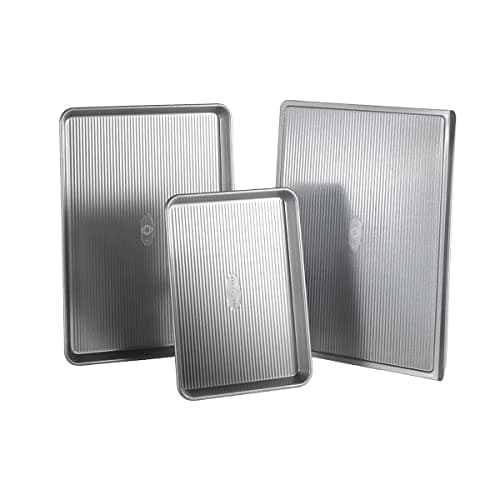
USA Pan builds its bakeware this way, with the AMERICOAT silicone coating published as free of PTFE, PFOA and BPA, made in the USA, with a lifetime warranty and explicit hand wash instructions.
The corrugated surface these pans use is a real design feature: it reduces contact area and improves airflow under the bake, which helps release. It also traps batter and makes washing genuinely slower. Both are true.
Dark coated steel
The supermarket default and the material behind most home-baking frustration. Poor conduction, high radiant absorption, a coating that scratches, and a tendency to warp because thin steel has less stiffness than it looks.
If your recipes come out with dark bottoms and pale tops, and you have been adjusting the recipe, try an aluminum pan before you adjust anything else. It is one of the few single-variable fixes in cooking.
Glass and ceramic
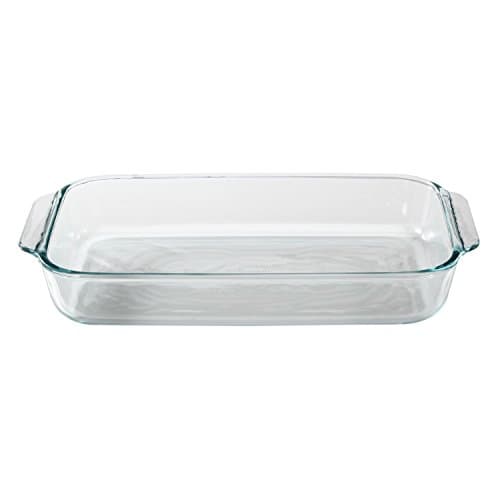
Very low conduction and high heat retention. That makes them poor at browning and good at holding temperature, so they suit casseroles, gratins and anything you serve from the dish.
Two practical consequences. They heat slowly, so a recipe written for metal may need longer. And they keep cooking after you remove them from the oven, which is exactly what you want for a lasagne and exactly what you do not want for a tray of vegetables.
Why color matters as much as material
A dark pan absorbs radiant heat much more efficiently than a light one. Two pans of identical metal and thickness, one anodized dark and one bare, will not bake the same.
The rule of thumb: if a recipe was developed on a light pan and you are using a dark one, drop the oven temperature by about 25F, or pull the bake earlier and check. This is more consequential than most recipe adjustments people make.
If you are baking
Use
Why
Cookies
Bare aluminum half sheet
Even, gentle browning; nothing to burn the base
Roasted vegetables
Bare aluminum half sheet
High heat, fast browning, easy release with parchment
Bread loaves
Aluminized steel loaf pan
Stiffness holds the shape; the coating releases a sticky crumb
Muffins and cupcakes
Aluminized steel
Release matters more than browning evenness here
Cakes
Bare or anodized aluminum
Even rise; parchment on the base for release
Casseroles and gratins
Glass or ceramic
Heat retention, and you serve from the dish
Pizza
Steel or a stone, not a sheet pan
You want stored heat delivered fast into the base
Parchment does more than you think
It provides release on any pan, protects bare aluminum from acid, prevents sugar welding itself to the surface, and turns washing up into throwing something away.
It also means you do not need coated bakeware for flat baking at all — which matters, because a coating is a wear item and parchment is not. Use parchment rather than cooking spray, always: spray polymerizes into a varnish that is genuinely hard to remove and progressively ruins release.
If you buy one thing after reading this, make it a bare aluminum half sheet and a roll of parchment. Picks are in the best sheet pans, and the full list of what a kitchen needs is in what bakeware you actually need.
What to buy, if you are buying
These are the products this page's reasoning actually points at. Same rules as everywhere else on the site: published specs, a stated trade-off, and a live price only where one exists.
Top pick · Bare aluminumSpecs read September 3, 2026
Nordic Ware Naturals Half Sheet, 18 x 13 in
The material this page argues for: 237 W/m-K of conduction, a steel-encapsulated rim so it stays flat, and nothing on it to fail.
Best for: Roasting vegetables, sheet-pan dinners, cookies - the pan you use most weeks
Published specifications for the Nordic Ware Naturals Half Sheet, 18 x 13 in
Exterior dimensions
17.9 x 12.9 x 1 in
Material
Aluminum
Rim
Encapsulated steel rim
Gauge
Not published by Nordic Ware
Warranty
Lifetime
Dishwasher
Hand wash recommended. Automatic dishwasher use is not advised
Made in
America of domestic and imported materials
Good
Aluminum conducts at 237 W/m-K, which is why it browns evenly and a steel pan does not
The encapsulated steel rim is the reason it does not warp in a hot oven
Lifetime warranty on a pan this cheap
Not good
Nordic Ware does not publish a gauge figure, so thickness cannot be compared like for like
Bare aluminum stains and reacts with acid
Not dishwasher safe by the maker's own advice
The trade-off. Bare aluminum discolors and reacts with acid. It will look used within a month and Nordic Ware advises against the dishwasher.
Skip this if. You want a pan that stays looking new, or you will not hand wash. Buy an aluminized-steel coated pan instead and accept the coating as a wear item.
Bare aluminum with an encapsulated steel rim. Aluminum conducts at 237 W/m-K against steel's 45, so heat spreads across the pan almost immediately and food browns evenly rather than burning where the heat lands.
›Is aluminized steel the same as aluminum?
No. Aluminized steel is a steel sheet with an aluminum-silicon layer bonded to it, giving aluminum's surface conduction on a stiffer steel base. It suits shapes that must hold their form, like loaf and muffin pans.
›Why does pan color affect baking?
Dark surfaces absorb radiant oven heat far more efficiently than light ones. Two pans of identical metal will bake differently if one is dark. If a recipe was developed on a light pan, drop the oven about 25F when using a dark one.
›Should I use glass or metal for roasting?
Metal. Glass has very low conductivity, so it heats slowly and browns poorly, and it keeps cooking after you take it out. Glass suits casseroles and gratins where heat retention is the point.
›Is parchment better than cooking spray?
Yes, on every bakeware material. Spray polymerizes into a varnish that is genuinely hard to remove and progressively ruins release. Parchment gives release on any pan and protects bare aluminum from acidic food.
Sources
Every figure on this page came from one of these. Follow them and check our arithmetic — that is the point.