Heads up: some links on this page earn us a commission at no extra cost to you. It does not change what we recommend or the order. How we are funded.
The short answer
What you are making
Pan color
Why
Cookies
Light
Dark pans burn bases before tops set
Cakes and cupcakes
Light
Even rise needs a crust that sets slowly
Bread in a loaf pan
Dark
A darker crust is the goal
Roast vegetables and potatoes
Dark
More browning, faster, is exactly right
Pies and tarts
Dark or glass
The base needs heat to set before the filling soaks in
Bars and brownies
Light
Edges over-bake in dark pans
Anything with a lot of sugar
Light
Sugar caramelizes and then burns quickly
One property explains all of it
An oven heats food two ways: by conduction through the pan, and by radiation from the elements and hot walls. Conduction depends on the metal. Radiation depends on the surface - and dark surfaces absorb radiant energy while light, shiny surfaces reflect it.
So two pans of identical aluminum, identical thickness, one anodized dark and one left bright, will run at meaningfully different surface temperatures in the same oven at the same setting. The dark one is effectively a hotter pan.
That is the whole mechanism. It is not about quality, brand or coating chemistry - sheet pan materials covers what the metal underneath contributes.
What dark pans do
Brown faster and deeper, especially on the base and sides.
Set crusts sooner, which limits how much a batter can rise before it locks.
Crisp better, which is exactly what roast potatoes and vegetables want.
Hide staining, which is why so much mid-market bakeware is dark.
Burn sugar, because sugar goes from caramel to carbon over a narrow range.
Non-stick coatings are usually dark, which means the pan you bought for easy release is also the pan running hotter than the recipe assumed. That combination causes a lot of disappointing cakes.
What light pans do
Brown gently and evenly, which is what cookies and cakes need.
Give a slower-setting crust, so batters rise further before locking.
Resist scorching sugar and dairy.
Show every stain, and darken with age - which slowly moves them toward behaving like dark pans.
Crisp less well, which is the real cost for roasting.
Bare aluminum darkens over years of use, and a well-used bakery sheet is noticeably browner than a new one. That patina is harmless and mildly beneficial - but it does mean a very old light pan bakes a little hotter than it did when new - bakeware care and cleaning.
Adjusting for the pan you own
Most recipes are written for light metal, because that is what test kitchens use. If your pan is dark, the standard correction is to reduce the oven temperature by about 25F, or keep the temperature and check early - typically at three quarters of the stated time.
Dark pan, light-pan recipe: drop about 25F, check early.
Light pan, dark-pan recipe: add a little time rather than temperature.
Dark pan and convection: the two effects compound - drop the temperature and watch it - cookware for convection ovens.
Either pan, unknown oven: verify the oven first, because a 25F correction applied to an oven already 25F out is worse than doing nothing - oven temperature accuracy.
Parchment between the food and a dark pan also helps, by adding a thin insulating layer at exactly the surface that is running too hot.
Where glass fits
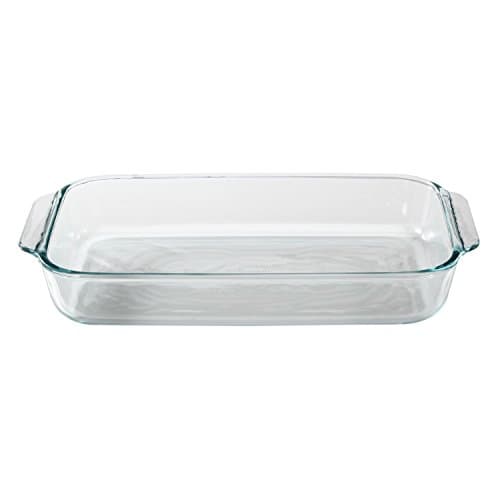
Glass is a third category rather than a point on the dark-light scale. It transmits radiant heat rather than absorbing or reflecting it, heats slowly, and holds heat once hot - so it browns bases well and continues cooking after it leaves the oven. That makes it excellent for pies and casseroles and poor for cookies - glass versus metal bakeware.
If you only buy one finish, buy light. It is far easier to add browning to a light pan - a hotter oven, a higher rack, a few more minutes - than to remove it from a dark one.
Light for baking, glass for casseroles
Buy light if you buy one finish - adding browning to a light pan is easier than taking it out of a dark one.
Nordic Ware Naturals Half Sheet, 18 x 13 in
Roasting vegetables, sheet-pan dinners, cookies - the pan you use most weeks
These are the products this page's reasoning actually points at. Same rules as everywhere else on the site: published specs, a stated trade-off, and a live price only where one exists.
Top pick · The light pan to ownSpecs read September 3, 2026
Nordic Ware Naturals Half Sheet, 18 x 13 in
Bare aluminum, reflective, and the correct surface for cookies, cakes and anything sugary.
Best for: Roasting vegetables, sheet-pan dinners, cookies - the pan you use most weeks
Published specifications for the Nordic Ware Naturals Half Sheet, 18 x 13 in
Exterior dimensions
17.9 x 12.9 x 1 in
Material
Aluminum
Rim
Encapsulated steel rim
Gauge
Not published by Nordic Ware
Warranty
Lifetime
Dishwasher
Hand wash recommended. Automatic dishwasher use is not advised
Made in
America of domestic and imported materials
Good
Aluminum conducts at 237 W/m-K, which is why it browns evenly and a steel pan does not
The encapsulated steel rim is the reason it does not warp in a hot oven
Lifetime warranty on a pan this cheap
Not good
Nordic Ware does not publish a gauge figure, so thickness cannot be compared like for like
Bare aluminum stains and reacts with acid
Not dishwasher safe by the maker's own advice
The trade-off. Bare aluminum discolors and reacts with acid. It will look used within a month and Nordic Ware advises against the dishwasher.
Skip this if. You want a pan that stays looking new, or you will not hand wash. Buy an aluminized-steel coated pan instead and accept the coating as a wear item.
They bake hotter, which usually means faster and browner. Dark surfaces absorb radiant heat from the oven elements while light, shiny surfaces reflect it, so two otherwise identical pans run at different surface temperatures at the same oven setting.
›Should I lower the temperature for dark pans?
Yes, by roughly 25F, or keep the temperature and start checking at about three quarters of the stated time. Most recipes are written for light metal because that is what test kitchens use. Verify your oven first, so you are not stacking two corrections.
›Are dark or light pans better for cookies?
Light, clearly. Dark pans burn cookie bases before the tops have set, which is the single most common baking complaint. Light bare aluminum reflects radiant heat and browns bases evenly, which is why commercial bakeries use it.
›Are dark pans better for bread?
For a loaf with a deep crust, yes - a darker pan drives more browning on the sides and base, which is usually the goal with bread. The same property that ruins cookies helps here.
›Why did my light aluminum pan turn dark?
Bare aluminum darkens with use as oils polymerize onto the surface. It is harmless and mildly beneficial for release, though a very old pan does bake slightly hotter than it did when new. It is patina rather than damage, and not worth scouring off.
Sources
Every figure on this page came from one of these. Follow them and check our arithmetic — that is the point.