Heads up: some links on this page earn us a commission at no extra cost to you. It does not change what we recommend or the order. How we are funded.
The short answer
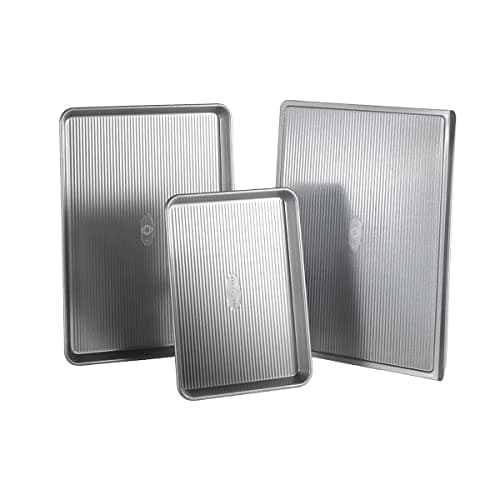
In a convection oven, choose pans with low sides, choose light-colored metal for baking and dark for roasting, and leave clearance on all sides so the fan can move air around the food. Deep roasting pans, crowded racks and lids all block the airflow that makes convection work, which turns an expensive fan oven back into a conventional one. Rimmed half sheet pans are the single most useful convection vessel there is.
What a fan actually changes
A conventional oven heats food mostly by radiation from the elements and by slow natural circulation of hot air. A convection oven adds a fan that forces air across the food. That does three things: it transfers heat faster, it evens out the hot and cold spots every oven has, and it continuously removes the layer of moist air sitting on the food surface.
That last one is the important one. Removing the moist boundary layer is what makes convection brown better, crisp skin, and dry out anything delicate. Everything about pan choice follows from it.
Low sides win, and it is not close
A pan with tall sides creates a pocket of still air around the food. The fan cannot reach into it, so the food inside cooks conventionally while everything else in the oven gets the benefit. A rimmed sheet pan with a one-inch lip exposes food to moving air from every direction.
This is why roast vegetables come out dramatically better on a sheet pan than in a roasting pan in a fan oven, and why the roasting pan is still right when you are making gravy and need the drippings contained - roasting pan versus sheet pan covers the trade in full. Best sheet pans covers the pans themselves.
Color matters more in a fan oven, not less
Convection already accelerates surface browning. A dark pan absorbs radiant heat and accelerates it further, and the two effects compound. For roasting, where you want that, dark is an advantage. For baking, where an over-browned base ruins the result, light aluminum or aluminized steel is the safer surface. Sheet pan materials explains why color does as much work as the metal underneath it.
What you are cooking
Pan shape
Pan color
Why
Roast vegetables
Rimmed sheet pan
Dark or light
Airflow matters far more than color here
Chicken pieces, bacon
Rimmed sheet pan, on a rack
Either
The rack lifts food into the airflow
Cookies
Flat or low-rimmed sheet
Light
A fan plus a dark pan burns bases
Cakes
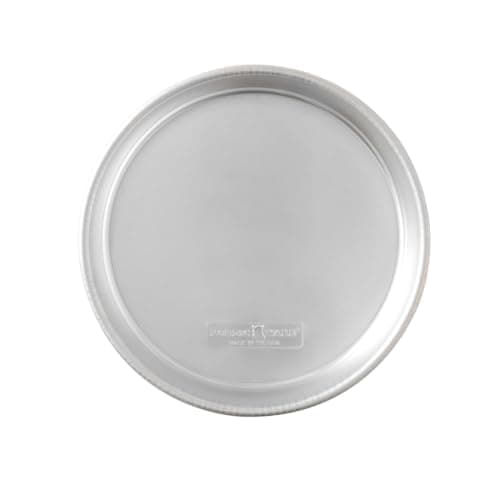
Round cake pan
Light
Even rise depends on not over-setting the crust
Bread
Dutch oven or loaf pan
Any
Lid on for the first phase - see below
Custards, cheesecake
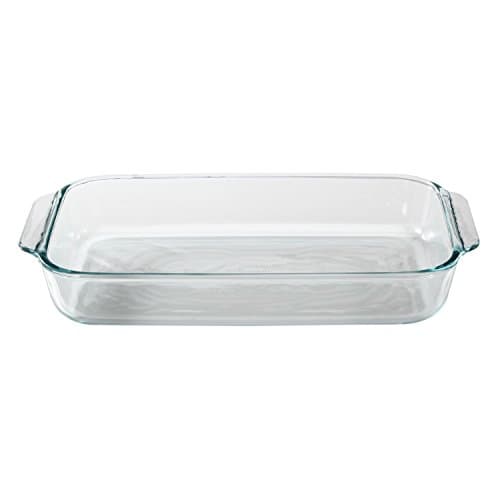
Glass or ceramic, water bath
n/a
Convection dries these out; shield them
Large roasts with gravy
Roasting pan
Dark
You need the drippings more than the airflow
Clearance is a specification nobody prints
A pan that fills the rack leaves no path for air to circulate. The fan pushes air at a wall of metal and the oven behaves conventionally, or worse, because the airflow now concentrates on whatever edges are exposed and scorches them.
Leave one to two inches around the pan on all sides, including the back.
Use two smaller pans rather than one that fills the rack.
Stagger pans on two racks rather than lining them up, so air can pass between.
Do not line the bottom rack with foil. It blocks the return path as well as the radiant heat.
The corollary is that convection is the only oven configuration where cooking on multiple racks genuinely works, which is most of the reason to own one.
Lids, foil and the things that switch convection off
Covering a dish defeats convection completely. Inside the lid, you have a small conventional oven with still, moist air. That is sometimes exactly right - a braise wants moist heat, and bread wants a covered first phase so steam can keep the crust soft while the loaf expands. It is simply worth knowing that you have turned the fan off as far as that dish is concerned.
The useful technique is sequencing: covered for the first phase to cook through, then uncovered with the fan for the last stretch to brown and crisp. It is why convection suits roast chicken and covered braises equally well, at different stages.
Bread in a Dutch oven is the clearest case - baking bread in a Dutch oven covers why the lid goes on first and comes off later.
The temperature rule, and why the oven may already apply it
The standard conversion is to reduce the recipe temperature by about 25F, or to keep the temperature and shorten the time by roughly a quarter. Check your manual first, because many ovens labeled "convection bake" apply the offset automatically and applying it twice will underbake everything you make.
Where an oven has both "convection bake" and "convection roast," the difference is usually which elements run alongside the fan. Roast favors the upper element for browning; bake balances them for even rise. Neither changes which pan to use.
None of this helps if the oven's dial is wrong to begin with, which is more common than people expect - oven temperature accuracy.
A convection conversion applied to an oven that already runs hot is two errors stacked. Verify the dial before you adjust the recipe.
Does pan material matter?
Less than in a conventional oven, and much less than shape and color. Convection heats the food from outside via air, so the pan's ability to store and conduct heat is doing proportionally less work than it does on a stovetop. Thermal mass still matters for anything where the pan contacts the food directly and needs to stay hot - a pizza steel, a preheated Dutch oven, a cast iron skillet for a steak finish.
For everything else, a thin aluminum sheet pan outperforms heavy cookware in a fan oven, because it heats fast and gets out of the way of the airflow. Cookware materials compared covers the stovetop side, where the ranking is entirely different.
Countertop convection and air fryers
An air fryer is a small convection oven with an aggressive fan, and the same rules apply harder: low sides, clearance, and single layers. The reason food must not be crowded in an air fryer basket is precisely the reason pans must not fill a convection rack. Countertop ovens also need pans that fit with clearance, which usually means quarter sheets rather than halves - bakeware for toaster ovens.
The pans a fan oven rewards
Low sides and light metal for most of it, glass for the things convection would otherwise dry out.
Nordic Ware Naturals Half Sheet, 18 x 13 in
Roasting vegetables, sheet-pan dinners, cookies - the pan you use most weeks
These are the products this page's reasoning actually points at. Same rules as everywhere else on the site: published specs, a stated trade-off, and a live price only where one exists.
Top pick · The best convection pan there isSpecs read September 3, 2026
Nordic Ware Naturals Half Sheet, 18 x 13 in
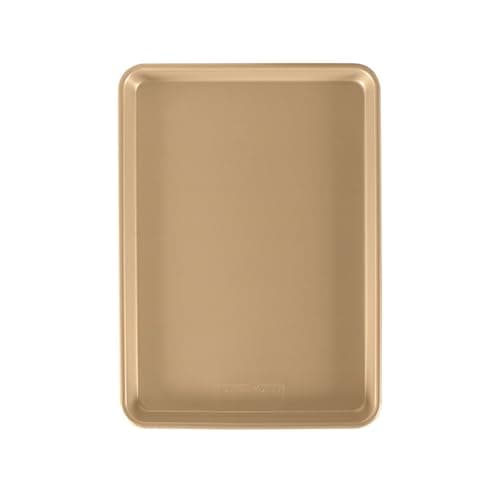
Low rims, light aluminum and a footprint that leaves clearance on a standard rack - everything a fan oven wants.
Best for: Roasting vegetables, sheet-pan dinners, cookies - the pan you use most weeks
Published specifications for the Nordic Ware Naturals Half Sheet, 18 x 13 in
Exterior dimensions
17.9 x 12.9 x 1 in
Material
Aluminum
Rim
Encapsulated steel rim
Gauge
Not published by Nordic Ware
Warranty
Lifetime
Dishwasher
Hand wash recommended. Automatic dishwasher use is not advised
Made in
America of domestic and imported materials
Good
Aluminum conducts at 237 W/m-K, which is why it browns evenly and a steel pan does not
The encapsulated steel rim is the reason it does not warp in a hot oven
Lifetime warranty on a pan this cheap
Not good
Nordic Ware does not publish a gauge figure, so thickness cannot be compared like for like
Bare aluminum stains and reacts with acid
Not dishwasher safe by the maker's own advice
The trade-off. Bare aluminum discolors and reacts with acid. It will look used within a month and Nordic Ware advises against the dishwasher.
Skip this if. You want a pan that stays looking new, or you will not hand wash. Buy an aluminized-steel coated pan instead and accept the coating as a wear item.
Low-sided pans, above everything else. A rimmed half sheet pan is the most useful convection vessel because it exposes food to moving air from every direction. Tall roasting pans create a pocket of still air the fan cannot reach into.
›Can you use glass bakeware in a convection oven?
Yes, and it is genuinely useful for custards and anything a fan would dry out, because glass heats slowly and shields food from direct airflow. Observe the usual thermal shock rule and do not move it between temperature extremes.
›Do you need special pans for convection baking?
No, but shape and color matter more than in a conventional oven. Light-colored metal resists the over-browning a fan accelerates, and low sides let the air reach the food. Existing sheet pans and cake pans are usually fine.
›Why is my convection oven not browning evenly?
Usually the pan is too large for the rack, so there is no clearance for air to circulate and the fan concentrates on the exposed edges. Leave one to two inches on all sides, or use two smaller pans instead of one big one.
›Should you cover food in a convection oven?
Only when you want the fan to stop mattering. A lid or foil creates still, moist air, which suits braises and the first phase of bread baking. Uncover for the last stretch if you want the browning and crisping convection is good at.
Sources
Every figure on this page came from one of these. Follow them and check our arithmetic — that is the point.