Heads up: some links on this page earn us a commission at no extra cost to you. It does not change what we recommend or the order. How we are funded.
The short answer
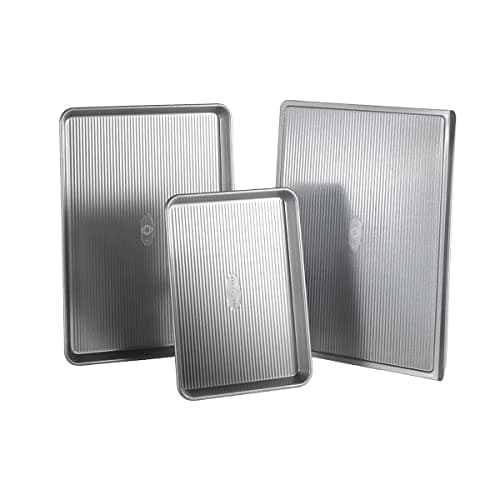
Buy a bare aluminum half sheet with an encapsulated steel rim, and buy two. Aluminum conducts at 237 W/m-K against steel's 45, which is why it browns evenly and dark coated steel burns the bottoms of things. The steel rim is what stops it warping. Nordic Ware publishes both the dimensions and the rim construction and warrants it for life.
Quick picks
The whole answer, on one screen. Tap a row to jump to the full write-up. Every pick below carries a stated trade-off further down — including the one at the top.
#
Product
Best for
Price
1
Nordic Ware Naturals Half Sheet, 18 x 13 in
17.9 by 12.9 inches, bare aluminum, encapsulated steel rim, lifetime warranty, made in America. The professional default for good physical reasons.
Aluminized steel with a silicone coating published as free of PTFE, PFOA and BPA. Choose this if you want release and will accept a coating as a wear item.
Prices last checked October 19, 2026. Prices move constantly — the number on Amazon when you click is the real one.
How we chose these
We have not baked on them. We read the published dimensions, materials, rim construction, warranty terms and care instructions, and noted where a figure is not published at all. The method is here.
Bakeware is the easiest category on this site to reason about from published data, because the physics is unusually clean: one material property explains almost every difference in how these pans behave.
The number that decides it
Aluminum conducts heat at 237 W/m-K. Steel conducts at about 45. That is more than a fivefold difference, and on a thin flat pan sitting in radiant oven heat it is the whole story.
An aluminum sheet spreads heat across itself almost instantly, so the whole surface sits at roughly the same temperature and food browns evenly. A steel sheet does not: hot spots stay hot, and the pan relies on the oven to even things out, which the oven does slowly.
Then add color. Dark surfaces absorb radiant heat far more efficiently than light ones, so a dark coated steel pan gets hotter, faster, at the surface — while still spreading that heat badly. That combination is why cookies burn on the bottom before the tops are done, and if that has been happening to you, it is the pan and not the recipe.
Material
Conduction
Browning behavior
Warps?
Bare aluminum
237 W/m-K
Even and gentle; the professional default
Not with an encapsulated steel rim
Aluminized steel
Aluminum surface on a steel core
Even, slightly faster than bare aluminum
Rarely - the steel core is stiff
Dark coated steel
About 45 W/m-K, plus high radiant absorption
Fast, uneven, burns undersides
Frequently
Insulated (air-gap) sheets
Deliberately poor
Very slow; resists browning entirely
No, but they defeat the point
Conduction figures from Engineers Edge and Thermtest, read 2026-09-03.
The rim, which is the other half of the answer
Bare aluminum on its own is soft and warps. Put a hot pan into cold air, or cold food onto a hot pan, and thin aluminum flexes — usually with a loud bang and often with everything sliding to one corner.
Nordic Ware publishes an "encapsulated steel rim" on the Naturals half sheet: a steel wire rolled into the edge, giving the pan a stiff perimeter that resists deformation while the middle stays aluminum. That is the entire reason these pans stay flat, and it is why a rimmed sheet outlasts an unrimmed one many times over.
When comparing sheet pans, this is the specification to look for, and a surprising number of listings do not mention it.
The rolled edge is a steel wire inside aluminum. It is the difference between a pan that stays flat and one that buckles.
Half sheet, and why two
A half sheet is nominally 18 by 13 inches — Nordic Ware publishes 17.9 by 12.9 by 1 inch exterior — and it is called a half sheet because it is half of a commercial full sheet. It fits every domestic oven with room for air to circulate, which a full sheet does not.
Buy two. They cost very little, and the moment you bake anything in quantity you need to rotate trays; the moment you roast a full dinner you need one for vegetables and one for protein. The second sheet is the cheapest capability upgrade in the kitchen.
Quarter sheets are genuinely useful for one or two people or a toaster oven. Full sheets do not fit domestic ovens. Do not buy one.
The honest trade-off with bare aluminum
It discolors. Within a month of real use a bare aluminum sheet is mottled brown and looks used. That is cosmetic and does not change how it bakes, but it is worth knowing before you buy something you expected to stay silver.
It also reacts with acid. Tomatoes, lemon and vinegar on bare aluminum for a long roast will pit the surface and can pick up a metallic edge. Parchment solves this entirely and you should be using parchment anyway.
And Nordic Ware advises against the dishwasher: "Hand wash recommended with warm, soapy water. Automatic dishwater use is not advised." Detergent discolors bare aluminum badly. Hand washing a sheet pan takes thirty seconds.
When a coated pan is the right answer
For loaf pans, muffin pans and cake tins, release matters more than browning evenness, and a coating earns its place. USA Pan builds these in aluminized steel — steel with an aluminum-silicon layer bonded to it, so you get aluminum's surface conduction on a stiffer base — with its AMERICOAT silicone coating, published as free of PTFE, PFOA and BPA.
The trade-offs are real and published: the corrugated surface that helps release also traps batter and makes washing slow, and USA Pan states the pans are not dishwasher safe. A silicone coating is still a coating and will eventually wear, though far more slowly than a nonstick frying pan does.
For flat sheet pans, though, parchment does the same job for pennies and leaves you with a pan that has nothing to wear out. That is why the top pick here is uncoated.
What to stop buying
Dark coated steel sheets. The supermarket default, and the reason most people think they are bad at baking cookies.
Insulated air-gap sheets. They deliberately impede heat transfer, which prevents browning — the thing you wanted.
Unrimmed cookie sheets. They warp, and the flat edge means anything with liquid ends up on the oven floor.
Glass or ceramic for roasting. Very low conduction, slow to heat, and they hold heat after you take the food out, which continues cooking it.
Cooking spray, on any bakeware. It polymerizes into a varnish that is genuinely difficult to remove and ruins release over time. Parchment or a wipe of oil.
The whole answer to sheet pans: bare aluminum, steel rim, two of them, parchment on top. It costs very little and it will still be right in twenty years. More on the material reasoning in sheet pan materials compared.
Every pick, in full
Each write-up below gives the published specs, what the pan is genuinely good at, what it costs you, and who should skip it. The trade-off line is there on the top pick too — a recommendation with no downside is an advertisement.
Top pick · Best overallSpecs read September 3, 2026
Nordic Ware Naturals Half Sheet, 18 x 13 in
17.9 by 12.9 inches, bare aluminum, encapsulated steel rim, lifetime warranty, made in America. The professional default for good physical reasons.
Best for: Roasting vegetables, sheet-pan dinners, cookies - the pan you use most weeks
Published specifications for the Nordic Ware Naturals Half Sheet, 18 x 13 in
Exterior dimensions
17.9 x 12.9 x 1 in
Material
Aluminum
Rim
Encapsulated steel rim
Gauge
Not published by Nordic Ware
Warranty
Lifetime
Dishwasher
Hand wash recommended. Automatic dishwasher use is not advised
Made in
America of domestic and imported materials
Good
Aluminum conducts at 237 W/m-K, which is why it browns evenly and a steel pan does not
The encapsulated steel rim is the reason it does not warp in a hot oven
Lifetime warranty on a pan this cheap
Not good
Nordic Ware does not publish a gauge figure, so thickness cannot be compared like for like
Bare aluminum stains and reacts with acid
Not dishwasher safe by the maker's own advice
The trade-off. Bare aluminum discolors and reacts with acid. It will look used within a month and Nordic Ware advises against the dishwasher.
Skip this if. You want a pan that stays looking new, or you will not hand wash. Buy an aluminized-steel coated pan instead and accept the coating as a wear item.
#2 · Best coated alternativeSpecs read September 3, 2026
USA Pan Aluminized Steel Bakeware
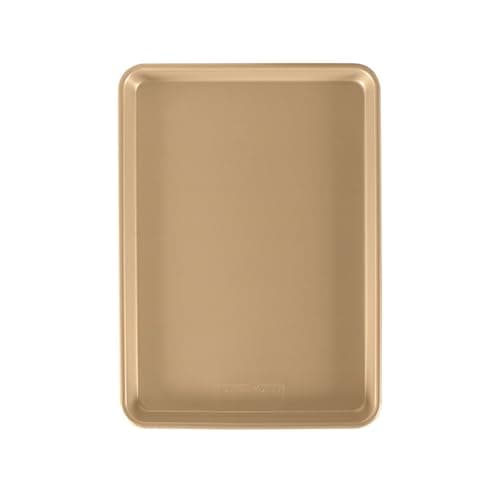
Aluminized steel with a silicone coating published as free of PTFE, PFOA and BPA. Choose this if you want release and will accept a coating as a wear item.
Best for: Loaf pans, muffin pans and cake pans that release without paper every time
A bare aluminum half sheet with an encapsulated steel rim. Aluminum conducts at 237 W/m-K against steel's 45, so it browns evenly, and the steel rim is what stops it warping. Nordic Ware publishes both specs and warrants the pan for life.
›Why do my cookies burn on the bottom?
Almost always a dark coated steel pan. Dark surfaces absorb radiant heat efficiently and steel spreads it badly, so the underside cooks far faster than the top. Switching to bare aluminum fixes it without changing anything else.
›What size sheet pan should I buy?
A half sheet, about 18 by 13 inches, which fits every domestic oven with room for air to circulate. Buy two - you need to rotate trays the moment you bake in quantity. Full sheets do not fit home ovens.
›Can sheet pans go in the dishwasher?
Nordic Ware advises against it for bare aluminum, because detergent causes discoloration. USA Pan states its aluminized steel bakeware is not dishwasher safe either. Hand washing a sheet pan takes about thirty seconds.
›Does it matter that my aluminum sheet pan has gone brown?
No. Discoloration on bare aluminum is cosmetic and does not change how the pan bakes. It happens within a month of real use and is not a sign of damage.
Sources
Every figure on this page came from one of these. Follow them and check our arithmetic — that is the point.